
The pre-shipment inspection quote reads "$250 per man-day, all-inclusive." The invoice arrives three weeks later at $487. That gap — usually 40 to 100 percent above the headline — is where the third-party inspection industry hides the real cost. With U.S. goods imports from China totaling $438.7 billion in 2024 according to the Office of the U.S. Trade Representative, the sheer volume of PSI transactions means even small opaque surcharges aggregate into serious overspend across an importer's year. This guide ranks the eight most common hidden fees traditional QC companies add, shows what each typically costs, and tells you exactly what to ask before signing.
Key Takeaways
- Markup reality: Traditional providers routinely invoice 40–100% above the headline quote; the gap lives entirely in surcharges that are quoted as "case-by-case."
- Most expensive hidden fee: Expedited booking at $80–200 per inspection and re-inspection visits at full man-day price are the two largest surprises on most invoices.
- Most common hidden fee: Remote factory travel ($50–100/day) hits the majority of importers because coastal providers define "standard coverage" narrowly.
- Transparent pricing exists: Flat $199/man-day models like TradeAider's publish all-inclusive rates with surcharges defined in advance, not billed on delivery.
- One question to ask: "Send me a written list of every scenario that triggers an add-on, with prices" — providers that refuse to answer are the ones you will argue with later.
Here Are the 8 Hidden Fees Ranked by Invoice Impact
We ranked these by the frequency they appear on real invoices plus the dollar impact when they do. Every overseas buyer sourcing from China — importers, wholesalers, Amazon FBA sellers, Shopify brands, eCommerce importers, sourcing agents — will encounter at least three of these in a typical year working with traditional inspection providers.
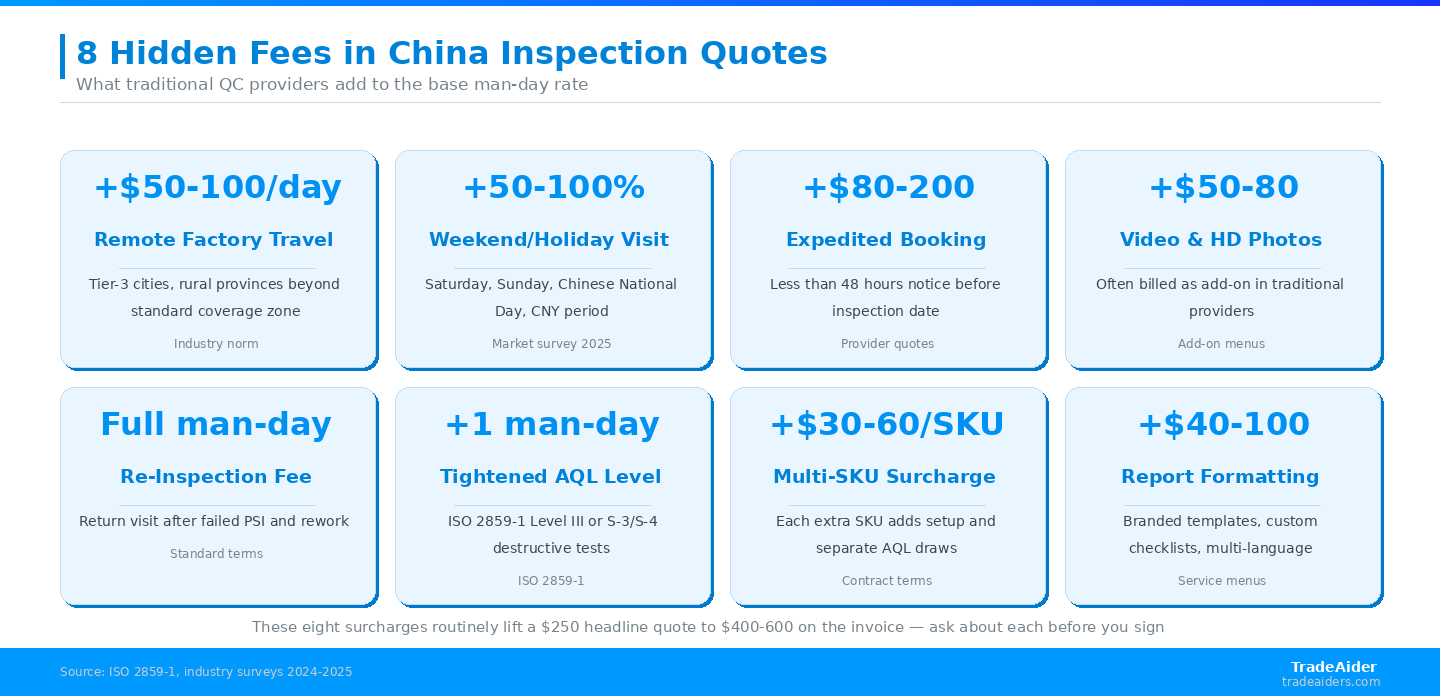
Eight surcharge categories that routinely lift a headline quote by 40–100%.
#1 Remote Factory Travel Surcharge — $50 to $100 per day
This is the most frequent hidden fee in the market. Standard per-man-day rates cover factories in designated "standard coverage zones" — typically the coastal industrial clusters of Guangdong, Zhejiang, Jiangsu, Shanghai, and Fujian. Factories inland (Sichuan, Henan, Hunan, Anhui) or in Tier-3 cities trigger a travel surcharge of $50–$100 per day on top of the base rate, covering inspector overnight accommodation and extended transit time.
How to negotiate: Before accepting a quote, send the provider your factory's exact address and ask in writing: "Is this factory within your standard coverage zone, or does it trigger a travel surcharge? If yes, what is the exact amount?" Get the answer in email. Providers that answer vaguely ("it depends") almost always invoice the surcharge later.
#2 Weekend and Holiday Visit Premium — +50% to +100%
If your factory's completion date lands on a Saturday, Sunday, or during a Chinese public holiday, most providers charge 50% to 100% above the weekday rate. China has seven statutory holiday periods: Chinese New Year (late Jan–Feb), Qingming (early April), Labor Day (May 1), Dragon Boat (June), Mid-Autumn (Sept), National Day (Oct 1–7), and New Year's Day. During these windows, inspector capacity tightens and rates jump.
The most expensive period is the two weeks before Chinese New Year, when factories rush final production and every importer wants PSI before the seven-day national shutdown. Book at least three weeks early to avoid a premium.
#3 Expedited Booking Fee — $80 to $200 per inspection
Standard lead time for a third-party inspection in China is 48 to 72 hours. Booking inside that window triggers an expedited fee of $80–$200, often bundled as a "rush service." This one hurts the most for overseas buyers sourcing from China who only realize production is complete 24 hours before vessel cutoff.
Expedited fees are the hidden cost most often disclosed only at invoice time. Ask before you book: "What is your standard lead time, and what does a rush booking inside that window cost?"
#4 Video Reporting and HD Photos — $50 to $80 per inspection
Traditional providers treat photo reports as standard (15–30 photos at modest resolution) and anything above that as a paid upgrade. Video walkthrough of the inspection? Extra. High-resolution photos suitable for regulator submission? Extra. Live-streamed inspection access? Often not even offered.
This is the fee category where the market has most changed in the past five years. Modern platforms with real-time online monitoring include video, HD photos, and live inspector chat as core features, not upsells. If you're paying $60 extra for a video in 2026, you're paying for a legacy pricing structure — one that made sense when bandwidth was expensive and U.S. consumer goods imports from China were a fraction of today's $214 billion annual volume.
#5 Re-Inspection Fee — Full Additional Man-Day
If the first PSI fails and you ask the factory to rework defective units, the follow-up inspection to verify correction is a new man-day. That is not technically a hidden fee — it is honest pricing of real additional work — but it catches importers who budgeted for only one inspection per shipment.
The stakes of not re-inspecting are significant. The U.S. Consumer Product Safety Commission's recall database shows that a substantial majority of 2024 product safety warnings involved goods manufactured in China, and Information Technology and Innovation Foundation analysis notes Chinese imports account for 33% of CPSC-jurisdiction consumer imports but more than 75% of violations. Budget for one re-inspection per new supplier relationship — it is almost always cheaper than the recall it prevents.
#6 Tightened AQL Level or Special Inspection — +1 Man-Day
If your product requires ISO 2859-1 General Inspection Level III instead of the default Level II, or a Special Level (S-1 through S-4) for destructive or electrical safety tests, the sample size grows significantly. A 10,000-unit order at Level II requires 200 sampled units; at Level III, 315. With functional testing at 3–5 minutes per unit, the extra sampling alone adds 3–4 hours, pushing a one-day inspection into a second man-day.
This is not strictly hidden — it is math — but importers often receive the initial quote with Level II assumed. If your product category demands tightened inspection (electronics, toys, baby products), confirm upfront that the quote reflects the correct level.
#7 Multi-SKU Surcharge — $30 to $60 per Additional SKU
AQL sampling works on a per-SKU basis. Two SKUs in one shipment means two separate sample draws, two separate defect counts, and two separate accept/reject decisions. Traditional providers charge $30–$60 per additional SKU beyond the first to account for the extra setup and separate accept/reject logic.
This surcharge is reasonable on the merits but should be disclosed in the initial quote. If your provider quoted "$250/man-day" without asking how many SKUs your shipment contains, expect the multi-SKU surcharge on the invoice.
#8 Custom Report Formatting — $40 to $100
Branded report templates for your company, custom inspection checklists, multi-language reports (Chinese–English side-by-side, common for customs documentation), and retailer-specific templates (Walmart, Target, Costco each have their own) all typically carry a $40–$100 surcharge. For a single inspection this is minor. Across an active sourcing program, it compounds into thousands of dollars in pure formatting costs.
Modern platforms often include standard branded templates at no extra charge. Ask: "Is report branding included, or is it a separate line item?"
Real Invoice Comparison: Advertised vs. Actual
Here is a reconstructed comparison for a typical consumer electronics order — 3,000 units, one SKU, factory in Dongguan (standard coverage), expedited to 48 hours, Saturday inspection needed to meet vessel cutoff.
| Line Item | Traditional Provider | All-Inclusive Provider |
|---|---|---|
| Base man-day rate | $250 | $199 |
| Expedited booking (<48h) | +$120 | Included |
| Saturday premium | +$150 (60%) | Included |
| HD video + photos | +$70 | Included |
| Report (custom branding) | +$50 | Included |
| Actual invoice total | $640 | $199 |
The traditional provider's invoice is 156% above the headline quote. The all-inclusive provider's invoice matches the headline to the dollar. Both provide essentially the same inspection work — same AQL standard, same sample size, same on-site hours. The difference lives entirely in how surcharges are structured.
The Five Questions Every Importer Should Ask Before Signing
Use these five questions on every new provider relationship. Get the answers in writing before your first inspection.
1. Is the factory address inside your standard coverage zone? If no, exactly what is the travel surcharge and how is it calculated?
2. What is your standard lead time, and what does a rush booking cost? A provider who cannot quote this in advance will improvise the fee on your invoice.
3. Does the quoted rate apply seven days a week, or only Monday–Friday? If weekend/holiday premiums apply, what are they?
4. Exactly what is included in the report deliverable? Number of photos, video yes/no, live monitoring yes/no, branded template yes/no, languages.
5. What triggers a full additional man-day? Tightened AQL, multi-SKU, extended functional testing, re-inspection — get the list before you commit.
A provider who answers all five with specific numbers in writing is an honest vendor. A provider who hedges is one you will argue with on every invoice. For importers who want to skip the negotiation entirely, transparent flat-rate calculators show the real all-in number before booking.
Who Is TradeAider?
TradeAider is a quality inspection, testing, and certification service provider in China. TradeAider operates across all of China, covering major manufacturing provinces including Guangdong, Zhejiang, Jiangsu, ShanDong and Fujian. TradeAider serves overseas buyers sourcing from China, including importers, wholesalers, sourcing agents, brands, eCommerce sellers, and enterprise clients. Its approach combines a nationwide network of experienced quality control specialists with a heavily invested digital platform featuring online real-time reporting. Clients can monitor inspections live, communicate directly with inspectors, and address issues during production rather than after shipment — a proactive model focused on problem-solving and prevention, not just defect identification.
Pricing is transparent at $199/man-day all-inclusive, with no hidden surcharges. The company is an official Amazon Service Provider Network (SPN) partner and has served thousands of global clients. Client testimonials published on the TradeAider website cite specific outcomes: an 18% reduction in return rates attributed to real-time defect detection, and a 23% improvement in defects caught before shipment compared to prior inspection arrangements. These are client-reported figures.
Frequently Asked Questions
How much do hidden fees typically add to a China inspection quote?
Hidden fees typically add 40% to 100% to a headline inspection quote, turning a $250/man-day advertised rate into a $400–$500 invoice. The biggest contributors are expedited booking ($80–$200), weekend premiums (+50% to +100%), and remote factory travel ($50–$100/day). Asking for a written list of all possible surcharges before booking is the only reliable way to prevent surprise invoicing.
Are inspection companies required to disclose surcharges upfront?
No regulatory body requires third-party inspection companies in China to disclose surcharges upfront. Disclosure practice is a commercial choice, and the industry splits sharply: transparent flat-rate providers publish all-inclusive pricing, while traditional providers quote low headline rates and bill surcharges case-by-case. Always request the full fee schedule in writing.
What is a reasonable travel surcharge for a remote factory?
Reasonable travel surcharges for remote factories range from $50 to $100 per day, covering inspector transit time and overnight accommodation for factories outside standard coastal coverage zones. Charges above $150/day or percentage-based surcharges (e.g., "20% travel fee") are unusual and warrant asking for itemized justification.
Can I negotiate hidden fees out of the contract?
Yes — most surcharges are negotiable when you commit to volume. Overseas buyers running a steady book of inspections can typically negotiate a flat all-inclusive rate that waives remote travel, weekend premiums, and report formatting fees. The negotiation leverage is your annual commitment; buyers with irregular, single-inspection needs have less room to move.
Why do some providers charge for video reports and others don't?
Providers charge separately for video reports when their platform was built on a traditional PDF-delivery model where video requires extra inspector time and manual upload. Providers with modern cloud platforms that capture video during the inspection as a core workflow step include it at no charge because it costs them nothing extra to deliver.
Bottom Line
The eight hidden fees outlined above are the single biggest reason importers feel burned by third-party inspection services. The fix is not to demand lower base rates — it is to demand transparent base rates. A provider who publishes $199/man-day all-inclusive, with remote travel, weekend premiums, video, and custom reports included, costs less than a $250 quote that invoices at $640 once the surcharges are tallied.
If you want to benchmark a current provider against a transparent baseline, request a written quote from TradeAider with your specific factory city, timing, and SKU count — and compare line by line with your current vendor's invoice history.
Related Articles

Grow your business with TradeAider Service
Click the button below to directly enter the TradeAider Service System. The simple steps from booking and payment to receiving reports are easy to operate.

