
- معلومات عنا

- خدماتنا
- صناعتك
- الموارد
- الأخبار والمدونة
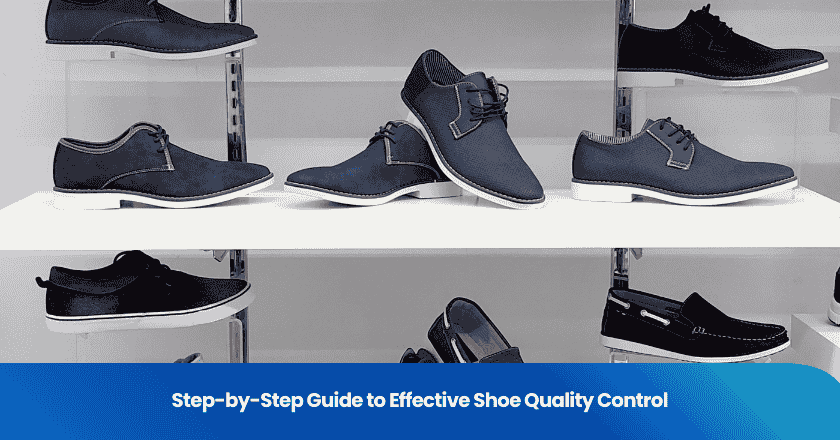
Effective shoe quality control is not a final appearance check; it is a staged proof system that connects the last, materials, construction, pair matching, labels, packaging, and release action before defective footwear reaches buyers. The practical answer is to inspect the risks that can still be changed, record the evidence that proves conformity, and decide whether to release, hold, sort, rework, test, or reinspect before the shipment moves beyond buyer control.
Key Takeaways
- Start with the shoe file: last, approved sample, BOM, size range, materials, packaging, and labels should be frozen before inspection.
- Control construction before boxing: stitching, lasting, bonding, outsole alignment, pair matching, and finish defects get harder to isolate once shoes are packed.
- Use AQL at finished-lot release: AQL helps decide whether the packed lot passes, but it does not replace process checks or laboratory tests.
- Map defects by size and material: footwear defects often concentrate by size, color, production line, adhesive batch, or upper material lot.
What Is the First Step in Effective Shoe Quality Control?
The first step is freezing the shoe quality file before inspection starts. Without a current last, approved sample, material list, size chart, packaging file, and release rule, the inspector is forced to interpret quality after defects appear.
A shoe is not a single generic product. It combines upper material, lining, insole, outsole, adhesive, stitching, hardware, decoration, size marking, pair matching, carton packing, and often safety or destination-specific requirements. The ISO footwear standards catalogue shows how many footwear properties can be standardized, from defects vocabulary to upper materials, sizing, components, and test methods.
The buyer should therefore provide a complete product file: PO, approved golden sample, last or fit reference, material bill, color standard, outsole and insole specifications, logo position, size chart, tolerance, label artwork, barcode file, inner box, master carton, and test requirements. If the factory and inspector use different versions, the inspection may pass the wrong shoe.
The most practical shoe QC plan follows the shoe: product file, material, upper, sole, assembly, fit, label, carton, and release decision. Each step answers a different risk before it becomes a customer return.
Shoe Quality Control Steps From Product File to Release
Use a step sequence rather than a loose checklist. Footwear quality depends on the relationship between components. A clean upper cannot compensate for a weak bond, and correct pair matching cannot compensate for a wrong size label.
| Step | QC Focus | Typical Shoe Defects | Evidence to Require |
|---|---|---|---|
| 1. Product file | Last, BOM, sample, size, labels | Wrong version, missing trim, unclear tolerance | Approved file and change log |
| 2. Materials | Upper, lining, sole, insole, adhesive | Shade, odor, scratches, wrong lot | Lot photos, material match, test request |
| 3. Upper process | Cutting, stitching, decoration | Loose thread, seam crack, misaligned logo | Close-up photos and defect count |
| 4. Assembly | Lasting, bonding, outsole alignment | Open glue, skewed sole, poor shape | Pair photos, pull or flex checks |
| 5. Fit and function | Size, pair balance, comfort, hardware | Left-right mismatch, zipper failure | Size readings and function result |
| 6. Packaging | Pairing, label, barcode, carton | Wrong size mark, barcode error, crushed box | Carton spread and packing photos |
| 7. Release | AQL, defect severity, buyer action | Major defect concentration | Release, hold, sort, rework, or reinspect |
This sequence is intentionally simple. It does not replace a category-specific standard for safety footwear, children's footwear, or regulated claims. It gives the importer a control path so the inspection report does not become a photo album with no release logic.
A beautiful shoe can still fail quality control if the size, pair match, label, carton, or bonding evidence is wrong. The inspection plan should therefore include both product appearance and shipment evidence.
Material and Component Checks Come Before Finished Shoe Inspection
Footwear defects often begin before final assembly. Upper material shade, leather defects, fabric delamination, lining tears, outsole hardness, eyelets, buckles, zippers, laces, adhesive age, and printed logos can all create finished defects later. A buyer who waits until final inspection may discover that every boxed pair repeats the same input mistake.
When hidden safety or restricted-substance questions matter, visual inspection is not enough. NIST footwear compliance guidance maps U.S. footwear-related compliance topics such as consumer product rules, certificates, children's footwear, tracking labels, and testing. That does not mean every shoe needs the same test; it means the buyer should decide which claims require documents or lab evidence before shipment.
Upper and sole materials need lot visibility
The buyer should know which material lot is used for which size or color. If one upper lot has poor color fastness or one outsole batch has poor finish, the report should show whether the risk is isolated or mixed across the full order. That is why material photos, lot numbers, supplier labels, carton spread, and production date matter. Without lot visibility, a failed finding may force broad sorting even when the defect started in one smaller subgroup.
For a 9,600-pair footwear order, one outsole lot or upper material lot can affect 1,000 pairs or more before final packing. A report that maps material lot, color, size, and production date gives the buyer a smaller decision unit. Without that map, even a focused material issue can become a broad finished-goods hold.
Bonding and construction need process evidence
Open glue, sole separation, poor lasting, uneven toe shape, crooked stitching, loose thread, skipped stitch, wrong needle mark, and weak hardware are construction defects. They should be recorded with close photos, location, severity, affected size or color, and whether the issue is random or concentrated. If a defect is concentrated by line or adhesive batch, the buyer should request correction evidence before relying on final AQL alone.
Bonding defects are often process defects, not isolated cosmetic marks. If a weak adhesive batch touches 18 percent of pairs, the buyer needs line, date, and size concentration, not only close-up photos. A useful report shows whether the supplier corrected temperature, drying time, pressure, or handling before the next 500 pairs moved forward.
Finished Shoe Inspection Should Combine AQL and Footwear-Specific Checks
At final inspection, sampling must represent the finished lot. ISO 2859-1:2026 supports lot-by-lot attribute inspection with AQL-indexed sampling schemes, and ASQ explains why attributes and variables sampling answer different questions. For shoes, that means AQL can support lot acceptance, while measurements or tests may still be needed for fit, bond strength, safety, or material claims.
TradeAider PSI should be booked when the shoe order is 100 percent complete and at least 80 percent packed for export. That timing matters because pair matching, box labels, carton marks, barcodes, size ratio, accessories, silica gel, stuffing paper, hangtags, and carton condition are part of the shipment decision.
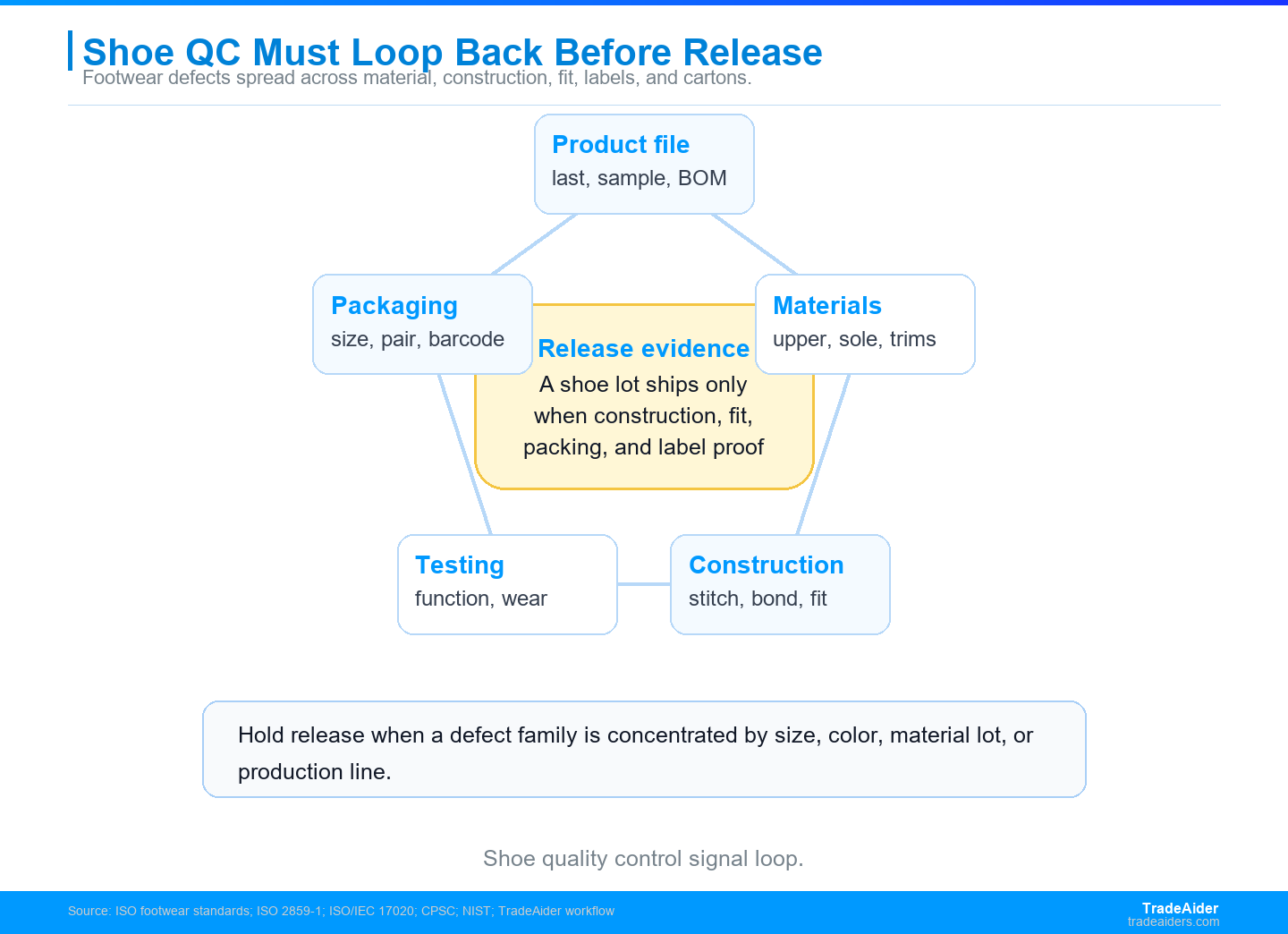
Shoe quality control works as a loop: requirements, materials, construction, testing, packaging, and report evidence all feed one release decision.
Defect severity must be defined before counting
Critical, major, and minor defects should not be invented after the report arrives. A sharp exposed nail, unsafe metal edge, failed safety claim, severe sole separation, wrong size label, missing pair, or unreadable barcode can require a different action from a small glue mark or tiny surface scratch. The buyer should define unacceptable defects before inspection so the AQL result connects to a business decision instead of a negotiation about words.
A footwear AQL result can change dramatically when one critical defect is defined clearly before inspection. A sharp edge, failed safety feature, severe sole separation, or wrong size label should not be negotiated as a minor mark. The buyer's 3 severity levels should be written before the inspector starts counting defects.
Sampling should show size and color spread
A shoe order can look acceptable if samples come from one easy size or one color. A useful report shows sample spread across sizes, colors, cartons, production dates, and packing locations. If defects appear mostly in size 43 black, or mostly in a late production batch, the buyer needs that concentration signal. Footwear quality control works only when the report shows which defect family is random and which one is concentrated.
A 5-size, 2-color order has at least 10 visible subgroups before production dates are considered. Sampling only the easiest cartons may miss the subgroup that actually carries the defect. The report should show enough spread for the buyer to know whether a failed finding belongs to the whole lot or one concentrated group.
Label, Tracking, and Safety Checks Can Decide Release
For children's products sold in the United States, CPSC tracking label guidance requires information that helps identify the manufacturer or private labeler, production location and date, and cohort such as batch or run where practicable. Footwear importers should not treat label checks as cosmetic work when traceability or safety rules apply.
Safety footwear is another boundary. OSHA guidance references protective footwear consensus standards, including ASTM F2413 in occupational contexts. An inspection report can verify marking, construction evidence, and document presence, but it should not claim a safety certification unless the correct testing and documentation support that claim.
The CPSIA context also matters for children's products. If a shoe is intended for children, the buyer should confirm tracking labels, certificates, and test requirements before final release. The inspection plan should flag missing labels, wrong age grading, destination mismatch, or certificate gaps as release risks, not just paperwork items.
Scenario Estimate: A Bonding Defect Found After Boxing
Scenario estimate: assume a 9,600-pair shoe order has one adhesive batch used on 18 percent of pairs. If the weak bond is noticed during assembly, the factory may isolate the affected line, adjust process controls, and rework exposed pairs before boxing. If the defect is discovered after final packing, 1,728 pairs may need carton opening, pair sorting, rework, and reinspection.
Calculated from the scenario assumptions, 9,600 pairs x 18 percent x USD 0.55 equals about USD 950 before counting replacement materials, carton damage, delay, or retail penalties. This means an earlier bonding check can protect the buyer from a size-by-size sorting project.
The estimate is intentionally conservative. The point is not that every shoe order has this cost. The point is that footwear defects often become expensive when they are mixed across sizes, colors, cartons, and production dates.
Calculated from the same shoe order, every 500 affected pairs at USD 0.55 equals USD 275 of handling before replacement cartons or labels are counted. Calculated from a 5-size run and 2 colors, the order means 10 subgroups where a defect can concentrate. Calculated from a 1-day sorting delay, a packed footwear order means a vessel-cutoff risk even when direct rework cost looks small. Calculated from 60 sampled pairs, a visible concentration in one size means the buyer should ask for targeted sorting before full release. Calculated from 9,600 pairs and 10 subgroups, even 2 weak subgroups means 20 percent of the size-color map needs targeted review. Calculated from 120 cartons, checking only 30 cartons means 75 percent of carton positions remain unrepresented.
Where TradeAider Fits in Shoe Quality Control
TradeAider helps footwear importers connect product-file control, in-process evidence, AQL sampling, packing checks, and release action.
If the factory has not started mass production, Pre-Production Inspection can confirm the product file, approved sample, material readiness, labels, and packaging before the first production mistake repeats. If shoes are already being made, During Production Inspection can check upper quality, assembly, bonding, size spread, and correction evidence before the lot is boxed.
If the buyer needs a final shipment decision, Pre-Shipment Inspection can use AQL sampling, size and color spread, visual checks, measurements, function checks, pair matching, label review, carton condition, and report evidence. For hidden claims, TradeAider can coordinate product testing services rather than letting a visual report overclaim proof.
If your footwear order is close to shipment and you are unsure whether the report should focus on materials, bonding, size, labels, or packing, send TradeAider the PO, approved sample, size range, product file, packing file, production status, and known defect history. The next step is to set up the shoe QC plan before release.
SPAR Scenario: Size Labels Passed, Pair Matching Failed
Situation: A buyer ordered 6,400 pairs of casual shoes in five sizes and two colors.
Problem: Box labels were correct, but some left and right shoes were mixed after a packing station change.
Action: TradeAider checked pair matching across carton spread, photographed affected size-color groups, and required the supplier to sort the packing zone where the mismatch started.
Result: The buyer released clean cartons after reinspection, accepted a one-day sorting delay, held the affected subgroup, and added a pair-matching check before carton sealing for the next order.
Shoe Quality Control Checklist
Use this checklist before booking shoe inspection, especially when the order has new materials, a new supplier, a new size run, or a strict retail deadline.
- Freeze last, approved sample, BOM, color standard, size chart, label file, carton file, and tolerance.
- Check upper, lining, outsole, insole, trims, adhesive, hardware, logos, and packaging materials.
- Inspect cutting, stitching, lasting, bonding, finishing, pair matching, function, size, and comfort risks.
- Plan AQL sampling with carton, size, color, and production date spread.
- Verify labels, barcodes, hangtags, tissue, silica gel, inner boxes, master cartons, and carton marks.
- Define release, hold, sort, rework, testing, or reinspection rules before findings appear.
A shoe QC report is useful only when it tells the buyer which defect can be accepted, which one must be corrected, and which subgroup is affected.
Related Guides
For related planning, review quality inspection methods, inspection plan control, and the AQL calculator. TradeAider buyers can use those resources to connect footwear checks with sample size and release action.
Frequently Asked Questions
What is shoe quality control?
Shoe quality control is the process of verifying that footwear matches the approved product file, materials, construction, fit, labels, packaging, and release criteria. It includes material checks, upper and sole inspection, bonding review, pair matching, measurements, function checks, AQL sampling, and final shipment evidence.
When should shoe quality inspection happen?
Use earlier checks when materials, bonding, sizing, or construction risks can spread during production. Use pre-shipment inspection when the order is 100 percent complete and at least 80 percent packed for export so the buyer can review finished-lot evidence before release.
What are common shoe defects?
Common shoe defects include open glue, sole separation, crooked stitching, skipped stitches, shade mismatch, wrong material, poor lasting, left-right mismatch, wrong size marking, damaged hardware, poor finishing, label errors, barcode problems, crushed boxes, and carton mark issues.
Does shoe QC require laboratory testing?
Some shoe risks require testing, especially restricted substances, color fastness, slip resistance, protective footwear claims, durability, or children's product requirements. Visual inspection can flag risks and collect samples, but it should not replace required lab evidence.
How does AQL apply to shoe inspection?
AQL supports finished-lot acceptance by sampling pairs from a defined order quantity and checking defects against preset acceptance criteria. The sample should represent sizes, colors, cartons, production dates, and packing locations so the result is not biased.
مقالات ذات صلة

نمِ عملك مع خدمة TradeAider
انقر على الزر أدناه للدخول مباشرة إلى نظام خدمة TradeAider. الخطوات البسيطة من الحجز والدفع إلى تلقي التقارير سهلة التشغيل.

