
- About Us

- Our Services
- Your Industry
- Resources
- News & Blog
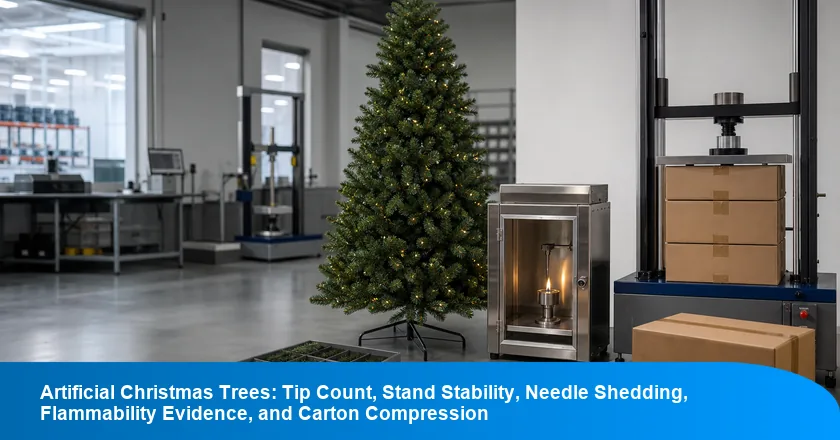
An artificial Christmas tree release is more than a visual pass on branches and a sealed carton. The buyer's decision needs the listed tree, assembled configuration, destination evidence, instructions, and carton range to identify the same packed version.
A Tree Is Ready to Release Only When Its Listing, Build, and Carton Agree
The release unit is the approved tree configuration in its documented packed carton range, not an isolated branch sample or unopened box.
A release record joins the records a buyer uses to decide whether that packed tree range can move: the listing, assembled build, destination evidence, instructions, and carton identity.
That distinction is useful when a marketplace listing promises a certain height, profile, tip count, color, stand, and optional pre-lit configuration. Each promise may look plausible on its own. The release decision becomes weak when the assembled sample, product documents, and carton evidence do not identify the same version. A buyer can avoid that gap by treating the finished tree, its approved records, and its traceable pack-out as one decision object.
For an artificial Christmas tree inspection, start with four questions: Which destination is this retail version for? Which claims will a customer see? Which parts must be assembled to observe those claims? Which carton range contains that exact configuration? Those questions turn a broad holiday-product check into a scoped release record.
- Verify listing claims against an assembled configuration, not a loose branch or carton photograph.
- Keep the stand, branch sections, instructions, and optional lighting configuration together during inspection.
- Read fire-related and packaging evidence for its actual product and market scope.
- Hold only the smallest carton range that cannot be tied to a verified configuration.
Route the Tree Before Treating Evidence as Universal
Destination, intended use, and whether the tree is pre-lit determine the evidence route; an inspection does not replace conformity assessment or legal advice. The EU General Product Safety Regulation places its own general-safety, documentation, and information responsibilities on the relevant economic operators, while UK product-safety guidance likewise frames duties around the product and the responsible business role.
Make a route map before production is finished. A market route is the destination, intended use, and evidence path selected for a tree configuration. It should name the sales markets, product configuration, whether lights are included, applicable label or document questions, and the owner of any specialist review. An unlit polyethylene or PVC tree and a plug-connected pre-lit tree may share a retail silhouette, but they do not present the same evidence questions. The map does not certify the product. It makes clear what must be confirmed before a final field inspection is asked to judge the lot.
Separate an Unlit Tree From a Pre-Lit Electrical Route
US seasonal-lighting scope identifies portable, plug-connected temporary-use lighting products; a pre-lit tree therefore needs a separate electrical route from the unlit tree structure. 16 CFR Part 1120 provides that stated product-scope context.
Record whether the sample is unlit, plug-connected pre-lit, battery-operated, or supplied with a separate lighting set. Then compare the physical tree and its instructions with the configuration named in the route map. The structural inspection can still cover branch sections, hinges, stand fit, tip count, color, and packed parts. Electrical evidence should stay attached to the pre-lit configuration rather than being inferred from the same unlit frame. If a supplier proposes a last-minute lighting substitution, pause the release record until the actual configuration and destination route are reconciled.
Turn Listing Claims Into Release Checks
Height, tip count, tree profile, color, and included stand are buyer-approved product claims that should be checked against the assembled configuration.
Ask the buyer to provide the exact listing claim, approved sample reference, revision identifier, and intended counting or measurement method. A declared tip count is not useful if the supplier and inspector count different constructions. The same is true of height: record the stated basis and setup condition rather than improvising a method in the factory. Product pages often compress these distinctions into a few selling points; the inspection brief needs to expand them into observable conditions.
A practical release record also names what is included: stand components, screw or pin hardware, branch sections, gloves, assembly instructions, spare parts, and any pre-lit accessories. It allows a buyer to identify a substituted part without relying on a generic “appearance passed” conclusion.
TradeAider can help structure a pre-production tree specification review that aligns the approved tree sample, listing copy, intended market, and pack-out plan before the supplier starts a large run. This is especially useful when one base tree is sold with multiple stand, light, plug, language, or retail-carton variants.
Build a Tree Claim Ledger Before Sampling
A claim ledger ties each shopper-facing tree claim to an approved source, an observed check, and a carton range.
The ledger is deliberately simple. Its purpose is to prevent a result from floating free of the product it describes. It can be prepared by the buyer or supplier and used by the inspector as a comparison sheet.
| Customer-facing claim | Approved source | Observed check | Release record |
|---|---|---|---|
| Height and profile | Approved listing and sample | Assemble as instructed | Tree revision and carton range |
| Tip count | Declared count and method | Apply the approved method | Observed configuration |
| Stand included | BOM and instructions | Fit all specified parts | Hardware revision |
| Fire or lighting claim | Route-specific evidence | Compare product, label, and insert | Destination version |
Assembly Shows Whether the Stand Supports the Sold Tree
Stand stability can be observed only after the specified tree sections, base hardware, and setup instructions are assembled together.
Inspect the assembly in the same sequence a retail customer will use. Confirm that every section seats as intended, the pole or connectors are compatible, stand legs or feet are complete, fasteners or locking features function, and the instructions identify the version in hand. Then examine branch hinges and the distribution of the tree’s weight in the actual stand. A stable-looking base beside an incomplete tree does not answer whether the sold configuration can be assembled and supported as represented.
Capture the observed stand and tree revision in the report. Where there is a correction, use during-production tree assembly checks before carton sealing to verify the corrective build, rather than assuming a replacement component has been applied across a later lot.
Check the Stand as a Complete System
Canada's Consumer Product Safety Act prohibits supply of a consumer product that is a danger to human health or safety; it does not establish a universal artificial-tree stand stability limit. Section 7 of the Canada Consumer Product Safety Act provides the general prohibition.
For that reason, do not invent a single angle, load, or shake result and call it a market-wide rule. The buyer should define the intended setup, relevant product route, expected accessories, and acceptance method. The field record can then state what was assembled, what moved or failed to seat, whether any hardware was missing, and which tree or carton range the observation represents. A condition that cannot be tied to the released build needs escalation, not a broad claim of compliance.
Needle Shedding and Branch Retention Need an Approved Appearance Standard
Needle shedding, branch retention, hinge behavior, and color consistency must be judged against a buyer-approved appearance and assembly specification.
Inspect shedding and retention after the declared assembly and fluffing sequence. Record the branch material, observed color consistency, loose pieces, hinge action, broken or deformed branch components, and any visible difference from the approved sample. The aim is not to turn an ordinary handling observation into a fake universal failure rate. It is to decide whether the actual configuration remains within the buyer’s agreed appearance and assembly standard.
When a finding points beyond an appearance comparison, keep the field observation separate from any required technical route. Tree product testing coordination can help a buyer structure the handoff of the exact revision, product material, and destination context for the appropriate evidence work.
Classify the Observation Without Inventing a Universal Limit
Australia requires compliance with relevant mandatory standards before supply, but not every consumer product is subject to a mandatory standard. Australian product-safety guidance makes that scope distinction.
Use that boundary to label the finding correctly. A shed needle, failed hinge, inconsistent color, or missing component may be a buyer-defined appearance or durability issue. It may also trigger a separate technical or product-safety review depending on the product and route. The inspection report should preserve the physical observation and its traceable configuration; it should not claim that a generic appearance check resolves a legal or technical question.
Flammability Evidence Is a Claim-and-Market Evidence Check
A fire-resistant label is a limited product claim, not proof that a tree cannot burn or automatically meets every destination-market requirement.
Ask for the evidence the buyer expects for the destination and product configuration, then compare it with the physical product, label, retail insert, instructions, and listing claim. The inspection scope can check that the provided documents and claims identify the same version. It cannot convert a document from another revision or destination into proof for the tree in hand. For a pre-lit configuration, keep the electrical route attached to that same release record.
The inspection-standard reference should state how buyer-defined claims, approved documents, defect classifications, and escalation questions will be recorded. That reduces the risk that a loose marketing phrase is treated as a technical conclusion.
Compare the Label, Evidence, Instructions, and Destination
Canada's Consumer Product Safety Act prohibits packaging or labeling that may create an erroneous impression about a consumer product's danger to human health or safety. Section 9 of the Canada Consumer Product Safety Act provides that Canadian packaging and labeling boundary.
Put the label artwork, insert, instructions, evidence request, and sample photograph into one review set. Confirm the product name, revision, destination, relevant language, and claim wording are aligned. If a retail carton still displays an older claim or names a prior tree version, mark the carton range rather than assuming that the current product record covers it. The right next step may be a document correction, a market-route review, or new evidence for the changed product—not a generic approval.
Carton Compression Is a Product-and-Distribution Check
Carton compression is a packaging-and-product check: it must protect the finished tree's branch geometry, hardware, and parts identity, not only the box's appearance.
Start with the actual distribution profile: intended stacking exposure, master-carton orientation, transit handling, fulfillment route, retail presentation, and the tree revision inside the carton. A carton that looks intact can still conceal shifted sections, crushed branch geometry, a bent stand part, or a mixed hardware set. Conversely, an evidence record for a different tree revision is not automatically evidence for the packed tree on the floor.
ISTA compression guidance explains that compression relevance depends on stacking exposure and distribution inputs. It is a useful reminder to define the handling assumption before asking for a test record. Do not copy a load or conclusion from a different carton, route, or product revision.
Choose the Test Route From the Actual Distribution Profile
ISTA describes 1 Series procedures as non-simulation integrity screening and 2 Series procedures as partial simulation tests; the distribution profile determines which evidence is meaningful. ISTA's procedure guidance distinguishes those test purposes.
The buyer’s packaging plan should therefore identify the product revision, packed configuration, carton dimensions, expected handling, stacking assumption, and success criteria before a test is selected. The inspection record can then compare the carton marking and physical contents with that plan. This is more reliable than declaring that every artificial tree needs one compression result or one universal test load.
Illustrative Scenario: the Approved Tree and Packed Tree Diverge
A documented configuration-and-carton conflict can justify a limited traceable hold rather than an arbitrary order-wide decision.
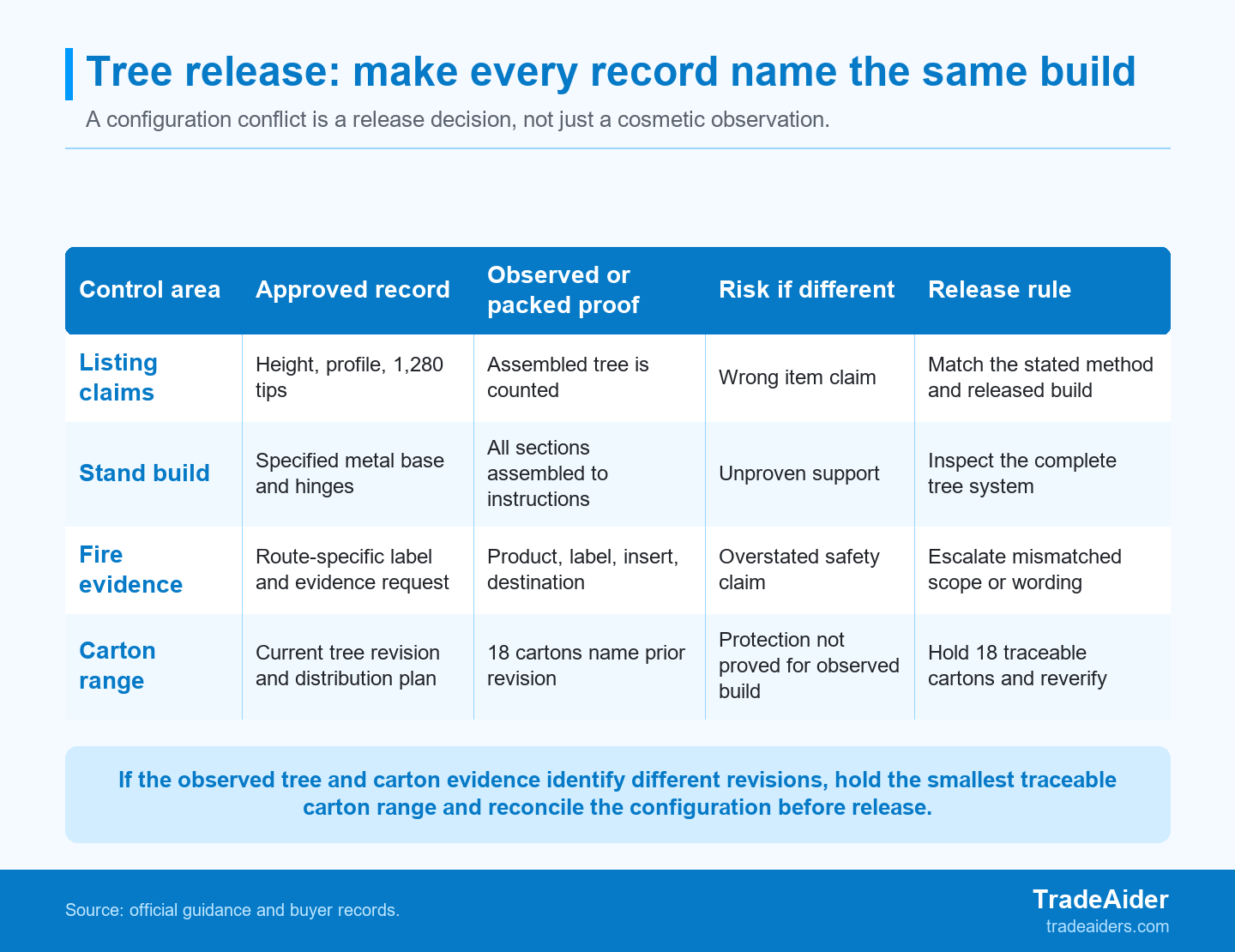
Hold the smallest traceable carton range when the observed tree configuration and supporting record do not agree; this illustration shows an 18-carton hold.
Illustrative buyer scenario; figures are not performance benchmarks. A marketplace quality manager is preparing one artificial-tree SKU for US, UK, EU, Canada, and Australia listings.
Separate, Reconcile, and Recheck Before Release
The correction sequence must restore one shared configuration identity across the assembled tree, claim ledger, evidence, instructions, and carton range.
A marketplace quality manager is preparing one artificial-tree SKU for US, UK, EU, Canada, and Australia listings. The buyer has 1,200 retail trees packed across 60 master cartons, with declared height, 1,280 tips, a specified metal stand, and an approved carton range. The approved sample, instructions, and market-evidence request were in the release packet before final carton sealing.
During assembly, the lower sections in an 18-carton range carry a substituted hinge block and a confirmed count of 1,168 tips rather than the approved 1,280-tip configuration. The same carton range has a compression record that names the prior tree revision, so it cannot prove protection for the observed build. The discrepancy is a configuration-and-carton traceability conflict, not evidence that all 1,200 trees are defective.
Hold the 18 traceable cartons while the unaffected 42-carton range remains separate pending its own record review. Restore the specified hinge and tip-count configuration or issue a buyer-approved revised specification, then update the carton and instruction records for the affected range.
Reassemble the corrected configuration, reconcile the declared tip count and stand hardware, and obtain packaging evidence that identifies the corrected carton range and distribution plan. This illustrative example does not set a universal tip-count tolerance, stability limit, flammability rule, or compression load.
Hand Off a Tree Release Record Before Carton Sealing
The inspection scope needs the market route, approved sample, claim ledger, stand and appearance criteria, evidence request, instructions, and carton range before final checking.
Send those items as a single release packet. Include the target markets, retail SKU and version, approved listing claims, tip-count method, required stand and hardware, appearance standard, pre-lit status where relevant, label and evidence questions, instructions, packing method, master-carton marking, and the range to be inspected. The clearer the packet, the less likely the final report is to compare a correct observation with the wrong configuration.
When the records are ready, use the Pre-Shipment Inspection scope to apply the buyer’s release criteria to the identified lot and pack-out. If the details still need to be assembled into a lot-specific plan, schedule tree inspection before carton sealing so count, assembly, and packaging defects can still be corrected.
Who Is TradeAider?
TradeAider provides quality inspection, testing, and certification service context in China and publishes approved client-reported outcomes with qualification. Buyers sourcing in Guangdong, Zhejiang, Jiangsu, Shandong, Fujian and other regions can review the TradeAider background when they need a defined inspection scope for artificial Christmas trees.
For Inspection & QA Services, TradeAider states a $199/man-day all-inclusive rate. Client-reported outcomes include an 18% reduction in returns and 23% of defects caught before shipment; these are client-reported figures, not universal results for every tree program, supplier, or destination market.
TradeAider also provides testing services, covering Hardline Products, Softline Products, Electrical & Electronic Products, and Industrial Products, enabling buyers to manage quality control and testing needs within a single service framework.
Provider support can structure fieldwork and reporting, but it does not replace product-specific conformity or legal assessment for the destination market.
Frequently Asked Questions
Does a Fire-Resistant Label Make an Artificial Tree Compliant Everywhere?
A fire-resistant label is limited evidence about burning resistance and does not by itself establish every destination-market requirement. Confirm the exact product configuration, destination, instructions, and supporting evidence before deciding whether the label and documents can be used for that retail version or must be escalated for specialist review.
What Tip Count Should a Pre-Shipment Inspection Accept?
The buyer-approved declared count and stated counting method supply the acceptance basis for the released tree configuration. Put both in the claim ledger, apply them to the assembled tree revision, record the result, and avoid accepting a count that cannot be linked to the shipped configuration or stated retail claim.
Is Stand Stability a Carton Inspection Only?
Stand stability must be assessed on the specified tree sections, stand hardware, and assembly setup together. Carton checks can confirm the needed parts and their identities, but they do not replace an observation of the complete tree system with its specified instructions, components, and assembled branch sections.
Does an Artificial Tree Carton Always Need Compression Testing?
The distribution route and stacking exposure determine whether and how a compression evaluation belongs in the packaging plan. Record the actual handling, stacking assumption, and product revision first, then select or review evidence that matches those stated conditions rather than copying a conclusion from another carton.

Related Articles



Grow your business with TradeAider Service
Click the button below to directly enter the TradeAider Service System. The simple steps from booking and payment to receiving reports are easy to operate.

