
- About Us

- Our Services
- Your Industry
- Resources
- News & Blog
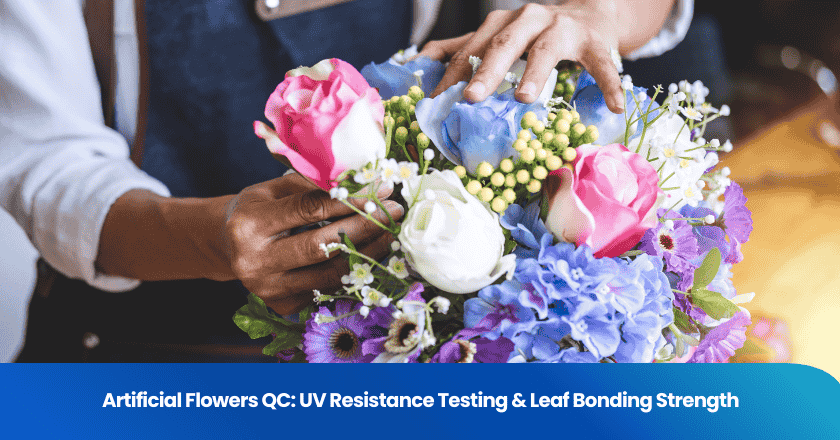
Artificial flowers and plants face harsh realities: intense sunlight, fluctuating weather, and frequent handling. To ensure these products maintain their beauty and structure over time, manufacturers rely on rigorous quality control. UV Resistance Testing evaluates the material's ability to resist fading and degradation, while Leaf Bonding Strength checks confirm that foliage stays securely attached. For buyers in the home decor and landscaping industries, these tests are critical for verifying product longevity and customer satisfaction.
| Material | UV Resistance | Suitability |
|---|---|---|
| Polyethylene (PE) | High | Best for outdoor use |
| PVC | Moderate | Indoor / Sheltered outdoor |
| Polyester (Silk) | Low | Primarily indoor use |
- UV-protected artificial plants can last 3-5 years outdoors.
- Untreated products fade and crack rapidly under UV exposure.
- High-quality items with UV inhibitors retain color fidelity significantly longer.
Key Takeaways
- UV resistance testing is essential for outdoor longevity, preventing color fading and material brittleness.
- Select products with inherent UV inhibitors rather than just surface sprays for durable protection.
- Leaf bonding strength checks are crucial to ensure foliage doesn't detach during transport or handling.
- Request third-party test reports (like ASTM G154) to verify claims of UV resistance.
- Understanding warranty terms and care instructions helps maximize the lifespan of artificial greenery.
UV Resistance Testing for Artificial Plants
What Is UV Resistance?
UV resistance refers to a material's ability to withstand damage from ultraviolet radiation. Sunlight can cause photodegradation, leading to fading colors and structural cracking. Manufacturers combat this by incorporating UV stabilizers directly into the raw materials (like PE or PVC) during production, or by applying protective coatings.
Why UV Resistance Matters
Without protection, UV rays break down the chemical bonds in polymers, causing them to become brittle and discolored. Research indicates that UV-treated artificial plants can retain their color significantly longer than untreated counterparts. For commercial installations or outdoor landscaping, this durability is non-negotiable.
UV Resistance Testing Methods
Quality control relies on standardized testing to simulate years of sun exposure in a short timeframe.
- Accelerated UV Aging Tests (ASTM G154): Samples are placed in a chamber and exposed to intense UV light, moisture, and heat cycles. This method provides quick data on how materials will perform over time.
- Natural Exposure Tests: Samples are left outdoors in high-UV environments for months. While more realistic, this method is slower.
Industry Standards and Certifications
Reliable suppliers should provide test reports based on recognized standards. Key certifications to look for include:
| Certification/Standard | Focus |
|---|---|
| ASTM G154 | Standard practice for operating fluorescent light apparatus for UV exposure. |
| ISO 4892 | Methods of exposure to laboratory light sources. |
| ISO 9001 | Quality management systems ensuring consistent production. |
Leaf Bonding Strength Checks
What Is Leaf Bonding Strength?
This metric measures how securely leaves and flowers are attached to their stems. Weak bonding leads to "shedding," where parts fall off during shipping, installation, or cleaning. Strong adhesion is achieved through high-quality glues or mechanical locking designs.
Mechanical and Functional Testing
Inspectors perform a "pull test" to verify bonding strength. A specific force is applied to the leaf or flower head to see if it detaches. This simulates the stress of packing, unpacking, and daily use. Results are compared against a predetermined standard (e.g., must withstand 2kg of pull force).
Workmanship and Defect Classification
During inspections, defects are categorized to assess overall quality:
- Critical: Sharp edges or exposed wires that could cause injury.
- Major: Detached leaves, significant color mismatch, or poor gluing affecting usability.
- Minor: Slight glue residue or minor shape deformation.
Choosing Quality Artificial Flowers & Plants
What to Look for in UV Resistance and Bonding
When sourcing artificial greenery, prioritize materials with "inherent" UV protection (mixed into the resin) over surface sprays, which wear off. For bonding, check if leaves are molded onto the stem (injection molding) or simply glued, as molded connections are far superior.
| Feature | Benefit |
|---|---|
| Inherent UV Protection | Long-lasting color and structural integrity. |
| Injection Molded Leaves | Superior attachment strength compared to glue. |
| Flame Retardant Materials | Compliance with fire safety codes for commercial spaces. |
Questions to Ask Suppliers
- Do you provide ASTM G154 test reports for UV resistance?
- What is the expected lifespan of the product outdoors?
- Are the leaves glued or molded onto the stems?
- Does the product meet local fire safety regulations (if required)?
Ensuring the quality of artificial flowers and plants requires a dual focus on environmental durability and mechanical strength. By verifying UV resistance through standardized testing and checking leaf bonding strength, buyers can avoid premature fading and structural failure.
| Common Pitfall | Solution |
|---|---|
| Confusing UV spray with inherent protection | Verify if protection is "in-resin" or topical. |
| Ignoring test reports | Always request third-party lab data. |
| Overlooking warranty terms | Check for specific coverage on fading vs. breakage. |
FAQ
How long do UV-resistant artificial plants last outdoors?
High-quality UV-resistant plants typically last 3 to 5 years outdoors before showing significant fading, depending on the climate and sun exposure.
What is the best way to test leaf bonding strength?
A manual pull test is most effective. Inspectors apply a specific amount of force to leaves to ensure they do not detach under normal handling conditions.
Do all artificial plants need UV resistance?
No. UV resistance is critical for outdoor plants or those placed in direct sunlight windows. Indoor plants in low-light areas do not necessarily require high-grade UV protection.
Can buyers request custom UV resistance tests?
Yes. Buyers can specify testing parameters, such as the duration of exposure (e.g., 2000 hours vs. 500 hours) to match their specific quality requirements.
Related Articles
Grow your business with TradeAider Service
Click the button below to directly enter the TradeAider Service System. The simple steps from booking and payment to receiving reports are easy to operate.

