
- About Us

- Our Services
- Your Industry
- Resources
- News & Blog
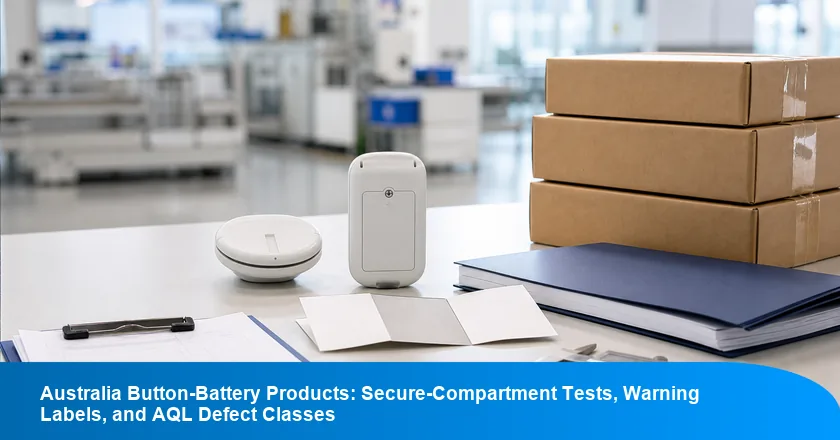
For Australia-bound products containing button or coin batteries, an AQL inspection is only the last question. First establish that the finished unit matches the applicable safety evidence; then confirm that the required warning appears in the form supplied to the buyer; only then use the agreed sample plan to classify the remaining quality observations. This order keeps a passing sample from being mistaken for a release decision on an unreconciled product version.
Australia Button-Battery Release Priorities
A buyer should resolve product safety evidence, required warning presentation, and the AQL sampling question in that order. Use the sequence as a release brief, not as a legal classification tool. It separates three questions that are often merged in supplier email: “Has the relevant configuration been evidenced?”, “Does the finished presentation carry the right warning artefact?”, and “What does the agreed sample say about remaining workmanship or packing defects?” Each question has a different proof, owner, and consequence.
- Evidence gate: identify the product version, battery-access design, and applicable test records before finished-lot sampling begins.
- Warning gate: compare the approved warning artwork and instructions with the actual product, packaging, or attachment delivered with the goods.
- AQL gate: use the buyer’s agreed critical, major, and minor defect rules only after the first two gates are intact.
For a China-side programme, start that sequence while the buyer can still lock the intended version and warning files instead of reconstructing them from packed goods.
Start With the Australian Evidence Boundary
Australia’s four mandatory button/coin battery standards separate product safety, product information, battery safety, and battery information requirements. The ACCC overview identifies the four-standard structure, while the product safety instrument and product information instrument set separate boundaries.
That distinction changes an inspection brief. A remote control supplied with a replacement battery, for example, may involve the product’s battery compartment and warning information as well as separate battery-pack requirements. The finished-unit inspection should therefore name the product, the separately supplied battery if any, and the evidence owner for each. It should not state a blanket “button battery compliant” conclusion from a visual check.
The mandatory standards were made in December 2020 and became mandatory from 22 June 2022, according to the ACCC’s business guide. For a buyer, the immediate operational point is simple: request the applicable product and information records before the factory visit, then use the visit to check whether the physical production version is the one those records describe. TradeAider can coordinate product-testing evidence for a defined product version, but that support does not replace the product-specific evidence itself.
Secure-Compartment Checks Need a Version Match
A secure-compartment review must compare the physical battery-access design with the evidence for that product version; a visible fastener alone is not the compliance verdict. The ACCC product safety guidance says products must have a secure battery compartment and pass compliance testing, and its business guide explains that testing must be undertaken before supply to consumers.
At inspection, capture the cover geometry, opening method, screw or latch type, cavity shape, battery orientation, product code, and revision mark. Then compare those observations to the report, sample photographs, drawings, and change notices supplied by the buyer or factory. A version match is not paperwork for its own sake: it is what lets the buyer decide whether the evidence is connected to the units in the export carton.
Build this check into the pre-shipment brief as a recordable comparison, not a yes/no impression. A captive fastener is a screw or closure that stays with the battery-cover door when it is opened; note its design and condition as part of the version record. If the factory changes a moulded cover, latch, or access path after the evidence was created, flag the document-product gap. The correct next action depends on the documented affected population and the evidence path for the changed configuration; it is not automatically a routine cosmetic defect.
Where the product is still in build, use the approved drawing and sample to check the approved battery-compartment build before production. This creates a reference point for the later finished-goods comparison and reduces the chance that a late design change is discovered only after cartons are closed.
A Fastener Is Evidence, Not the Verdict
A visible fastener is a version-control observation, not a substitute for the applicable test evidence. That makes the fastener worth photographing and matching to the record, but it does not allow an inspector to infer that every relevant test has passed from a screw head alone. Use the observation to locate the correct record and, if it differs, to identify the shipment range that needs a hold or escalation. Record both the fastener condition and its revision context in the inspection report.
Where a replaceable compartment uses a screw or similar fastener, the product safety instrument addresses captive-fastener requirements for the stated replaceable battery-compartment condition.
Check Warnings Across the Product, Pack, and Instructions
Warning artefacts must be checked in the applicable form—instructions, packaging, or attachment to unpackaged goods—and be visible, prominent, and legible. The ACCC information-standard guidance describes those delivery forms, and the information standard provides the regulatory source.
Translate that into a finished-goods checklist: open the instruction leaflet, inspect the retail carton artwork, and check whether an unpackaged item carries the required attached warning where that is the applicable form. Record the artwork version and photograph the actual placement. Do not treat a supplier PDF as proof that the warning made it onto the relevant pack, leaflet, or product presentation.
A visual inspection cannot demonstrate compliance testing, and warning-information omissions have appeared in ACCC enforcement work. In one ACCC review covering more than 400 businesses, 34% of products and 28% of battery packs did not include mandatory warning information or symbols.
The enforcement figures do not predict the condition of any individual supplier. They do show why warning presentation deserves its own release checkpoint: the inspection team can observe finished artwork, while test reports and version control require a separate evidence review. For online listings, the ACCC also recommends a clear, prominent, and legible button-battery hazard warning; treat that as a channel check alongside the physical goods, not as a replacement for the supplied warning artefacts.
Use the Battery-Access Release Matrix Before AQL
AQL sampling should begin only after the buyer has reconciled the evidence packet with the physical product version and defined carton population. The Battery-Access Release Matrix is a two-gate buyer framework: Gate 1 compares the current evidence with the finished battery-access design and warning presentation; Gate 2 uses AQL to classify the remaining agreed quality findings. If Gate 1 is unresolved, an AQL tally can describe observations but cannot close the gap.
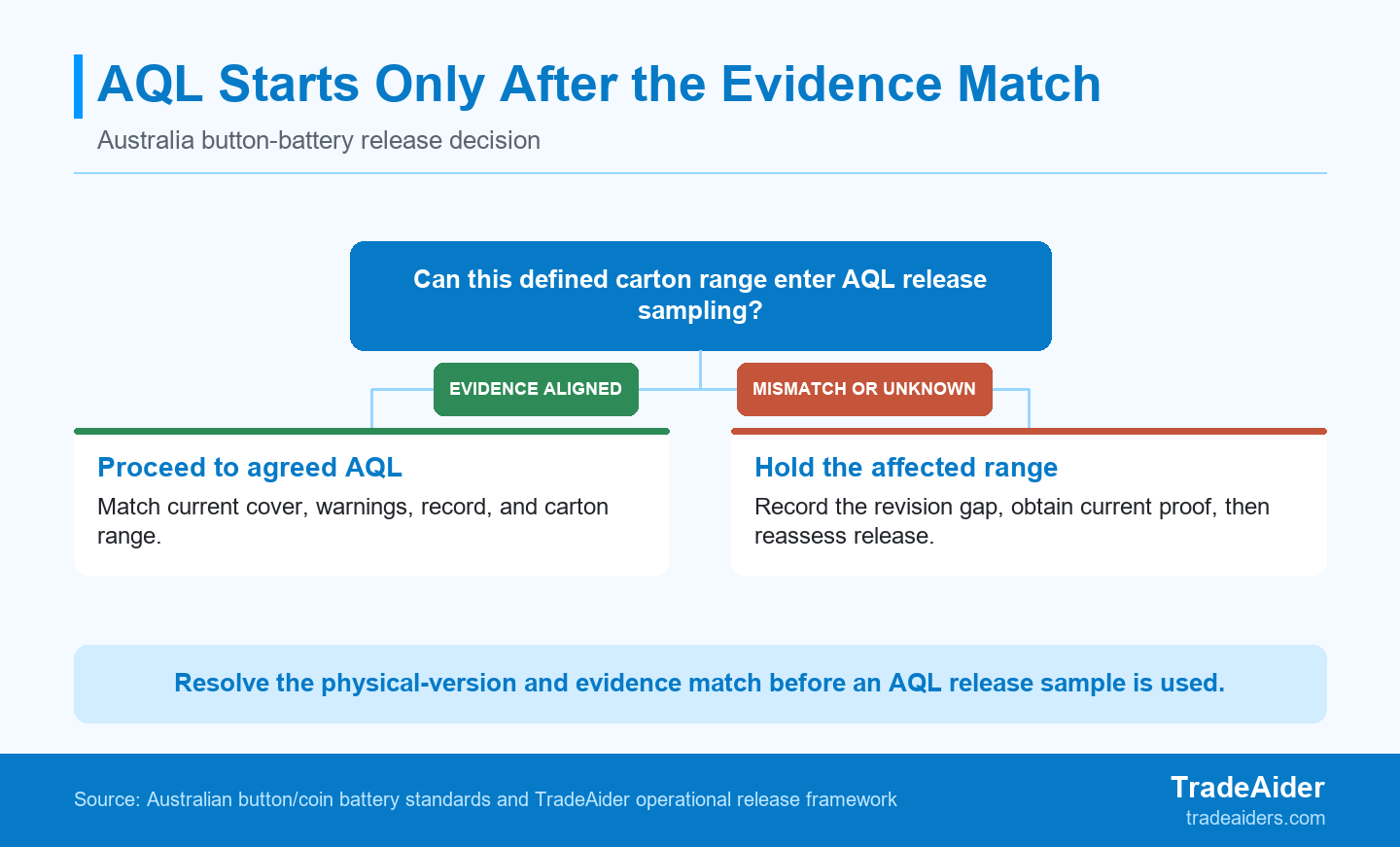
AQL classifies agreed sample observations only after the current battery-access design, warnings, and evidence packet align.
The ACCC business guide states that compliance testing must occur before supply to consumers. That timing keeps later AQL sampling in its proper role: a quality-sampling control, not proof that a product version meets its applicable evidence boundary.
Set the matrix before the visit. Include the report identifier, current drawing or artwork revision, physical identifiers to check, carton population, and the agreed action for a conflict. The matrix is the buyer-side control that keeps the current version connected to the evidence. This creates a clean handoff to calculate an AQL sample size: the sample size and acceptance criteria apply to the defined population after the critical gate has been cleared.
| Question | Evidence aligned | Evidence unresolved | Buyer action |
|---|---|---|---|
| Battery-access design | Current cover, access method, and record connect | Cover or access path differs from the evidence packet | Hold or segregate the traceable population |
| Warning presentation | Applicable warning artefact matches finished presentation | Artwork, instructions, or attachment cannot be reconciled | Correct the evidence or finished presentation before release |
| Remaining quality findings | Population is defined and evidence gate is closed | Population or evidence boundary is uncertain | Apply agreed AQL only in the aligned case |
The Battery-Access Release Matrix does not create a new Australian defect standard. It prevents a buyer from averaging a safety-evidence conflict into a sampling result. Once the evidence and physical product are aligned, the AQL result can answer its proper question: whether the defined lot meets the buyer’s agreed quality threshold for the observations sampled.
Critical, Major, and Minor Findings Answer Different Questions
A battery-access, required-warning, or version-evidence conflict is a critical hold condition in the buyer’s inspection brief, not a defect to average into an AQL pass. Define this as a commercial inspection rule before work begins. A critical hold concerns a condition that blocks the release decision: accessible battery risk, a missing or mismatched required warning artefact, or a product version that cannot be linked to its record. Major and minor classes can then cover the agreed remaining quality observations—such as non-critical workmanship, print finish, or pack condition—within the buyer’s documented AQL plan.
Record the classification rationale in the report. If a finding is treated as critical because it breaks the evidence link, the report should identify the physical feature, document revision, carton range, and next evidence step. That is more useful than a generic “fail” label because it tells the buyer what must be reconciled before a re-inspection or release decision.
Illustrative Scenario: A New Cover Revision Stops Release
When a physical battery-cover revision cannot be reconciled to the supporting evidence, the honest operational response is to hold the defined population until the version link is restored. This fictional example shows why the order of decisions matters: an approved package warning does not cure an unreconciled battery-access revision, and a routine AQL sample cannot prove which version sits in the packed cartons.
What the Buyer Holds and What Reopens Release
In this illustrative scenario, the buyer holds the affected carton population until the physical cover, evidence set, and carton traceability can be reconciled. The hold makes the decision boundary visible: a quality sample can be reported, but it cannot release an unidentified version.
Situation. An importer is preparing Australia-bound novelty lights made in China for retail sale.
The illustrative lot contains 4,800 finished products in 160 export cartons, with approved warning artwork and a battery-compartment report tied to an earlier cover revision.
Finished goods are in export packing and carton identifiers remain available, so the buyer can still define a hold population before dispatch.
Problem. Two sampled units show a snap-cover geometry that differs from the approved evidence packet.
The retail package carries the approved warning artwork, but the factory cannot provide a signed change record that connects the new cover to the earlier test evidence.
The package warning does not repair the missing link between the access mechanism and the record. Because the revision cannot be limited to a clean subset, the relevant carton range remains uncertain and the issue is an evidence hold rather than a cosmetic AQL observation.
Action. The buyer freezes release of the 160-carton population, asks the factory to separate any documented earlier version, and requests the current cover drawing, physical samples, revision history, and an appropriate evidence or testing path for the new configuration. The inspection result can still record routine defects, but it does not convert the conflict into a sampled acceptance count.
Result. The buyer holds the 160-carton population while the factory establishes the applicable path for the current version.
Release reopens only after the physical cover, applicable warning artefacts, supporting evidence, and an identifiable carton population connect again.
This illustrative example is a fictional operational hold, not a claim that one test method or conclusion fits every product. The outcome is traceability: the buyer knows what is held, why, and what proof changes the decision.
Hand Over a Release Packet Before Packing Closes
A release packet should identify the current evidence, physical version, sampling question, and carton range before final packing closes the traceability window. It gives the inspection team a reproducible decision rather than a vague instruction to “check compliance.”
First, list the current product code and revision. Next, name the report or evidence ID that the buyer expects to cover that version, and include the relevant warning artwork and instruction file. Add the physical identifiers the inspector should compare: cover geometry, access method, fastener or latch, cavity layout, battery orientation, and any mould, date, or revision mark. If the product is supplied unpackaged, state the intended attached warning artefact too.
Then define the lot boundary. A carton map should show the export-carton range, packing date or line where available, and how a changed version can be isolated. State the sampling question separately: the inspection team needs the agreed inspection level, AQL rules, and defect classifications for quality observations after the critical evidence gate is closed. If a gap appears, the report should name the document, physical observation, and defined population rather than imply an all-or-nothing conclusion.
A pre-shipment inspection is a check of completed goods during export packing against an agreed scope. Use it to scope a pre-shipment inspection around the approved evidence pack while cartons can still be linked to product versions. It is especially useful when the buyer needs to confirm that warning presentation, product revision, and sampling population have not drifted apart at the last stage.
Before the visit, identify who can answer a version-control question and who can approve a hold or corrective path. Give the factory a deadline for its revision record and state whether an earlier documented build can be segregated. Ask the inspection team to preserve photographs, carton identifiers, and the exact artefact that was compared. These details shorten the time between a discovered mismatch and a decision that can be reproduced by procurement, quality, and the supplier.
If the brief needs an evidence-led scope rather than a generic final check, request an Australia button-battery inspection brief before the visit. The request should state the current version, expected proof, carton range, and release question; it is a practical way to scope support, not a promise of a compliance determination.
Who Is TradeAider?
For a China-side check, the buyer should give the provider the product version, warning artwork, evidence set, and required release decision.
TradeAider is a quality inspection, testing, and certification service provider in China. Its service coverage includes Guangdong, Zhejiang, Jiangsu, Shandong, and Fujian, and its published Inspection & QA Services rate is $199 per man-day, all inclusive. TradeAider is an official Amazon Service Provider Network (SPN) partner.
For buyers who need an evidence-led final check, the useful starting point is a defined product version and release question. TradeAider reports that clients have achieved an 18% return-rate reduction and a 23% improvement in defects caught; those are client-reported outcomes, not a forecast for every shipment. Its China-side support is most useful when the buyer has already decided what must be compared and what result will change release.
Frequently Asked Questions
Does AQL acceptance make a button-battery product compliant in Australia?
No, an AQL result describes only the agreed sample inspection and cannot replace the safety or information records required before supply. Use AQL after the evidence packet, physical version, and carton population have been reconciled. A passing sample may still be limited to workmanship or packing observations and cannot establish that an unreconciled access design is the version covered by the relevant record.
Which button-battery findings should trigger a shipment hold?
Hold the defined carton range when battery access, required warning presentation, or the product-to-record link cannot be reconciled. The exact corrective action depends on the version record and evidence path, not on a generic AQL count. The inspection report should identify the affected physical feature, related document, carton boundary, and the proof required to decide whether the goods can be released or segregated.
Do Australian warning requirements apply to online product listings?
Yes, ACCC guidance recommends a clear, prominent, and legible button-battery hazard warning on relevant online listings. That recommendation sits alongside, rather than replaces, the required warnings supplied with the product in its applicable physical form. Keep the channel review distinct: a correct listing can support safer customer communication, but it does not show that the finished carton or instructions contain the applicable warning artefact.
Can a factory inspection replace button-battery compliance testing?
No, a factory inspection compares goods and documents against an agreed brief but cannot substitute for applicable compliance testing. The ACCC business guide states that compliance testing must occur before supply to consumers. The useful inspection role is to capture the finished configuration, warning presentation, and lot boundary so the buyer can see whether the physical goods remain connected to the relevant records.
Related Articles
Grow your business with TradeAider Service
Click the button below to directly enter the TradeAider Service System. The simple steps from booking and payment to receiving reports are easy to operate.

