
- About Us

- Our Services
- Your Industry
- Resources
- News & Blog
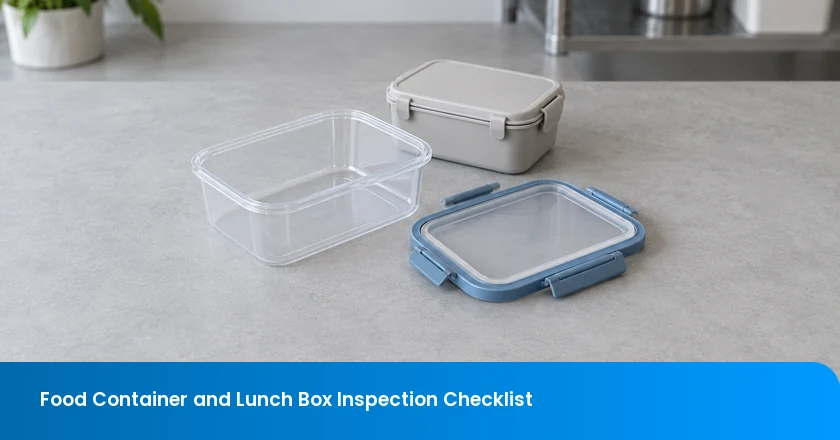
A food container inspection checklist should cover seal leakage, lid fit, odor and drop performance under defined conditions. Keep those factory findings separate from food-contact compliance documents. A lid can snap shut without sealing correctly, and an odor-free container can still lack the evidence needed for its intended food use. Before accepting a shipment, identify what was tested, which conditions applied and which questions remain unresolved.
Decisions to Set Before Container Testing
- Specify the food, temperature, filling and handling conditions the product is intended to support.
- Distinguish the individual container’s durability from the protection provided by its shipping packaging.
- Define the required post-test function and assign responsibility for material-document gaps.
Define the Food Container and Its Intended Use
The European Commission’s food-contact overview includes food packaging and containers, kitchenware and tableware. It distinguishes general food-contact requirements from rules applying to particular materials. This matters for a lunch box assembled from a body, lid, gasket, coating and printed components: a statement about one material does not automatically describe the whole article.
Record the destination market and the exact container version. Identify the body material, lid and seal references, capacity, compartment arrangement and intended use. Dry-snack storage, soup transport, frozen storage and reheating place different demands on the product. Do not turn a familiar product category into an assumption that every version is suitable for each use.
The buyer’s specification should connect packaging claims with measurable acceptance criteria. If the carton says leakproof, establish the conditions under which that claim will be checked. If it says microwave-safe, establish the permitted component configuration and instructions. Resolve contradictions before sampling, when the factory can still provide the correct references and equipment.
Prepare the Approved Samples and Test Conditions
The FDA’s food types and conditions of use tables distinguish different foods and uses, including refrigerated storage and reheating. These are reference tables for food-contact substance notifications, not an approval of a finished lunch box. Use the intended conditions to ask whether the supplied evidence addresses the use actually advertised.
Provide the approved assembled sample, component drawings, material references, artwork and instructions. For functional tests, specify sample preparation, filling medium and level, temperature, duration, orientation and acceptance criteria as relevant. State which checks use the same units sequentially and which need separate samples. Otherwise a factory may demonstrate a room-temperature empty box while the buyer expects performance after impact or conditioning.
Choose a provider that can confirm the required facilities, fixtures and observation time before the visit. Keep specialist tests outside the routine visit clearly identified. For background when assessing that provider, review TradeAider’s company background.
Food Container Inspection Checklist: Results to Record
Record seal leakage, lid fit, odor and drop results separately from food-contact compliance documentation. Connect every observation to the selected unit, its configuration and the method used. An overall “passed” entry is not useful when it leaves the buyer unable to distinguish a completed test from an unverified claim.
| Inspection area | Evidence to record | Decision trigger |
|---|---|---|
| Seal leakage | Assembled configuration, preparation, fill, orientation, duration and location of any escaped liquid. | Leakage outside the approved limit, or conditions that do not match the claimed use. |
| Lid fit | Body and lid match, rim condition, gasket seating, latch engagement and agreed dimensional or operating checks. | Warping, uneven closure, damage, missing seals or a result outside the specified tolerance. |
| Odor | Component, packaging condition, preparation, observation method and comparison reference. | Unexplained or unacceptable odor requiring investigation; no chemical conclusion from smell alone. |
| Drop performance | Bare product or packed configuration, loading, conditioning, agreed sequence and post-drop function. | Cracking, closure damage, leakage or other failure against the defined post-test requirement. |
| Food-contact documents | Material and article identity, destination scope, use conditions, supporting reports and relevant declarations. | Missing coverage, inconsistent components or evidence for a different intended use. |
Also verify quantities, assortment, usable capacity where specified, accessory counts, label accuracy, cleanliness and retail packaging. Record carton locations and sample identifiers so a finding can be traced to the selected configuration. A lid from another size or a missing gasket can make an otherwise sound body unusable.
For recorded measurements, identify the instrument, measurement units and relevant calibration status. This makes dimensional or leakage-quantity results interpretable against the agreed limits.
Agree defect categories and the treatment of incomplete checks before the inspection. A missing test fixture is a coverage gap, not evidence of product failure or a passing result. Use the buyer’s product limits together with inspection-standard guidance.
Seal Leakage: Test the Claim Under Defined Conditions
Not every lunch box promises leakproof performance. Sistema Lunch care instructions state that the covered products are not leak-proof and call for care when transporting food containing liquid. That limitation belongs to the named range. It is neither a rule for all lunch boxes nor permission to disregard another product’s explicit leakproof claim.
For a product required to resist leakage, use the approved liquid, fill level, temperature, closure method, orientation and duration. Check the assembled product as supplied, with the gasket properly seated and any valve in the specified position. Record the setup before starting. A water-filled inversion demonstration cannot establish performance for every food viscosity, temperature or transport condition.
Dry the exterior as required by the method so residual filling water is not mistaken for a leak. Identify the escape path: lid perimeter, corner, valve, body crack or another interface. Record when leakage appears and the agreed measurement or observation result. If the method calls for quantity measurement, a photograph of a wet surface cannot replace that measurement.
Keep the initial result intact if the factory removes and reseats the gasket during troubleshooting. That intervention changes the tested assembly. A successful second demonstration may help locate the cause, but it does not erase the original finding or show that every packed unit received the correction. Document the change and apply the agreed verification plan.
Where performance is required after washing, freezing, handling or impact, include the relevant conditioning and subsequent leakage check in the approved sequence. Do not substitute a fresh untouched sample for the conditioned unit without identifying the change. The result needs to answer the condition the buyer actually specified.
Lid Fit: Check the Body, Seal and Closure Together
Check the matched lid, body, gasket and latches together. A lid that closes successfully does not by itself establish sealing performance. The closure may engage while a damaged rim, uneven gasket or distorted corner leaves a path for liquid.
Compare the assembly with the approved sample and drawings. Look for flash or damage on sealing surfaces, uneven rim geometry, incomplete gasket seating and latches that do not engage consistently. Inspect the full perimeter rather than only the easiest closing edge. Use the specified dimensional checks where a visual comparison cannot resolve the difference.
Assess opening and closing using the agreed method. If operating force or repeated-use durability is specified, record the required measurement or cycle result. Do not turn an inspector’s impression that a latch feels stiff into a numerical force claim. Similarly, a few manual openings do not establish performance over an advertised service life.
Where lids are sold as interchangeable, test the relevant combinations from production, not just the factory’s matched demonstration pair. Keep size, tooling or component identifiers where available. An interchangeability problem may otherwise be hidden by repeatedly using the same well-fitting lid and body.
TradeAider schedules pre-shipment inspection (PSI) when the order quantity is 100% complete and at least 80% packed for export. The packing threshold does not mean production is partly complete. Confirm the assembly references, sample preparation and required fixtures when arranging the pre-shipment inspection service.
Odor: Record the Finding Without Inventing a Safety Result
An odor observation is sensory evidence, not a measurement of chemical migration or proof of food-contact compliance. Migration concerns substances transferring into food. A container with no noticeable smell has not, for that reason alone, demonstrated acceptable migration; an unusual smell also does not identify a particular chemical or its concentration.
Use an agreed observation method and a defined reference. Record whether the odor was noticed when the retail pack was opened, after unpacking, or following specified preparation. Keep the body, lid, gasket and packaging distinguishable during investigation. Otherwise an odor from an insert or bag may be attributed to the container without evidence.
Do not wash or air out a sample solely to make an unfavorable result disappear. If the approved method requires cleaning or conditioning, follow it and record both the preparation and relevant findings. A difference after preparation is useful information about the conditions of the observation, not permission to omit the initial complaint.
Ask the factory to investigate unexplained findings against its material, processing and packaging records. Retain identified samples when technical follow-up is needed. Sensory assessment or laboratory work should use an appropriate agreed procedure; factory personnel should not taste food exposed to an unverified suspect article as an improvised acceptance test.
The buyer can then distinguish a specification failure requiring corrective action from a question requiring further evidence. Keep that disposition separate from the material-compliance assessment. Neither a clean-looking product nor an acceptable odor observation closes a missing report or a mismatch in the declared material.
Drop Tests: Separate Product Durability from Shipping Protection
ASTM D5276 covers free-fall drop testing of loaded boxes, cylindrical containers, bags and sacks. Its public scope concerns the loaded container and protection of contents during impact. It does not establish a universal drop height or acceptance requirement for every bare lunch box.
Define the test object first. A shipping-carton test evaluates the agreed packed configuration; a product durability test evaluates the specified container assembly under its own conditions. Record whether the product is empty or filled, its mass, lid and valve positions, conditioning, impact surface and required drop sequence. The applicable method and buyer specification must supply the values.
Afterward, inspect the relevant function as well as visible damage. Look for cracks, displaced seals, broken latches and loss of fit. Where continued leak resistance is required, perform the defined post-drop leakage check on the identified units. A carton that still looks acceptable does not establish that the enclosed lids and seals function correctly.
Agree how tested units will be identified and segregated, and how the results affect the order decision. A destructive durability sample should not silently become part of saleable stock. Missing equipment or an uncompleted sequence should be reported as a limitation on what was verified.
For workmanship sampling, agree the acceptance quality limit (AQL) and inspection level with the buyer. A durability test may require a separate sample and acceptance rule; do not infer those from an illustrative example. Plan the workmanship sample with the AQL calculator.
Illustrative Example: Leakage Appears After the Drop
In an illustrative order of 1200 completed lunch boxes, the buyer’s agreed criterion requires no leakage after the specified drop sequence. The factory has the finished containers and approved method ready. All 8 selected units show no leakage before the specified drop sequence, but 2 of those same 8 units leak afterward. Sample labels connect each result to the same container.
The first observation cannot establish sealing after impact. The paired results show a loss of required function in the tested units, even if the lid still closes. Keep shipment disposition pending under the agreed post-drop criterion and report the observed failures. Do not convert the sample outcome into an estimated number of defective boxes in the order.
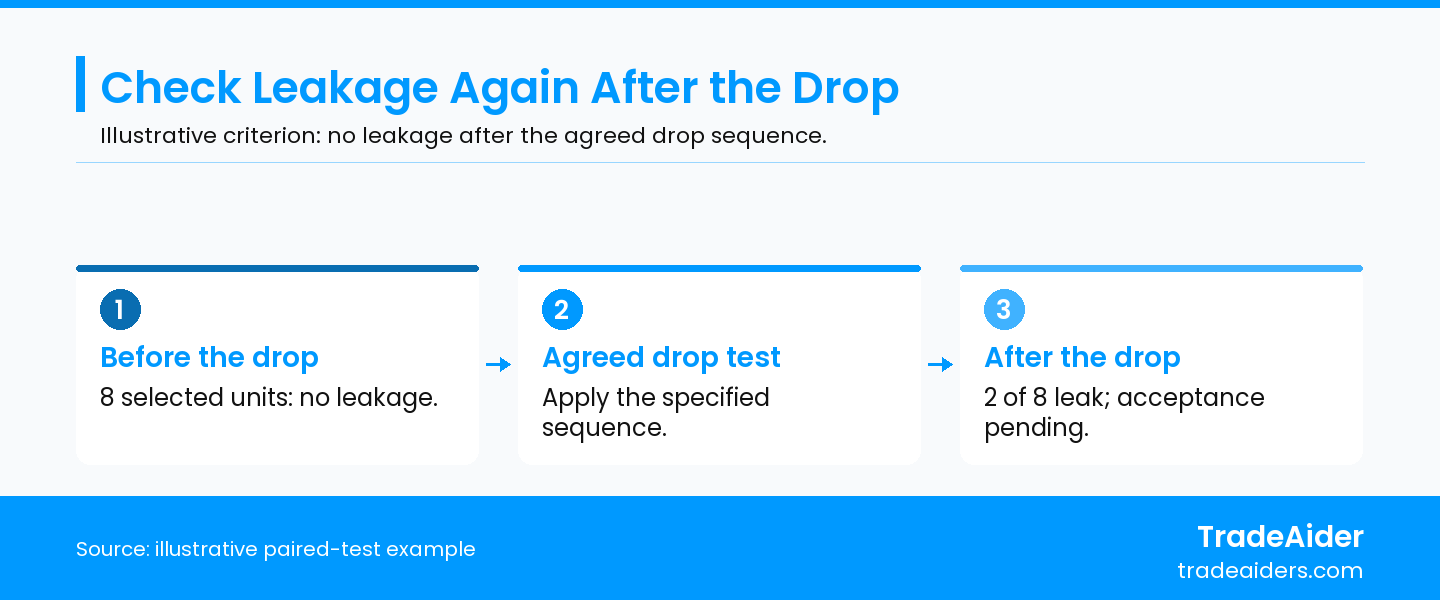
Illustrative criterion: no leakage after the drop. These paired observations are not a prescribed sample size or drop procedure; the earlier result cannot establish post-drop performance.
The factory investigates the relevant lid, gasket and closure interfaces and proposes a controlled correction. The buyer approves the corrective action and verification scope. Fresh, appropriately selected units then repeat the complete agreed sequence after correction, including the initial and post-drop leakage checks. Review those results before deciding disposition; simply reseating a gasket on a failed sample and showing it closed would not complete that verification.
This is an illustrative exercise, not a prescribed sample size, drop procedure or AQL plan. It does not establish the batch-wide extent of the problem or prove that every container fails. The release decision also depends on the other agreed inspection findings and any unresolved food-contact documentation.
Food-Contact Documents: Match Materials and Use Conditions
The European Commission’s legislation guidance explains that a Declaration of Compliance (DoC) for plastic food-contact materials relies on supporting documentation. It also describes migration testing under time and temperature conditions representative of the intended food use. These plastic-specific documentation and testing provisions should not be treated as one universal report format for every container material.
Build a component-to-document check: body, lid, gasket, coating and other relevant food-contact parts should have identifiable material references and an applicable evidence basis. Compare the supplier and product descriptions, tested specimen, manufacturing references and covered use with the order. A report on an uncolored resin alone does not explain whether a finished colored, coated or assembled article is covered.
Look for use restrictions that change the decision. Evidence limited to cold storage may not support the reheating claim on the retail sleeve. A stated material name does not resolve a change in additives, coating or gasket formulation. Ask the supplier’s technical owner or responsible laboratory to explain applicability and identify any further assessment needed.
The relevant rules depend on the destination, materials and current requirements. Check amendments and applicable transition arrangements rather than treating an old report date or a regulation number on a cover sheet as sufficient. The Commission’s page links material-specific measures; it is not a substitute for assessing the exact article. Avoid treating a narrow substance claim such as “BPA-free” as evidence of overall compliance.
Factory inspection can record the documents supplied, match accessible identifiers and flag discrepancies. It does not turn a visual check into chemical testing or authorize the inspector to approve an unsupported material substitution. Keep the owner and required follow-up for each gap clear, so the buyer knows what remains to be resolved before acceptance.
Request an Inspection That Resolves the Open Findings
Provide product references, test conditions, acceptance criteria and documentation gaps so the provider can confirm feasible checks and reporting. Include destination markets, material and component identifiers, the approved sample, leakage and drop methods, quantities, packing status and the required treatment of tested units.
Ask TradeAider to confirm which observations and measurements can be completed during the factory visit and which require another arrangement. Agree a report linking selected units to findings and photographs, with uncompleted checks and document mismatches identified. That gives the buyer a concrete basis for corrective action and evidence follow-up. Send the specification and open questions for scope confirmation: Contact TradeAider to plan your food container inspection.
Frequently Asked Questions
Does an outer seal keep food from moving between compartments?
Not necessarily. A perimeter seal can prevent escape outside the box while allowing liquid to move between internal compartments. If separation is claimed, define a compartment-specific test and the relevant filling and orientation conditions. Inspect removable dividers and their fit separately from the lid’s outer sealing interface.
Does microwave-safe mean the lid stays closed during heating?
No. Follow the instructions for the exact container and lid combination; removal, venting or another specified configuration may be required. Check that symbols and written instructions agree. A general microwave-safe marking does not establish that every accessory, seal or closure position is suitable for heating.
Can drop-tested containers return to saleable stock?
Follow the agreed disposition plan. Keep damaged, contaminated or otherwise unsuitable test units segregated and identified. Destructive or conditioning tests may affect a unit even when the defect is not obvious in a photograph. Confirm replacement quantities and packaging so tested samples do not silently re-enter retail cartons.
Can one plastic report cover glass or stainless-steel versions?
Do not assume so. Match the evidence to the actual materials, coatings and food-contact components in each version. A glass or steel body may still use a plastic lid or elastomeric gasket needing its own applicable assessment. Shared branding and similar dimensions do not establish material equivalence.
Related Articles
Grow your business with TradeAider Service
Click the button below to directly enter the TradeAider Service System. The simple steps from booking and payment to receiving reports are easy to operate.

