
- About Us

- Our Services
- Your Industry
- Resources
- News & Blog
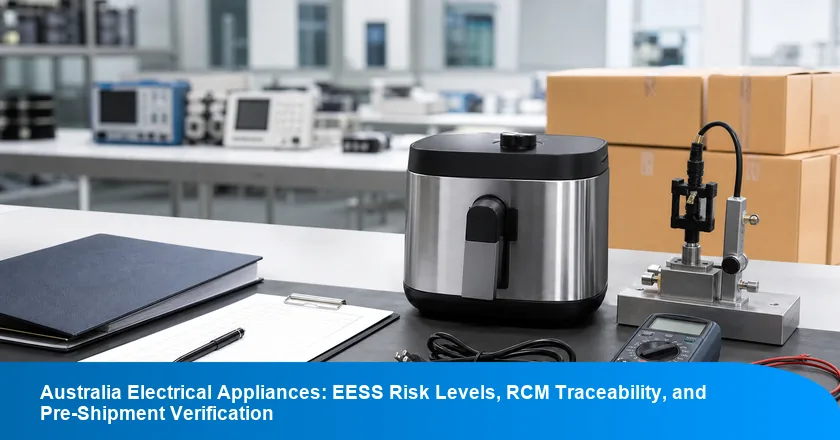
For Australian electrical appliances, the weak release question is “Can we see an RCM?” The useful question is whether the risk path, the supplier’s records, the model and component identifiers, and the packed lot still describe the same equipment. Under EESS, a Responsible Supplier is a legally identifiable Australian or New Zealand entity or person who manufactures or imports in-scope electrical equipment. A pre-shipment check can test that connection; it cannot turn an inspection report into a legal approval.
A release decision needs three matching records
Australia's Electrical Equipment Safety System (EESS) is a safety framework for in-scope household, personal and similar electrical equipment. A buyer should approve an appliance lot only after three things agree: the applicable regulatory path, the product record, and the identifiable cartons or pallets being released. If any one changes—especially a model suffix, plug, cord set, power supply, label artwork or packing population—the previous evidence may no longer describe the shipment in front of the inspector.
EESS risk level is the risk classification applied to in-scope electrical equipment in the Australian electrical safety framework. It determines the proportionate pre-sale evidence, registration and certification path; it is not a quality grade assigned by an inspector.
- Compliance intent: determine the declared EESS risk path before writing an inspection checklist.
- Traceability intent: connect the RCM, trade name, model and relevant evidence to the current configuration.
- Release intent: approve only the carton population that can be shown to match that configuration.
What EESS risk levels decide before inspection
EESS classifies in-scope electrical equipment into Risk Levels 1, 2 and 3, with a sliding scale of regulatory requirements. The level is determined from the current equipment definitions, not from a buyer’s product label or a factory’s preferred description. Before a visit is booked, the Australian Responsible Supplier should be able to state whether the equipment is in scope and which risk path applies.
The official EESS definition describes Level 1 as low or unknown risk, Level 2 as medium risk, and Level 3 as high risk; higher-risk equipment is defined through the current equipment definitions and relevant standards. The framework also identifies different pre-sale requirements by level, so a sourcing team should not assume that every “electrical appliance” has the same documentation route. Confirm the regulator’s current definitions before fixing the scope.
The Responsible Supplier is the locally identifiable Australian or New Zealand manufacturer or importer in the EESS model, not simply the overseas factory that made the goods. That ownership distinction matters at shipment stage: the factory can provide technical information, but the supplier responsible for supply must own the classification, declarations, registrations and retained evidence required for the product.
What RCM traceability must link
The Regulatory Compliance Mark (RCM) is a useful physical checkpoint only when it can be reconciled to a responsible supplier and a current equipment identity. EESS states that authorization to apply the RCM resides with the Responsible Supplier, and the mark is generally placed on the equipment near model identification. An inspector can observe the mark, its presentation and its proximity to the model information; that observation is not a stand-alone compliance verdict.
Ask for the exact brand, model or trade name used in the record, the current model suffix, label artwork revision, input rating, and any configuration-controlled component codes. The EESS registration FAQ explains that equipment registration links a product model or trade name to the registered Responsible Supplier, while the public database includes brand and model details for Level 2 and Level 3 equipment. Those details make model drift a release issue, not a cosmetic discrepancy.
In practice, create a short reconciliation sheet before the inspection: one row per declared model, with its evidence reference, RCM artwork revision, relevant component code, carton mark and planned quantity. If the buyer needs help reviewing the technical evidence before that sheet becomes an inspection scope, they can review product-testing support for the evidence pack.
The EESS Evidence-to-Lot Check
The EESS Evidence-to-Lot Check is a buyer-side verification framework, not an EESS rule or a substitute for certification. This buyer framework checks product identity and the packed lot against the declared risk path before the buyer releases the lot. A failure at an earlier gate should be resolved before adding more sampling at a later gate.
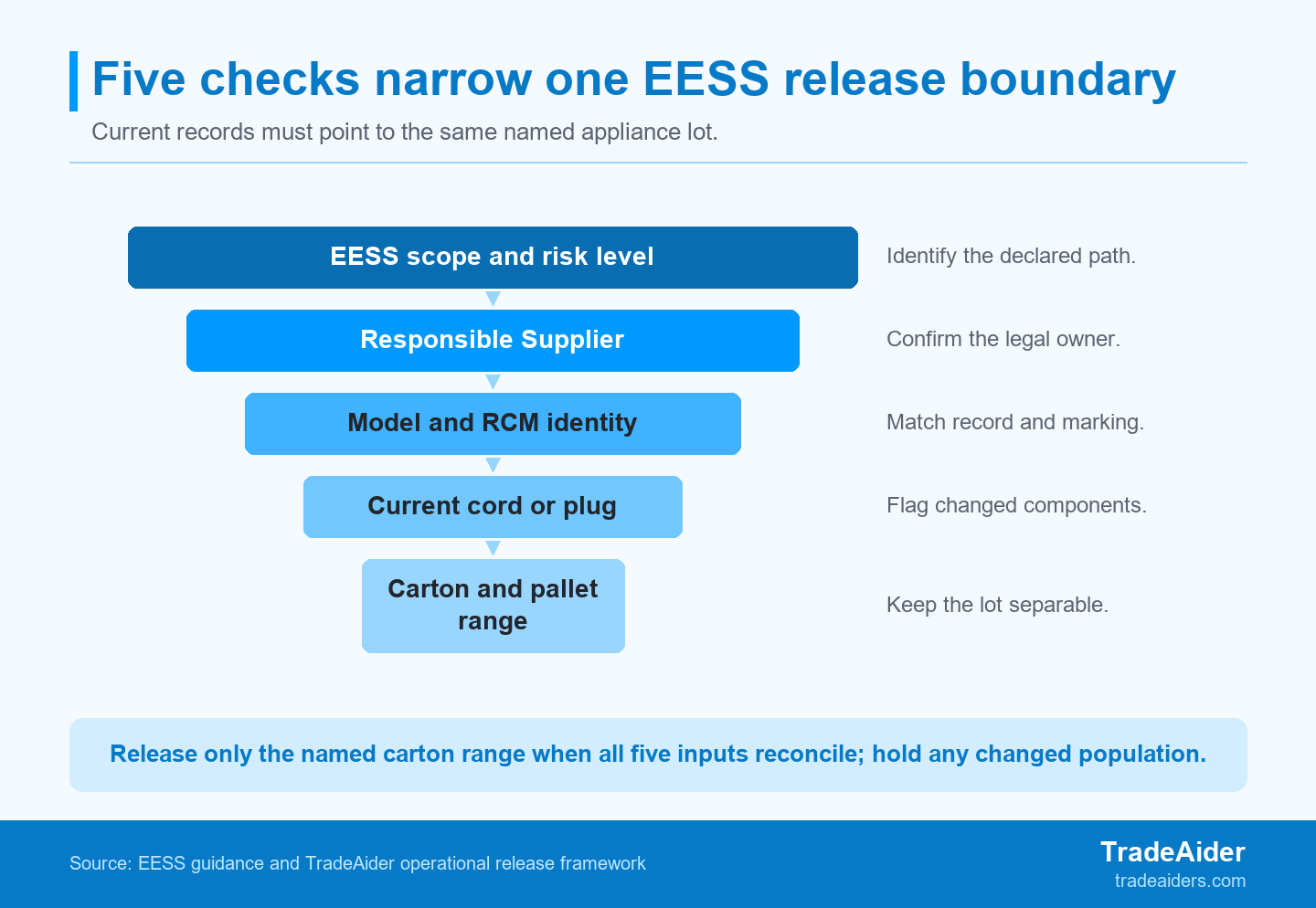
A release decision becomes defensible when the declared path, product identity, component version, and packed-lot record converge.
Gate 1: establish the regulatory path. Confirm the declared in-scope status, risk level, Responsible Supplier and evidence route. Gate 2: reconcile product identity. Match the model, brand, input rating, RCM artwork and configuration-controlled parts to the supplied records. Gate 3: reconcile the packed lot. Verify that cartons, pallets and packing records identify the population that actually carries the matched configuration.
This sequence changes the inspection brief. It tells the inspector what to observe, tells the buyer what cannot be concluded from observation, and makes a split release possible only when the affected population remains demonstrably separate. Buyers who want an on-the-ground partner for those bounded checks can check component changes during production before final packing removes that separation.
TradeAider’s role in this framework is practical rather than regulatory: its China-wide network can compare buyer-provided identifiers with the goods and packing status at the agreed time.
Risk path, evidence and physical checks
The declared risk level changes the evidence and registration questions that should be answered before inspection. The physical check remains configuration-specific in every case: an inspection should confirm that the observed product and identifiable lot are the product described in the buyer’s evidence packet, rather than infer the level from appearance alone.
| Declared EESS path | Record to request before inspection | Physical check that supports release | Escalation boundary |
|---|---|---|---|
| Level 1 | Responsible Supplier registration, relevant-standard evidence, RCM artwork | Model, rating, RCM and carton identifiers match the declared configuration | Hold a changed or unidentifiable configuration |
| Level 2 | Equipment registration and compliance-folder references, plus current product identity | Observed unit and packing population reconcile to the registered model record | Escalate a record-to-product mismatch to the Responsible Supplier |
| Level 3 | Equipment registration linked to the applicable certificate and current technical configuration | Certificate-linked model and component identity remain unchanged through the packed lot | Do not release a revised configuration as though it were the certified one |
Based on this comparison, the correct inspection question is not “Did we sample enough units to determine the risk level?” It is “Does the declared path have a complete record, and does the current lot remain within that record’s product identity?” The regulator’s EESS compliance steps distinguish the Level 1, 2 and 3 evidence routes.
Worked scenario: a cord revision splits the lot
This illustrative scenario shows why a late component change should alter the release boundary rather than disappear inside an overall inspection result. It is not a statement about any specific appliance category, supplier or legal outcome; the Responsible Supplier and the relevant regulator determine the actual EESS obligations.
An importer has 3,600 units packed in 120 export cartons. Before inspection, the buyer receives a model list, RCM artwork and evidence references for the original configuration. The factory then reports a late cord-set revision. During the visit, 40 cartons show the earlier cord-set code that matches the supplied evidence, while 80 cartons show a later code absent from that evidence pack. Pallet records and carton labels keep the two groups separate.
The meaningful observation is not simply that both groups carry an RCM. The changed cord-set code creates a configuration question, and the clean segregation creates a controllable population boundary. The buyer should retain the carton-to-code list, photographs of the relevant identifiers, packing counts and a clear statement of which population was observed.
If a buyer is setting up such checkpoints before a production change reaches final packing, they can see how an inspection standard can structure checkpoints around the model, component and carton evidence.
Release rule for the two carton populations
The buyer may consider a split release only for the 40-carton population that remains separately identifiable and matches the reviewed configuration, subject to the commercial and regulatory owners’ decision. The 80 cartons with the revised cord set should be held until current technical evidence, model identity, RCM artwork and carton identifiers reconcile. The control is not “release 40 cartons because they look similar”; it is “release only the named, evidenced population.”
This is an illustrative buyer importing a small household appliance into Australia.
The order scale is 3,600 units across 120 export cartons, with 80 cartons affected by the revised cord-set code.
The evidence packet and RCM artwork were supplied before inspection, but the configuration changed after that review.
Forty cartons retain the earlier cord-set code that matches the provided evidence.
Eighty cartons carry a later cord-set code that is absent from the evidence pack.
Carton and pallet records make the two configurations separately traceable, so an evidence gap is not averaged across the entire order.
Release only the verified subset if the appropriate owners accept a split shipment; hold the revised subset pending review.
Obtain evidence for the revised configuration, reconcile the model and marking details, and recheck the held cartons.
Do not release the revised subset until its component code, model identity, evidence reference and carton population align.
The scenario is illustrative only and does not determine legal classification, certification or approval.
Where pre-shipment verification helps—and stops
Pre-shipment verification is valuable when it tests the agreed relationship between the evidence packet and the physical lot: visible model and rating information, RCM presentation, component identifiers, packaging marks, quantity, carton segregation and documented packing status. Responsible Suppliers must meet the applicable requirements for the equipment they supply. It is especially useful after a change, because it can show whether the shipment still appears unchanged from the reviewed configuration or whether a defined subset needs to be held.
It stops short of determining EESS classification, issuing a certificate, registering equipment, or transferring the Responsible Supplier’s legal duties to the inspector. Certificate-holder guidance also says importers should have technical information to verify that each shipment remains unchanged from the certified and registered equipment. Confirm those responsibilities before assigning a shipment decision.
That boundary makes the service useful rather than weaker. A buyer can inspect the packed lot before shipment against a specific model-and-evidence brief, receive observations and exceptions, and then have the Responsible Supplier or compliance adviser decide the regulatory response. The report should say what was checked, which identifiers were seen, which cartons were in scope, and what was outside the inspection scope.
Build a lot-specific inspection brief
A useful EESS-aware brief gives the inspector enough information to compare a real lot with a controlled record, while making the release boundary explicit. It should be issued before final packing whenever possible, then updated immediately if a model suffix, cord set, plug, power supply, label artwork or packaging population changes. If the lot is already packed and those inputs are ready, request a lot-specific verification scope.
- Declared in-scope status, risk-level decision, Responsible Supplier name and the owner for regulatory escalation.
- Brand, full model code, input rating, RCM artwork revision and the technical evidence or registration references supplied by the buyer.
- Configuration-controlled component codes, including cords, plugs, power supplies and any allowed alternatives.
- Carton marks, pallet mapping, planned quantity, packing completion status and any segregated subset.
- Clear release rule: release, partial release, hold or escalate; plus the person authorized to make that decision.
This is also the right time to state what the inspection cannot decide. For example, “confirm that the observed model and cord-set code match the buyer-provided record” is an observable checkpoint. “Certify EESS compliance” is not. The resulting report should be a decision record for the buyer and Responsible Supplier, not a substitute for their compliance determination.
Who Is TradeAider?
TradeAider is a quality inspection, testing, and certification service provider in China. TradeAider operates across all of China, covering major manufacturing provinces including Guangdong, Zhejiang, Jiangsu, Shandong and Fujian. For organization context, read about TradeAider's inspection coverage.
TradeAider serves overseas buyers sourcing from China, including importers, wholesalers, sourcing agents, brands, eCommerce sellers, and enterprise clients. Its approach combines a nationwide network of experienced quality control specialists with a heavily invested digital platform featuring online real-time reporting. Clients can monitor inspections live, communicate directly with inspectors, and address issues during production rather than after shipment — a proactive model focused on problem-solving and prevention, not just defect identification.
Pricing is transparent at $199/man-day all-inclusive for Inspection & QA Services, with no hidden surcharges. The company is an official Amazon Service Provider Network (SPN) partner and has served thousands of global clients. Client testimonials published on TA cite 18% return rates reduction and 23% improvement in defects caught before shipment, client reported.
Frequently Asked Questions
These answers summarize narrow EESS and inspection boundaries after the record-to-lot method has been applied. The EESS registration FAQ states that equipment registration links a product model or trade name to the registered Responsible Supplier. For a real product, confirm the current classification, participating-jurisdiction requirements and supplier-held evidence with the Responsible Supplier and, where needed, a suitably qualified compliance adviser.
What does an EESS risk level mean for an appliance importer?
An EESS risk level determines the evidence, registration and certification path that applies to in-scope equipment before it is supplied. It does not tell an inspector how many units to sample or replace the need to identify the current model. The importer should obtain the declared classification from the Responsible Supplier, check it against the current EESS definitions, and then make sure the inspection scope follows that declared path.
Can an RCM mark be checked during pre-shipment inspection?
Yes, an inspector can check the visible RCM and its relationship to the model information on the equipment or agreed alternative location. That check is valuable when the buyer also provides current record references and configuration identifiers. It cannot, by itself, prove that the equipment is correctly classified, registered, certified where required, or legally ready to be supplied in every relevant jurisdiction.
Does a factory test report prove an appliance can be supplied in Australia?
No, a factory test report is only one possible evidence item and must match the applicable standard, equipment configuration and EESS supply requirements. A report can lose practical value when it names a different model, rating, plug, cord set or revision from the goods being shipped. The Responsible Supplier should confirm the complete evidence and registration position; inspection can then test whether the lot still matches the stated configuration.
What should an EESS inspection brief include before shipment?
An EESS-aware inspection brief should name the model, risk-level decision, evidence references, RCM artwork, component revision, packing population and release boundary. It should also identify who decides whether an exception leads to release, partial release or hold. The best briefs distinguish visible checkpoints from regulatory conclusions, so the inspection report gives the Responsible Supplier and buyer a usable decision record rather than a vague statement of compliance.
Related Articles
Grow your business with TradeAider Service
Click the button below to directly enter the TradeAider Service System. The simple steps from booking and payment to receiving reports are easy to operate.

