
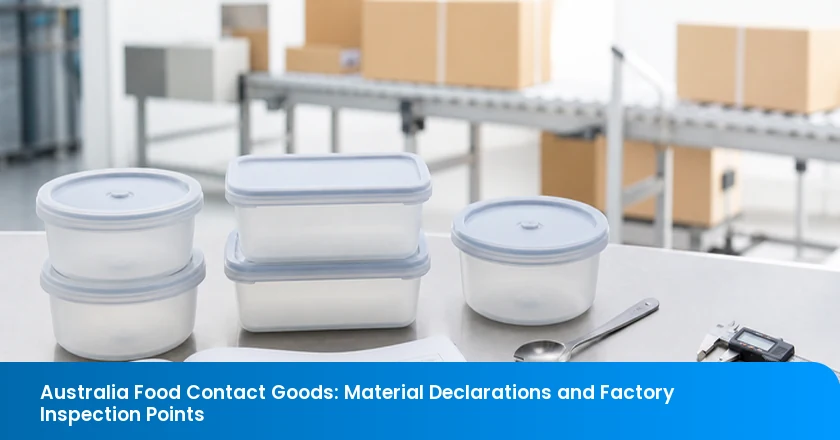
An Australia-bound kitchenware shipment should not be released on a generic supplier statement. The document only becomes useful when it can be connected to the item, the way it will be used, and an identifiable lot of finished goods.
The factory check described below is a procurement control. It does not issue a regulatory approval, a laboratory conclusion about material performance, or an imported-food clearance.
Start With the Actual Food-Contact Use
For Australia-bound food-contact goods, a material statement is useful only when it names the intended food contact and use conditions, rather than merely calling the product food-safe. The packaging clause in Standard 3.2.2 sets the relevant intended-purpose and contamination boundary. Food-contact goods include containers and utensils intended to touch food. For these procurement decisions, intended use covers the food and the conditions of use, including contact, time, temperature, heating, cleaning, and reuse.
- State the food and the contact relationship before accepting any material statement.
- Name each food-contact layer, then connect it to the finished SKU and controlled version.
- Ask the factory to show which batch and carton range the packet covers.
- Escalate a missing or changed link; do not expand a declaration beyond the goods it identifies.
That sequence prevents a common release mistake: treating a supplier declaration as though it automatically applies to every colour, seal, coating, material batch, and carton in the shipment. A useful inspection brief turns the declaration into observable questions. It asks what the product is meant to do, what touches food, what version was made, and which units can be identified from the records.
Match the Material to Food, Time, Temperature, and Reuse
Direct or indirect contact, food type, storage time, temperature, heating, reuse, cleaning, and recycled content can change the suitability question for a packaging material or article. FSANZ's food-packaging factsheet identifies these exposure factors because they can affect chemical leaching. The practical consequence is simple: a material name without a use description leaves the buyer unable to judge whether the supplier's evidence fits the intended product use.
Use the purchase specification to state the normal and foreseeable conditions, rather than asking the factory to guess them. For example, a silicone storage container may be intended for cold leftovers, microwave reheating, dishwasher cleaning, or all three. The declaration packet should make clear which situation it addresses. Migration is the movement of substances from a material into food under relevant conditions. If the conditions cannot be read from the packet, send the question for a product-testing evidence review before treating the record as release-ready.
The food profile determines the material question
FSANZ identifies food type, including whether food is acidic, as a factor that can affect whether a packaging material is fit for its intended use. Safe Food Australia gives acidic foods as an example of why the same nominal material cannot be assessed in the abstract. A buyer should record whether food touches the whole item, only a liner or seal, or never reaches a particular decorative surface. That distinction determines which component must appear in the declaration.
Do not convert this into a broad legal catalogue of every food and material combination. The point of the factory brief is narrower: identify the product's claimed use so that the material evidence can be assessed by the appropriate technical party if needed. A declaration that only says “silicone” or “stainless steel” does not identify the food profile, contact surface, or construction that the buyer is actually purchasing.
Heat, cleaning, and reuse create the second half of the use case
FSANZ lists contact time, temperature, humidity, heating, freezing, cleaning, sanitising, reuse, and recycled content among factors that can affect suitability for food contact. The current packaging guidance makes those conditions part of the buyer's use description, not optional afterthoughts. A microwave claim, repeated dishwasher use, or a freezer-use claim should therefore point back to the controlled version and the supporting evidence route.
A visual check cannot measure migration. The buyer's job at the factory is to verify that the goods, labels, and records match the agreed configuration; a laboratory or qualified technical review addresses questions that visual observation cannot resolve. Keeping those roles separate makes an escalation faster and avoids a misleading “passed inspection” interpretation.
Build a Material Declaration That Can Be Matched to Production
FSANZ advises food businesses to understand food composition and seek supplier or manufacturer assurance that the material is food-safe; a buyer should make that assurance traceable to the purchased configuration. FSANZ's packaging guidance is useful here because it turns a general supplier assurance into a use-specific question. Ask for the declaration, product specification, version or revision identifier, and a record that connects the package to the material batch or component supplier used in production.
Australia's Food Standards Code, including Standard 3.2.2, requires manufacturers to ensure food in contact with packaging is safe, while food businesses must use packaging fit for its intended use and unlikely to contaminate food. FSANZ's consumer guidance on chemicals in food packaging explains that boundary. It does not turn an inspection company into a certifier; it tells the buyer why a declaration needs enough identity detail to be checked against the purchased goods.
A factory-ready declaration packet needs an identity chain from material and food-contact layer to finished SKU, document revision, and production lot; that is an inspection planning rule, not a substitute for technical assessment. The useful test is whether all four fields resolve to the same goods. If one field remains unknown, the packet supports a question for escalation, not a shipment-wide release decision. For a TradeAider pre-production request, this is where pre-production material control matters: the material, component supplier, use condition, and reference sample should be frozen before the production record becomes hard to reconstruct.
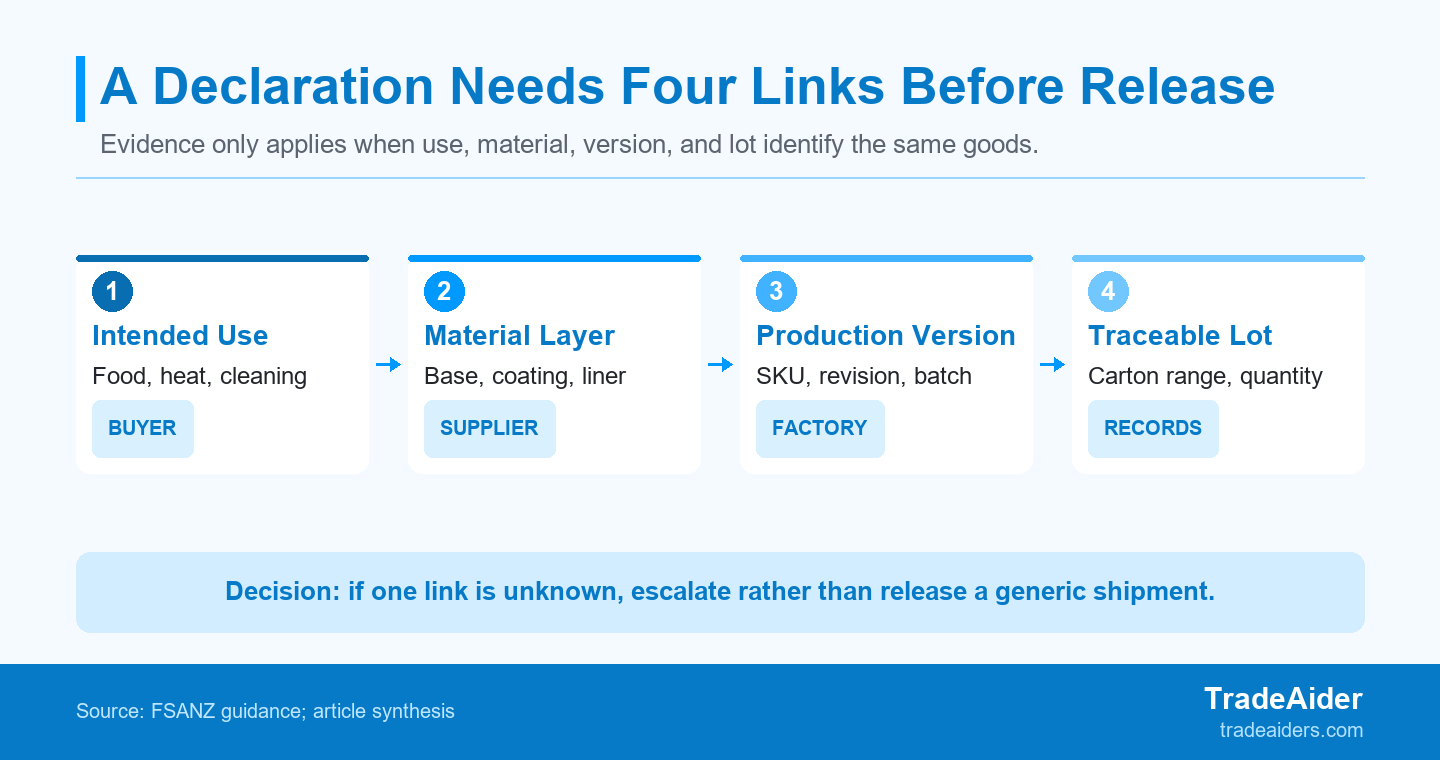
A material declaration earns release value only when intended use, material layer, production version, and lot records identify the same goods.
| Identity field | What the buyer requests | What the factory can show | Escalate when |
|---|---|---|---|
| Intended use | Food, contact, heat, cleaning, and reuse conditions | Product claim, work instruction, or approved specification | The claimed use is absent or broader than the evidence |
| Material layer | Base, coating, liner, seal, or contact component | Component label, incoming record, or approved sample | A contact layer is unnamed or substituted |
| Production version | SKU, drawing, formula, colour, and document revision | Controlled production record and finished-goods marking | The declared and produced versions differ |
| Traceable lot | Batch, quantity, and carton range | Batch log, packing list, and carton labels | The affected scope cannot be isolated |
Name every food-contact layer, not only the outer product material
A buyer should identify every layer that can contact food because the Food Standards Code guidance addresses packaging materials and added components used with food contact; the resulting layer map is a buyer-side control method. For a lidded container, the map can include the vessel, a silicone seal, a valve, an inner coating, a liner, or a printed surface if that surface is within the claimed contact area. The material named in a sales description is not necessarily the entire food-contact construction.
Give each relevant layer a practical identifier: a component part number, supplier name, material code, drawing callout, or material-batch reference. The purpose is not to demand the factory's confidential formula. It is to make a late change visible. When a supplier replaces a seal or changes a coating, the buyer can identify which evidence record must be revisited and which finished goods may be affected.
Bind that declaration to the production version and material batch
ACCC product-safety guidance warns that design, material, or production changes can require further testing, which makes an evidence review after a material change a prudent procurement boundary. The ACCC's sourcing and testing guidance also recommends a customised pre-shipment protocol. For the buyer, this means a document revision should not be assumed to cover a substitute resin, colourant, liner, or component simply because the finished product looks similar.
A workable change-control note answers four questions: what changed, when it changed, which material batch or production run used it, and which carton range contains it. If the factory cannot answer one of those questions, enlarge the hold until it can. This is a records decision, not a judgement about the safety of the changed material. The correct next step may be supplier clarification, an updated declaration, a technical evidence review, or a combination of those actions.
Inspect What the Declaration Cannot Prove
Food-contact surfaces of fixtures, fittings, and equipment must be able to be effectively cleaned and, when necessary, sanitised; the guidance highlights contamination risks from materials, cracks, chips, ridges, and grooves. The relevant Safe Food Australia guidance gives the buyer a useful condition lens: inspect the agreed contact surfaces for visible damage, residues, sharp fragments, poorly seated seals, and inconsistent finish, then record what was observed rather than asserting a technical compliance conclusion.
A physical inspection can test whether the declared configuration appears in production and whether visible condition, labelling, packing, and traceability match the agreed scope; it cannot certify migration performance from observation alone. TradeAider can compare a buyer-approved declaration packet with visible product, packaging, and lot records, provided the brief defines the required evidence and the release decision. The result should state what was checked, what was not observable, and what must be resolved before release.
The best observation points are concrete: compare component marks or approved samples where available; photograph the carton-range labels; check that packing records match the declared run; and identify mixed cartons before loading. For a change likely to occur during manufacture, use during-production control checkpoints rather than waiting until the full order is packed. Earlier containment can preserve a traceable subset and reduce the scope of a later evidence review.
Use Lot Traceability to Define the Release Population
FSANZ guidance says traceability should cover inputs including packaging, transaction dates, batch or lot identifiers, and quantities, which supports a defined release population instead of a shipment-wide assumption. FSANZ's traceability guidance gives the buyer a record-based way to contain uncertainty. A release population is the identifiable units and cartons supported by the same evidence and records; it is not simply every carton booked on the same vessel.
Before a release call, reconcile the quantity in the packing list with the quantity in the production and material records. Confirm that carton labels follow a continuous range and that the range can be matched to the finished SKU, not merely to a warehouse location. If cartons from two runs share a label pattern, write the allocation rule into the release brief. Also record who created each entry and when it was checked, so a reviewer can trace a correction to the responsible production shift. If the factory cannot provide a credible link from a changed component to a carton range, treat the record gap as a reason to extend the hold.
When a change is isolated to a documented run, a buyer may be able to hold only that subset while keeping the original run separated. When records cannot distinguish the two runs, a split release creates a false sense of precision. Convert the declaration packet into inspection-standard criteria: which carton labels must match, which record identifies the material batch, who accepts a revised document, and what evidence ends the hold.
Illustrative Scenario: A Colourant Change After the Approved Declaration
When the affected material batch is traceable, isolate that subset, correct the packet or product, and verify it again before a split release; where it cannot be isolated, hold the broader lot. In this illustrative scenario, an Australian homewares importer is preparing 3,600 silicone food-storage containers for a retail launch. The order is packed in 180 cartons across two production runs. Before production, the supplier issued a declaration and approved specification for the original silicone and red colourant combination.
During a records review, the factory's change log shows that the original red colourant ran out and a substitute was used in the second run. Carton labels and production records identify 54 cartons from that run; the other 126 cartons remain tied to the original material combination. The goods look alike, so an appearance-only final inspection would not distinguish the changed cartons. The value of the record check is not that it proves the new colourant suitable, but that it identifies where uncertainty starts and stops.
The declaration may continue to support the original run, but it does not automatically answer the changed-colourant question. Because the affected cartons are identified, the buyer holds the 54-carton subset, requests a revised evidence route for the changed configuration, and keeps the 126 original-run cartons physically separate pending a targeted record and product-identity check. If the labels or logs had been mixed, the same decision could not be narrowed safely; the broader population would remain on hold until the factory reconstructed a credible boundary.
The corrective action is to update the production packet, mark the affected carton range, and prevent mixed packing while the revised evidence is reviewed. The verification gate is equally specific: release the identified subset only after the buyer accepts the evidence route and the agreed observations match the segregated cartons. The trade-off is a delay for 54 cartons, not a claim that the material is unsafe. This is an illustrative procurement scenario, not a TradeAider client result or a conclusion about any particular colourant.
Give the Factory a Release Brief, Not a Generic Food-Safe Request
A non-food cookware or container inspection should not be presented as a laboratory conclusion, regulatory approval, or imported-food clearance; its useful role is to reconcile the agreed evidence packet with the observable goods. A release brief should therefore identify the food-contact use, the named material layers, the approved version, the lot or carton range, the visible checks, the hold trigger, and the person authorised to accept a revised document.
Send that brief before the factory visit, along with the controlled declaration and any approved sample or drawing. At the final stage, a pre-shipment inspection is most useful when the order is 100% complete and at least 80% packed for export. TradeAider can then focus the check on the evidence-to-goods connection and report exceptions that need the buyer's decision. A buyer who needs that defined observation scope can request a food-contact pre-shipment inspection.
Frequently Asked Questions
Is a food-safe logo enough for Australia-bound kitchenware?
No, a food-safe logo alone does not identify the actual material layers, intended use, production version, or lot that the buyer needs to reconcile. It may be part of the supplier's product information, but it does not show which resin, seal, coating, or carton range the claim covers. Ask for a declaration or linked specification that identifies the claimed use and the current production configuration.
Should a Material Declaration List Temperature and Reuse Conditions?
Yes, when those conditions are relevant, the declaration or linked specification should state the temperature, heating, cleaning, or reuse assumptions that define the intended food-contact use. A buyer does not need every conceivable use condition, but it should be clear whether the product is represented for freezing, microwave heating, dishwasher cleaning, or repeated use. An undefined use envelope is a reason to pause rather than infer a broader claim.
Can a Factory Inspection Replace Food-Contact Migration Testing?
No, a factory inspection can reconcile visible product and lot identity with an agreed packet, but it cannot establish migration performance from visual observation alone. The inspection can show whether the declared component appears to be in the finished goods, whether records and carton labels align, and whether visible condition meets the buyer's criteria. A technical question about material performance needs an appropriate evidence or testing review.
What Should Trigger a New Food-Contact Evidence Review?
A changed resin, colourant, coating, liner, seal, food-contact component, supplier, or use condition should trigger a new evidence review before the affected goods are released. The first task is not to label the change a failure; it is to establish its boundary. If the factory can identify the exact batch and carton range, the buyer can isolate that subset. If it cannot, the hold needs to cover the broader population.
Related Articles

Grow your business with TradeAider Service
Click the button below to directly enter the TradeAider Service System. The simple steps from booking and payment to receiving reports are easy to operate.

