
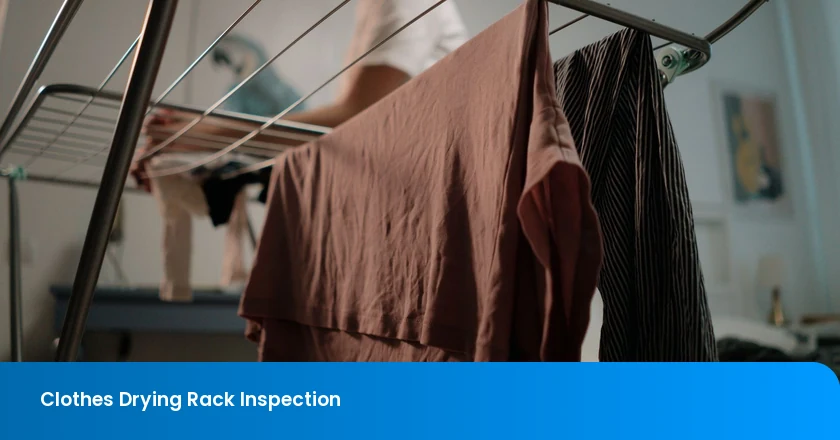
A drying rack may support a load spread across its rods yet become unstable when wet laundry hangs on one wing. It may also open correctly while a folding lock fails to stay engaged. Buyers therefore need to check how the assembled rack performs in the specified use configurations, as well as its workmanship. The six checks below cover load resistance, stability, folding locks, reachable pinch points, corrosion protection and boxed assembly for manually operated freestanding racks. Heated airers and mounted systems need additional electrical or installation verification.
Start with These Six Drying Rack Checks
| Check | What to do | How to judge it |
|---|---|---|
| Load resistance | Apply weighed loads to the agreed rods, wings or shelves for the specified time; measure while loaded and after unloading. | Deformation and recovery meet the limits; no unacceptable damage to rods, joints or supports. |
| Stability | Check foot contact and wheel positions on the specified surface, then apply the agreed uneven load. | Rocking, sliding, lifted feet and tipping meet the separate stability criteria. |
| Folding locks | Open and fold as instructed, verify engagement and repeat retention checks after the agreed cycles. | Locks remain engaged in use; no unintended folding, excessive play or damaged hinge parts. |
| Pinch points | Trace moving legs, supports and release levers with the approved safe tools or probes. | Reachable hazardous closure or uncertain risk goes to engineering review; never insert fingers into a closing joint. |
| Corrosion and finish | Inspect garment-contact surfaces, welds, tube ends and caps; match any laboratory report to the ordered coating. | No unacceptable rust, burrs, flaking or snagging; applicable coating tests meet their own defined criteria. |
| Assembly and packing | Count the boxed parts and assemble using the retail instructions and specified tools; inspect protection and post-transport function. | Correct components and understandable assembly, with no forcing or undocumented substitutions; no unacceptable transport damage. |
- Agree masses, distribution, dwell time, folding cycles and limits before inspection.
- Treat drying length as hanging space; confirm the weight rating for the actual configuration.
- Record load resistance, stability and lock retention separately so one pass cannot conceal another failure.
Agree on the rack configuration and inspection schedule
Write the test schedule for the configuration the customer will assemble and use. Record the permitted wing and shelf positions, feet or wheels, and the applicable load ratings. When two configurations use different supports or load positions, do not assume that a result from one establishes the performance of the other.
Start with the approved drawing, material and coating specifications, sealed sample, assembly instructions, and retail packaging artwork. Identify the model, wing positions, optional wheels, and instruction revision. A tower rack with several shelves does not share the same load path as a crossed-leg winged rack. Even color variants may need separate evidence if they use different coating processes.
Separate drying length from load capacity. Length tells buyers how much hanging space is available; it does not establish how many kilograms the frame can support. Ask the supplier to state the rated total load and any limits for individual wings or shelves. Then record the configuration in which those ratings apply. An unqualified capacity claim is difficult to verify when the supplier changes the arrangement during testing.
Keep the random workmanship sample and the functional test allocation distinct. ISO 2859-1:2026 describes acceptance sampling by attributes, where items are assessed against specified characteristics. A sampling plan does not supply the drying rack's load, folding-cycle, or corrosion-test requirements. Agree those separately, including how many units will undergo time-consuming or destructive checks.
Before production starts, resolve missing test conditions rather than leaving the inspector to negotiate them beside the cartons. Use the TradeAider inspection standard to align defect descriptions and the reporting format with the inspection provider.
Check load resistance and stability separately
Load resistance asks whether the drying rack's rods, joints, and frame withstand the agreed load. Stability asks whether the assembled rack stays upright in the agreed use configuration. A strong frame can still tip if laundry is concentrated on one side, while a stable base can hide a weak wing support. The report should show both results rather than one general “load test passed” entry.
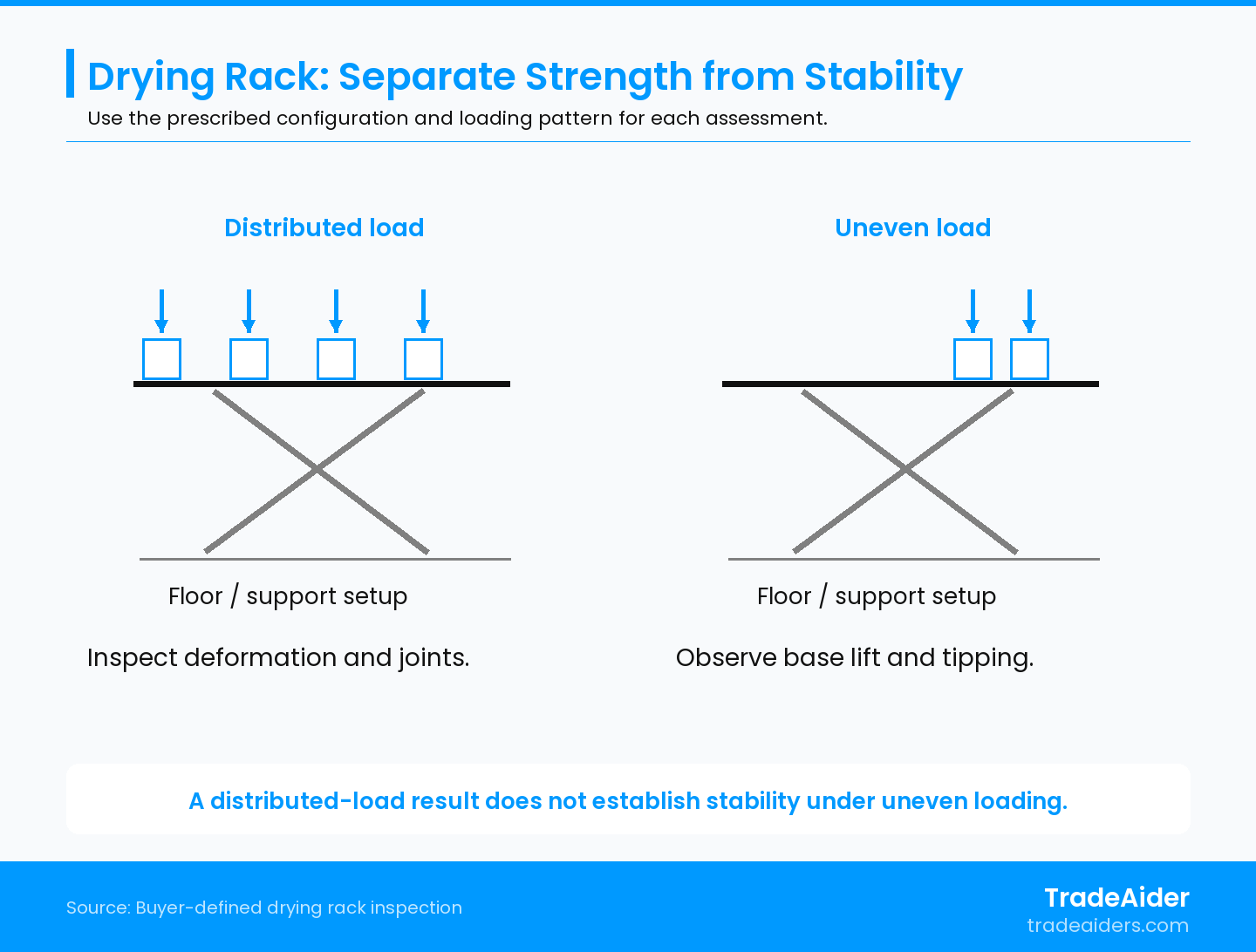
Loading arrangements are schematic. Use the prescribed load, positions and support conditions; supporting distributed mass and resisting tipping are separate results.
Record where the load sits and what changes afterward
Use weighed test masses or another buyer-approved loading method, distributing the load across the specified rods, wings, or shelves. Photograph the arrangement before timing begins. Record total mass, load by zone, dwell time, and the surface supporting the feet. A photograph of one heavy bag suspended from the center cannot demonstrate an agreed distributed-load test.
Brabantia’s Tower 23 m rack has adjustable wing height and a platform for flat drying of delicate laundry. Those features belong to that model. Record which supports and wing positions are included in the buyer’s loading arrangement rather than treating the advertised drying length as a load rating.
Measure deflection while loaded and check for residual deformation after unloading where the specification calls for it. Temporary bending and a permanently bent rod are different observations. Look again at welds, rivets, hinge pins, and support arms after the test. Photograph the same locations before and after so a changed joint can be distinguished from an existing cosmetic mark.
Do not use an inspector's body weight as an improvised test mass or sit on a rack to demonstrate strength. Use a controlled setup with an exclusion area, and stop if the frame becomes unstable. Identify tested units separately; a unit damaged by destructive testing should not return to saleable stock.
Include the permitted uneven-use configurations
For stability checks, assemble the drying rack as instructed and verify that the feet contact the agreed level surface. Check whether bent legs, uneven caps, loose joints, or an incorrect wheel position create rocking. Next, apply the buyer-approved asymmetric loading arrangement. Record which wing or shelf is loaded and whether the rack slides, lifts a foot, or tips.
Do not invent a universal tipping angle or lateral force at the factory. If the buyer needs a quantified resistance test, engineering should define the method, equipment, loading direction, and acceptance threshold before inspection. A normal-use screen is useful for finding obvious instability, but it is not equivalent to validating every foreseeable use condition.
If random sampling will govern lot acceptance, use the AQL calculator to check the agreed plan inputs. Acceptance quality limit, or AQL, is a parameter used in an acceptance-sampling scheme; it is not a promise that the inspected lot contains no defects. Keep any agreed safety-escalation rule separate from routine cosmetic acceptance.
Operate folding locks and review reachable pinch points
A drying rack's folding mechanism should stay in its intended operating position and release through the instructed action. Check the actual lock engagement, not just whether the rack opens. Leifheit describes a folding safety mechanism on its Classic 200 Easy Black rack that prevents unintended folding. That model-specific feature is a useful reminder to verify the function a supplier promises, without assuming every rack uses the same lock design.
Follow the retail instructions when opening and closing the rack. Record whether the lock has a visible, tactile, or audible engagement indication and whether both sides engage consistently. Complete the agreed folding cycles, then repeat the retention check. Inspect hinge play, shifted pins, loose rivets, and cracked plastic parts. A mechanism that works on the first opening may change as its connections move.
Check Reachable Pinch Points During Folding
A pinch point is a location where moving parts can trap or compress a body part. Trace the rack's movement through setup, adjustment, and folding, paying attention to crossed legs, wing supports, and release levers. Review reachable gaps using the approved method and suitable tools or probes. Never put fingers into a closing joint to prove the hazard.
An accessible harmful closure, unexpected collapse, or uncertain locking position calls for an engineering risk review, not a cosmetic downgrade. Record the movement and affected component, then stop the unsafe operation. A new warning label is not evidence that an unresolved mechanical problem has been corrected. The buyer should agree how such findings affect shipment authorization.
Separate surface inspection from corrosion evidence
Factory inspection can find visible rust, exposed metal, coating damage, and poor edge finish on a drying rack. It cannot establish the service life of the coating by appearance alone. Examine rod undersides, welds, tube ends, drilled holes, and areas beneath caps, where damage or incomplete coverage may be less obvious than on the top surfaces.
Check garment-contact surfaces for burrs, sharp weld edges, flaking finish, and contamination using the agreed safe method. A finish defect that merely changes appearance and one that snags fabric have different consequences. Record its location, size, and effect instead of relying on “scratch” as the complete description. Compare the result with the buyer's approved defect examples.
If coating separation resistance is part of the contract, select a suitable method rather than calling any tape pull an adhesion test. ISO 2409:2020 describes a cross-cut procedure for assessing resistance to separation from the substrate; it does not measure adhesion strength. Its scope excludes textured coatings and coatings thicker than 250 µm. Confirm suitability, specimen preparation, and acceptance criteria with the testing party.
ISO 9227:2022 specifies salt-spray apparatus, reagents, and procedures, but does not set the exposure duration or result interpretation for a particular drying rack. The product specification needs those details. Ask for a report that identifies the tested material, coating system, specimen condition, exposure, and evaluation criteria, then check whether that construction matches the ordered model.
ASTM B117-26a similarly provides a controlled salt-fog environment rather than a universal product pass threshold. Its public scope cautions against predicting natural-environment performance from stand-alone salt-spray results. Do not translate an agreed chamber exposure into a number of rust-free outdoor years. Laboratory findings and production records should support the actual claim being made, with their limits intact.
Assemble a boxed unit and verify instructions and protection
A complete drying rack should assemble correctly from its retail carton with the specified components and instructions. Open randomly selected cartons and count the parts before assembly. Compare fasteners, caps, wheels, support pieces, and supplied tools with the packing list. An assembled showroom sample cannot reveal a missing fitting in the packed shipment.
Check assembled dimensions, symmetry, and foot contact against the drawing and approved sample. Follow the specified tightening method; do not choose a torque merely because it feels secure. Test adjustable shelves, wing supports, and wheel brakes where fitted. Record any instruction step that cannot be completed without forcing a part, substituting hardware, or relying on knowledge absent from the manual.
Match instruction artwork and load markings to the exact version in the carton. Pay particular attention to outdoor claims. Brabantia limits its HangOn 20 m rack to indoor and limited outdoor use, excluding rain and corrosive environments. That restriction applies to its product, but the broader purchasing lesson is useful: an “outdoor” description needs defined exposure conditions rather than an assumed all-weather promise.
Inspect separators and restraints that prevent rods, hinges, and coated surfaces from rubbing during transport. Check whether a folded rack can shift inside the carton or release a retained part. Where the buyer has agreed a package-impact protocol, inspect the product's assembly and function after that test as well as the carton. An intact outer box does not show whether a hinge or rod has been damaged inside.
Investigate Failures and Verify the Correction
Record each failure against the tested unit, model and identifiable production group, with the actual setup, measurements and photographs. Keep failed checks separate from checks that could not be performed. “Not tested” is an unfinished requirement, not a passing result. Describe the controlled correction and the checks needed to confirm it.
Illustrative scenario: replacement hinge pins change lock retention
Consider an illustrative importer order of 1,200 winged steel racks awaiting shipment release. The factory records replacement hinge pins in a 400-unit production group. Appearance checks are acceptable, but the locks disengage on two tested units after the folding cycles specified in the buyer's schedule. These hypothetical counts are not TradeAider client results, and the two failures do not establish the exact number of defective racks in the shipment.
The buyer holds the traceable 400-unit group while engineering checks whether the replacement pin and hinge tolerances explain the lost retention. The supplier proposes a controlled repair and identifies all affected stock. If the factory cannot separate that group reliably, the buyer expands the hold to the stock that may contain the changed component. The two observed failures locate a problem in the tested units; the component records determine which additional racks may share it.
After repair, revised units undergo the agreed retention, assembly, and loading checks under the original conditions. The buyer reviews the results and the identification of repaired stock before authorizing release. Reopening one corrected rack is insufficient to verify the whole repair action. This illustrative example explains decision logic; the actual acceptance plan and any engineering validation remain specific to the buyer's product.
Send the Rack Configuration and Test Schedule
Send the rack specification, approved sample details, instruction revision, loading arrangement and folding schedule to scope the inspection. Include lot quantities, part changes, packing drawings and unresolved technical questions. Identify checks that need laboratory equipment or a longer test period so they can be arranged before the factory visit.
If a hinge design or instruction is still unsettled before mass production, discuss Pre-Production Inspection with the service provider. TradeAider describes that stage as checking materials, components, and initial production samples. Send the intended rack configuration and explain the unresolved lock question; confirm the agreed scope rather than assuming a routine visit includes an engineering validation.
TradeAider’s Pre-Shipment Inspection takes place when the order is 100% complete and at least 80% packed for export. Its published scope includes product conformity, packaging and accessories, measurements, functional checks and a formal report. Confirm which drying rack checks fit the visit and which need separate specialist testing.
Contact our team with the rack specification and test schedule for scope and quote review. Agree how failed or unfinished checks will be reported before booking.
Frequently asked questions
Can a supplier lower the rating after a load failure?
A lower rating needs a controlled review of the product, supporting tests, instructions, and sales claims before the buyer accepts it. It is not enough to replace a label after a failed check. Ask engineering to establish what the failure means and whether the revised use conditions are defensible. Update the approved specification and affected packaging consistently, and consider destination-market obligations before authorizing the change.
Does a magnet check prove that a rack is stainless steel?
A magnet check alone does not establish the specified alloy grade or prove the drying rack's claimed corrosion performance in use. The British Stainless Steel Association explains that stainless-steel families differ in magnetic response and that cold working can change the response of austenitic steel. Treat it as an observation rather than a material certificate. Ask for traceable material evidence and agree an appropriate verification method with a qualified testing party if identity is important to the purchase. Keep alloy identity, coating condition, and corrosion-test performance as separate evidence questions.
Is an approved sample enough after a hinge component changes?
An approved sample establishes a reference configuration, but it does not demonstrate that a changed hinge component performs identically in current production. Compare the changed component with the approved construction, review the supplier's change record, and agree the affected verification checks. Preserve the sample as a reference instead of quietly replacing it. The result should show which production stock contains the change and what evidence supports acceptance.
What if the supplied assembly tool cannot complete the instructions?
Check the intended assembly process with the supplied tool before accepting a substitute that hides a problem customers will encounter at home. If the instructions require an additional household tool, confirm that they name it correctly and that assembly works with it. Record inaccessible fasteners, damaged tool tips, or an insufficient grip. Ask the supplier to correct the kit or instructions and verify the revised boxed unit.
Related Articles
Grow your business with TradeAider Service
Click the button below to directly enter the TradeAider Service System. The simple steps from booking and payment to receiving reports are easy to operate.