
A vacuum storage bag can shrink during a demonstration and still fail to keep its contents compressed. Initial evacuation shows that the tool removed air; it does not show how the zipper, valve and film behave over the intended storage period. For buyers, a useful inspection combines closure checks with timed measurements of a consistent textile load. The protocol below covers valve leakage, seal integrity, compression retention, film defects and packing, with the test conditions and acceptance limits agreed for the ordered model.
Start with This Vacuum Storage Bag Inspection Protocol
| Check | What to do | How to judge it |
|---|---|---|
| Valve leakage | Inspect parts, seating and film attachment; evacuate through the intended tool interface and observe the closed valve. | Correct parts and normal operation; investigate suspected leakage with a suitable agreed method, rather than blaming the cap from swelling alone. |
| Seal integrity | Check both zipper ends and the full track; inspect factory-made edge joins separately. Record the first closure attempt before cleaning or resealing. | No unacceptable damage, contamination or incomplete closure; retain any initial failure alongside the retest. |
| Compression retention | Use a consistent dry textile load. Measure the loaded bundle before evacuation, at time zero and at every agreed checkpoint. | Dimensional change meets the buyer-defined limits under unchanged conditions. An unfinished checkpoint remains pending. |
| Film defects | Inspect corners, folds and valve attachment against a contrasting background; verify materials and thickness where specified. | No holes or damage outside the defect criteria. Thickness readings and material records match the approved construction. |
| Packing | Count the specified bag sizes, sliders and model-specific accessories; unpack and operate closures and supplied pump connections. | Correct kit contents and instructions, with no unacceptable folding damage or incompatible supplied attachment. |
Use the measurement record in the retention section alongside these checks. If a bag expands, record when and where the dimensions changed before disturbing the closures. That result establishes loss of compression under the recorded conditions; additional investigation is needed to distinguish air entering through a closure or damaged film from changes in the textile bundle.
Agree the vacuum bag test specification before sampling
Agree the load, closure, evacuation endpoint, measurement points, hold duration and acceptance criteria before testing. The buyer and supplier should approve this method alongside the product specification, not improvise it after a swollen sample appears. The inspection provider needs a usable method that fits the available time and equipment.
Identify each bag size, valve revision, film construction and retail kit configuration. Select representative dry textiles, record their mass and folding arrangement, and leave the clearance specified by the product instructions. An underfilled demonstration bag and a tightly packed customer load answer different questions. Keep the chosen load consistent across specimens intended for comparison.
Define the evacuation tool and its connection, how the operator recognizes the endpoint, and which valve parts are opened or closed. Also agree ambient conditions, static versus handling observations, the permitted dimensional change and the disposition of failed samples. If the purchase specification supplies no retention limit, report the measured result for buyer review rather than inventing a pass threshold.
Set the surrounding lot-inspection rules using TradeAider inspection standards. The functional protocol determines what to observe; the broader inspection plan determines sample coverage, defect classes and how findings affect the shipment. Keep those decisions separate so a sampling allowance is not mistaken for a leakage-performance requirement.
Inspect the valve and zipper as separate leak paths
Inspect the valve, zipper and factory-made film joins separately so a closure fault is not hidden in a generic leak result. Photograph their condition before loading. A compressed bundle shows that air was removed, but it does not identify the entry path when the bundle later expands. Local observations make the investigation more useful than a single “leaks” notation.
Valve design, seating and accessory fit
Valve checks depend on the actual design. The Space Bag cube instructions describe a cap-free valve that prevents air from returning. That is a model-specific operating feature, not a reason to omit caps from products designed to use them. Compare the sample with its approved assembly and instructions before calling a cap absent or incorrectly fitted.
Inspect the valve body and its attachment to the film for cracks, loose seating, distorted parts and visible gaps. Check any specified diaphragm, gasket, plug or cap against the approved parts list. Operate the closure as instructed and note whether it seats normally. Avoid forcing an unknown valve open: an improvised manipulation can change the condition being investigated.
During evacuation, record whether the supplied tool can remove air through the intended interface. After removal, photograph the valve state and any visible separation at its base. A cap that appears tight is only one observation; it does not prove that the underlying valve or film attachment is leak-free. Retain a suspect sample for the agreed diagnostic test rather than attributing every failure to the cap.
Zipper tracks, ends and perimeter seals
Check zipper alignment, damaged tracks, folded sections and closure continuity through both ends. Packmate’s troubleshooting guidance specifically advises checking the track for fibers, hair or debris. For an inspection, record contamination before cleaning it, because a corrected seal and a clean first-use result are different evidence.
Perimeter seals are the factory-made joins around the film edges. Examine them separately from the reopenable zipper for splits, incomplete joins, wrinkles crossing the sealed area and damage near corners. Compare seal width and workmanship with the approved drawing or sample where those criteria exist. Appearance can locate a concern, but an attractive seal alone does not demonstrate retention.
Preserve the initial result before a controlled reseal and retest; a successful correction does not erase first-use failure. Follow the model’s closure directions, identify the change made, and retain the same specimen ID. If the zipper only closes after repeated special handling, the buyer needs that usability finding as well as the eventual compression result.
Measure compression retention with a time-stamped record
Immediate compression demonstrates evacuation under the recorded setup; compression retention is whether the loaded bag stays compressed for a stated period under stated conditions. Compare the same load after the agreed elapsed time. Air return and textile rebound can affect the observed bundle, so keep diagnosis separate from measurement. Until the scheduled checkpoint is completed, the retention result remains pending.
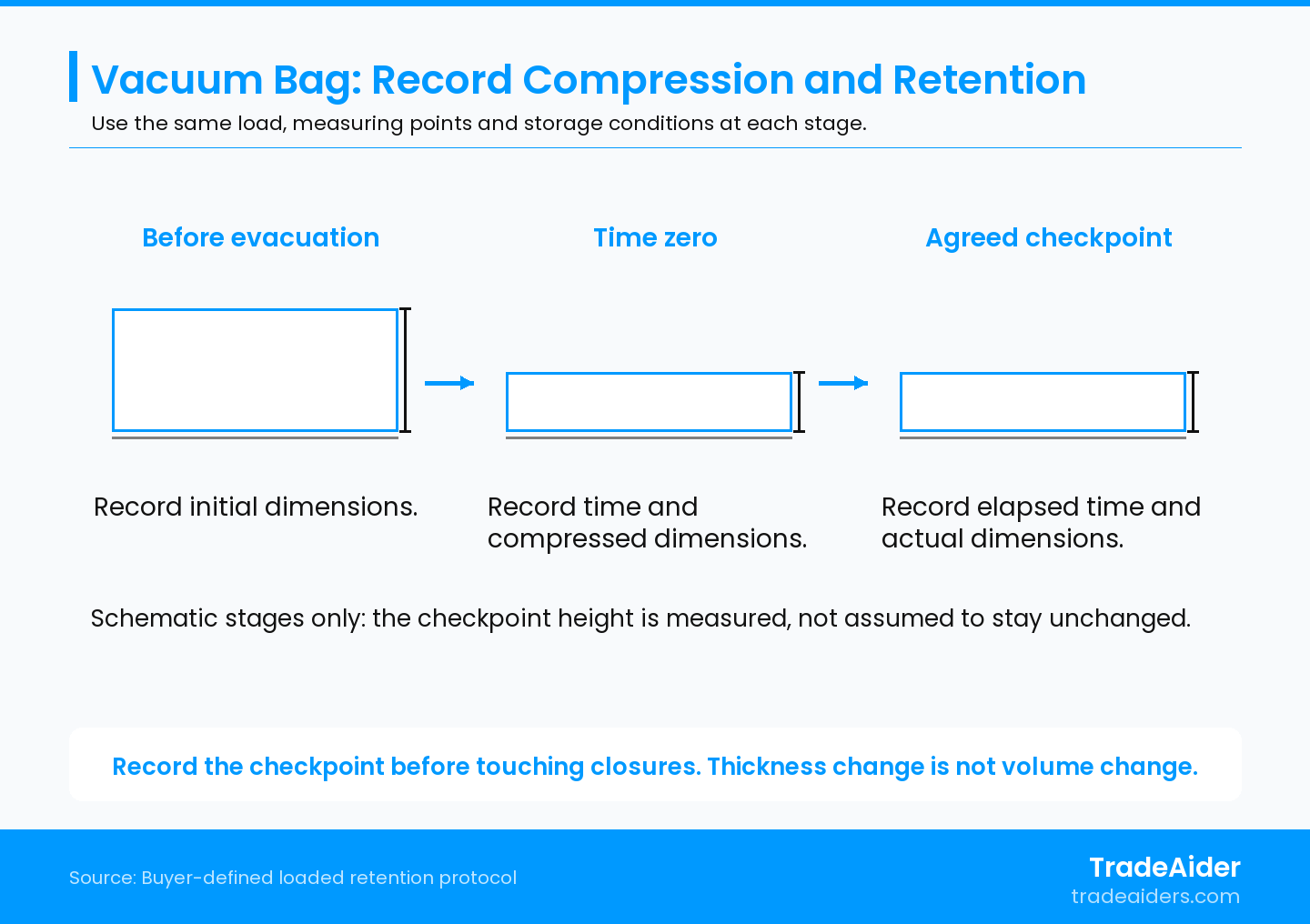
These drawings identify measurement stages, not measured retention results. Record the actual checkpoint dimensions before touching the valve or closure.
Record dimensions before and immediately after evacuation
Record the loaded bundle dimensions before evacuation, immediately after evacuation and at each agreed checkpoint using the same measurement locations. Distinguish the bag’s flat length and width from the loaded bundle’s length, width and thickness: they describe different things. Photograph a ruler or other agreed measuring device beside the designated points without pressing down on the contents.
Start time zero after the operator finishes the approved evacuation and closure sequence. Record the actual time, load identity, tool, operator and sample ID. Keep the bag on the specified surface and note whether it is constrained by a box or shelf. Changing that constraint can alter the visible bundle shape and make the later measurement difficult to compare.
Use the record below as a buyer-adaptable evidence sheet. Add the agreed dimensional limits and units before testing. A numerical compression claim needs a defined measure and denominator; a reduction in bundle thickness should not be relabeled as the same reduction in storage volume. Record raw measurements even when a calculated percentage is also requested.
| Record stage | Fields to fill for each specimen | Decision use |
|---|---|---|
| Specimen and setup | SKU, size, lot, valve revision, textile load, tool and environment | Tie every observation to the same bag and method |
| Before evacuation | Loaded length __; width __; thickness __; units __; point IDs __ | Show the starting condition |
| Time zero | Time zero __; length __; width __; thickness __; closure photo ID __ | Document initial compression |
| Scheduled checkpoints | Elapsed time __; length __; width __; thickness __; location/handling __ | Compare ongoing compression with the agreed limits |
| Defect and retest | Initial finding, photos, correction, repeat setup and result | Preserve failure history and separate the retest |
Hold the sample and distinguish swelling from proven leakage
Choose the observation period to match the agreed test and claim. TAILI’s support procedure recommends leaving a bag still on a flat, clean surface for 24 hours during troubleshooting. This is a useful example of a controlled hold, not an industry-wide acceptance duration or evidence that every product will retain compression for months.
At each checkpoint, compare dimensions and photographs before touching the valve or zipper. Log swelling, closure changes and any handling since time zero. If the limit is exceeded, preserve the specimen and investigate possible leak paths. Do not diagnose valve leakage solely from increased thickness: the observation establishes dimensional change, while localization needs additional evidence.
A specialist leak method may help, but its scope matters. ASTM D3078 addresses gross leaks in flexible packaging containing headspace gas and notes that small leaks may not be detected. It does not, by itself, establish long-term retention of a compressed textile bag. An informal squeeze or immersion check should not be labeled ASTM-compliant. Agree a suitable diagnostic method and its conditions before using its result for acceptance.
Check film defects without assuming a universal material or gauge
Film inspection starts with visible damage and the approved material requirements. Collective Comforts’ instructions tell users to look for small tears or punctures before use. Inspect the bag against a suitable background, paying attention to corners, folded regions and the valve attachment. Photograph the location and distinguish an observed hole from a suspected thin area.
Do not assume every vacuum storage bag uses the same film or closure materials. IKEA’s SPANTAD product information lists the bag and closure components separately. Those materials belong to that specific SKU; another supplier’s film, cap and valve need their own approved bill of materials. A film description cannot stand in for the identity of every attached component.
If thickness is specified, agree the instrument, measurement locations and method for the relevant film construction. Measure away from seams or multilayer overlaps unless those areas are intentionally part of the criterion. Retain individual readings and the approved tolerance. A single measurement at a thick folded edge can conceal variation elsewhere.
Scratches, printing flaws, gels or other appearance defects need buyer-defined classifications. Record whether they affect presentation, closure operation or the functional result instead of treating every mark as a leak. If puncture resistance, material chemistry or aging performance is important, arrange appropriate supporting tests; a visual inspection and short hold do not establish those properties.
Verify retail pack contents and protect the closures
Verify the exact retail set: bag count, size assortment, sliders, pump, adapters, caps where applicable, and instructions. Match these to the approved packing list rather than to a generic accessory checklist. An optional pump omitted from a bag-only SKU is not the same defect as a missing pump in a kit sold with one.
Test the supplied attachment as the customer is instructed to use it. Neusu’s valve guidance explains that internal threads may be intended for a manual pump rather than a vacuum cleaner connection. Check the declared interface on the actual kit; apparent threads alone do not establish compatibility with every household nozzle.
Inspect packed zipper folds and closures against the approved packing method, then verify operation after unpacking. Look for trapped accessories, abrasion points and parts that press against the film. Separate static retention from any agreed handling or repacking test so the record shows when the condition changed.
Interpret Failures and Keep Retests Separate
Record a completed pass, an initial failure and an unfinished observation separately. “No leak observed during the visit” does not establish that a bag passed its scheduled overnight checkpoint. Keep an incomplete retention result pending until the actual measurements are available.
Apply the buyer-approved defect classification and acceptance plan to the actual findings. Preserve specimen IDs, initial failure counts, retest results and the affected lot or SKU boundaries. A successful reseal may explain an operating problem; repeated failures after the correct procedure may justify a supplier investigation or specialist test. Neither result automatically authorizes shipment.
Use the AQL calculator when resolving the agreed sampling plan. Acceptance Quality Limit, or AQL, is a sampling-plan parameter, not a promise that a bag is airtight or that no defective item exists. Set the functional method and defect categories first. Any extended or destructive tests can need separately agreed sample coverage and disposition.
Illustrative scenario: a missing overnight result blocks release
Illustrative scenario: a home-storage buyer has 1,200 retail kits ready for review. The approved method calls for an overnight retention observation on 12 identified samples. All compress during the site visit, but one zipper needs a second closure attempt. The inspector photographs that first-use finding and records the corrected closure separately.
The shipment decision cannot use the immediate compression results as the overnight results. The samples remain in the agreed location with their loads unchanged until the checkpoint. If the inspection visit ends first, the buyer and supplier need an agreed person to take the later measurements and photographs. Otherwise, a schedule that ends at initial evacuation leaves the specified performance check unfinished.
At the scheduled checkpoint, the owner records the actual dimensions and closure condition for each sample. The buyer reviews those results against the agreed limits and retains the original zipper finding in the report. If evidence is missing or conditions changed, the buyer resolves that gap before deciding. This hypothetical example is not a TradeAider customer case or a recommended sample quantity.
Send the inspection provider a complete test brief
Submit the approved SKU specification, representative load, closure instructions, retention schedule and defect criteria to scope the inspection and report. Include the packing list, approved sample, bag sizes, valve revisions and any claimed compression or storage duration that needs verification. These inputs let the provider identify the required observations and equipment rather than infer them from product photos.
Ask who performs a checkpoint outside the site visit, how the sample is protected, and how the later evidence reaches the buyer. Agree the report fields, photographs and status of any unfinished test. The buyer should also decide whether a failed sample may be resealed, repaired or replaced during the investigation, and how each intervention is recorded.
TradeAider describes Pre-Shipment Inspection as taking place when the order is 100% complete and at least 80% packed. The packing threshold is not production completion. Its finished-goods checks can include specified dimensions, function, packaging and accessories, but a hold extending beyond the visit needs an agreed observation arrangement.
TradeAider’s published pre-shipment service includes specified dimensional, functional and packing checks with a formal report. Send the test brief for scope and quote review, and request documentation of completed observations plus outstanding checks. Confirm the retention arrangement before booking; do not assume an overnight hold is included within the original visit. Contact our team to scope your inspection.
Frequently asked questions
Can one successful test prove a reusable bag’s life?
Repeated use needs its own agreed cycle and handling conditions; a first-use pass alone does not demonstrate reusable life. Define how the bag is loaded, opened, emptied, folded and closed during each cycle. Repeat the relevant retention check at the agreed stages and record damage or closure difficulty. Keep the cycle evidence separate from the shipment’s initial-use result.
Should a patched vacuum bag be counted as acceptable?
A patched bag should remain a recorded defect unless the buyer explicitly approves a repair policy and suitable verification. A patch used to investigate a leak can help isolate a suspected area, but it changes the specimen. Retain the original photographs and identify the intervention. Do not replace the initial failure with a clean pass or quietly ship a repaired sample as new.
Does one tested bag size represent the whole kit?
Apply the functional test to the agreed size coverage rather than assume one bag represents every size in a kit. Sizes can differ in their load arrangement, seams or valve configuration. Identify which versions the plan covers and report untested configurations honestly. Also count the entire retail assortment: correct function on the tested bag does not establish that the kit contains the promised sizes.
Can a short retention test validate months of storage?
A short retention check cannot establish a months-long storage claim without evidence covering the longer period and relevant conditions. Ask the supplier for the supporting method, load, environment and results behind that claim. Check whether the evidence represents the supplied construction and intended use. Use the short inspection hold for its agreed purpose, while treating the longer claim as a separate substantiation question.
Related Articles
Grow your business with TradeAider Service
Click the button below to directly enter the TradeAider Service System. The simple steps from booking and payment to receiving reports are easy to operate.