
A pet bowl’s material label, finish and capacity claim describe different aspects of quality. A stainless steel body does not establish that a coating will stay attached, and a non-slip ring does not establish resistance to tipping. Buyers need checks that match the actual construction and intended use. The checklist below covers material identity, rim finish, base stability, coating, capacity and packing, showing which observations can be made on site and which claims need separate analytical or performance evidence.
Start with This Pet Bowl Inspection Checklist
| Check | What to do | How to judge it |
|---|---|---|
| Material identity | Match bowl and components to approved records; use a suitable analytical method when grade or composition needs verification. | The method and report cover the actual material and current construction; appearance or magnet response alone is insufficient. |
| Rim finish | Inspect the full rim, seams, foot and accessible molding edges using a safe agreed method. | No chips, burrs, flash (excess material at a mold seam) or accessible sharp edges outside the defect criteria. |
| Base stability | Check rocking, tipping and sliding separately at the specified fill on the named surfaces. | Each result meets its own limit; a non-slip ring does not prove tipping resistance. |
| Coating | Inspect finish; perform the suitable agreed adhesion or cleaning-durability check where required. | No unacceptable peeling or change; adhesion and chemical release are judged separately. |
| Capacity | Measure each selected bowl at the agreed fill line or headspace, with specified units and tolerance. | The stated capacity matches its defined fill condition, rather than an assumed brimful volume. |
| Packing | Open selected nested packs; inspect separators, rings, surfaces, contents and labels. | Correct packout, with no unacceptable contact damage or functional change after applicable transport testing. |
Material identity concerns what the bowl is made from; chemical release concerns what is released under a specified method; adhesion concerns whether a finish stays attached. These results are not interchangeable. An inspection plan can address each where relevant without treating them as one broad “food grade” decision.
Define the Pet Bowl Specification Before Inspection
Set separate acceptance criteria for material identity, workmanship, performance and packing; a cosmetic pass cannot close a missing material file.
Start with the purchase-order SKU, intended pet and use, destination market, approved sample and current drawing. Identify the body material and grade, glaze or coating, pigment, non-slip ring, adhesive and any removable insert. Specify cleaning claims, dimensions, weight, capacity definition and retail-pack contents. A sample establishes the approved appearance only where it is actually representative; written requirements still govern features that cannot be judged by looking.
For each test, name the equipment, conditioning, load or fill level, surface, duration, tolerance and sample coverage. Agree defect classes and escalation rules before the factory visit. Workmanship sampling and a performance-test subset may have different coverage. TradeAider’s inspection-standard resource can help organize the inspection vocabulary; the actual bowl criteria come from the buyer’s approved brief.
Verify Material Identity by Bowl Construction
Match the delivered bowl and its components to the approved material specification and production records. Use a suitable analytical check when the grade or composition needs verification; appearance alone cannot establish it.
Request documents that identify the actual construction and link it to production. A certificate for raw sheet, an old report for a different color, or a resin trade name can be useful background. None independently shows that every contact component in the current finished bowl matches the approved version. Record which component each document covers and what remains unknown.
Stainless Steel: Confirm the Grade, Not Just Magnet Response
Use traceable alloy records and an appropriate composition check rather than magnet response as the material-identity decision.
The BSSA guidance explains that cold work can increase the magnetic response of austenitic stainless steel. Pressed corners can therefore respond differently from flat areas. Magnet attraction alone is insufficient to accept or reject a claimed bowl grade.
Positive material identification means analytical checks used to verify alloy composition. Choose a technique that can measure the elements needed for the specified grade. The Thermo Fisher application note explains that handheld X-ray fluorescence (XRF) cannot measure carbon needed to distinguish grades such as 316L and 316H. Ask the laboratory or qualified operator to confirm the method and surface preparation for the ordered grade.
At inspection, connect sampled bowl IDs to the relevant material or production lot. Note coatings, welded parts or inserts that could affect the measurement location. Keep alloy verification separate from thickness, finish and corrosion-performance checks. Even a matching alloy composition does not establish every durability or contact-safety claim printed on the retail pack.
Ceramic and Plastic: Match Glaze, Resin and Color to the Evidence
A glaze, pigment or resin substitution can change which construction a material or chemical report covers even when the bowl looks the same. A changed base ring can also alter the assembled product’s performance. Check the relevant report and approved specification against the changed component rather than relying on the unchanged shape or SKU.
For ceramic bowls, distinguish the body from the contact glaze and decoration. Check whether the report identifies the same glaze system, color, decorated areas and finished construction. For plastic bowls, request the resin specification and records for pigments, fillers and other contact components. A molded recycling symbol is a useful identity clue, but it is not a laboratory finding or a complete composition statement.
When leach testing is appropriate, the measurement must answer the right question. FDA EAM 4.6 measures extractable lead and cadmium from ceramic foodware using acetic-acid extraction and elemental analysis. A total-element screen and an extractable-metal result are different evidence: the former identifies what is present, while the latter addresses what is released under the method’s conditions.
Confirm legal scope before copying a human-foodware limit into a pet-bowl specification. Regulation 178/2002 defines food in relation to human ingestion and explicitly excludes feed. Regulation 1935/2004 uses the relevant definitions in Regulation 178/2002, so intended use matters when considering its scope.
Ask a qualified laboratory to confirm the destination requirements, intended use and any dual-use claims. Human-foodware methods may be useful contractual benchmarks without automatically becoming the same legal obligation for a pet-only bowl. The lab should state the tested construction, selected method and conclusion rather than relying on a broad “food grade” label.
Inspect the Whole Rim and the Surfaces That Must Be Cleaned
Check the whole rim, seams, chips, molding flash and cleaning access; isolate hazardous findings without running a bare hand along suspect edges.
Rotate the bowl under adequate light rather than examining only its front. On steel bowls, look at the rolled rim, cut edges, seams and accessible burrs. On ceramic bowls, look for chips, cracks and damaged glaze around the lip and foot. On plastic bowls, inspect molding flash, gate remnants and sharp parting lines. Use the agreed safe edge-check method and record the location of a suspected hazard; appearance sorting is not a substitute for investigating it.
Cleanability is also part of usable finish. FDA pet-food handling guidance recommends washing pet food bowls and scooping utensils with soap and hot water after each use. Inspect seams, removable rings and narrow grooves for accessible cleaning, retained debris and an assembly design that matches the supplied instructions. This supports a cleaning-access check, not a claim that inspection proves microbial safety.
Check a removable ring both in place and removed where the design allows it. Verify that reassembly leaves no unacceptable residue-trapping gap or rough edge. Compare the cleaning directions with the actual parts so a customer is not instructed to detach a permanently bonded component.
Separate Rocking, Tipping and Anti-Slip Performance
A bowl can resist sliding yet tip, or sit level yet slide; specify separate rocking, tipping and sliding checks with named surfaces and fill states.
Begin on a verified flat reference surface. Check whether an empty bowl rocks and whether the result changes at the agreed working fill. Rotate the bowl to distinguish an uneven base from a surface problem. A bent steel foot, warped plastic base or uneven ceramic foot can produce different contact points. Photograph the orientation and observed gap rather than recording only “unstable.”
For an anti-slip claim, name the floor surface and its condition. Dry tile, wet tile and a textured mat are different test conditions. Use a repeatable buyer-approved push or pull method, including the direction, application height and fill state. An informal shove by hand may expose a problem but is a poor basis for comparing two lots. A result on one surface should not become an unrestricted “non-slip on all floors” claim.
Tipping concerns the relationship between the applied force, its height and the bowl’s geometry and weight. It is not the same result as sliding resistance. Use the agreed load and setup rather than inventing a universal tipping force. A wider base may behave differently from a tall narrow body even when their base-ring materials match.
Finally, inspect ring seating, retention and deformation. Compare the approved ring with the production version; then repeat the relevant base check after assembly or packing if ring compression could affect contact. These comparisons help locate the cause of failure, while the documented acceptance method decides whether correction is sufficient.
Check Coating Durability Separately From Chemical Release
Coating appearance, adhesion and chemical release answer different questions and need separate evidence.
Inspect the inside, rim, outside and underside for peeling, pinholes, exposed substrate, scratches, color mismatch and cracks. Record where the defect lies and whether it is on a contact surface. A small external appearance flaw and peeling at the inner rim have different use consequences. Agree those distinctions in the defect catalog rather than negotiating them after the inspection result.
ASTM D3359 concerns adhesion ratings for relatively ductile coating films on metallic substrates. It is not a universal ceramic-glaze test or a chemical-safety assessment. Confirm that the agreed adhesion method fits the actual coating and substrate before applying it to a bowl.
Tape choice, environmental conditions and operator technique affect the result; ASTM D3359 ratings do not measure absolute bond strength. Specify the conditions and segregate samples damaged by cutting or peeling. An unspecified tape pull may help investigate an obvious issue, but should not be reported as a standardized method result.
For cleaning-durability claims, define detergent, temperature, cycle count and drying conditions in the agreed protocol. Inspect for changes after that exposure, including coating loss and base-ring damage. Keep the chemical-test report as a separate gate: a surface that stays attached can still require chemical evidence, and a passing chemical result does not excuse visible peeling or a changed production coating.
Measure Working Capacity and Brimful Capacity Separately
Measure capacity at the agreed fill line or headspace; brimful volume is not automatically the practical serving volume.
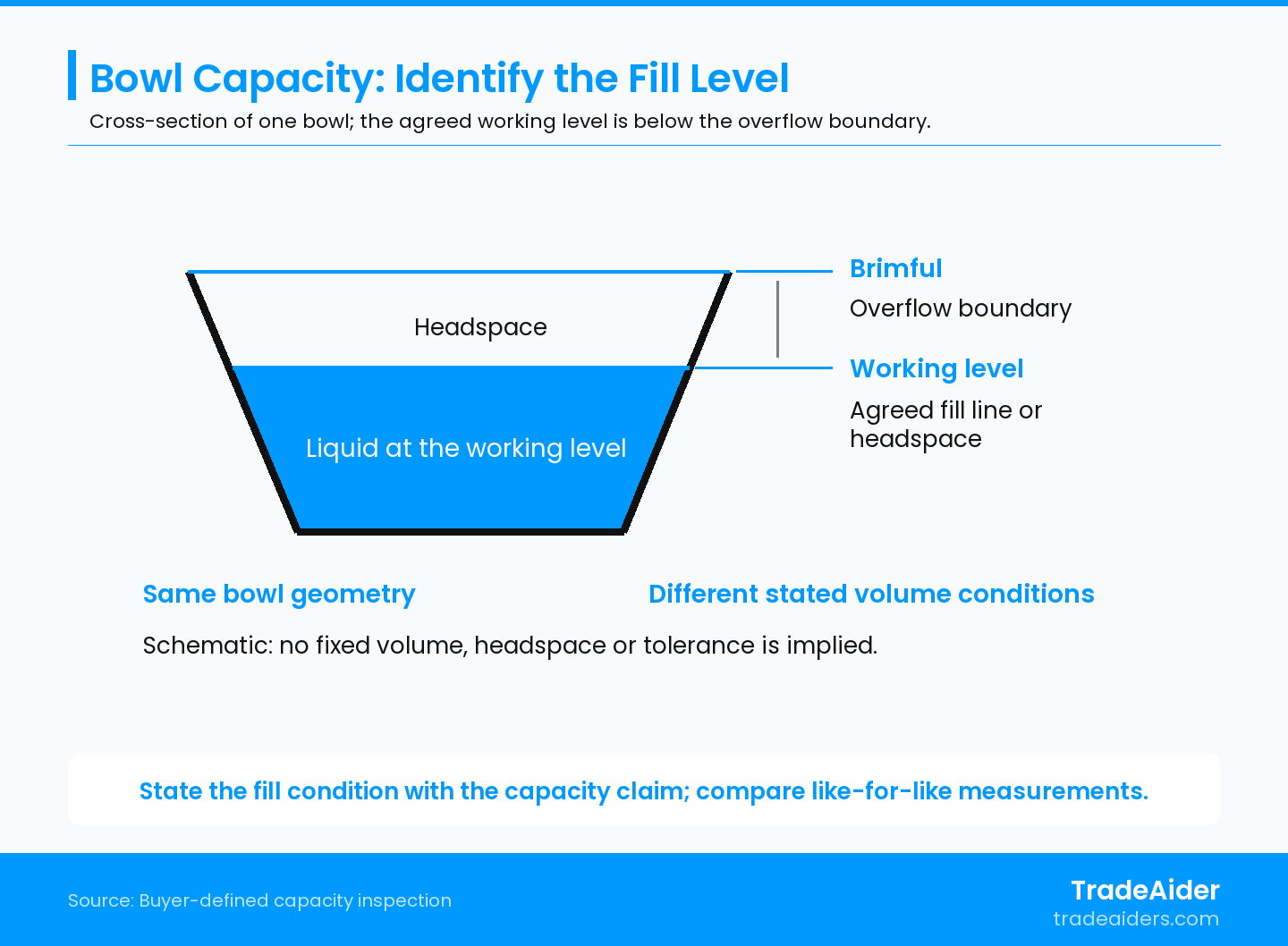
Brimful capacity reaches the overflow boundary; working capacity uses an agreed lower level. The schematic sets no universal volume or headspace.
First identify what the package claims. Brimful capacity means filling to the overflow boundary. Working capacity means filling to a defined usable level, such as a marked line or specified distance below the rim. That space can matter when the pet moves the bowl or the owner lifts it. A nominal volume without a definition leaves the inspector and supplier measuring different things.
Place the bowl level and use the agreed calibrated volumetric equipment. If the protocol instead uses water mass, record the tare, water conditions and conversion basis. Do not silently treat a kitchen measuring cup as a precise instrument. Keep units consistent, especially where “cup” could refer to different regional measures.
Measure individual samples and report the actual values, not only the average. A lot average can conceal a subgroup outside the approved tolerance. Note any molded fill line, internal insert or geometry change that affects the result. Diameter and height are useful checks, but a curved bowl cannot be accepted for volume simply by comparing those dimensions.
Select the workmanship sample plan before the visit. The AQL calculator can help calculate agreed sampling inputs; acceptance quality limit (AQL) is a lot-sampling parameter, not permission to invent a capacity tolerance. State separately how many bowls receive the volume check and how a failed measured result affects the lot.
Open Nested Packs and Recheck the Protected Surfaces
Open nested units to verify separators, rim protection, base-ring shape, cleanliness, component counts and SKU identity.
Packing can create defects that were absent at the end of assembly. Remove bowls from the top, middle and bottom of selected nests using the agreed coverage. Check whether contact points scuff a coating, chip a ceramic rim or compress a ring. Confirm that separators remain in place and that removal does not require forcing rims against each other. Photograph the pack arrangement before disturbing it so the supplier can locate the damaging contact. Compare separator position and bowl orientation with the drawing, including any difference between the first and final nest.
For ceramic products, compare cushioning and separation with the approved packing drawing. For steel and plastic products, verify that nesting protects finish and shape. Look for moisture, dirt, foreign material and packaging residue on contact surfaces. Check inserts, removable rings, accessories, retail labels, barcodes, carton counts and size/color identification against the packing list.
A packing drawing alone does not establish transport performance. If an agreed transport test is part of the acceptance plan, name the route-relevant method and assess the complete packaged product afterward. Recheck the surfaces and functions that packing could change, rather than looking only for obvious carton damage.
Record the Failure and Choose the Right Correction
Record which requirement failed and which bowls it affects. A material that has not been verified needs an appropriate material assessment; a base that slides needs investigation under the specified setup. An acceptable finish cannot resolve either issue.
The report should distinguish a failed test, a visible defect and an unverified requirement. Record SKU, sampled unit, component lot, carton group, method, result and photos. The buyer can then request the right correction: laboratory clarification for a material gap, process correction for a formed edge, or packing changes for repeat abrasion. Sorting an appearance defect does not resolve an unidentified resin or glaze.
Illustrative Scenario: A Changed Base Ring Alters the Result
Illustrative example: an importer orders 3,600 stainless steel bowls with removable non-slip rings. Carton records distinguish an original ring lot from a newly substituted lot covering 900 bowls. Both groups look acceptable and have matching steel-body evidence, but samples from the new ring lot slide during the agreed wet-tile check.
The team repeats the setup and swaps rings between otherwise comparable bowls. The failure follows the new ring rather than the steel body. That observation supports a component-specific diagnosis; it does not establish a universal friction limit. The buyer holds the traceable 900-bowl group. Other cartons remain subject to their own agreed acceptance evidence.
The supplier restores the approved ring and checks groove seating. Reinspection repeats the defined wet and dry sliding checks, rocking and ring retention after repacking. Release of the corrected group depends on those results and confirmed lot identity. If carton records cannot reliably isolate the new rings, the buyer expands the hold until the affected scope is established. This is a hypothetical procurement example, not a TradeAider client result.
Send a Bowl-Specific Brief Before Booking Inspection
Send the material schedule, approved sample, capacity definition, base-test setup, coating method, packing drawing and release criteria to the inspection provider.
TradeAider conducts Pre-Shipment Inspection when 100% of the order quantity is complete and at least 80% is packed for export. Arrange the agreed on-site checks at that stage and schedule any required laboratory work separately.
Before booking, confirm feasible equipment, protocols and sample coverage. Request a report that records the specified measurements, observed findings and unresolved evidence. Include the destination and retail claims so the inspection brief and any laboratory work answer the same product-use question. Contact TradeAider to scope the inspection.
Frequently Asked Questions
Can one inspection plan cover all three bowl materials?
One order can share reporting and sampling administration, but stainless steel, ceramic and plastic bowls need construction-specific material and defect checks. Keep separate SKU criteria for alloy records, ceramic chips and glaze evidence, or plastic resin and molding defects. Mixed orders also need clear accessory and carton identification. Avoid blending every material into one undifferentiated pass/fail result when a failure affects only a specific construction.
Does a dishwasher-safe claim need a separate test?
A dishwasher-safe claim needs evidence for the stated cleaning conditions, because a quick visual check cannot establish repeated exposure performance. Define the dishwasher protocol and acceptable changes, including the bowl finish, decoration, bonding and removable ring. Check whether the claim covers the complete assembled product or requires removal of a component. Instructions should reflect that boundary so the retailer does not promise more than the evidence supports.
Should inspectors return destructively tested bowls to saleable stock?
Bowls damaged by cutting, adhesion tests or other destructive checks should be segregated from saleable stock under the buyer’s agreed disposition rule. Mark the sampled units and record the test and resulting damage. Do not return an apparently tidy tested bowl to the nested retail pack without disposition approval. Plan sample quantities in advance so destructive testing does not create unexplained shortages or mix damaged units with untouched goods.
Can a reusable report cover a later production order?
An earlier report can inform a later order only when the tested construction, materials and relevant conditions still match the new production. Later orders need report applicability review after construction or material changes. Check the report’s product identity, method, tested components and any stated validity or scope limits. A new pigment, glaze, resin or ring supplier may require additional evidence even if the shape and retail SKU remain unchanged.
Related Articles
Grow your business with TradeAider Service
Click the button below to directly enter the TradeAider Service System. The simple steps from booking and payment to receiving reports are easy to operate.