
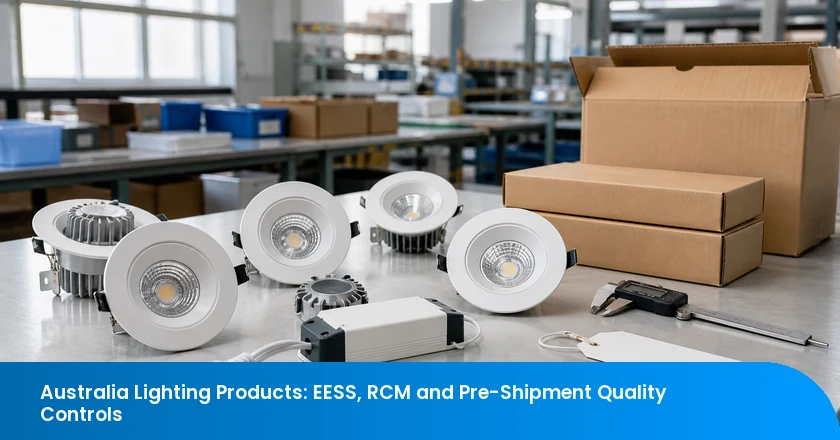
For Australia-bound lighting, the release question is not whether a carton contains an RCM image. It is whether the exact lighting configuration in that carton still matches the relevant EESS route, the controlled evidence, and the product identity being shipped. A downlight housing, LED driver, cord, plug, rating label, instructions, and retail pack can change on different dates. When those changes are not reconciled, a visually clean inspection result can give a buyer confidence in the wrong configuration.
Treat Each Lighting SKU as a Safety Configuration, Not Just a Lamp
A lighting shipment is inspection-ready only when the exact luminaire configuration, its applicable Australian safety route, and its controlled evidence can all be reconciled before physical checks begin. In practical terms, this means treating the SKU as a connected set of parts and records, not as a product name on a purchase order. EESS is Australia's Electrical Equipment Safety System for relevant electrical equipment, while RCM means Regulatory Compliance Mark. Neither term turns a photograph, a generic test file, or a supplier declaration into proof that every packed unit is the reviewed configuration.
An RCM image or a generic lamp test file cannot by itself establish that the packed lighting SKU, its electrical parts, and its declared supply path still match. The useful release decision is therefore narrower: identify the configuration, confirm who owns the scope and evidence decision, observe the parts and consumer information that reach the buyer, and keep the result tied to identifiable cartons. This does not make a pre-shipment inspection a certification step. It makes the inspection evidence useful to the person who must decide whether the goods can move, must be separated, or need another technical review.
- Start with configuration: record the luminaire model, driver code, supply lead or plug, label version, instructions, and pack identity before sampling.
- Keep ownership clear: the Australian or New Zealand Responsible Supplier owns the regulatory records; the factory and inspector can supply or compare evidence without assuming that role.
- Release an identifiable population: a clean sample is meaningful only when the cartons it represents can be linked to the same controlled configuration.
Classify the Lighting Product Before You Book a Pre-Shipment Check
Before assigning a factory check, the buyer should record the actual lighting configuration, intended use, supply characteristics, and the owner of the EESS scope decision. That short record prevents an everyday category label such as “LED downlight” or “pendant light” from doing too much work. The same sales description can conceal different installation conditions, drivers, connectors, or markets. It also gives the factory a clear list of items that may not be substituted without an evidence review.
Use the product facts to decide which question belongs to whom. The Responsible Supplier or a suitably qualified adviser should confirm the regulatory route for the actual product. The buyer should then request the relevant current references. The factory should identify the installed components and version-controlled consumer materials. The inspector should verify agreed observations on the finished goods and their traceable packed population. Separating these tasks early stops a physical check from being asked to answer a legal classification question.
Separate Mains-Connected Household Lighting From Other Use Cases
EESS describes in-scope equipment using voltage and household, personal, or similar-use criteria, so a product name alone does not determine the applicable route. The EESS risk-level definition specifies electrical equipment above 50 V AC RMS or 120 V ripple-free DC, below 1000 V AC RMS or 1500 V DC, and designed or marketed for household, personal, or similar use. Record the supply characteristics and intended use for the exact SKU, then let the responsible owner confirm whether EESS applies and which level is relevant.
A buyer should not convert that boundary into a blanket rule that every LED product follows the same process. A mains-connected domestic luminaire, a separate driver, and a product intended for a different installation context may raise different scope questions. The inspection brief should preserve that uncertainty where it exists rather than filling it with an assumed risk level.
Map the Luminaire, Driver, Cord and Plug as One Configuration
A lighting configuration is more than the visible housing. It can include a luminaire, LED driver, control gear, flexible cord, plug, model label, instructions, and consumer pack. One important boundary is specific rather than universal: EESS guidance says recessed luminaires and independent LED drivers classified as NON IC are not in-scope electrical equipment because they are not considered suitable for domestic installation. Read that as a classification condition for the actual product, not as a shortcut for every recessed light or every driver. The relevant EESS NON IC guidance should be considered alongside the product's design and intended installation.
For a repeat order, freeze the practical identifiers before production: model suffix, driver manufacturer and code, input rating, lead and plug configuration, label artwork version, instruction revision, and carton mark. Pre-production configuration checks are most useful when they compare that controlled list with the factory's bill of materials and planned retail pack before mixed components reach the line. A later inspection can then compare finished goods against a defined reference rather than reverse-engineering the reference from a carton.
Turn the EESS Risk Path Into a Buyer-Owned Evidence Packet
EESS describes proportionate evidence routes: Level 1 needs evidence of compliance, Level 2 needs evidence and a Compliance Folder, and Level 3 needs evidence and a Certificate of Conformity. The EESS compliance steps support that distinction. The buyer's inspection packet should record the applicable route declared for the SKU, the document reference and version, the model identity covered, and the person who must assess any change. That makes it possible to distinguish a missing factory document from an evidence-to-product mismatch.
The Australian or New Zealand Responsible Supplier owns the required EESS declarations and records; an overseas factory can supply technical information but does not take over that responsibility. The EESS Responsible Supplier guidance defines that party as the Australian or New Zealand entity or person that manufactures or imports relevant in-scope equipment and is responsible for required declarations and records. An overseas factory can provide technical drawings, reports, component identifiers, and change notices, but it should not be described as taking over that regulatory role.
Match the Required Evidence to the Declared Risk Path
Build a short evidence index before the visit. For each SKU or controlled variant, list the declared route, the evidence reference, the models and configurations it covers, the current label and instruction versions, and the factory contact who can explain a difference. If the driver, cord, plug, rating, model suffix, or pack changes after that index is approved, treat the change as a review trigger rather than a clerical update. Where the question is whether a revised component still belongs to the technical evidence, a product-testing evidence review with TradeAider is a better next step than asking an inspector to infer equivalence from appearance.
Treat the RCM as a Reconciliation Point, Not a Stand-Alone Pass
RCM authorization resides with the Responsible Supplier, so the mark should be reconciled to the current product identity and evidence rather than treated as a generic factory pass mark. The EESS marking guidance says the mark is generally placed on the equipment near model identification. An inspection record should therefore capture the mark, the adjacent model identity, the production date or lot reference where available, and the version of the label artwork used. The comparison is what makes the observation actionable.
EESS says the RCM is generally placed on the equipment near model identification, which makes the finished unit a useful place to compare the mark and model record together. The same EESS marking guidance supports that comparison. If the observed driver code, model suffix, rating, or consumer pack does not match the controlled packet, the issue is not solved by taking a better photograph of the label. Escalate the mismatch to the evidence owner, then establish which cartons share the condition before deciding the hold scope.
A useful reconciliation packet also keeps the change trail. ACMA's record-keeping guidance lists items such as a declaration of conformity, test report, product description, customer guide, and product-change statement among the records that may be kept. For lighting buyers, this is a practical reminder to attach an approved change statement to the same SKU record as the observed label and component identifiers, rather than storing it in an unrelated supplier email thread.
Build a Lighting-Specific Pre-Shipment Inspection Scope
A buyer-side lighting release matrix should connect the declared scope, model-specific evidence, observed luminaire components, marking and consumer information, and identifiable carton population before release. For Australia lighting shipments, that means linking the EESS scope decision, the current evidence reference, the observed lighting configuration, and the named carton population. The RCM is one observation within that chain, not a substitute for it. This is an original buyer-side decision rule: if a driver, cord, model label, or consumer pack cannot be matched across the records, the affected population is not yet ready for release.
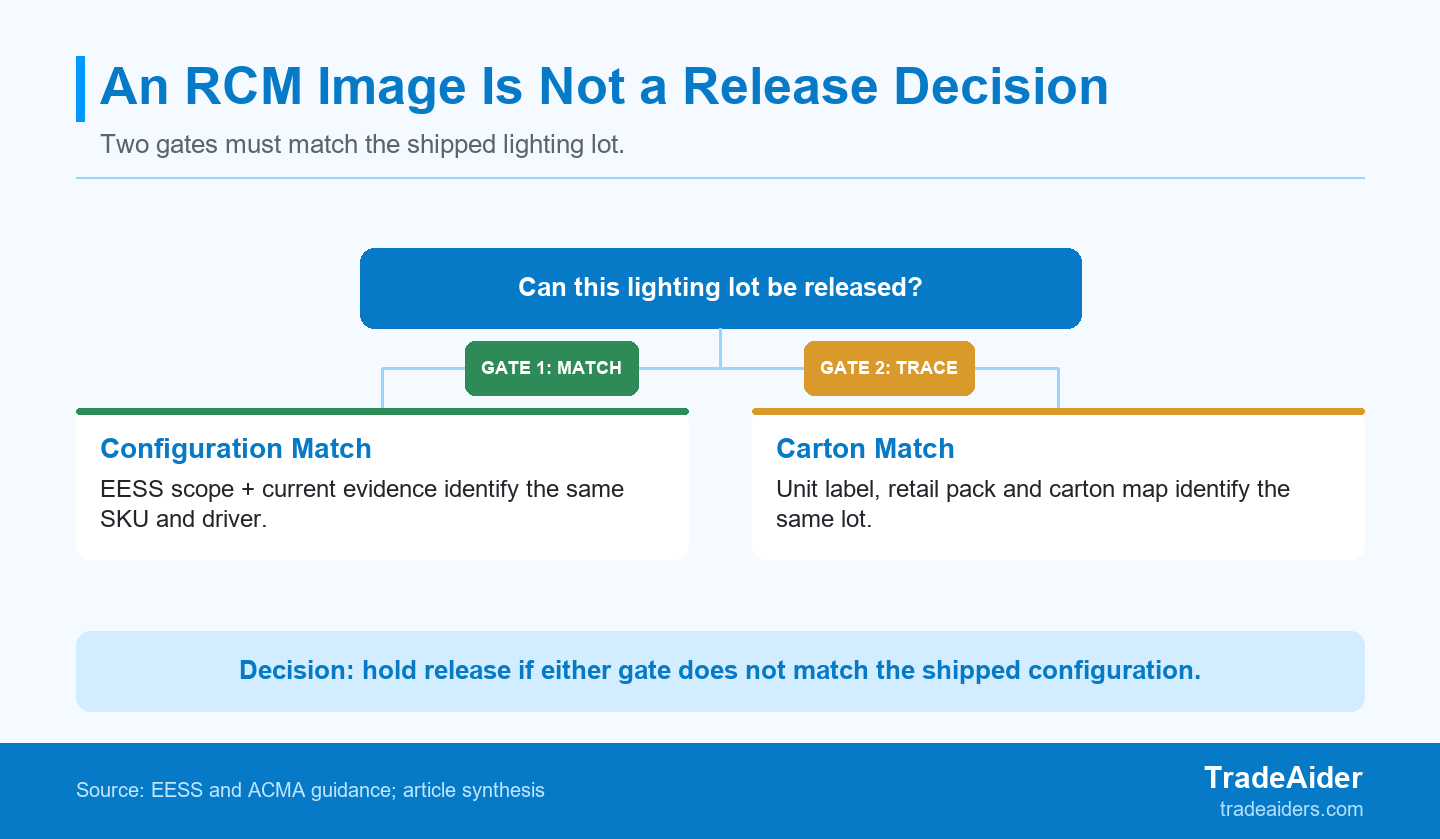
An RCM observation gains release value only when both the configuration record and carton identity match the packed goods.
| Record | What to match | Factory or inspector observation | Release consequence if it does not match |
|---|---|---|---|
| Scope decision | Actual equipment, intended use, and declared route | SKU and configuration facts in the inspection packet | Pause the scope-based checklist and return the question to its owner |
| Controlled evidence | Model, driver, rating, and document version | Current reference file and component code | Hold the changed configuration for evidence review |
| Finished unit | Luminaire, driver, cord or plug, RCM, model, and rating label | Observed units and label photographs | Record the exception and identify its affected population |
| Consumer pack | Instructions, label version, SKU, and carton identifiers | Retail pack and export carton sample | Do not release a pack range that cannot be tied to the reviewed configuration |
A pre-shipment inspection can compare the agreed configuration with actual units and packaging, but it does not classify equipment, issue certificates, register products, or transfer the Responsible Supplier’s legal duties. Its value lies in producing a dated record of what was observed, what did not match, and how broadly the exception may extend. TradeAider can scope those physical observations against a buyer-provided configuration packet without presenting the inspection as regulatory approval.
Where certificate-linked evidence is involved, the EESS certificate-holder guidance says the certificate holder should have the technical construction-file information needed to verify that each shipment is unchanged from the certified and registered equipment. That is why a component change should be raised before loading, not buried in a final inspection note. During-production inspection checkpoints can surface changes while the factory can still isolate a driver, label, or assembly variant and keep the cartons identifiable.
Illustrative Scenario: the Approved Downlight Sample Does Not Match Production
Why an Unmapped Driver Population Cannot Be Split Released
In the illustrative scenario, the approved downlight sample and the packed production lot have different LED drivers, so the sample file does not prove that the production configuration matches the evidence packet. An importer is preparing an Australia-bound order of recessed LED downlights for household retail sale: 2,400 downlights in 240 export cartons, sold under one SKU across two production dates. The buyer has an approved sample, a model record, label artwork, and technical evidence references for the reviewed driver configuration. The order appears ready for a final check because the carton SKU and label artwork look unchanged.
A final inspection sample shows a second LED driver code not shown in the approved sample packet. The carton exterior uses the same SKU for both driver variants and the factory cannot map the second driver to individual cartons. The RCM and model label artwork appear visually consistent, but the controlled component identity is unresolved. These observations mean that visible labels cannot identify which cartons contain the changed component.
This is a sample-to-production mismatch, not a cosmetic substitution. A clean unit with the reviewed driver cannot define a separately evidenced subset when the cartons that contain the other driver are unknown. The buyer should hold the 240-carton population until the factory can establish the configuration and carton mapping, or restore one reviewed configuration across the affected goods. The immediate cost is a delayed release; the alternative is shipping an unidentified mix while the evidence owner still cannot reconcile the driver population.
When cartons mix two driver variants without a reliable carton-level map, the buyer cannot identify an evidenced subset and should hold the unresolved population until it is reconciled. The factory can create a component-to-carton map, isolate or rework the changed-driver goods, update the evidence packet as appropriate, and preserve records for the corrected population. The verification gate is then specific: resample the mapped or corrected configuration; compare driver code, input rating, label, instructions, and carton identifiers with the approved packet; and record any remaining exception. This is an illustrative operating example, not a TradeAider client case, legal advice, EESS classification, or a certification decision.
The corrective inspection should name the exact driver code, the cartons selected for recheck, the label and instruction revisions, and the disposition of the remaining cartons. Those inspection-standard criteria keep the correction verifiable. They also prevent a repeated sample from becoming an untraceable reassurance exercise: the buyer should be able to say which cartons were corrected, which were rechecked, and which cannot yet be released.
Use a Four-Record Release Rule Before Australia-Bound Lighting Ships
Release only when the scope decision, controlled evidence, observed configuration, and carton population all refer to the same lighting SKU and any known variant is resolved. The rule is deliberately practical: it does not ask the inspector to certify a product, and it does not let a buyer treat a single label photograph as a ship decision. It requires the four records to agree before a packed lighting lot is treated as an identifiable release population.
- Scope record: name the product facts and the party responsible for the EESS decision.
- Evidence record: list the current document references, model coverage, and any change that still needs review.
- Observation record: compare the selected units, electrical parts, RCM, model label, instructions, and pack against the controlled packet.
- Carton record: show which cartons belong to the observed configuration and which cartons remain unresolved.
When a buyer can provide those four records, the pre-shipment brief can focus on meaningful checks and clear exception handling. The buyer should give TradeAider the SKU list, declared route, evidence references, component identifiers, label artwork, and carton map. That information lets the observation scope name the units, retail packs, and carton groups that represent the reviewed configuration, while leaving unresolved groups outside the release recommendation. The useful deliverable is an agreed observation scope and exception record, not a promise of regulatory certification. For that configuration-to-carton comparison before dispatch, request a lighting pre-shipment inspection.
Frequently Asked Questions
Does every LED lighting product need the same EESS registration route?
No, not every LED lighting product follows the same EESS registration route because the actual equipment facts and intended use can differ. The product name “LED light” does not settle those points. The Responsible Supplier should confirm the route for the specific configuration, while the buyer records that decision and uses it to request the right evidence. A different driver, installation condition, or product form can be enough to require a fresh review of the assumptions behind the original record.
Can an RCM mark on a downlight prove the full shipment is compliant?
No, an RCM mark on a downlight is only one finished-goods observation, not proof for every component and carton in the shipment. Check that the RCM sits with the expected model identity, then compare the observed unit with the current evidence packet and the carton population it represents. If the driver, rating, label version, or pack differs, escalate the mismatch instead of treating the mark as a complete release decision.
What should change trigger a new lighting evidence review?
A changed driver, cord, plug, control gear, model suffix, rating label, instruction, or market pack should trigger a new evidence review before any final inspection. The review is especially important when the changed part cannot be identified by carton or production date. Record the change, its effective production window, and the evidence owner before the final inspection. That gives the buyer a way to contain the affected goods rather than relying on a generic replacement statement.
What can a pre-shipment lighting inspection verify?
It can compare agreed identifiers, components, marking, packaging, instructions, and carton population with the buyer's controlled packet. It can also record visible mismatches and confirm whether a corrected range is identifiable for recheck. It does not classify equipment, register a product, issue a certificate, or replace the Responsible Supplier's obligations. Its role is to make the physical condition and traceability of the packed lot clear enough for the buyer and evidence owner to decide what happens next.
Related Articles

Grow your business with TradeAider Service
Click the button below to directly enter the TradeAider Service System. The simple steps from booking and payment to receiving reports are easy to operate.

