
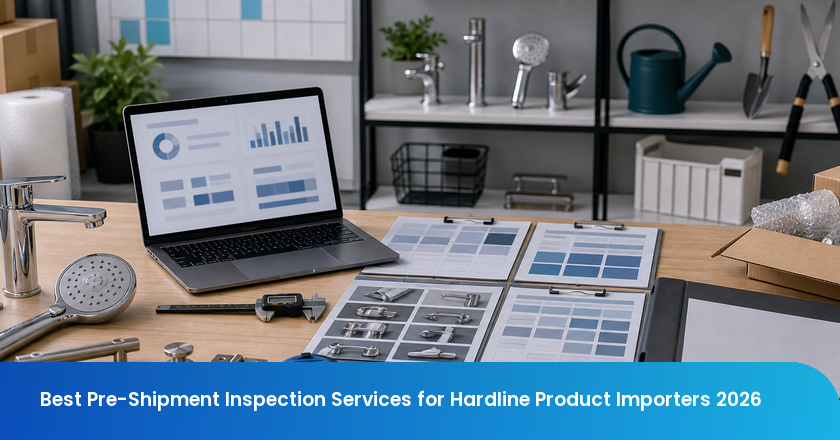
The best pre-shipment inspection service for hardline product importers in 2026 is not simply the cheapest factory visit; it is the service that combines AQL discipline, hardline product knowledge, function and fit checks, packaging review, compliance-file awareness, clear photo evidence, and practical reinspection support. Hardline products fail in ways that a generic visual checklist can miss.
Hardline importers often ask which inspection service is best. The answer depends on the product and risk. A bathroom accessory importer needs finish, corrosion, installation, and packaging checks. A garden tool importer needs strength, sharp edge, coating, moving-part, and carton checks. A home hardware importer needs dimensions, fit, thread, plating, part count, and barcode checks. One generic PSI service cannot be best for all of those unless it adapts the checklist.
In 2026, buyers also need better evidence discipline. Marketplaces, retailers, and regulators may ask for product files, certificates, labels, and compliance records. A PSI service does not replace testing or legal compliance work, but it should verify that the physical shipment matches the buyer's approved file. That means the report must show more than a few surface photos.
- Best for release decisions: a service that applies AQL correctly and links defects to release rules.
- Best for hardline risk: a service that checks fit, function, finish, hardware, sharp edges, and packaging.
- Best for evidence: a service that produces structured photos, measurements, part-count records, and carton proof.
- Decision rule: choose the PSI provider by evidence quality, not only by speed or price.
The Direct Answer
A strong hardline PSI service should prove whether the actual lot matches the buyer's specification, AQL plan, functional expectations, packaging file, and release rule.
ISO/IEC 17020:2026 specifies requirements for the competence, impartiality, and consistent operation of inspection bodies. Source: ISO/IEC 17020:2026.
ISO 2859-1:2026 is the current ISO standard for AQL-indexed sampling procedures for lot-by-lot inspection by attributes. Source: ISO 2859-1:2026.
CPSC general use product guidance explains that certain non-children's consumer products subject to CPSC rules require certification based on testing or a reasonable testing program. Source: CPSC general use product certification.
These sources shape the selection framework. The buyer should look for competence, consistent inspection process, sampling discipline, and awareness that product compliance evidence may exist outside the PSI report. A provider that says every product is checked the same way is not the best match for hardline imports.
2026 Hardline PSI Scorecard
Use a scorecard instead of a vague best-service claim.
| Selection Factor | What Good Looks Like | Why It Matters | Red Flag |
|---|---|---|---|
| AQL discipline | Lot, sample size, defect class, Ac/Re, and result are clearly reported | Makes release decisions defensible | Arbitrary sample count |
| Hardline checklist | Fit, function, finish, hardware, sharp edge, dimension, and packaging checks | Finds real use failures | Only surface photos |
| Photo evidence | Photos show sample selection, defects, measurements, labels, opened kits, cartons | Supports supplier negotiation | Few staged images |
| Packaging review | Internal protection, carton strength, hardware separation, barcode, marks | Prevents transit damage | Only outside carton photo |
| CAPA support | Failed findings become rework, sorting, and reinspection actions | Stops repeat defects | Report ends at pass/fail |
| Compliance awareness | Visible labels and shipment identity checked against buyer file | Avoids file-to-product mismatch | Provider claims inspection replaces testing |
The best provider is the one that can explain how each factor will appear in the report. If the provider cannot show how sample size, defect classes, measurements, part counts, and packaging evidence are recorded, the buyer should not rely on slogans.
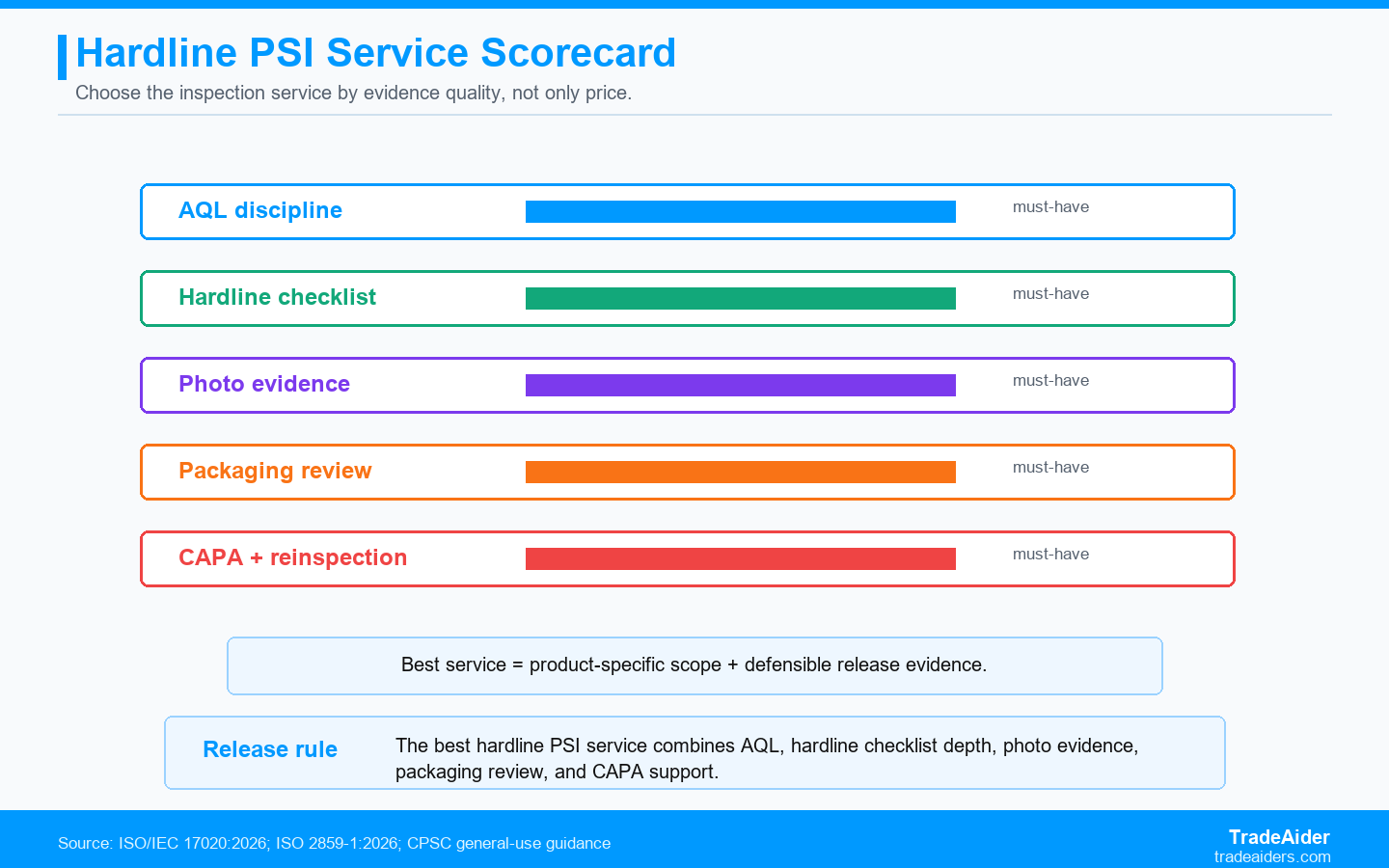
The best hardline PSI service combines AQL, hardline checklist depth, photo evidence, packaging review, and CAPA support.
What Makes A Hardline PSI Service Different
Hardline inspection needs product-use thinking, not only factory-visit logistics.
Hardline products are often installed, assembled, loaded, twisted, opened, closed, exposed to humidity, or shipped with small parts. The inspector must understand how the customer uses the item. A bathroom hook is not only a metal piece; it is an installed load-bearing product. A garden tool is not only a handle and head; it is a product with edges, force, and outdoor exposure. A hinge is not only a shiny part; it must fit, move, and hold.
The PSI service should ask for drawings, approved sample photos, part lists, instruction sheets, packaging files, AQL values, known defect history, and destination-market labels. If the provider does not ask for product files, the provider may be preparing a generic inspection rather than a hardline-specific inspection.
The best services also understand that packaging is part of hardline quality. Heavy and metal items can damage each other in transit. Small screws and accessories can disappear. Retail boxes can be crushed. A good PSI report should show internal protection and opened kit evidence, not only finished product appearance.
How To Evaluate Report Quality
A hardline report should be useful to the buyer, supplier, and next inspector.
The report should show lot identity, sampling method, inspected quantities, defect classifications, measurements, opened kits, functional checks, labels, barcode, carton marks, packaging structure, and clear photos. A buyer should be able to read the report and know what passed, what failed, what was sampled, and what must be corrected.
Good reports also separate observation from decision. The inspector records defects and checks; the buyer makes the commercial release decision according to agreed rules. A provider should not hide borderline findings because the supplier is rushing shipment. The buyer needs facts, not reassurance.
The report should also be reusable. If the shipment fails, the report should guide rework and reinspection. If the shipment passes but customers later complain, the report should show what was checked and what was not checked. If the buyer reorders, the report should help improve the next checklist.
Where TradeAider Fits For Hardline Importers
TradeAider fits by building PSI around hardline product risk and buyer release decisions.
TradeAider can provide Pre-Shipment Inspection for hardline goods, including AQL sampling, dimensions, function, fit, finish, part count, packaging, labels, and report evidence before shipment.
TradeAider can add During Production Inspection when hardline defects need to be caught before final packing. If a supplier repeatedly fails, factory audit service can review process controls and CAPA discipline.
The business fit is service precision. TradeAider helps hardline importers avoid paying for a generic visit when the shipment needs product-specific evidence.
SPAR Scenario: The Cheapest PSI Missed The Real Risk
The buyer compared price, but the product needed a better checklist.
Situation: A hardline importer orders metal bathroom shelves and receives a low-cost PSI quote that promises basic visual checks and carton count.
Problem: The real risks are missing wall anchors, incorrect brackets, finish scratches, weak adhesive pads, and internal rubbing damage. A basic visual checklist would not open enough kits or check installation completeness.
Action: TradeAider scopes a hardline PSI with AQL sampling, opened kit checks, finish review, bracket fit, packaging separation, barcode verification, and reinspection triggers.
Result: The inspection catches missing anchors and poor internal packing before shipment. The buyer pays for a more useful service, not merely a factory visit.
Action Card: Choose A Hardline PSI Service
Ask evidence questions before comparing quotes.
- Ask how the provider applies AQL and reports sample size, Ac/Re, and defect classes.
- Ask whether the checklist is customized for bathroom goods, garden supplies, or hardware.
- Ask what function, fit, measurement, part-count, sharp-edge, and packaging checks are included.
- Ask for a sample report that shows opened kits, measurement photos, labels, and carton evidence.
- Ask how failed findings lead to sorting, rework, CAPA, and reinspection.
- Ask whether the provider distinguishes inspection evidence from lab testing or legal compliance evidence.
A buyer should also decide how much control is needed. A low-risk repeat order may need normal PSI. A new supplier, new mold, new finish, high complaint history, or large retail launch may need DPI plus PSI. The best service is the service that matches exposure.
The buyer should track provider performance over time. Did the report catch real defects? Did customer complaints match missed risks? Did photos help supplier negotiation? Did reinspection focus on corrections? A service is best only if it improves decisions across multiple orders.
In 2026, hardline importers should also keep product files organized. A PSI provider can only compare the shipment with files the buyer supplies. Without approved samples, drawings, labels, packaging specs, and defect priorities, even a competent inspector has less to work with.
Which Service Level Fits Your Hardline Order?
The best service changes when order risk changes.
A repeat low-risk hardline order may only need a standard PSI with AQL sampling, visual checks, quantity, labels, packaging, and a small set of functional checks. The buyer already knows the supplier and the defect history is stable. The inspection still matters, but the scope can remain focused.
A first order or new product version needs more. The PSI should include stronger sample distribution, opened kits, measurement checks, packaging review, and a more detailed defect photo plan. If the product uses a new mold, finish, coating, or accessory set, the inspection should verify the exact new version, not only the product category.
A high-risk or complaint-sensitive order may need DPI plus PSI. DPI can catch process issues before goods are fully packed, while PSI confirms the final lot. This is useful for hardline goods with plating problems, kitting errors, weak packaging, tool wear, or function drift during assembly.
A supplier with repeated failures may need a factory audit before the next large order. If PSI keeps finding missing parts, bad coating, wrong packaging, or weak CAPA, the problem may be system-level. The best inspection service may then be a combined plan: audit the root control, inspect during production, and verify the final shipment.
What To Put In The Booking Brief
The provider can only inspect what the buyer defines clearly.
A good booking brief should include the product use case, drawings, approved sample photos, part list, known failure modes, AQL limits, defect classes, packaging file, barcode file, carton mark, destination market, and final release rule. The buyer should also state which checks are mandatory and which are optional observations.
For hardline products, the booking brief should identify the customer's installation or use step. If the item is mounted, check mounting parts. If it locks, check keys. If it bears load, define a reasonable load or fit check. If it touches water, check finish and corrosion clues. If it ships with small hardware, open kits and count parts.
The buyer should also decide what evidence is needed for the next conversation. If the report will support a supplier claim, photos and counts matter. If it will support a retailer release, labels and carton marks matter. If it will support internal risk review, defect trends and CAPA notes matter. The best service anticipates that use.
If you want to compare hardline PSI options, send TradeAider the product category, order value, defect history, packaging file, and release decision. The next step is to ask TradeAider to scope the best pre-shipment inspection service for your hardline shipment.
Frequently Asked Questions
What is the best PSI service for hardline products?
The best service is the one that matches the product risk: AQL sampling, hardline checklist, function and fit checks, packaging review, clear photos, and reinspection support.
Should I choose the cheapest PSI provider?
Only if the scope answers the release decision. A cheap visit that misses installation parts, fit, function, or packaging risk can become expensive.
Does ISO/IEC 17020 guarantee a good report?
No. It is a useful competence and impartiality reference for inspection bodies, but buyers still need product-specific scope and clear files.
Can one PSI checklist work for all hardline products?
No. Bathroom goods, garden supplies, and home hardware need different checks because they fail in different ways.
Related Articles

Grow your business with TradeAider Service
Click the button below to directly enter the TradeAider Service System. The simple steps from booking and payment to receiving reports are easy to operate.

