
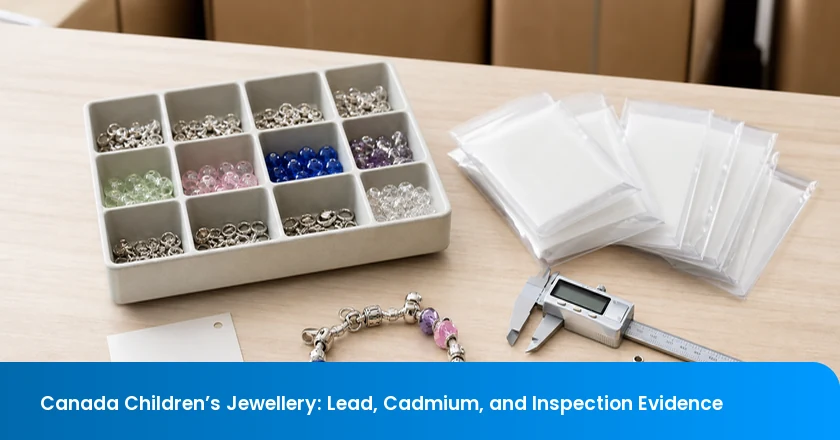
For Canada children’s jewellery, lead and cadmium compliance is not established by a generic metal report or by a visual inspection alone. The release decision becomes defensible only when four things identify the same goods: the product classification, a component map, laboratory evidence that matches the actual build, and records that identify the finished cartons.
Before a factory handoff or final inspection, an importer needs to know what can be reconciled against the goods and where a laboratory conclusion is still required. A missing component-to-carton link should create a hold rather than a guessed release. The controls below do not replace legal advice, a laboratory result, certification, or Health Canada approval.
Start With Scope, Not a Generic ‘Kid’ Label
A Canada-bound item falls within the Children’s Jewellery Regulations when it is manufactured, sized, decorated, packaged, advertised, or sold in a way that appeals primarily to children under 15 years of age. That test is broader than a buyer’s informal “kids’ item” label: product design, packaging, promotion, and point of sale can all matter. Start the file with the intended Canadian presentation, the age appeal, the product photos, and the SKU description. The current Children’s Jewellery Regulations are the controlling source for that product definition.
The regulations set a 90 mg/kg total lead limit and a 130 mg/kg total cadmium limit for a jewellery item small enough to be fully enclosed in the small parts cylinder under 4.45 N; the testing must use good laboratory practices. Record those facts in the evidence brief rather than paraphrasing them as “metal-safe.” The regulation text governs if a commercial summary conflicts with it.
The useful first decision is therefore not “Do we have a report?” It is “Which Canadian product path applies to this exact SKU, and which physical parts must the evidence packet identify?” That question prevents an adult-accessory report, an obsolete sample description, or a vague assortment label from being treated as a shipment-wide pass.
- Classify the finished SKU and its Canadian presentation before requesting evidence.
- Map every physical part, material, coating, supplier, and report line.
- Release only cartons that the matching records and observations identify.
Separate Children’s Jewellery From Toy Jewellery
Jewellery with learning or play use can be toy jewellery and may be subject to the applicable Toys Regulations as well as other CCPSA requirements. Here, toy jewellery means jewellery intended for play, learning, dress-up, or wear by a toy. Flag this at product approval, especially where a design uses a toy character, flashing feature, doll accessory, or play-set presentation. See Health Canada’s children’s toys and related products guide.
Children’s jewellery rules do not replace the broader CCPSA prohibition on products that are a danger to human health or safety. Health Canada’s summary for children’s jewellery notes that this broader boundary remains relevant. In practical terms, a buyer should escalate an ambiguous classification or a safety concern rather than trying to solve it with a single inspection checkbox.
Translate the Lead and Cadmium Limits Into a Component Map
A component map gives the buyer one reference for the finished item’s parts, materials, coatings, report lines, and supplier or lot identifiers. Build it before production changes become difficult to reconstruct. The map should carry the buyer’s Canada scope decision, not merely a factory’s internal part number. TradeAider can use it for pre-production component-control planning: freeze the approved supplier, material description, surface finish, reference sample, and evidence request before mass production starts.
| Map field | What to identify | Release question |
|---|---|---|
| Physical part | Chain, clasp, charm, bead, pendant, plastic cord, coating, or kit component | Is every separately supplied or detachable part named? |
| Build identity | Material, finish, color, supplier, drawing or approved sample revision | Does the observed item match the described part? |
| Evidence link | Report line, sample description, report date, and applicable small-parts decision | Does the evidence actually cover this part? |
| Shipment link | Incoming lot, assembly run, carton range, or other controlled identifier | Which finished goods can be released or held? |
A buyer does not need to invent a complex database for a small order. A controlled spreadsheet or a short approved-parts sheet can work, provided its part names, document revisions, and carton identifiers resolve to the same physical goods. The point is to make the evidence usable during a factory review, not to create paperwork detached from the product.
Map Base Metal, Coating, Plastic, and Charm Parts
Health Canada says the lead and cadmium limits apply to all materials and coatings, and tests parts separately because components can separate and have different metal content. This includes metallic and non-metallic materials such as glass and crystal. The Health Canada industry guide is clear on this point.
That is why the map should not stop at “alloy” or “bracelet.” List the base metal and plating separately where both can vary; list a decorative charm separately from the chain; and include plastic beads, glass or crystal components, lacquered surfaces, and loose parts supplied in a jewellery-making kit. A sample description that says only “silver bracelet” leaves too much room for an unapproved clasp or coating to disappear from the report scope.
Decide Which Parts Need the Cadmium Boundary
The cadmium question depends on whether a part is small enough to be fully enclosed in the small parts cylinder; it is not a blanket excuse to omit cadmium from the evidence review. For each relevant item or part, record whether it can be fully enclosed in the small parts cylinder under 4.45 N. The regulatory small-parts wording sets a cadmium limit of 130 mg/kg for that condition and a total-lead limit of 90 mg/kg.
Operationally, add one column to the map: “small-parts decision recorded: yes/no,” with the component reference and the person or technical source used for the decision. Do not let the column become a visual guess by an inspector. If the size or configuration is unclear, hold the decision open for the appropriate technical assessment and keep the related report request open as well.
Ask for a Report That Proves the Right Build
Health Canada does not prescribe one mandatory method for total lead and cadmium in children’s jewellery, but methods used to assess compliance must meet the regulation’s good-laboratory-practice requirement. A report must identify the physical material or component it tested, not just state a favourable result. The industry guide’s test-method section sets that boundary.
Published Health Canada methods can support understanding of total-metal testing, while regulated parties remain responsible for assessing their products against the applicable requirements. A test-method reference is not a certification, and an inspection report is not a laboratory conclusion. Review the regulator’s product safety test-method information with the laboratory’s actual scope and report revision.
A test report is a release candidate only when its part scope and material description match the observed build and its document scope can be linked to the finished-goods lot. Use this four-part release test: the component map must match the test scope, the test scope must match the observed build, and the resulting document must identify a traceable finished-goods population. If either link is unresolved, the report is an escalation input—not a release statement.
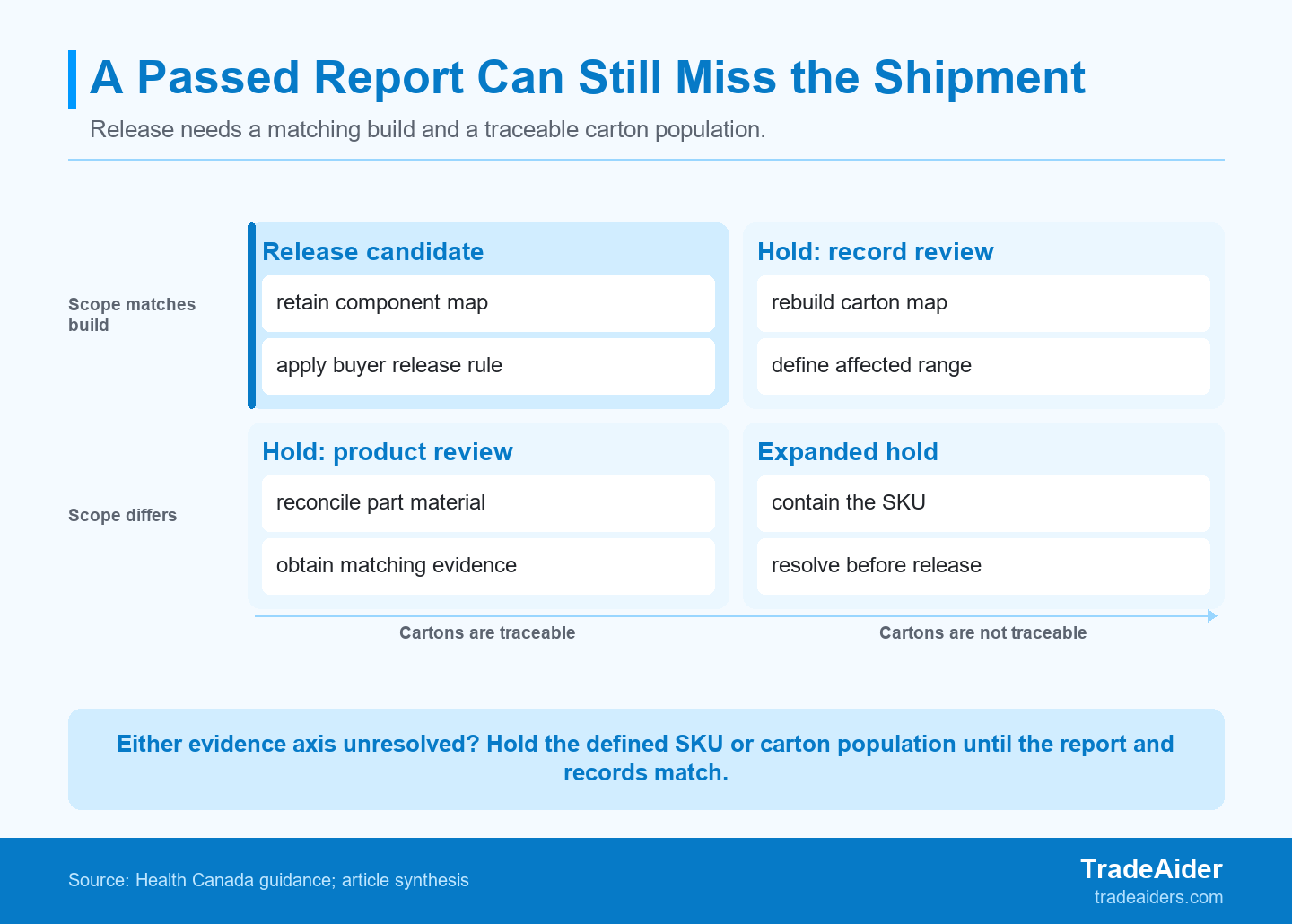
A report supports release only when both the physical build and the traceable carton population match its scope.
TradeAider can use the defined map, report scope, and carton range as the observation brief for a pre-shipment visit. The service check is limited to the agreed visible goods and records; it does not replace a laboratory or regulator.
When the mapping is incomplete, a product-testing evidence review can help define the missing evidence request. The purpose is not to collect a prettier PDF. It is to determine whether the specific component now in the SKU has evidence that matches its current construction and Canadian destination.
Match Test Scope to the Production Bill of Materials
A production bill of materials should be reconciled to the report’s sample description and to the supplier or revision evidence before the report is used for release. “Plated alloy clasp” is not a reliable match if the report says “unplated clasp,” or if the factory substituted the clasp supplier after the tested sample was made. Capture the accepted report revision and the person authorized to approve a material change.
Document the comparison row by row, including the sample description, supplier, material, coating, and revision. This turns a vague “tested” status into a specific statement about the parts actually packed for Canada.
Treat Screening as Triage, Not a Release Statement
A screening result can identify a part for escalation, but it does not itself establish a total-metal result for a Canada-bound component. Keep the screen result, the component identity, the date, and the next action together. Do not convert a screen reading into a pass/fail declaration, and do not use a clean-looking finish to close an evidence gap.
For a positive, unusual, or undocumented signal, isolate the related parts or cartons where possible; confirm whether the component map and report still match; then request the appropriate technical or laboratory review. This keeps an inspection observation useful without assigning it authority it does not have.
Turn the Evidence Packet Into Inspection Checks
Inspection can reconcile observable product identity, component mix, markings, packaging, and records against an agreed evidence packet; it cannot generate a total-metal laboratory conclusion from visual observation. Write the inspection request so it states exactly which parts, documents, and carton range are in scope. Appearance, a portable screen, and a factory declaration do not change that boundary.
| Inspection check | Evidence to compare | Escalate when |
|---|---|---|
| Part identity and finish | Approved map, sample, drawing, and report description | A clasp, charm, coating, material, or supplier differs |
| Pack and label presentation | Canadian classification decision and approved artwork | Presentation creates an unreviewed child or toy appeal question |
| Carton traceability | Assembly record, lot sheet, and carton-range list | The evidence cannot be connected to the packed goods |
When a substitution or record gap is likely to appear during assembly, schedule during-production change-control checks while the factory can still separate parts and carton ranges. Earlier reconciliation can preserve a traceable subset; waiting until final packing may turn a narrow issue into a full-SKU hold.
When Missing Records Expand the Hold
The CCPSA document duty makes supplier, buyer, and traceability records relevant to a Canadian importer’s evidence packet, and the general retention period is six years after the relevant year. The CCPSA record duty is not a substitute for a component report, but it explains why supplier, buyer, lot, and shipment records belong in the decision file.
Call the linked set of goods a release population: the specific goods and cartons that the evidence and records actually identify. A report may support one traceable carton range, but not an adjacent range that used a different component supplier. If the map cannot distinguish them, the buyer does not have a defensible basis for a split release.
Convert this into inspection-standard criteria before the visit: which carton labels must match, which incoming record identifies the component lot, which revision is accepted, and what finding triggers a hold. This turns traceability from a filing task into an observable release condition.
Illustrative Scenario: An Unmapped Clasp Lot
When a factory cannot map an untested clasp lot to finished cartons, the evidence gap expands beyond the originally suspected cartons because the affected population is not defined. In this illustrative scenario, a Canadian accessories importer is preparing 4,800 children’s charm-bracelet sets packed in 240 cartons across two assembly periods. The buyer has a total-metal report for the pendant and an approved component map listing one plated clasp supplier. During final preparation, the factory reports that the approved supplier ran short and an alternate clasp supplier was used.
The alternate clasps were stored beside the approved clasps, and the factory cannot map their incoming lot to a defined carton range. The pendant report does not establish the status of the alternate clasp. More importantly, the missing component-to-carton link means the buyer cannot credibly limit the evidence gap to a small subset. A guessed split release would create a paper boundary that the factory records cannot support.
The decision is to hold the bracelet SKU, request a corrected component map, traceable incoming records, and appropriate evidence for the alternate clasp, then rebuild the component and carton ledger. Remaining alternate clasps should be separated and future packing should prevent mixing. Release can be reconsidered only when the packet identifies the clasp material, evidence scope, finished-carton range, and matching physical checks. This is an illustrative procurement scenario, not a TradeAider client result or a conclusion about a particular clasp.
Release Only a Defined Population
A final inspection brief should identify the applicable classification, part map, report scope, accepted document revision, lot or carton range, and escalation rule before finished goods are checked. A pass should mean “these defined cartons match this defined evidence packet,” not “the supplier once provided a report.”
At the final stage, the order should be 100% complete and at least 80% packed so the check can reconcile the visible SKU, evidence packet, and carton population. A buyer who has defined that scope can request a children’s jewellery pre-shipment inspection focused on the agreed observations and records. TradeAider can reconcile those agreed checks; it does not issue laboratory total-metal conclusions or regulatory approvals.
Buyer Questions
Does every children’s jewellery part need lead evidence?
Health Canada says that lead and cadmium limits apply to all materials and coatings and tests each part independently. The practical map should not silently omit a clasp, coating, charm, bead, chain, or plastic component simply because it is small or decorative. See the Health Canada component guidance before relying on an existing report.
When does cadmium testing matter for children’s jewellery?
Cadmium evidence matters when a jewellery item can be fully enclosed in the regulatory small-parts cylinder under the stated force. Record that decision next to the component identity and supporting evidence. If the item’s size, configuration, or product classification is unclear, keep the question open for appropriate technical review instead of treating a general report as a definitive answer.
Can an inspection replace total lead and cadmium testing?
No. An inspection can compare the agreed evidence packet with visible goods, packaging, component identity, carton labels, and records. It cannot establish total lead or total cadmium content without the relevant laboratory evidence. The strongest inspection brief states this boundary clearly, so a factory observation is not misreported as a laboratory or regulatory result.
What should force a shipment hold before Canadian release?
Hold the affected SKU or a clearly identified carton range when a component report is missing, a material or coating changed without a matching evidence review, a toy-like presentation remains unclassified, or records cannot connect the component lot to finished cartons. Release only resumes when the buyer can define the goods the evidence actually covers.
Related Articles

Grow your business with TradeAider Service
Click the button below to directly enter the TradeAider Service System. The simple steps from booking and payment to receiving reports are easy to operate.

