
- About Us

- Our Services
- Your Industry
- Resources
- News & Blog
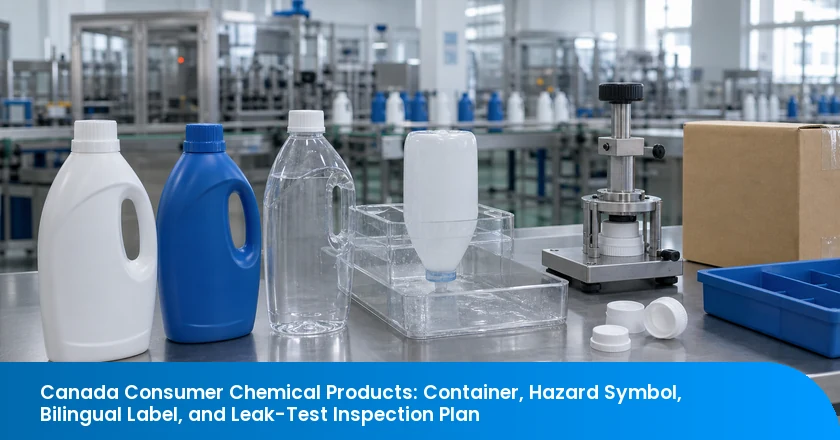
For a Canada-bound consumer chemical product, a traceable shipment group is the specific set of units and cartons that share the approved classification record, bilingual artwork, container and closure, filled product, and traceable carton range.
A Canada consumer chemical product inspection should begin with the approved compliance evidence, not with a generic bottle sample. The Consumer Chemicals and Containers Regulations, 2001 (CCCR, 2001) determine what must be established for the product and its container; factory inspection can then compare the finished pack, observe agreed conditions, and document a bounded release decision. That distinction matters when a household cleaner, adhesive, or liquid maintenance product is sourced from China: a correct-looking bottle does not prove the hazard category, and a passed sample does not automatically represent every export carton.
This plan connects container evidence, the hazard symbol, panel placement, English-and-French information, and a Schedule 3 leak-test boundary. It is operational guidance for importers. Product-specific classification, legal label review, child-resistant protocol testing, and laboratory determinations remain separate responsibilities.
Canada Chemical Release Priorities
Define the classification record, the approved pack evidence, and the release population before using a sample to support a Canada-bound chemical-product shipment decision. That order prevents an inspection result from being stretched beyond the units and cartons it can actually describe.
- Definition: A release population is a traceable product-and-carton group, not the full purchase order by default.
- Decision: Obtain the responsible person’s classification and required-information file before comparing labels or containers.
- Evidence: Match finished units to the approved bilingual artwork, the current container and closure specification, the fill record, and the carton range.
- Boundary: A PSI can report observable pack conditions and an agreed sample result; it does not make the chemical classification or certify a child-resistant protocol.
Start With Classification, Not a Bottle Checklist
Under CCCR, 2001, the responsible person determines the applicable hazard category, required container type, and required information before a finished-pack inspection can compare the lot with approved evidence. Section 4 of the current regulation makes that sequence explicit, while the consolidated CCCR text gives the broader regulatory context. The Justice Laws index also provides the current consolidated structure, including container, display, and Schedule 3 requirements.
For the importer, the first inspection brief should therefore identify the SKU, intended Canadian retail pack, product classification evidence, approved bilingual artwork revision, container and closure specification, and any applicable child-resistant-container evidence. If one of those items is missing or unresolved, the useful decision is to pause the compliance comparison and escalate to the responsible compliance owner or qualified testing route. Asking an inspector to infer a hazard category from a finished bottle reverses the required order.
The responsible person must keep documents relating to those determinations for at least three years and provide them within 15 days after an inspector request. The consolidated CCCR text is the source for those periods. The wider statutory context is the Canada Consumer Product Safety Act, which provides the statutory context for Canada-bound consumer products.
Use a Pre-Production Inspection when the buyer needs to lock the intended container, closure, and artwork version before filling begins. The objective is not to approve a chemical by appearance. It is to stop an unapproved component, artwork revision, or closure from entering the production population that later has to be sampled.
Build a Container-to-Carton Evidence Chain
A defined release population is the specific set of units and cartons that share the approved product, closure, label revision, fill run, and traceable carton range. This is editorial release-control terminology, not a defined CCCR term. Its value is practical: a sample is informative only when the buyer can say which other units share the attributes that were actually checked.
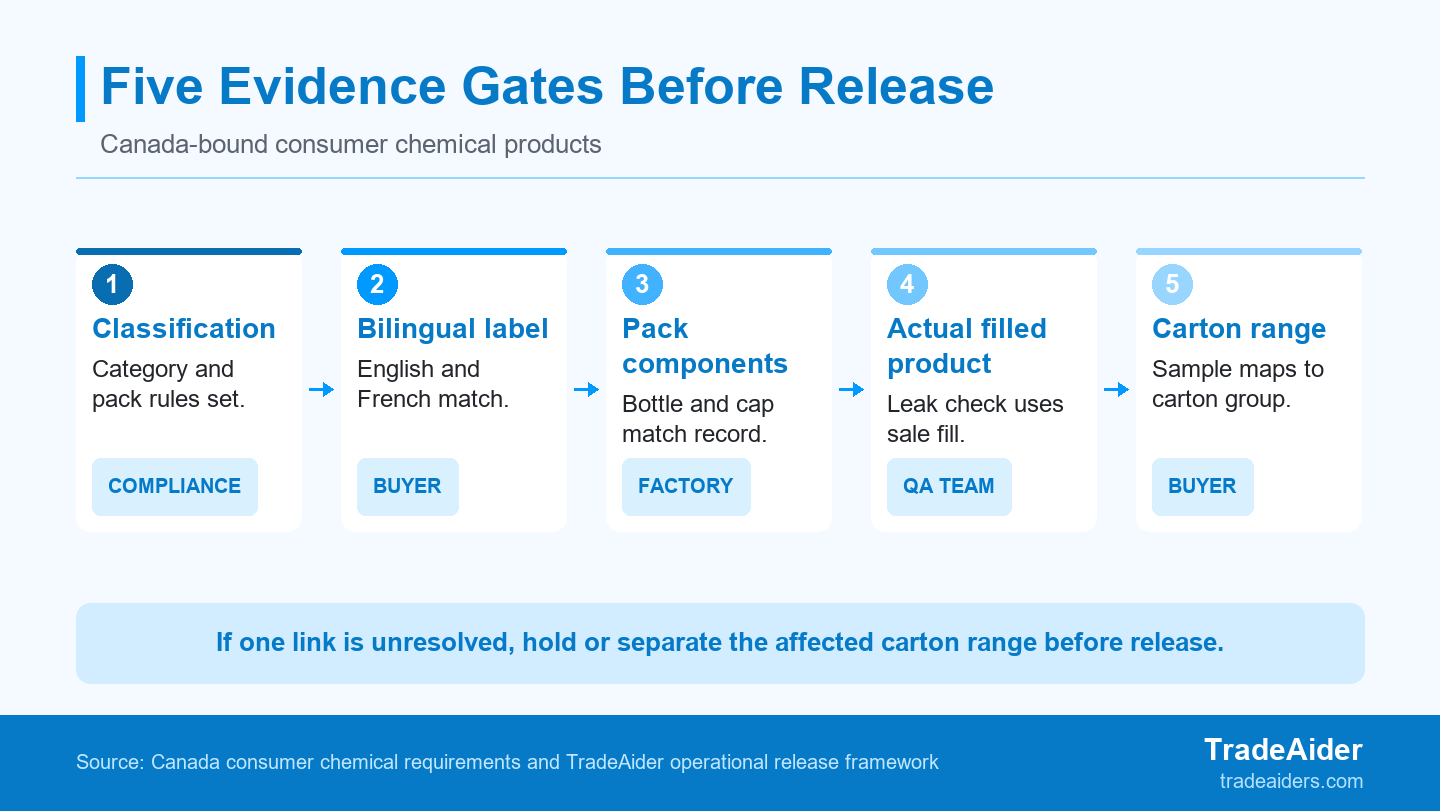
A sample supports a release decision only for cartons that share all five evidence links.
Build the chain in five links: classification record; approved bilingual artwork; container and closure specification; actual filled product and fill-run identifier; and the carton range. A new cap delivery, revised label file, capper adjustment, or unrecorded rework can break that chain. When it does, do not average the difference into one inspection result. Split the relevant population, preserve the identifiers, and assign the recheck only to the units and cartons that can be reconciled.
A simple release question exposes the gap: “Can this sampled unit stand for carton 1 through carton 420?” The answer is yes only if the carton range shares the same evidence links. When a supplier cannot map a closure delivery or fill shift to cartons, the evidence is not broad enough for release; the uncertainty is itself a reason to hold or narrow the scope.
TradeAider’s During Production Inspection is useful before different filling shifts and packing ranges merge. It can document the current artwork, component identity, line setup, and in-process pack condition while a correction remains traceable. That is materially different from discovering a mixed population only after export cartons are closed.
Compare Hazard Information as a Finished-Pack Attribute
Required information displayed on a chemical-product container must be in both official languages and remain clear and legible throughout the useful life of the product under normal conditions. CCCR presentation requirements make language, legibility, and durability finished-pack attributes, rather than artwork-only assumptions.
A main display panel is the consumer-visible part of a container presented for sale where key safety information appears. Inspect the finished pack against the approved bilingual reference: compare the English and French text, hazard symbol, signal word, primary hazard statement, directions, and any required caution or first-aid information applicable to the approved classification. Health Canada explains that the main display panel carries the hazard symbol, signal word, and primary hazard statement in a prescribed order. Section 26 is the direct reference for that placement.
| Inspection question | Compare against | Record or decision |
|---|---|---|
| Is the correct artwork revision on the unit? | Buyer-approved English and French artwork file | Hold the revision if the file and finished unit differ |
| Is the key hazard information on the expected panel? | Approved pack layout and applicable CCCR information | Photograph the panel and identify the affected label range |
| Are both language versions legible after normal handling? | Finished print, adhesion, contrast, and abrasion condition | Escalate a print or durability mismatch before release |
| Does the closure match the approved pack? | Closure code, liner, torque or setup record, and sample | Define the closure batch and carton boundary for the result |
The table does not replace a product-specific legal review. It gives the inspector observable points to compare once the responsible person has supplied the correct reference evidence.
Use a Leak Test as a Defined-Lot Control
A liquid chemical-product container must pass the Schedule 3 leakage test or an equivalent test, and Health Canada's guidance describes a one-hour observation after an inverted 45-degree position over suitable paper. A release plan should identify the actual product, the container and closure configuration, the test population, the observation record, and the decision boundary before any unit is opened. The CCCR requirement and Schedule 3 method state that the product is filled for sale and conditioned at 23 ± 2°C for at least four hours.
That does not mean every factory observation is a regulatory determination. The buyer should confirm the applicable method, safe handling controls, and who is authorised to execute the test for the actual product. For inspection planning, write down the SKU, fill level, closure and liner, preparation instructions, sample selection basis, product batch, closure batch, fill shift, carton range, observation time, and pass/hold response. A water-only trial may be a separate packaging exercise, but it should not be presented as the CCCR test for the actual chemical product.
Child-resistant packaging is a separate design and evidence question; a visual closure check does not itself demonstrate compliance with a recognized child test protocol. The CCCR rules identify construction or recognised child-test protocol requirements and continuing compatibility evidence for applicable child-resistant containers. A PSI can compare the closure in use with the approved specification and check the presence of supporting records; it cannot certify the protocol from an on-site visual check.
TradeAider states that a PSI is conducted when 100% of the order quantity is completed and at least 80% is packed for export. That timing makes a Pre-Shipment Inspection, a finished-goods check against the buyer's agreed scope before export, useful for comparing completed goods and export packing against the agreed evidence packet. It does not convert the PSI into chemical classification, laboratory testing, or child-resistant certification.
When Repeat Leak Findings Become a Process Escalation
Three leak findings tied to one closure delivery and fill window should trigger a bounded hold and process investigation rather than replacement of sampled units alone. A repeat pattern changes the decision geometry: the question is no longer whether three units can be repaired, but which production window and cartons could share the same unresolved condition.
Trend escalation is most useful when the factory can connect a finding to a closure batch, filling shift, capper setting, rework record, and carton range. When those links are absent, expand the hold because the affected population cannot be demonstrated. When they are present, keep separately documented populations separate rather than treating the entire order as either passed or failed.
Illustrative Scenario: Three Leak Findings Change a Rework Decision
The repeated leak pattern is carried into a bounded hold, corrective record, and targeted recheck for the affected carton range. This fictional example shows an operational release-control decision, not a client case or a product-specific compliance conclusion.
Situation: An importer is preparing a Canada-bound household maintenance liquid sourced from a China factory.
The order contains 12,600 finished units in 420 export cartons, with three filling shifts, two closure deliveries, and one approved bilingual artwork version.
The goods are in export packing and the carton range is still identifiable.
Problem: During the agreed actual-product leak check, three sampled units show trace leakage. All three use the same closure delivery and late-shift fill window, while the factory proposes replacing only those three closures and continuing pack-out.
The three observed units share a closure delivery and a late-shift filling window, which gives the buyer a traceable basis for an initial hold rather than a product-wide conclusion.
Carton records identify 96 cartons from that window. The remaining cartons use the separately documented earlier closure delivery. This does not prove that all 96 cartons leak, but it shows that the observed units and the 96 cartons share a process and component path that the other cartons do not share.
Replacing the sampled units alone would not resolve whether the liner, torque, or remaining units in the same process window are acceptable.
Action: The buyer places the 96-carton range on hold and keeps the earlier-closure range distinct.
The factory verifies the capper setting, segregates the closure delivery, replaces affected closures, records each rework carton range, and keeps the associated label and fill-run identifiers.
Result: A targeted recheck compares the corrected closure configuration, observes the agreed leak check on the affected range, and reconciles the rework records to the 96-carton hold list. Only the evidenced, corrected range is reconsidered.
This fictional example does not decide the chemical classification, prove a child-resistant protocol, or replace laboratory evidence.
Hand Over a Release Packet Before Packing Closes
A release packet preserves the classification-to-carton links required to define a reproducible inspection scope. Before the check, provide the applicable classification record, approved bilingual artwork, container and closure specification, relevant child-resistant evidence where applicable, fill and closure batch identifiers, packing status, carton map, and the exact release question. The packet should also say which range is eligible for sampling and which event would trigger a hold.
This preparation lets the inspector report a visible mismatch, trace a test observation, and name the correct corrective boundary. It also keeps the buyer’s request clear: if the decision needs a laboratory result or a product-specific regulatory interpretation, state that separately instead of treating it as an inspection finding. Gather the classification file, current artwork, container and closure specification, packing status, and release question before booking; when the records are ready, request a Canada chemical-product inspection brief.
Who Is TradeAider?
TradeAider is an Amazon Service Provider Network (SPN) partner. TradeAider is a quality inspection, testing, and certification service provider in China, operating across major manufacturing provinces including Guangdong, Zhejiang, Jiangsu, Shandong and Fujian. For importers who need a scoped China-side check, TradeAider can support inspection, testing coordination, and evidence-led reporting without presenting an inspection sample as a regulatory determination. Inspection & QA Services are available at $199/man-day all-inclusive for Inspection & QA Services. The company reports that 18% of clients are repeat clients and 23% come through referrals; these are client-reported figures, not independent market benchmarks. For service-provider details, see TradeAider as an Amazon Service Provider Network (SPN) partner.
Frequently Asked Questions
Does a factory inspection determine CCCR chemical classification?
A factory inspection can compare a finished lot with an approved classification file, but it does not determine the product’s CCCR hazard category. The responsible person’s determination and the supporting compliance route must exist before the inspector compares containers, labels, closures, and carton records. If that file is missing, escalate rather than ask the inspector to infer the outcome from appearance.
Must consumer chemical warnings appear in English and French?
Required CCCR information displayed on a container must appear in both official languages and remain clear and legible under normal use conditions. Inspection should compare the finished pack with the approved bilingual artwork and identify the precise label revision and carton range when a mismatch appears. It should not decide whether unapproved wording is legally sufficient.
Can water replace the actual product for a leakage test?
For the Schedule 3 leakage test, the sample is the product as filled for sale rather than a substitute liquid. A water trial may be a separate packaging exercise, but it is not the Schedule 3 method for the actual chemical product. Confirm safe, product-specific execution and document the actual product, closure, fill run, sample population, observation period, and decision rule before the test begins.
Does a passed sample release every export carton?
Only when the sampled units represent a defined lot with the same approved product, container, closure, label version, fill run, and documented carton range. That is an operational release rule, not a CCCR definition. A changed closure delivery or untraceable rework can split the population, requiring a separate hold or recheck rather than a broader pass statement.
When should a buyer hold a Canada-bound chemical lot?
Hold the affected range when required label evidence conflicts with the finished unit, leakage appears, a closure differs from the approved record, or the product-to-carton population cannot be identified. Define the hold by the evidence available: an identified process window may support a bounded recheck, while missing records may require the hold to expand until the scope can be reconciled.
Related Articles

Grow your business with TradeAider Service
Click the button below to directly enter the TradeAider Service System. The simple steps from booking and payment to receiving reports are easy to operate.

