
- About Us

- Our Services
- Your Industry
- Resources
- News & Blog
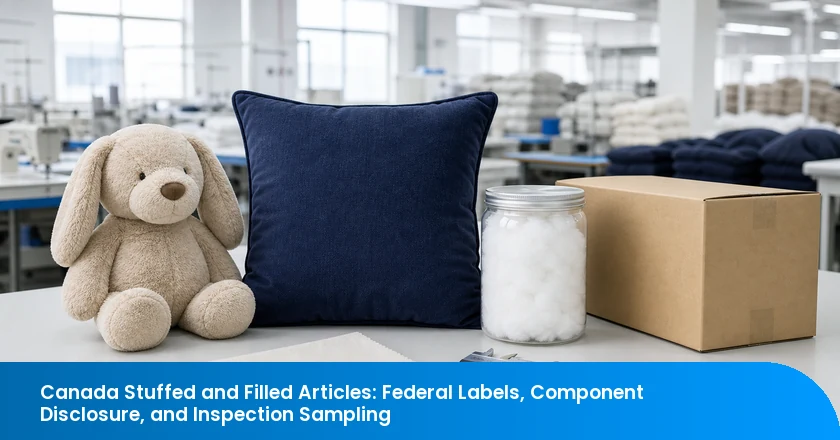
For a Canada-bound filled article, an evidence gate is a buyer-controlled sequence that confirms the product path, component records, and defined release population before any inspection sample is used to support shipment release.
A finished pillow, cushion, travel comfort item, or soft article can look consistent on a factory floor while the release evidence is still incomplete. The risk is not simply a missed sewing defect. It is a mismatch between the product category, the information disclosed for its textile parts, the approved label version, and the cartons that actually contain that configuration. Inspection is valuable when it makes that mismatch visible; it is not a shortcut to legal classification or fibre testing.
Canada Filled-Article Release Priorities
Define the product path, the component evidence, and the release population before using a sample to support a Canada-bound shipment decision. That order matters because a statistically neat sample has little release value when it mixes cartons with different filling declarations, label versions, or untraceable packing records.
- Classify first: confirm whether the product belongs on the federal textile-label path and flag a separate product-safety route when the item is marketed or designed as a toy.
- Read parts separately: outer covering and filling or stuffing, the inside textile material, can create different review questions.
- Stratify before sampling: split the population when SKU, filling lot, label revision, retail pack, or carton mapping changes.
- Hold the unknown range: if the component record cannot be tied to a carton range, expand the hold instead of using more random samples to guess.
Start With the Product Classification Boundary
Canada's federal textile rules apply to most consumer textiles, but the product path must be confirmed before a filled article is reviewed as a standard label check. The Competition Bureau's textile-labelling overview places responsibility on manufacturers, importers, and retailers to ensure required label information is correct. For a buyer, that means the factory inspection brief should start from the approved product specification and legal/compliance owner, not from a supplier's verbal description of the item.
A plush or soft toy can carry a separate product-safety question, so a filled-article label review is not a complete toy compliance decision. The Competition Bureau's filled-article guide itself uses a stuffed toy as a classification fork. Put differently, an inspector can verify the supplied label and physical presentation, but the accountable product team still needs to decide which legal and safety routes apply to the actual product and its claims.
Ontario Regulation 218/01 was revoked effective July 1, 2019, so old provincial stuffed-article label pages should not be treated as current Ontario requirements. The current Ontario revocation regulation is useful precisely because historic search results can otherwise send buyers to superseded material. This does not remove federal textile-labelling obligations; it tells the buyer to anchor the working packet in current federal guidance and product-specific review.
Use the Canada Filled-Article Evidence Gate
The Canada Filled-Article Evidence Gate is an editorial release method: first confirm the product path, then match the component declaration, approved artwork, finished product, and carton map before sampling. Here, the gate means checking product type, component declaration, cartons, and release evidence in one sequence. It is not a statutory test; it identifies whether a sample represents a known release population or only a mixed collection of finished goods.
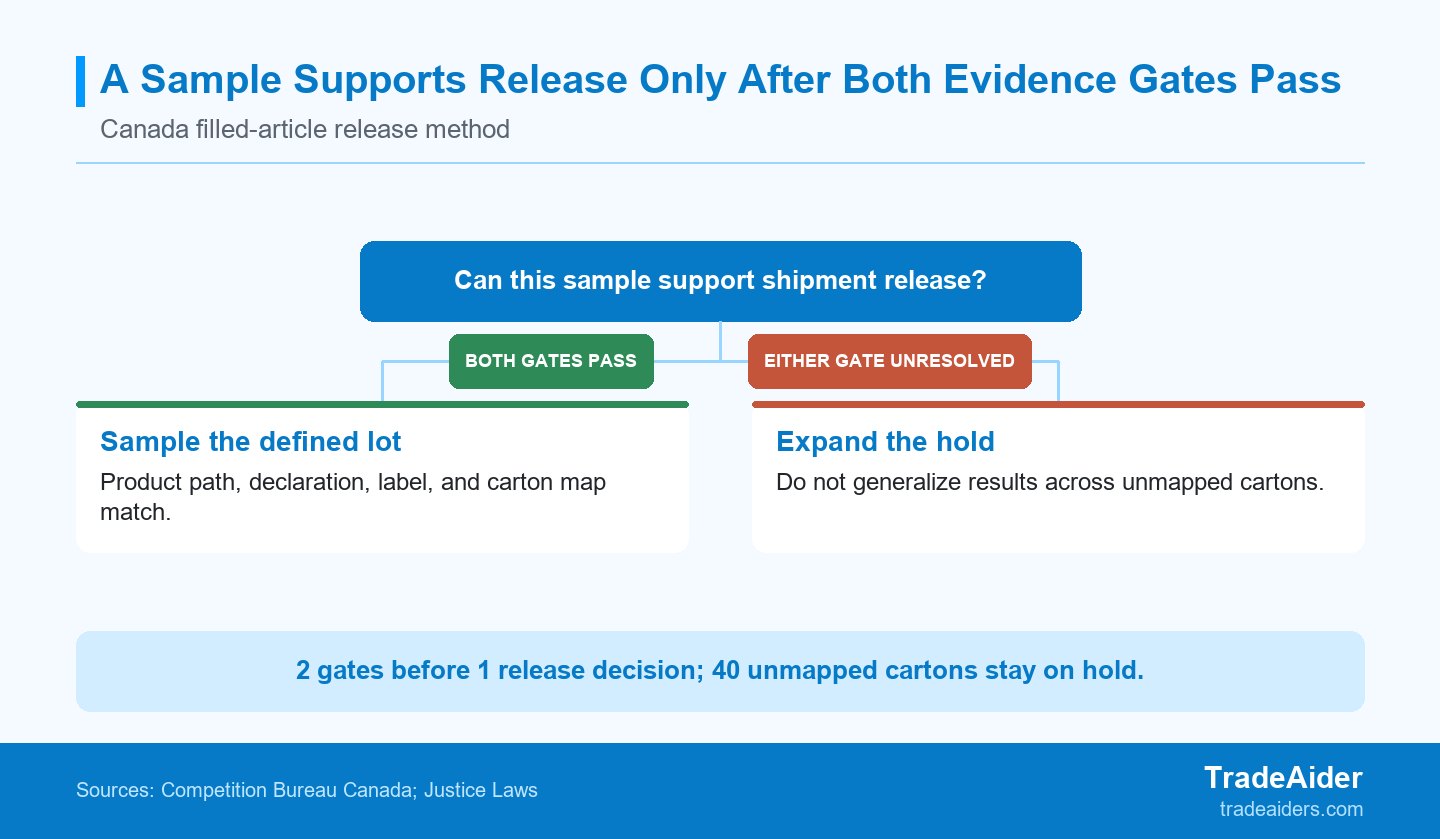
A sample supports a Canada-bound release only after product scope and component-to-carton evidence both define the lot.
The textile fibre content of a stuffed or filled article's outer covering or shell must be disclosed. That federal guidance gives the buyer a dependable first record, but it is not the last record. A shell label may be accurate while the filling declaration, retail-pack claim, or carton map is outdated. The evidence gate therefore asks five practical questions in sequence:
- What is the actual consumer product, and has its applicable path been confirmed?
- Which textile parts are the outer covering, the filling or stuffing, and any other relevant parts?
- Which current component declaration supports each part?
- Which approved artwork version carries that information into the final label and retail pack?
- Which SKU and carton range can be shown to use that same component-and-artwork combination?
This sequence also creates a useful production-control moment. If filling, artwork, or packaging changes while the order is still being made, a During Production Inspection can compare the current work against the buyer's approved reference before different versions become mixed in export cartons. That is a containment check, not a legal sign-off.
Separate the Outer Covering, Filling, and Other Textile Parts
For a covered article, filling or stuffing fibre content is shown separately and after the information for the outer covering or trimming. Section 38 of the Textile Labelling and Advertising Regulations is the source for that order. In practical terms, keep this information distinct from the shell declaration. The inspection packet should identify the declaration that supports each relevant textile part.
| Item or component | What the buyer should reconcile | What can change the question | Inspection evidence |
|---|---|---|---|
| Outer covering or shell | Fibre content, approved artwork, label placement | Fabric or artwork revision | Observed label and final product against the current SKU record |
| Filling or stuffing in a covered article | Separate declaration and its order after outer-covering information | Filling blend, supplier lot, or declaration change | Component declaration, label version, and carton-to-lot map |
| Listed excluded article | Article category and the approved marketing or product claim | A representation about filling or stuffing | Pack copy and approved claim record for escalation |
| Dealer information | Dealer name and postal address or an applicable approved alternative | Dealer-line or label-artwork change | Approved label artwork and final retail presentation |
For listed excluded articles, a representation about the filling or stuffing can make that information necessary. The same section 38 rule is why a buyer should preserve the approved product listing, packaging copy, and component declaration together. A product name such as “cushion” does not by itself settle every disclosure question when its packaging makes a material or filling representation.
A required disclosure label shows textile fibre content and, subject to exceptions, the dealer's name and postal address. Section 11 makes dealer information a separate control field, not a detail to check after component content is approved. Based on this comparison, the buyer should release a label only when each relevant row has a current source record and a known owner; a final sample can then test whether the packed goods match that packet.
Turn the Evidence Gate Into an Inspection Sampling Brief
A PSI is conducted when 100% of the order quantity is completed and at least 80% is packed for export. TradeAider's Pre-Shipment Inspection service uses this timing. Here, pre-shipment inspection means an agreed-scope check of completed goods and export packing; it is a service-timing condition, not a Canadian legal threshold, but it makes the link between observed product, retail pack, carton marking, and the shipment decision more meaningful.
A disclosure label must be legible and accessible to the consumer at the time of purchase. The Competition Bureau's label-presentation guidance makes this an observable final-product condition. Inspection sampling can therefore compare documents, labels, finished goods, retail packs, and carton records, but it cannot determine fibre composition or legal product classification; route those questions to the appropriate accountable review rather than calling the inspection result a compliance certificate.
Build the sampling plan around strata, not only an overall order quantity. At minimum, create a separate stratum whenever one of these changes: the product SKU, the declared filling or stuffing, the outer-covering construction, the label artwork revision, the retail-pack format, or the carton range. The sample size and acceptance method remain buyer-defined. The more important control is that every sampled unit can be assigned to the same documented population as the units the buyer wants to release.
A practical brief should name the sample points to be observed: label position and legibility, stated component information, dealer line, retail-pack copy, SKU, carton mark, and the record that connects the carton to the component lot. It should also name the decision rule in advance. A label mismatch in a mapped carton range may permit a bounded corrective action and recheck. An unknown component-to-carton relationship should trigger a broader hold because the sample cannot safely stand in for the rest of that range.
When Missing Component Records Expand the Hold
When the buyer cannot map a component declaration and label version to a defined carton range, the hold should expand to the smallest population the evidence can still describe. This is a release-control rule, not an AQL conclusion: taking additional samples does not restore a missing production record. The useful question is whether each proposed release carton can be connected back to one documented component-and-artwork combination.
Illustrative Scenario: Filling Records Without a Carton Map
This illustrative scenario shows why a sample cannot clear cartons whose component evidence cannot be mapped. It is not a client case or a legal decision.
Situation: A Canadian private-label travel-comfort importer is preparing filled travel pillows sourced from China. The buyer needs a shipment decision, but the product team has already approved two filling declarations and two label versions after a material change.
The order contains 12 SKUs across 180 export cartons. The change is not limited to colour or trim: the record set shows two declared filling blends, so the buyer needs to know which product and label combination sits in each release range.
All units are complete and 162 of 180 cartons are packed. The supplier can identify the two incoming filling delivery lots, yet it cannot tie the later delivery lot to individual finished cartons.
Problem: Inspection samples show both approved label versions in the finished travel-pillow range. That observation is not enough to clear the order because the packing list groups 40 cartons by SKU but does not identify which filling lot was used inside them.
The missing carton-to-filling-lot record also means the buyer cannot prove that the other 140 cartons are separate from the unresolved component range. A sample result might be accurate for the units opened, while still being non-transferable to cartons with an unknown component history.
Action: The buyer places the 40 unmapped cartons on hold and requires the factory to reconstruct the map from filling issue records, production dates, finished-goods labels, and packing logs. Any cartons that remain uncertain are segregated rather than counted inside a convenient release sample.
The buyer does not treat the remaining 140 cartons as a release subset until the supplier demonstrates that their component and label records are separate from the unresolved range. The decision geometry is deliberately conservative: the uncertainty is a missing traceability link, not a defect tally that can be averaged across the shipment.
The factory records the reconstructed carton-to-filling-lot relationship, replaces any label artwork that no longer matches the reconstructed declaration, and keeps the affected cartons physically identified through rework.
Result: The targeted recheck adds two days to the release decision but confirms the reconstructed mapping, observed label version, specified retail pack, and retained carton-range record before the held lot is reconsidered. The trade-off is explicit: a short delay buys a decision limited by evidence rather than a hopeful extrapolation from a mixed sample.
This illustrative scenario is an operational control example. It does not decide regulatory applicability, label sufficiency, or fibre composition.
Prepare a Component-to-Carton Evidence Packet
A component-to-carton evidence packet makes an inspection scope reproducible and makes a hold decision easier to explain. It also prevents the inspector from having to infer a product claim or a material history from a finished unit alone.
- Provide the current product specification and the question requiring confirmation.
- Attach approved label artwork and retail-pack copy by SKU and revision.
- List outer-covering and filling declarations with their applicable component lots.
- Supply the current packing list, carton marks, and carton-to-component mapping.
- State the buyer's hold, correction, and recheck rule before the visit.
If the order is already packed and the unresolved point is the match between labels, components, and cartons, send the specification, artwork, component declaration, packing status, and the decision you need documented so the scope can record observable evidence and clearly name what remains outside inspection. Then request a filled-article inspection brief.
Who Is TradeAider?
TradeAider is a quality inspection, testing, and certification service provider in China. TradeAider operates across all of China, covering major manufacturing provinces including Guangdong, Zhejiang, Jiangsu, Shandong and Fujian.
TradeAider also provides testing services, covering Hardline Products, Softline Products, Electrical & Electronic Products, and Industrial Products, enabling buyers to manage quality control and testing needs within a single service framework. For Canada-bound filled articles, the practical boundary remains important: an inspection can document an observable match or conflict, while product classification and technical testing follow their appropriate review routes.
For a buyer managing a filled-article order, the useful service handoff begins with the product specification, a component declaration, approved artwork, packing status, and the exact cartons that need confirmation. A China-side inspector can compare the documents with finished goods and retain the observed carton-range result. If a component record changes after production begins, preserve the old and new versions, identify the affected range, and state whether correction or a targeted recheck is required. That discipline distinguishes a visible presentation issue from a question that requires the responsible compliance or testing route.
Before the visit, name the decision owner and the requested output in the brief. One buyer may need photo evidence of label placement and carton marks; another may need a hold recommendation against a particular SKU range. The difference matters because the inspector should record what can be seen, the document revision used for comparison, and every limitation created by packing status or missing records. Clear handoff language lets the buyer act on the report without turning a routine inspection note into an unsupported legal conclusion.
TradeAider is an Amazon Service Provider Network (SPN) partner. $199/man-day all-inclusive for Inspection & QA Services. Client-reported figures, not guarantees, include an 18% reduction in return rates and a 23% improvement in defects caught before shipment. Review TradeAider's Amazon Service Provider Network (SPN) partner.
Frequently Asked Questions
Use these answers as operational boundaries and obtain product-specific confirmation when the article category, claim, or test route remains unclear.
Does Every Filled Article Need Filling-Fibre Disclosure in Canada?
No, but the answer depends on the article category and whether consumer-facing copy makes a filling or stuffing representation. The federal rules list excluded articles, but a representation about their filling or stuffing can trigger a disclosure requirement. The buyer should not use an exclusion as a shortcut based only on a product name. Review the actual article category, packaging claims, and approved component declaration together before approving final artwork.
Are Canadian Provincial Stuffed-Article Labels Still Required?
The provincial stuffed-or-filled labelling programs cited for Ontario, Manitoba, and Quebec have been repealed, while federal textile-labelling obligations still apply. Buyers should therefore avoid building a current release packet around historical provincial tags or permit concepts found in old webpages. Start with current federal guidance, then obtain product-specific confirmation where the item, component claim, or sales channel creates a question outside the inspection scope.
Can an Inspection Sample Prove Filling-Fibre Composition?
No, because visual inspection can compare records and construction but cannot determine the actual fibre composition inside a filled article. The sample can still be valuable because it may expose a mismatch between the approved declaration and the finished label or retail pack. When the question is actual fibre content or another technical property, define the applicable test route instead of treating a visual observation as proof.
How Should Buyers Sample a Mixed Filled-Article Order?
Sample each meaningful product, filling, label, and packing stratum rather than treating a mixed order as one uniform population. A new filling lot, artwork revision, retail pack, or carton range can justify a separate stratum even when the product looks similar. The plan should say which units represent each group and what happens if records are missing. More units from an undefined population do not solve a traceability gap.
When Should a Filled-Article Shipment Be Held?
Hold the affected scope when the buyer cannot map the current component declaration and label version to a defined product and carton range. A hold can remain narrow when records show exactly which cartons are affected. It should expand when the evidence does not support that boundary. Document the correction, retain carton identification, and use a targeted recheck before the held range is reconsidered for release.
Related Articles


Grow your business with TradeAider Service
Click the button below to directly enter the TradeAider Service System. The simple steps from booking and payment to receiving reports are easy to operate.

