
- About Us

- Our Services
- Your Industry
- Resources
- News & Blog
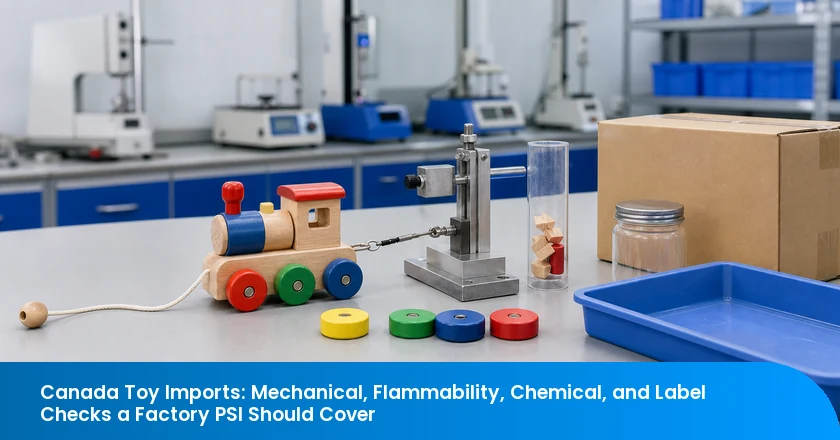
A Canada toy final-factory inspection is a comparison of completed goods and export packaging to the buyer’s controlled product and evidence references; it does not replace laboratory testing, regulatory assessment, or the importer’s release responsibility.
A Canada toy inspection checklist works best when it separates what can be observed at the factory from what must be supported by product-specific evidence. A production sample can look neat and still raise an unresolved question if its age grade, soft-vinyl component, warning artwork, report reference, or carton record no longer matches the controlled version. The practical release question is therefore narrow: can this defined export range be reconciled to the evidence that is meant to cover it?
The Canada Toy Release Framework: Four Evidence Lanes
The Canada Toy Release Framework is a four-lane factory control that connects each relevant hazard to evidence, an observable comparison, and a defined hold trigger. A Pre-Shipment Inspection (PSI) is a final-stage factory check of completed goods that are export packed against an agreed scope. It helps an importer brief the factory and inspector without asking either one to decide whether a toy is legally compliant. An evidence pack is the controlled set of references used for the comparison, including approved product and package files, material records, and report identifiers. Lot traceability means the ability to connect a finished item and its carton range to its production and supporting records. The four lanes are mechanical use, flammability and thermal exposure, chemical or material evidence, and package or label references.
Canada’s Toys Regulations organize requirements under packaging, electrical, mechanical, auditory, thermal and flammability, toxicological, and specific-product headings. That structure is useful because it prevents a buyer from treating one visual check, one report, or one packaging photo as proof for every hazard category.
- Mechanical: compare age grade, parts, mechanisms, edges, fasteners, magnets, and battery access with the controlled reference.
- Flammability and thermal: keep the relevant construction and report scope available for the accountable testing path.
- Chemical: preserve material identity and the lot link when a vinyl, coating, stuffing, or component record changes.
- Package and label: compare the final retail pack, warnings, product identifiers, and carton records with approved files.
| Evidence lane | Buyer-controlled reference | What PSI can compare | Hold trigger |
|---|---|---|---|
| Mechanical | Age grade, product photo, component list | Visible parts, attachments, edges, access points | Toy or feature differs from the approved version |
| Flammability / thermal | Construction, applicable evidence reference | Material, textile, electrical, or heat-related version cues | Construction cannot be tied to the evidence |
| Chemical | Material code, bill of materials, report scope | Presented component, supplier record, carton range | Material record or component is inconsistent |
| Package / label | Approved artwork, warning, pack specification | Printed pack, insert, bag, carton, marking | Final pack does not match controlled artwork |
Use the table as a scope tool, not a conformity score. Before the visit, set the inspection standard before the visit so the report can name the comparison reference, the selected units, the observed difference, the affected carton range, and the escalation owner. A clean result should mean that the agreed observations were reconciled; it should not be described as a laboratory or legal conclusion.
Set Mechanical and Foreseeable-Use Checks Before the Final Visit
Mechanical scope should compare the actual toy’s age grade and likely handling with agreed physical cues such as detachable parts, accessible edges, fasteners, mechanisms, magnets, and battery access. “Reasonably foreseeable use” means the ways a child is likely to handle a toy beyond the ideal demonstration, so a final-factory brief should not stop at whether the product looks intact on a table. It should state which parts must be present, attached, accessible, covered, or absent in the selected version.
An inspector can compare agreed physical cues such as detachable components, accessible edges, fasteners, mechanisms, magnets, battery access, packaging, and age-grade artwork with the controlled reference, then record a mismatch without declaring a test result. The buyer should supply close-up approval photos, a model or SKU list, material or component references where relevant, and an explicit photo list. That makes “different” meaningful: a report can identify the feature, the comparison file, and the cartons in which it appeared.
For toys with attachment points, moving parts, molded edges, strings, magnets, batteries, or parts intended for young children, ask the factory to show the exact production configuration before final packing hides it. If a recurring build issue can still be contained earlier, use a service designed to check toy build consistency during production rather than waiting for a shipment-stage dispute. The responsible owner still determines which physical features need a technical review; the earlier check simply keeps the production version visible.
Use Flammability and Chemical Evidence as a Handoff, Not an On-Site Claim
Canada’s Phthalates Regulations set a 1,000 mg/kg limit for DEHP, DBP, and BBP in vinyl toys and set the same limit for DINP, DIDP, and DNOP in mouthable vinyl parts of toys for children under four. That is a material-and-use question, not a color, smell, or appearance test. A buyer should therefore connect the applicable report or laboratory instruction to the relevant component, intended user, and current material reference before asking for a release decision.
A factory PSI should preserve material identity, report references, and the affected carton range when flammability or chemical evidence cannot be reconciled; it should not claim to determine the laboratory outcome on site. For example, an inspector may photograph a changed vinyl accessory, read a material code on the supplier record, and record its carton range. The inspector should not state that the component passes a phthalate limit or a flammability method merely because the part appears similar to a tested sample.
Keep the handoff practical. Give the inspector the controlled bill of materials, the report number or testing instruction supplied by the buyer, the product version it is intended to cover, and the factory’s lot logic. A new component color, supplier code, coating, textile, or soft-plastic part is not automatically a failure, but it is a reason to stop assuming prior evidence applies. TradeAider also provides testing services, covering Hardline Products, Softline Products, Electrical & Electronic Products, and Industrial Products, enabling buyers to manage quality control and testing needs within a single service framework. When the question requires an appropriate test path, buyers can coordinate product testing with the factory evidence pack.
Check Packaging, Warning, and Market-Label References Against Final Goods
Flexible film bags used for toy packaging with an opening circumference of 356 millimetres or more must carry the specified suffocation warning in English and French. This is a useful factory-check example because the bag, its dimensions, and its printed warning are all observable. It is not a reason to assume that every Canadian toy statement follows one universal bilingual formula; the accountable owner must confirm the label requirements for the actual toy and package.
The Consumer Packaging and Labelling Act requires a prepackaged product’s net-quantity declaration in the prescribed form and manner, on the principal display panel, clearly and prominently displayed, legible, and in distinct contrast. In a PSI brief, attach the approved retail artwork and identify exactly which surfaces the inspector should photograph: the age statement, warnings, product name or identifier, dealer information where applicable, net-quantity reference, insert, and any bag or carton marking.
There are two separate questions at the factory. First, does the presented pack match the approved file? Second, does the approved file meet every applicable Canadian requirement? PSI can answer the first question when the buyer supplies a controlled reference. The second belongs with the importer and its qualified regulatory or technical owner. Keep carton labels and pack revisions in the same comparison record, because a correct-looking retail pack in one carton is not evidence that the whole shipment carries the same version.
Use the Canada Toy Release Framework to Define a Hold
Section 13 of the Canada Consumer Product Safety Act requires commercial importers and other covered persons to prepare and maintain documents indicating the person from whom they obtained a consumer product or to whom they sold it, as applicable. That makes a carton-range record more than an inspection convenience. It is the practical connection between a factory observation, the supplier record, and the buyer’s ability to identify the product range that needs an accountable next decision.
Section 14 of the Canada Consumer Product Safety Act requires a person who manufactures, imports, or sells a consumer product commercially to provide incident information within two days after becoming aware of the incident. A factory observation does not decide whether a particular mismatch is a reportable incident. It does show why the observation should identify the model, component, package version, factory record, photographs, and carton range instead of being written as a vague “failed inspection” note.
When the product, package reference, material evidence, or carton record cannot be reconciled, hold the smallest clearly identifiable range and name the accountable next decision. If the factory can prove that the difference is limited to cartons C-241 to C-300, the buyer can keep that range separate while reviewing it. If the factory cannot distinguish the changed range from the rest of the order, the evidence does not support a narrow release, so the hold boundary must widen. This is the Canada Toy Release Framework in action: document the fact, preserve the link, and let the responsible owner decide the technical path.
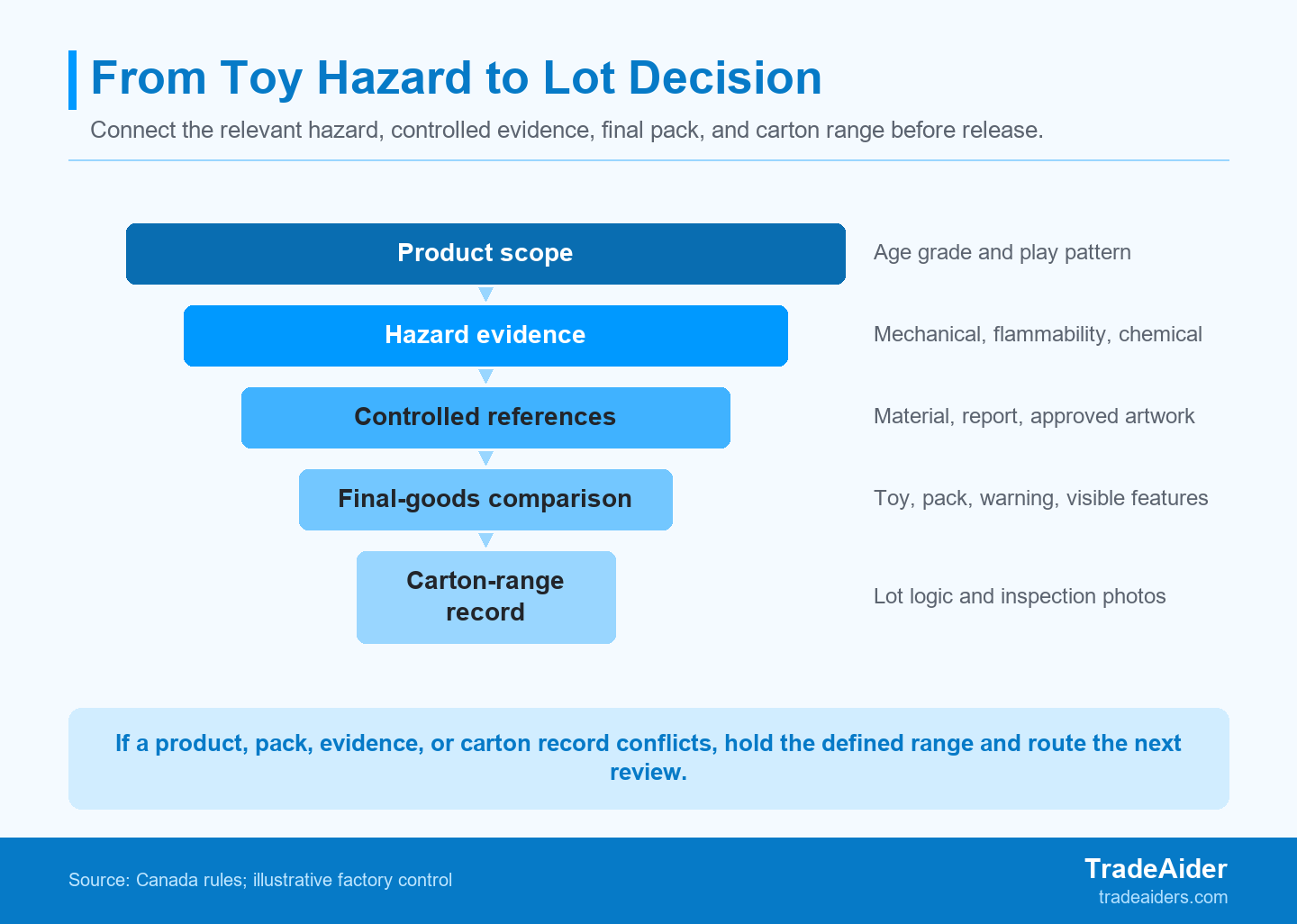
Use the funnel to preserve a product-to-evidence and carton-range record; it does not turn a factory observation into a laboratory or legal conclusion.
Do not let the inspection sample size blur that hold decision. An AQL inspection sample may help a buyer organize a finished-goods check, but it does not define a laboratory specimen or cure a missing material record. When a buyer needs to agree the physical inspection basis before the visit, it can calculate an inspection sampling plan and still keep every unresolved evidence conflict tied to the cartons in which it was found.
Illustrative Scenario: A Soft-Vinyl Accessory Conflicts With Its Report
A soft-vinyl component that differs from the controlled evidence pack creates a document-product conflict, not an on-site chemical conclusion. The following composite scenario shows a bounded factory-control response; it is not a TradeAider client case, a test result, or a determination of Canadian market compliance.
Situation, Problem, Action, and Result
Situation: A private-label importer is preparing an activity toy for Canada and needs final-factory evidence before shipment release.
Order context: The one controlled model has a defined blue soft-vinyl mouthable accessory, approved retail-pack artwork, and a carton plan for 480 export cartons.
Readiness state: All goods are completed and export packed, but the presented component cannot yet be reconciled to the controlled supplier material record.
Observation 1: During final sampling, the inspector observes a visually similar green soft-vinyl accessory in selected cartons from range C-241 to C-300.
Observation 2: The factory provides a packing list but cannot show a material-record link connecting those 60 cartons to the accessory named in the controlled evidence pack.
Analysis: The physical difference is a document-product conflict. It neither proves that the accessory exceeds a chemical limit nor confirms that the existing report covers the presented range.
Decision: The buyer holds the 60 identified cartons, keeps them separate from cartons that can be independently reconciled, and sends the observed product, material-record gap, report reference, and carton range to the responsible technical owner.
Corrective action: The factory either restores the controlled accessory or supplies a documented evidence path accepted by that owner, then updates the controlled reference before the held cartons return to a release decision.
Result: A controlled recheck of the held carton range can show whether the corrected component, final pack, and carton record now reconcile without turning the recheck into a chemical test. The recheck compares the accessory reference, age-grade pack, retail artwork, carton label, and first and last cartons in the held range. It does not authorize shipment by itself; the trade-off is the delay required to preserve a defensible lot boundary for the next owner-led decision.
Brief a Canada Toy PSI Around What Can Be Observed
A PSI is conducted when 100% of the order quantity is completed and at least 80% is packed for export. For a Canada-bound toy, the assignment should begin with the buyer’s controlled version—not a request to “check Canadian compliance.” Send the model and SKU list, age grade, approved product and package photos, relevant material or report references, carton numbering logic, packing status, sample basis, requested photos, and a named hold-and-escalation contact. Buyers can use that timing to scope a Canada-bound pre-shipment inspection around the finished goods, controlled evidence pack, and shipment record.
A Canada toy PSI brief should name the controlled toy version, age grade, evidence references, approved pack artwork, sample basis, required photos, carton logic, and the hold and escalation contact. Keep laboratory specimens and inspection samples separate: a laboratory sample answers the agreed technical question, while an inspection sample checks the selected finished lot against its supplied references. The report should state whether an item was reconciled, held for clarification, or not observed because the agreed reference was unavailable.
For the actual factory assignment, write the comparison points in plain language: “photograph the mouthable accessory beside the controlled reference,” “show the warning panel and retail-pack revision,” or “record the first and last carton numbers for the inspected range.” Include the factory address, contact person, planned inspection date, order quantity, production status, carton plan, and the person empowered to decide whether a mismatch requires correction, a technical review, or a targeted recheck. Add the approved revision date for every artwork file and report reference, plus a clear instruction for what to do if mixed cartons cannot be separated. This preparation gives the factory an actionable request and gives the importer a report that can support a controlled shipping decision rather than a generic pass/fail label.
If you already have those inputs and need help turning them into a factory-ready brief, request a Canada toy inspection scope review.
Who Is TradeAider?
TradeAider is a quality inspection, testing, and certification service provider in China. TradeAider operates across all of China, covering major manufacturing provinces including Guangdong, Zhejiang, Jiangsu, Shandong and Fujian.
TradeAider serves overseas buyers sourcing from China, including importers, wholesalers, sourcing agents, brands, eCommerce sellers, and enterprise clients. Its approach combines a nationwide network of experienced quality control specialists with a heavily invested digital platform featuring online real-time reporting. Clients can monitor inspections live, communicate directly with inspectors, and address issues during production rather than after shipment—a proactive model focused on problem-solving and prevention, not just defect identification.
For a Canada-bound toy assignment, the useful service conversation begins with the product version, factory location, packing status, approved product and package references, material or report identifiers, carton logic, and the person who can decide how a mismatch is handled. A China-side inspection can document agreed observations and preserve their link to the relevant export range. It does not replace the importer’s responsibility to determine the applicable Canadian requirements or the qualified technical owner’s decision on a testing path. This division of work helps the buyer receive a clear factual report while keeping a laboratory conclusion, market assessment, and release authority with the responsible parties.
Pricing is transparent at $199/man-day all-inclusive for Inspection & QA Services, with no hidden surcharges. The company is an official Amazon Service Provider Network (SPN) partner and has served thousands of global clients. Client testimonials published on the TradeAider website cite an 18% reduction in return rates and a 23% improvement in defects caught before shipment. These are client-reported figures and not a guarantee of future results. Learn more about its status as an Amazon Service Provider Network (SPN) partner.
Frequently Asked Questions
Factory observations, laboratory evidence, and importer release decisions have different owners and should be recorded separately. The answers below keep those boundaries clear while helping a buyer refine a Canada toy inspection brief.
Can a factory PSI prove a toy meets Canadian safety rules?
A factory PSI cannot prove that a toy meets Canadian safety rules because it can only document agreed observable facts and evidence mismatches. It cannot replace applicable laboratory testing, regulatory assessment, or the importer’s compliance responsibility. Its value is to compare selected finished goods, packaging, markings, and carton records with the buyer’s controlled references before export. When the physical product and evidence do not reconcile, the report should identify the affected range and route the question to the responsible owner.
Which toy features should trigger extra mechanical review?
Features that can detach, create sharp edges or points, trap a child, entangle, make excessive sound, or create a magnet or battery-access issue should trigger a product-specific mechanical review. The review should begin with the actual age grade, play pattern, materials, and approved product configuration. A PSI can observe and photograph agreed features, but the accountable technical owner determines whether a particular feature requires a method, test, correction, or further review.
Should a PSI retest soft vinyl for phthalates at the factory?
A PSI should not retest soft vinyl for phthalates at the factory because it cannot establish a chemical concentration through observation. It should preserve the relevant material identity and lot evidence, while an appropriate laboratory and responsible technical owner determine any chemical testing path. Ask the inspector to record the component, supplier material code, report reference, and carton range when a soft-vinyl part differs from the controlled version. That creates a usable handoff instead of an unsupported visual statement about a chemical concentration.
What label evidence should travel with a Canada-bound toy lot?
The lot packet should include approved product and package artwork, applicable warning references, product identifiers, dealer details where relevant, quantity declaration references, and the carton or batch records that connect them to final goods. Add a photo list that names the exact panels and components to capture. The final comparison should record what was observed against the approved file, not ask an inspector to make the legal determination that the artwork is sufficient for every applicable requirement.
What should an importer hold after a material-record mismatch?
Hold the smallest clearly identifiable carton range connected to the unresolved material record, then keep it separate until the responsible owner gives a controlled correction and recheck path. Preserve the product, packaging, material reference, factory record, carton numbers, and photos together. If the factory cannot show a reliable boundary between changed and unchanged goods, expand the hold to the range that cannot be distinguished rather than assuming an earlier report covers it.
Related Articles
Grow your business with TradeAider Service
Click the button below to directly enter the TradeAider Service System. The simple steps from booking and payment to receiving reports are easy to operate.

