
- About Us

- Our Services
- Your Industry
- Resources
- News & Blog
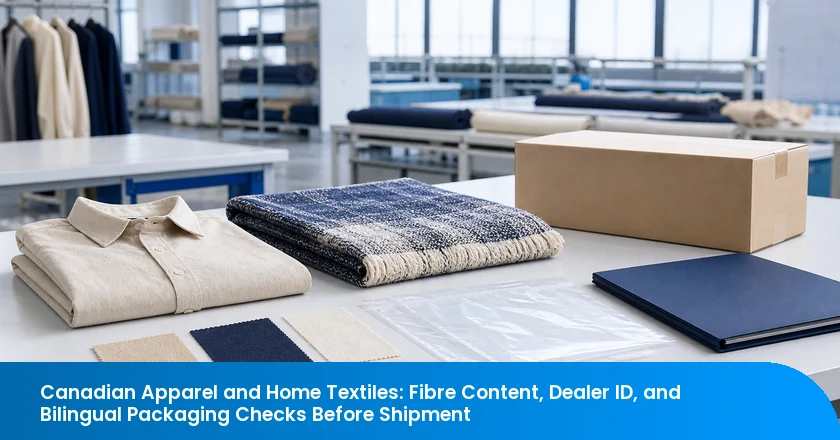
A Canada textile label release chain is a buyer-controlled method for connecting current fibre data, dealer information, approved artwork, final packaging, and a traceable carton range before shipment.
For apparel and home textiles, a label proof is only one piece of evidence. A revised fibre percentage can miss a colourway, a dealer line can change on a hang tag, or the final wrapper can hide information that the buyer expected to be visible at retail. The practical question is not “Was this artwork approved?” It is “Can this packed SKU still be connected to the current source data and a defined lot?”
A factory-facing control path turns Canadian textile-labelling requirements into a release record: it separates observable comparisons from legal, technical, and buyer-release decisions. It does not determine whether a particular article is regulated or replace any required fibre testing.
Canada Textile Release Controls
Current data, correct presentation, and a traceable lot are the three operational links a buyer controls. For a Canada-bound textile order, use them together rather than treating a label PDF as the final approval.
- Definition: The useful unit of control is the current SKU and its final retail presentation, not a generic “Canada label” file.
- Language: Review generic fibre names and fibre-content information against the applicable English-and-French presentation rule; do not turn that condition into a blanket rule for every field.
- Decision: If an artwork version, final pack, or carton record cannot be reconciled, hold the identifiable range and route the unresolved question to its accountable owner.
- Inspection scope: A final factory check can compare approved references with observable goods and packaging, but it is not a laboratory fibre analysis or a legal approval.
The Canada Textile Label Release Chain
A required disclosure label shows textile fibre content and, subject to exceptions, dealer identification information. Section 11 of the Textile Labelling and Advertising Regulations lists the core fields, while the Competition Bureau’s overview places the responsibility on manufacturers, importers, and retailers.
The Canada Textile Label Release Chain is a buyer control method, not an official legal test. It asks the buyer to preserve four links: current product data; approved label artwork; final article and retail pack; and SKU-to-carton traceability. A release recommendation is only as narrow as the narrowest verified link. If the artwork is right but the carton record is unknown, the buyer cannot reliably confine a hold.
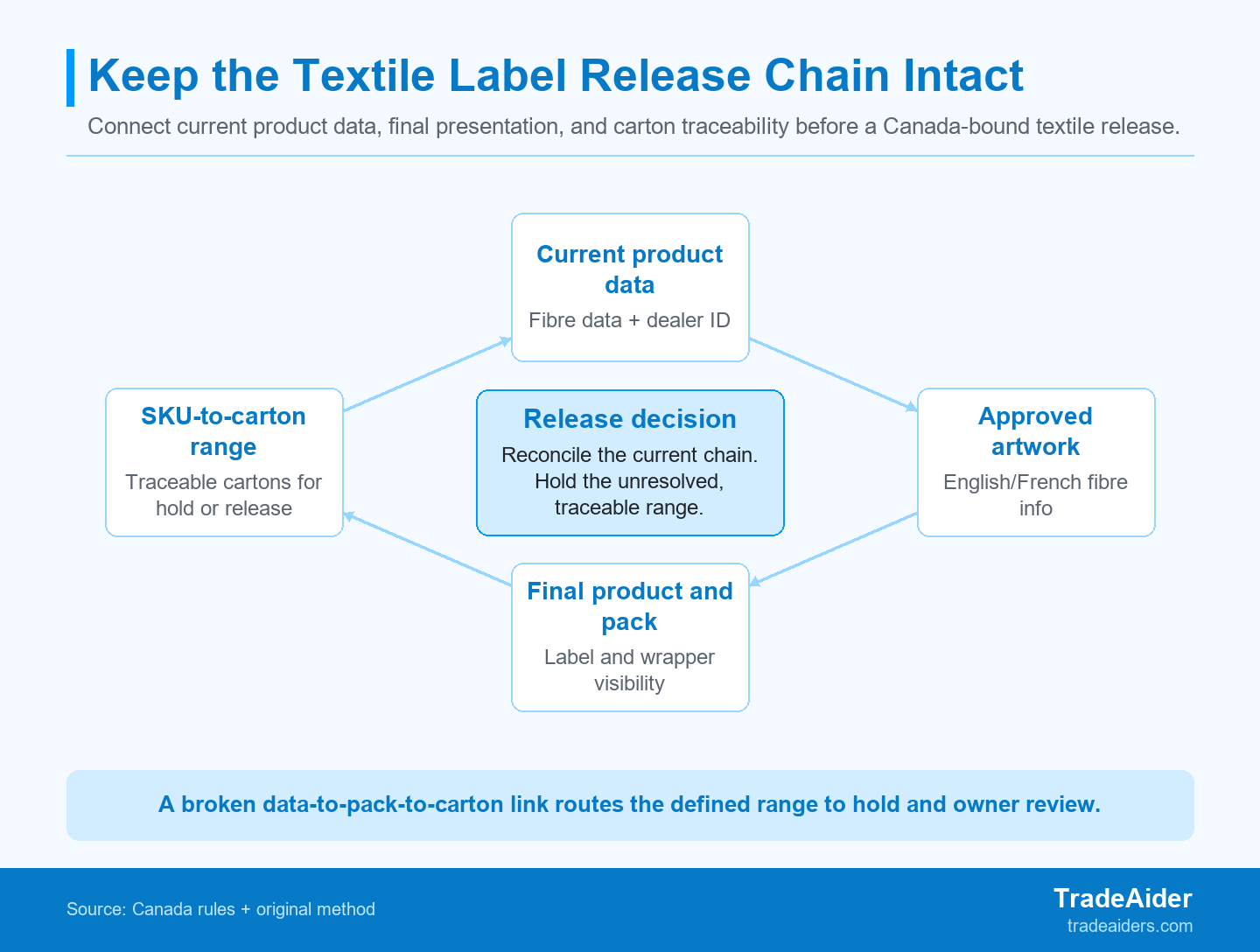
Use the loop to preserve the connection between controlled product information and a defined carton range; it does not replace legal review or technical testing.
Start by naming the owners. The importer or brand should control the product-data source and approved artwork revision. The factory should control application of the current labels and the packing record. The inspection brief should name exactly which references will be compared on site. Legal, regulatory, and technical owners should decide unresolved applicability questions. That division prevents a physical inspection from being asked to certify a conclusion it cannot support.
The framework also works upstream. If fibre data, packaging artwork, or a dealer line is still moving during production, use During Production Inspection to surface the production-stage condition before large quantities are sealed into retail packs. For buyers working with TradeAider, the brief turns a general request to “check Canadian labels” into a controlled evidence packet. The final check then confirms the version that actually reached the shipment, rather than re-opening every design decision at the dock.
Check Five Records, Not One Label Proof
The best label review separates records that often drift independently. Fibre data answers what the product is represented to contain. Dealer identity answers who is identified on the textile label. Language, legibility, permanence, and wrapper visibility answer how that information reaches the buyer. A change to one record does not prove that the other four stayed current.
| Control record | Buyer-controlled reference | Final-goods comparison | Release response if it conflicts |
|---|---|---|---|
| Fibre content | Current specification or approved material record | Generic fibre name and percentage on the current SKU | Hold the affected SKU range and obtain accountable-owner direction |
| Language presentation | Approved Canada artwork revision | English and French fibre information where the rule applies | Correct the artwork or label application before recheck |
| Dealer identity | Approved dealer line or eligible CA-number record | Current tag, label, or specified presentation | Stop release of the traceable range until the identity field is reconciled |
| Label and wrapper visibility | Approved packaging and retail-display plan | Legibility, accessibility, and any needed package repetition | Hold the affected pack configuration and review the presentation rule |
| SKU-to-carton traceability | Packing list, carton marks, and revision log | Observed SKU, pack version, carton range, and photos | Use a bounded hold only if the affected range is demonstrably identified |
Except in areas where only one official language is used in consumer transactions, generic fibre names and fibre content information must be shown in English and French. The Competition Bureau’s fibre-content guidance gives that condition. Put it into the artwork field for each SKU; do not simply tick “bilingual” for a whole product family after one sample review.
A CA identification number may be used in place of a dealer's name and address when the stated conditions are met. The Competition Bureau’s CA-number guidance explains the condition. Keep the eligibility decision, the exact identity presentation, and the artwork revision together so a production change does not place an outdated identity line on only part of an order.
A disclosure label must be legible and accessible to the consumer at the time of purchase. The Competition Bureau’s label guidance sets that presentation condition. When an attached label is not visible, the buyer should have the accountable owner confirm whether required information must also be shown on the wrapper, package, or container.
Where a permanent label is required, confirm the expected construction from the current product plan rather than relying on an artwork file alone. The Bureau’s business guidance describes a permanent label as remaining attached and legible after ten cleanings, and lists examples that include bed linens, towels, and draperies. An on-site observer can note attachment and legibility; whether the evidence is sufficient for the article remains a technical-owner decision.
Turn the Chain Into a Final-Factory Brief
A PSI is conducted when 100% of the order quantity is completed and at least 80% is packed for export. TradeAider’s Pre-Shipment Inspection page states that approved service timing. It matters here because a label-control check needs final goods, final retail packaging, and enough packing evidence to connect an observation to an export range.
Factory observation can record a match or conflict against supplied evidence; accountable owners retain legal and technical decisions. In practical terms, the inspector can compare the current SKU, sewn label or hang tag, retail wrapper, carton mark, and revision reference. The inspector should not be asked to infer fibre composition by sight, decide a regulatory exception, or turn a visual observation into a legal clearance.
A useful final-factory brief has four instructions: identify the current approved product-data source; attach the artwork revision for each inspected SKU; state where information should be visible at purchase; and require the report to connect each observation to a carton range. If the buyer has an unresolved fibre, testing, or applicability question, place it in the brief as an owner question rather than turning it into an inspector pass/fail criterion.
This is where a pre-shipment inspection becomes a decision aid instead of a generic checklist. TradeAider can compare the buyer-provided packet with observable final goods and packaging, photograph the relevant presentation, and record the scope and carton traceability. The buyer still decides whether the reconciled evidence supports release.
Use Traceability to Limit a Hold
Only the defined carton range is held when the affected revision can be proven by the carton record. That is the operational payoff of the Canada Textile Label Release Chain: it makes a narrow decision defensible when the evidence is narrow, and it signals when a broader hold is safer because the evidence is not.
Illustrative Scenario: A Traceable Artwork Rework
The illustrative hold covers the 24 cartons linked to the obsolete artwork revision. This is a fictional control example, not a client case or a statement about legal sufficiency.
Situation: A Canadian private-label importer is preparing seasonal towels and bedding sourced from China. The order has 18 SKUs across 240 export cartons, and two label artwork revisions were issued after a supplier-data correction.
The buyer’s current packet contains the SKU matrix, the revised artwork, a packing plan, and the owner list for unresolved questions. All units are complete, while 216 of the 240 cartons are packed for export.
The factory can present both the final retail pack and a carton map before dispatch. That makes a focused comparison possible, but it does not by itself resolve whether the old label wording is acceptable.
Problem: Four SKUs in cartons CT-081 through CT-104 show the earlier fibre-content artwork revision rather than the current reference packet.
The packing list and carton marks identify CT-081 through CT-104 as a distinct, traceable range. The remaining 216 cartons map to the current revision, so the buyer does not need to guess which output is affected.
The discrepancy is a document-version conflict with a bounded physical scope. The current references do not support release of the 24 cartons, yet the carton evidence supports a separate decision for the other 216 cartons. If the cartons had been mixed or the revision log were missing, the hold would need to expand because the affected range could not be demonstrated.
Action: Keep CT-081 through CT-104 segregated and on hold. Release consideration can continue for the reconciled 216 cartons only after the buyer confirms that the outstanding commercial and regulatory decisions are closed.
The factory replaces the affected labels, records the corrected artwork revision against the four SKUs, and retains the carton-range record. The correction is tied to the existing pack configuration so the recheck does not accidentally verify a different variation.
A focused recheck compares the corrected label revision, SKU, retail-pack presentation, and carton-range record. It does not repeat the entire inspection unless the records show that the problem is wider than the identified range.
Result: The 24 affected cartons remain blocked until the corrected artwork and SKU matrix reconcile, delaying their release but preserving a bounded decision. This illustrative scenario shows version and lot control only; it does not determine legal sufficiency or measure fibre composition.
Prepare the Release Packet Before You Schedule
The release packet must let a reviewer connect each checked SKU and final pack to a defined carton range. Build it before the factory visit, not while the inspector is looking for files on a production floor.
- Approved material record: identify the approved fibre-content and material reference for each SKU or variant.
- Approved artwork revision: include the label, hang tag, care label, and retail-package files that the factory should be using now.
- SKU and variant matrix: show the colour, size, set, or fabric differences that change information or presentation.
- Packing and traceability plan: state the carton marks, carton ranges, pack configuration, and current packing status.
- Owner questions and release rule: name what the inspector should record, which mismatch triggers a hold, and who decides any unresolved legal or testing question.
When the shipment is close to dispatch, give the inspection team the approved packet, the packing status, and the carton plan in advance. To schedule your inspection, share those four inputs—current artwork, fibre-data source, SKU matrix, and packing status—so the scope can be written as a document-to-lot comparison rather than a vague request to “check Canadian labels.”
Who Is TradeAider?
TradeAider is a quality inspection, testing, and certification service provider in China. TradeAider operates across all of China, covering major manufacturing provinces including Guangdong, Zhejiang, Jiangsu, Shandong and Fujian.
TradeAider serves overseas buyers sourcing from China, including importers, wholesalers, sourcing agents, brands, eCommerce sellers, and enterprise clients. Its approach combines a nationwide network of experienced quality control specialists with online real-time reporting, so buyers can monitor inspections, communicate directly with inspectors, and address issues during production rather than only after shipment.
Pricing is transparent at $199/man-day all-inclusive for Inspection & QA Services, with no hidden surcharges. TradeAider is an official Amazon Service Provider Network (SPN) partner. Client testimonials published on the TradeAider website cite an 18% reduction in return rates and a 23% improvement in defects caught before shipment; these are client-reported figures, not guarantees.
TradeAider also provides testing services, covering Hardline Products, Softline Products, Electrical & Electronic Products, and Industrial Products, enabling buyers to manage quality control and testing needs within a single service framework.
Frequently Asked Questions
Factory observation can verify supplied-reference matches; it does not decide legal applicability or testing sufficiency. Use the answers below to refine the release packet and route decisions to the appropriate owner.
Must every Canadian textile label be bilingual?
A Canadian textile label is not always required to be bilingual; fibre-content information is generally required in English and French, subject to the stated transaction-language exception. Review the applicable product, retail setting, and current official guidance before the buyer approves the final artwork, and keep the decision linked to the current SKU rather than a general family-level assumption.
Can a CA number replace the dealer address?
An eligible dealer may use a CA identification number instead of its company name and full postal address when the stated conditions are met. Keep the eligibility evidence, exact number, and approved label revision together because the option is conditional rather than automatic, and do not treat a prior label version as proof that the current variation remains eligible.
What does a factory inspection verify on a textile label?
A factory inspection can compare the current product, label, retail pack, and carton records with the buyer-approved reference packet for the defined lot. It can document what is observable, including an artwork mismatch and its carton range, but it cannot establish fibre composition by sight or issue a legal compliance determination.
When should a textile shipment be held for label review?
Hold the traceable affected range when the current fibre data, dealer line, language copy, product label, wrapper, or SKU record cannot be reconciled. State the unresolved field and its decision owner in the report. If the affected scope cannot be traced, consider a broader hold until the record gap is resolved.
Does pre-shipment inspection prove textile legal compliance?
Pre-shipment inspection does not prove textile legal compliance because it records observable conditions and reference matches rather than deciding regulatory applicability or testing sufficiency. Legal applicability, label approval, and any required testing remain accountable-owner decisions. Its value is a factual final-lot record that helps the buyer make a more informed commercial release decision.
Related Articles


Grow your business with TradeAider Service
Click the button below to directly enter the TradeAider Service System. The simple steps from booking and payment to receiving reports are easy to operate.

