
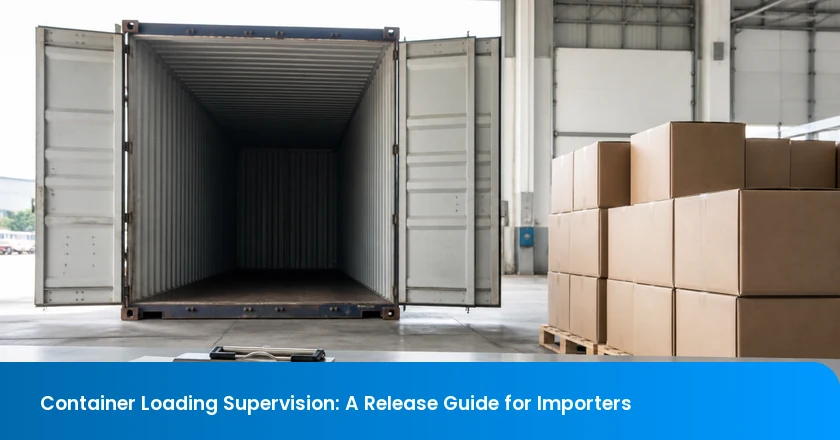
Container loading supervision gives an importer a usable release decision only when the observed cartons, the container, and the final paper trail can be reconciled before the doors close. When working with TradeAider or another inspection provider, define that evidence chain before the loading date so that the team knows exactly what can justify a hold or release.
What Must Match Before a Container Is Released?
A buyer release decision needs four connected proofs, not one broad pass signal. Container loading supervision is most useful when it connects the cartons that were supposed to ship, the condition and loading of the container, and the records that travel with that same shipment. A pass on only one of those points can still leave an importer unable to explain what was loaded, which cartons were held back, or whether the final paperwork describes the packed lot.
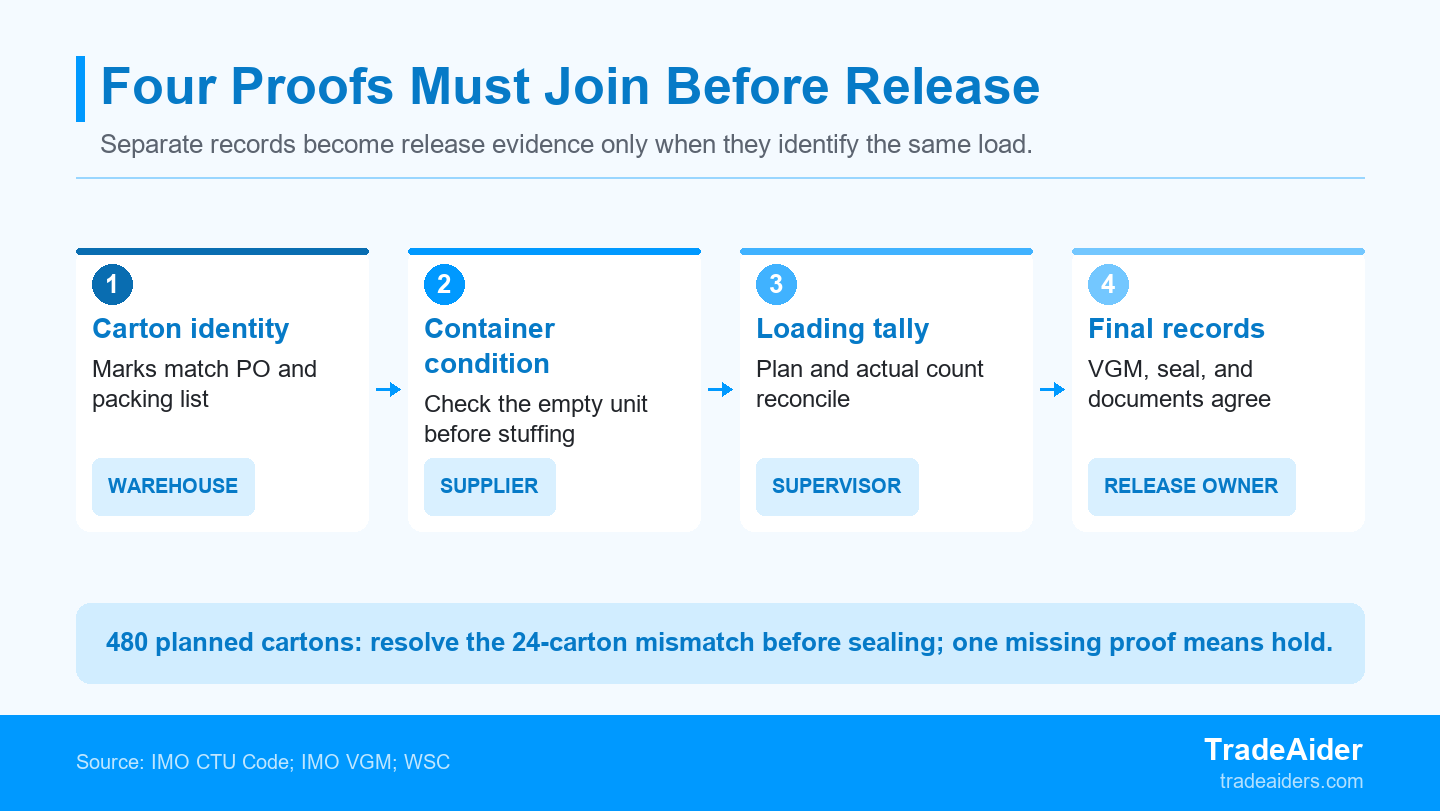
The container may be released only after four connected proof gates identify the same physical shipment.
Use the following four checks as one release frame. They are a buyer control method, not a substitute for carrier instructions, customs requirements, or the terms of a purchase order. The practical question is simple: can each final record be traced to the same container and the same carton population while the goods are still accessible?
- Order identity: the purchase order, SKU lines, carton marks, and packing list identify the cartons expected to load.
- Container readiness: visible container condition is recorded before stuffing begins, with any concern resolved before cartons are concealed.
- Controlled loading: the tally and loading plan show what entered the container, in which block, and under which document line.
- Final corroboration: the container number, seal field, weight status, photographs, and final documents refer to the same packed scope.
A buyer does not need to collect every possible photograph or form. The objective is to avoid disconnected proof: a clean-container photo with no carton tally, a seal number with no loading record, or a signed packing list that cannot be reconciled to the cartons on the floor.
What Container Loading Supervision Can and Cannot Establish
A loading record is only as strong as the agreed visibility and count method. A supervisor can record visible container condition, carton marks, the count method, loading sequence, seals, and exceptions that occur during stuffing. That does not certify hidden inner contents, replace a product inspection, or establish a fact the observer could not see. Write the observation scope into the release brief before the team arrives, especially where cartons are mixed, reworked, or split between containers.
The CTU Code provides guidance on loading and securing cargo in containers across the intermodal transport chain. The IMO/ILO/UNECE CTU Code is useful context for a buyer because it treats packing and securing as an upstream activity, not merely a port handoff. For an order-level visit, a container loading supervision service should therefore work from the approved order documents and specify what evidence will be captured during the event.
Start With the Empty Container, Not the Seal
Annex 7 says the fitness of the envisaged CTU should be verified before packing actually commences. The CTU Code’s detailed guidance makes that timing clear; the International Convention for Safe Containers separately addresses the testing, inspection, approval, and maintenance framework for internationally used freight containers. A loading-time observation is not a technical certification, but it can document visible holes, damaged flooring, odour, standing water, protrusions, contamination, door function, and the displayed container number before the first carton removes access.
Make the record usable rather than decorative. Pair wide photos of the empty interior with close images of any anomaly and a short status note: acceptable, held for replacement, or accepted under an agreed instruction. If the condition is unsuitable, stop before loading begins and record the escalation. A seal applied at the end of an otherwise undocumented loading event cannot prove that the container was suitable at the start.
Treat the Loading Plan as a Control Document
A loading plan becomes a release control when it can be reconciled to actual carton identity and count. The CTU Code guidance on packing operations calls for planning in advance as far as practical. For import release, add the fields that make the plan testable: purchase-order reference, SKU or carton-mark group, planned quantity, planned loading block, tally method, photo point, and the person authorised to resolve a difference.
A plan that says only “load 480 cartons” leaves too much room for silent substitution. A plan that divides the load into four identifiable blocks lets the team locate a discrepancy before the doors close. Align carton marks and count rules with the approved requirements in an inspection standard resource, then give the warehouse team a version-controlled copy. When cartons are relabelled, repacked, or moved to a separate lane, the plan should show the change rather than rely on a verbal explanation.
Build the Evidence Chain Before the Doors Close
Physical facts become release evidence only when they match the documents for the same shipment scope. Start by linking a carton mark and quantity to a purchase-order line. Link that line to a staged loading block, then link the completed loading record to the container number and final packing document. When one link changes, the release decision should pause long enough to identify whether the change affects the whole container or only a defined group of cartons.
Safe transport of containers starts at the source, where goods or materials are produced and packed for shipping. The World Shipping Council’s container-integrity guidance makes the timing important: after the doors are closed, the buyer often has only records to interpret. Before closure, the loading team can compare physical carton marks, tally sheets, staging lanes, and the current packing-list version. The four-proof rule turns those ordinary observations into a single question: does the release packet describe the same physical shipment that is about to leave?
Keep the evidence chain proportionate to the order. A low-complexity, single-SKU load may need a representative carton-mark record and a clear final count. Mixed-SKU, high-value, first-order, or split-shipment loads usually need block-level counts and a more deliberate photo trail. The point is not to promise that every image proves every carton; it is to make an exception traceable while correction is still possible.
Use Weight Records and the Seal as Corroboration, Not a Substitute
Verified gross mass (VGM) is the documented total weight of the packed container used for safe vessel stowage. VGM supports verified weight for vessel loading; it does not identify every carton. Under the IMO’s SOLAS VGM framework, the shipper is responsible for providing the verified weight in the shipping document in time for the ship’s stowage plan. Retain the VGM status in the release packet, but do not treat a correct total weight as proof that the right SKU mix or carton quantity was loaded. Different carton combinations can produce a plausible total mass.
The same limit applies to the seal. IMO’s overview of safe container transport distinguishes container, stowage, securing, and weight controls; a seal is only one closure record within that wider chain. Record the seal number, application time, container number, and the person who witnessed application. Then link that record to the last accepted tally and packing-list version. A seal confirms that the container was closed; it does not turn an unobserved or mismatched load into proven release evidence.
Worked Scenario: The Packing List and the Loaded Cartons Do Not Agree
When a mismatch occurs, define the affected scope as the identifiable cartons or loading block touched by that mismatch. Where it points to an earlier packing or production-control problem, a planned during-production inspection can provide an earlier checkpoint on a future order.
Reconcile the Affected Scope Before Sealing
This is an illustrative composite example. An operations manager at a home-goods importer is releasing a first container order from a new supplier. A 40-foot high-cube container is planned for 480 cartons across three SKU groups, divided into four 120-carton loading blocks on the packing plan. The finished cartons are beside the container, the carrier cutoff is approaching, and the team expects to apply the seal after the final block.
The fourth loading block shows 96 cartons on the tally sheet although the plan calls for 120. The remaining 24 cartons have the same outer carton mark but sit in a separate staging lane with no revised packing-list line. The 24 cartons in the separate lane and the fourth 120-carton block are kept accessible. Hold the affected 120-carton block until tally, carton marks, photographs, and documents match. The seal would show only that a container closed; it cannot answer whether those cartons were omitted, substituted, double-counted, or assigned to the wrong document line.
24 divided by 480 equals 5%. That calculation is not a universal acceptance tolerance; it shows why a visible difference deserves a concrete release decision before time pressure turns it into a post-shipment argument.
Trace the affected cartons to the tally, marks, images, and corrected documents before sealing or release. Count the separate lane, identify its SKU and purchase-order line, compare its marks to the packing plan, and correct the plan or packing-list version if required. If the buyer approves a split shipment, record exactly which cartons remain out, rather than simply changing the total. Release only when the 480-carton total, or an approved documented split, is supported by the tally, visible carton marks, loading photographs, and final packing documents.
This example does not prescribe a universal count tolerance. The purchase order and logistics arrangement determine whether a split is acceptable, how the carrier cutoff is handled, and who can authorise it. The operational boundary is firm even where the commercial answer varies: do not treat unresolved physical and documentary differences as a routine loading note.
Prepare a Release Packet the Loading Team Can Use
A release packet makes the PO, physical loading record, and shipping fields reconcilable before the doors close. Prepare it early enough that the warehouse, supplier, inspector, forwarder, and buyer know which version controls. It should be short enough to use at the loading bay and specific enough to assign a hold decision to a named person rather than an unowned email thread.
| Release-packet item | What it connects | Release check | Owner when it differs |
|---|---|---|---|
| PO and approved packing list | SKU lines, carton quantities, document version | Matches the cartons planned for this container | Buyer or authorised supplier contact |
| Carton marks and loading tally | Physical cartons to each loading block | Count method and observed quantity are recorded | Warehouse lead and loading supervisor |
| Container condition and loading plan | Empty-container record to the stuffing sequence | Visible condition accepted before loading begins | Supplier logistics contact |
| Container number, VGM status, and seal field | Final shipping records to the completed load | Fields point to the same released scope | Shipper and appointed release owner |
TradeAider describes PSI as a final check of finished goods against specifications and export packing before shipment. Use that earlier final-goods control when the unresolved question is product or pack quality; use loading supervision when the unresolved question is whether the observed, documented shipment was loaded and closed as agreed. The two controls can complement each other, but neither should be represented as evidence for work it did not observe. For a finished order that needs this earlier check, arrange a pre-shipment inspection.
Frequently Asked Questions
Does container loading supervision replace pre-shipment inspection work?
No, because loading supervision records the shipment event while pre-shipment inspection checks finished goods and export packing before loading. Loading supervision records the loading event; PSI checks finished goods and export packing before loading. A loading visit can document the condition of the container, the observable sequence, carton marks, counts, and closure records. Define the scope of each visit so that a loading record is not used to imply unobserved product testing or quality approval.
Can a seal number prove every carton was loaded?
No, a seal number identifies the closed container but does not independently prove carton quantity, product identity, or concealed condition. A seal number cannot prove every carton was loaded without the linked physical tally and identity record. It becomes useful release evidence when it is linked to the observed container number, the final tally, the packing-list version, and a record of when the seal was applied. The seal should close a documented shipment, not conceal an unexplained one.
Who is responsible for verified gross mass information?
Under the SOLAS VGM framework, the shipper is responsible for providing verified weight in the shipping document in time for the ship’s stowage plan. The shipper is responsible for providing the verified weight by stating it in the shipping document. Commercial parties may arrange weighing and document preparation in different ways, but the release packet should make the responsible shipper, status, method, and final value visible before handover. Keep VGM in its proper role: it confirms a documented weight for vessel loading, not the identity or count of every carton in the container.
What should happen when the carton count does not match?
Pause sealing or release of the goods under review until the staged count, loading record, packing list, and cause of the difference are reconciled. A carton-count mismatch should pause release of the affected scope until the physical and documentary records reconcile. Mark the goods under review, keep them accessible where practical, and identify whether the issue is an omission, substitution, duplicate tally, relabelling, or approved split. Release only when the final evidence records the actual outcome and the person authorised by the order has accepted any documented exception.

Related Articles


Grow your business with TradeAider Service
Click the button below to directly enter the TradeAider Service System. The simple steps from booking and payment to receiving reports are easy to operate.

