
- About Us

- Our Services
- Your Industry
- Resources
- News & Blog
A CPC PDF is not a release control when the product ID, lot, test support, and broker handoff no longer describe the same finished shipment. For a covered US import, the practical task is to build a current-evidence chain before final packing: the finished product must connect to the applicable certificate route, the supporting test basis, the production or lot record, and the data the broker will use at entry.
A Children’s Product Certificate (CPC) is the certificate route for a children’s product that is subject to applicable children’s product safety rules. A General Certificate of Conformity (GCC) is a different route for certain regulated general-use products. A reliable shipment handoff keeps factory evidence, certificate responsibility, and broker data aligned with the goods actually being exported. Product-specific classification, test sufficiency, and entry decisions remain with the responsible compliance and trade parties.
Why 2026 eFiling Is a Release-Control Change
For covered imported consumer products, eFiling changed the release task: certificate data must be ready for the import entry, not merely stored for later retrieval. CPSC’s eFiling program sheet identifies July 8, 2026 as the date for most regulated consumer products and January 8, 2027 for the stated Foreign Trade Zone route. The agency’s FTZ guidance also describes certificate data as part of the entry-time handoff to CBP.
That timing does not mean a new PDF has to be created at the port. It means the records behind the certificate must be settled early enough for the responsible firm and broker to transmit the right data for the right finished product. A factory can help by preserving product, lot, label, carton, and packing-list evidence. It cannot make an unclassified item compliant by attaching a generic certificate.
- Start with scope: confirm whether the finished product is subject to a CPSC certification requirement before assuming eFiling applies.
- Build for the current shipment: a prior test report or certificate is useful only when its product and production coverage can be demonstrated.
- Agree the broker handoff before release: the filing method affects the fields or identifiers the broker needs, but it does not cure an evidence mismatch.
For an overseas factory team, the important operational shift is simple: “certificate available” is not the same as “certificate data ready for this shipment.” The evidence chain must be assembled while the product and export cartons can still be checked, separated, or corrected.
CPC and GCC Are Separate Certificate Routes
A CPC and a GCC are not two labels an importer chooses between for the same item: the children’s-product and general-use routes have different testing and certification bases. CPSC’s certificate briefing materials and final-rule materials separate the two routes. The actual product, its intended user, and the applicable rules determine the route; a factory, retailer, or inspection company should not guess from a product name alone.
This distinction matters at shipment release because it changes the evidence you ask for. A children’s product may need applicable third-party testing by a CPSC-accepted laboratory to support its CPC. A GCC follows a different general-use route. Neither label tells a buyer, by itself, whether the report, production range, and certificate data fit the cartons now being prepared for export.
Category-specific testing can add further detail. For children’s sleepwear, for example, garment scope, fabric, trims, labels, and production units may need to be connected before a certificate is treated as current. The applicable evidence varies by product; that focused example is not a rule for all children’s goods.
Start With Retrievable Underlying Records
A foreign factory’s certificate does not transfer CPC responsibility; the importer needs due care and access to the underlying testing and related documentation. CPSC’s published rulemaking briefing materials tie children’s-product certificates to the appropriate third-party testing basis and certificate information.
Before a factory visit or a broker handoff, ask for the document set in a form the responsible party can retrieve and review: the test report references, applicable-rule citations, product identifiers, manufacturer and production information, and the record owner’s contact details. A screenshot of a report summary, an unlabeled PDF, or an email saying “same as last order” leaves too much unexplained when a product or lot has changed.
Then Name the Responsible CPC Issuer
The domestic manufacturer or importer remains responsible for issuing a CPC even when a laboratory or another party helps prepare records. CPSC’s certificate materials explain that responsibility. In practice, the release packet should name that owner before anyone requests a factory-side “compliance check.” It keeps the factory’s task practical—show the controlled product and packing evidence—and keeps certificate issuance where CPSC rules place it.
For imports, also make the trade-party roles explicit. The Importer of Record (IOR) is the party eligible to make entry, but the actual certificate responsibility and broker instructions must be confirmed for the specific entry structure. Do not use an inspection brief to quietly reassign a regulatory role. Use it to show who supplies the current files, who decides whether a discrepancy requires a hold, and who sends corrected data to the broker.
Build a Product-to-Certificate Evidence Chain
The useful factory release question is whether the current product identifier, production range, lot, tests, certificate fields, and packed shipment point to the same finished product. The Product Registry User Guide identifies the product and production fields that make this reconciliation possible. Treat it as a reconciliation exercise, not as document counting: a tidy folder can still be wrong if it refers to a prior material, colorway, component source, model revision, or untraceable production range.
Product Registry records use product identification and production fields, including manufacturer, manufacture date, production dates, and lot number; CPC entries use CPSC-accepted laboratory selection. The Product Registry User Guide makes those fields concrete. They create named links between product, production, testing, and the certificate record.
| Record | What must agree | Useful factory evidence | Hold trigger |
|---|---|---|---|
| Product identity | Product name, SKU, model, style, or other controlled identifier | Selected unit, approved artwork, product label, packing list | The identifier points to a different product or revision |
| Production or lot identity | Manufacture date, lot range, production range, and carton coverage | Lot mark, carton mark, packing list, production record | The shipped range cannot be connected to the record |
| Test basis | Applicable test references, laboratory, and product coverage | Approved report reference and controlled product comparison | A material, design, source, or required record change is unresolved |
| Certificate and handoff | Certificate route, current version, and broker payload | Certificate reference, handoff confirmation, carton range map | The broker has an old version or a mismatched identifier |
Based on this comparison, the release decision should follow the weakest unlinked record. A correct label does not repair a stale certificate version, and a current report does not repair cartons that cannot be tied to the covered lot. The goal is not to demand every possible document from the factory. It is to make every supplied record answer one traceability question.
If a material, label, or packing change appears before final packing, it is usually more controllable when the buyer can verify a changing production run during manufacturing against the approved references. That check does not issue a certificate; it can prevent a repeated physical change from spreading through the lot that will later be mapped to certificate data.
Test Coverage Must Reach the Shipment You Plan to Release
A CPC that covers multiple production batches or lots still needs due care and identifying information that connects it to the continued production coverage. CPSC’s certificate materials describe certificate content such as manufacture and testing information. For a release team, the practical question is whether those fields still reach the units and cartons in front of them.
Use a change log, even if it is simple. Record whether the factory changed the product design, component source, material, supplier, color, manufacturing process, labeling, or packing configuration after the support record was created. A “no material change identified” note is useful only when someone can say which version, lot, and physical fields were compared. If that chain is missing, hold the affected range for a responsible review rather than trying to infer coverage from a familiar product name.
Choose the Broker Handoff After the Evidence Matches
A Full PGA Message Set gives the broker seven certificate data elements; a Reference PGA Message Set requires three registry identifiers after the certificate has been entered in the Product Registry. CPSC’s Product Registry FAQ identifies the Reference fields as Certifier ID, Product ID, and Version ID. The filing method should be an output of the evidence chain, not the first decision the team makes.
| Handoff route | What reaches the broker | Best operational use | Release-control question |
|---|---|---|---|
| Full PGA Message Set | The required certificate data for the imported product at entry | A limited number of products or a shipment needing a direct full-data handoff | Does the supplied data describe this product and current lot? |
| Reference PGA Message Set | Certifier ID, Product ID, and Version ID that point to a Product Registry record | Repeated imports of the same product when the certificate record is current | Does the referenced version still match this shipment? |
Based on this comparison, use the Reference route only when the underlying registry record is actually reusable for the shipment. A repeated product name is not enough. The CPSC rulemaking package describes Full and Reference PGA methods as two ways to transmit certificate information, while the reference route depends on the correct certificate identifiers. If a certificate was updated, the broker needs the new reference—not the identifier saved from the last shipment.
Keep the handoff compact and owned. Give the broker either the validated full data or the three validated identifiers, plus a contact who can confirm a version question. Keep complete reports and working records with the responsible party unless a broker specifically needs an additional document. That division reduces the chance that an uncontrolled email attachment becomes the source of the entry data.
Use Factory Checks for Observations, Not Certification Decisions
A factory-side inspection can compare agreed observable product, label, carton, and lot fields with a supplied release packet; it cannot classify a product, issue a CPC or GCC, or file the entry. CPSC’s small-business reference guide places third-party testing and certificate duties with the appropriate product and responsible firm, while an inspection deals with what can be physically observed in the agreed sample and packing population.
For TradeAider, a useful factory-side brief might say: compare the selected product’s SKU, label revision, visible tracking or lot field, retail-pack artwork, carton mark, and packing-list range with the named release packet; photograph a discrepancy; and report the affected range. It should not say “confirm compliance.” The first instruction is observable. The second asks an inspector to make a legal and certification judgment that belongs elsewhere.
Before booking the visit, use an agreed field list to set observable checks against an inspection standard. The buyer should also name the acceptance decision owner. A report can document what was found; it does not decide whether a changed component needs new testing or whether a certificate record can be filed.
Pre-Shipment Inspection is best scoped once the order quantity is 100% complete and at least 80% packed for export. The 80% threshold refers to packing readiness, not production completion. At that point, selected cartons, product markings, labels, and packing-list ranges can be compared with the evidence packet while the shipment is still under the buyer’s release control.
Apply a Four-Record Release Rule
A shipment should be held for reconciliation when any of four connected records is missing or inconsistent: product identity, production/lot identity, test basis, or certificate-and-broker handoff. The Product Registry User Guide supplies the product and production fields that underpin this practical release-control rule. It is not a statutory test or a determination of admissibility; it turns a scattered compliance folder into one question: do all four records describe the shipment that is about to move?
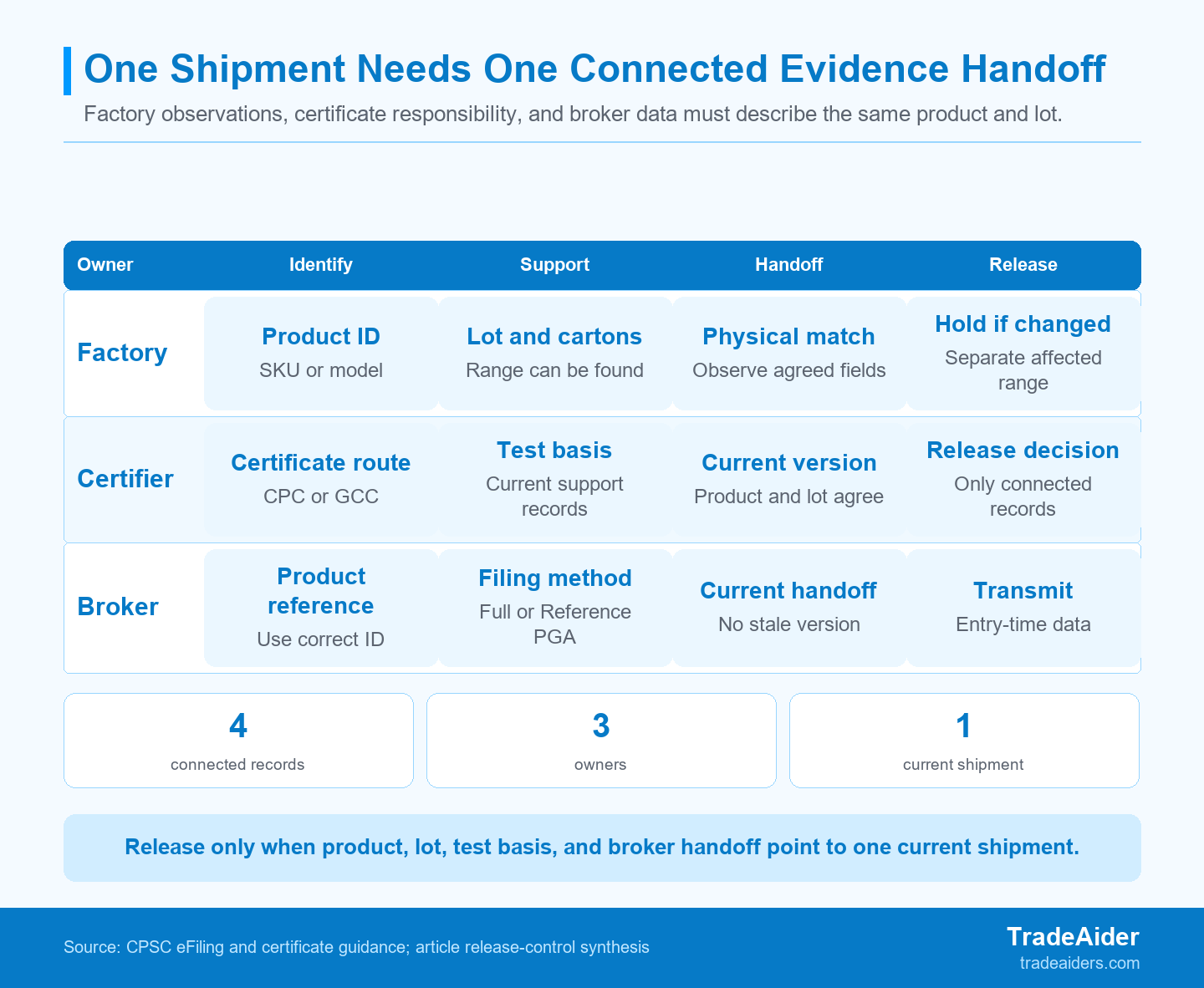
Factory observations, certificate responsibility, and broker transmission are different jobs; release works only when their records describe the same shipment.
- Product identity: Match the product name and identifier used in the certificate record with the physical product, approved artwork, packing list, and, where useful, a visible SKU or model.
- Production or lot identity: Match the manufacture date, lot, production range, or carton range with the population the buyer intends to release.
- Test basis: Confirm that the responsible party can identify the applicable test support, laboratory information, and any material-change review for the current product coverage.
- Certificate and broker handoff: Confirm the current CPC or GCC record and the exact Full PGA data or Reference PGA identifiers the broker will use.
When all four records agree, a factory observation has context: it corroborates a defined product and shipment range. When one fails, do not assume the whole order is defective or compliant. First ask whether the affected product and carton range is traceable. If it is, contain that range, correct the record or handoff, and recheck the named fields. If it is not traceable, the release decision has to widen because the team cannot honestly separate the affected population.
This rule also prevents a common timing error: asking the broker to “use the latest certificate” before the responsible party has named what “latest” means for the lot. The version is only meaningful when its product and production coverage are clear.
Illustrative Scenario: The Broker Has an Old Version
In the illustrative order, a shipment-wide hold is unnecessary if the affected carton and lot range is identifiable; the unresolved range can be contained while the certificate handoff is corrected. CPSC’s Product Registry FAQ explains the identifiers that must be current in a Reference handoff. This is an illustrative operational scenario, not a TradeAider client case or a legal conclusion.
Contain the 1,200-Unit Affected Lot, Then Reconcile
A US private-label children’s accessories importer buys a repeat order from an overseas factory and uses a customs broker for entry. The illustrative order contains 3,600 finished units across three 1,200-unit lots, each carrying the same product family SKU with lot-specific carton ranges. The goods are 100% complete and more than 80% packed for export; product labels, carton labels, packing lists, test references, and a certificate record are available. Two recent broker handoffs for this product family required last-minute correction because the submission worksheet retained an old certificate reference. For the third 1,200-unit lot, the current packing list identifies a separate carton range, but the broker’s saved Reference PGA handoff still points to the earlier Version ID. In the illustrative scenario, the separately identified 1,200-unit lot is contained and rechecked after the broker handoff is refreshed, while repeated errors trigger a process correction. The first two lots can move only if their own four records reconcile; the third lot remains held until the current reference is confirmed. The responsible party sends the correct Version ID or full data to the broker, marks the held carton range in the release packet, and rechecks selected units and cartons against the updated product ID, lot number, packing list, certificate reference, and broker confirmation. An owner is assigned to refresh version changes before the next shipment. This is an illustrative release-control method, not a prediction of a CPSC or CBP decision.
Send an Observational Release Brief Before Final Packing
An inspection brief is more useful when it names the physical observations, approved references, carton or lot coverage, and hold-and-recheck owner before the visit. If the order is complete and substantially export-packed, a buyer can scope a pre-shipment inspection for physical evidence checks rather than requesting a vague confirmation of compliance.
Send the inspector one controlled packet with: the product ID or SKU list; the applicable certificate route already decided by the responsible party; the approved label and retail-pack references; lot or carton coverage; the relevant test and certificate references; the packing list; and the action to take if a physical field differs. Mark what should be photographed, what can be counted, and which mismatch requires a hold. Keep the language observational: “compare,” “record,” “photograph,” “segregate,” and “recheck.”
Also name what the inspector should not decide. Do not ask for a new CPC or GCC, a test interpretation, a legal classification, a customs filing choice, or a claim that the product will clear entry. Those decisions belong to the responsible firm and its appropriate compliance and trade parties. A precise inspection scope is stronger because it respects that boundary and produces evidence the decision owner can use.
Before the visit, align the sample basis with the mapped shipment range. The brief should say whether the inspector needs to record every visible lot mark, select cartons from each identified range, photograph the outer case and retail pack together, or isolate a named range if the controlled reference does not match. It should also state how a late packing-list revision reaches the release owner and broker. These details turn an observation report into a usable handoff rather than a general statement that goods were inspected.
If you already have the product identifiers, current record references, carton map, and hold rules, send the release packet to TradeAider for scoping.
Frequently Asked Questions
Does every children’s product require a CPC?
A CPC is required when a children’s product is subject to applicable children’s product safety rules, but the rules and test path depend on the actual product. Start by determining the product’s intended user and applicable CPSC requirements. A children’s product is not automatically covered by one universal test list, and a certificate route should not be chosen from a generic category label.
Is a GCC an alternative to a CPC for children’s goods?
No. A GCC is the certificate route for certain regulated general-use products, while a covered children’s product follows the CPC route. The distinction affects the testing basis and the certificate record. If a product’s classification is uncertain, resolve that question with the responsible compliance party before asking a factory or broker to prepare eFiling data.
Should a broker receive test reports with eFiling data?
The broker needs the required data or the correct registry identifiers for the selected filing method, while the responsible party needs to retain and be able to provide supporting records. Current CPSC eFiling operational materials are maintained in the agency’s eFiling document library. Consult the CPSC eFiling resources and the broker’s current operating instructions; do not substitute an uncontrolled report attachment for the agreed data handoff.
Can a pre-shipment inspection issue a CPC or GCC?
No. A pre-shipment inspection can record agreed physical observations, but the responsible firm issues the certificate and the filing decision stays with the importer and trade parties. An inspection is most useful when it compares selected goods and export cartons against a controlled release packet, then documents any mismatch for the named decision owner to resolve.
Related Articles



Grow your business with TradeAider Service
Click the button below to directly enter the TradeAider Service System. The simple steps from booking and payment to receiving reports are easy to operate.

