

A cutting board quality inspection should establish whether the delivered board sits as intended, matches its dimensions, has a sound cutting surface and uses the specified materials. For wood-based boards, moisture readings also need a suitable method and agreed limits. Food-contact documents must match the board's construction and intended use; a smooth surface, acceptable smell or generic resin certificate cannot settle that question.
For an importer, the difficult defects are often the ones a showroom sample conceals. A board may look flat while restrained in its wrapping, rock because one foot is higher, or develop a raised edge beside a glue joint. Another may arrive with a report for a different color or coating. The checks below cover new wooden, bamboo, plastic and composite cutting boards. Choose the relevant material checks before inspecting the shipment, then keep physical findings separate from questions that require a laboratory or a review of material authorizations.
Six Checks to Include in a Cutting Board Inspection
Start with production samples, the approved board, a dimensioned drawing, material details and the intended cleaning instructions. Agree tolerances, conditioning, sample quantities and any destructive tests in advance. Use the following checklist to capture actual observations, rather than recording a single overall “quality OK” result.
| Check | What to do | What determines acceptance |
|---|---|---|
| Warpage and stability | Check the released board on a verified flat surface; measure specified face gaps and inspect feet separately. | Agreed flatness and stability criteria, with no force masking the distortion. |
| Moisture, where applicable | Use the approved wood-based-material method at defined locations; record settings and conditions. | Material-specific range and measurement method, not a borrowed universal percentage. |
| Surface finish | Inspect both faces, edges, grooves and joints for splinters, burrs, cracks, separation and residue. | Approved finish and defect definitions; functional damage is assessed separately from cosmetic variation. |
| Odor | Compare conditioned boards and packaging under an agreed sensory method. | Defined odor criteria; chemical safety needs separate supporting information. |
| Dimensions | Measure the specified length, width, thickness, grooves and accessory interfaces. | Drawing tolerances, units and measurement locations. |
| Food-contact evidence | Match declarations and reports to materials, model, formulation and intended conditions. | Applicable market requirements and demonstrated document coverage. |
A useful inspection sheet has a separate result for each check, with the sample ID, actual reading or finding, criterion and photograph where helpful. Mark wood-moisture checks as not applicable to an ordinary plastic board. For a composite, establish the measurement method first: a numerical display on a wood meter does not automatically represent its water content.
For a composite sold as bamboo, ask whether it is made from bonded bamboo pieces or contains bamboo powder in a plastic matrix. The Commission's Bamboo-zling guidance addresses plastic food-contact articles containing unauthorized bamboo and other plant-based additives. Its warning concerns those mixtures; it is not a blanket prohibition on solid bamboo articles. Confirm the formulation and applicable authorization rather than classifying the board by its marketing name or appearance.
Warpage: Measure the Board and Check Its Supports Separately
Check cutting board flatness without clamps, tight wrapping or hand pressure holding the board down. Use the specified conditioning period and a clean, verified flat reference surface. Examine the board in its intended operating position, then assess face flatness with a straightedge and gap measurement where the inspection method calls for it. Record the face, direction and location of the largest measured gap.
The USDA Forest Products Laboratory's 2021 chapter on wood moisture relations explains that wood exchanges moisture with its surroundings, with temperature, relative humidity and its existing moisture level affecting that exchange. This helps explain why conditioning and destination conditions matter. It does not establish a single shipment moisture limit for every wood species, thickness or cutting board design.
A straightedge placed across a concave face can reveal a gap beneath its center; other distortion may appear along the length, diagonally or on the reverse face. Follow the agreed measurement paths and support arrangement. Do not measure through a juice groove or over an intentionally raised feature and report that gap as ordinary face warpage. Record rocking separately from straightedge readings, since they describe different aspects of the board.
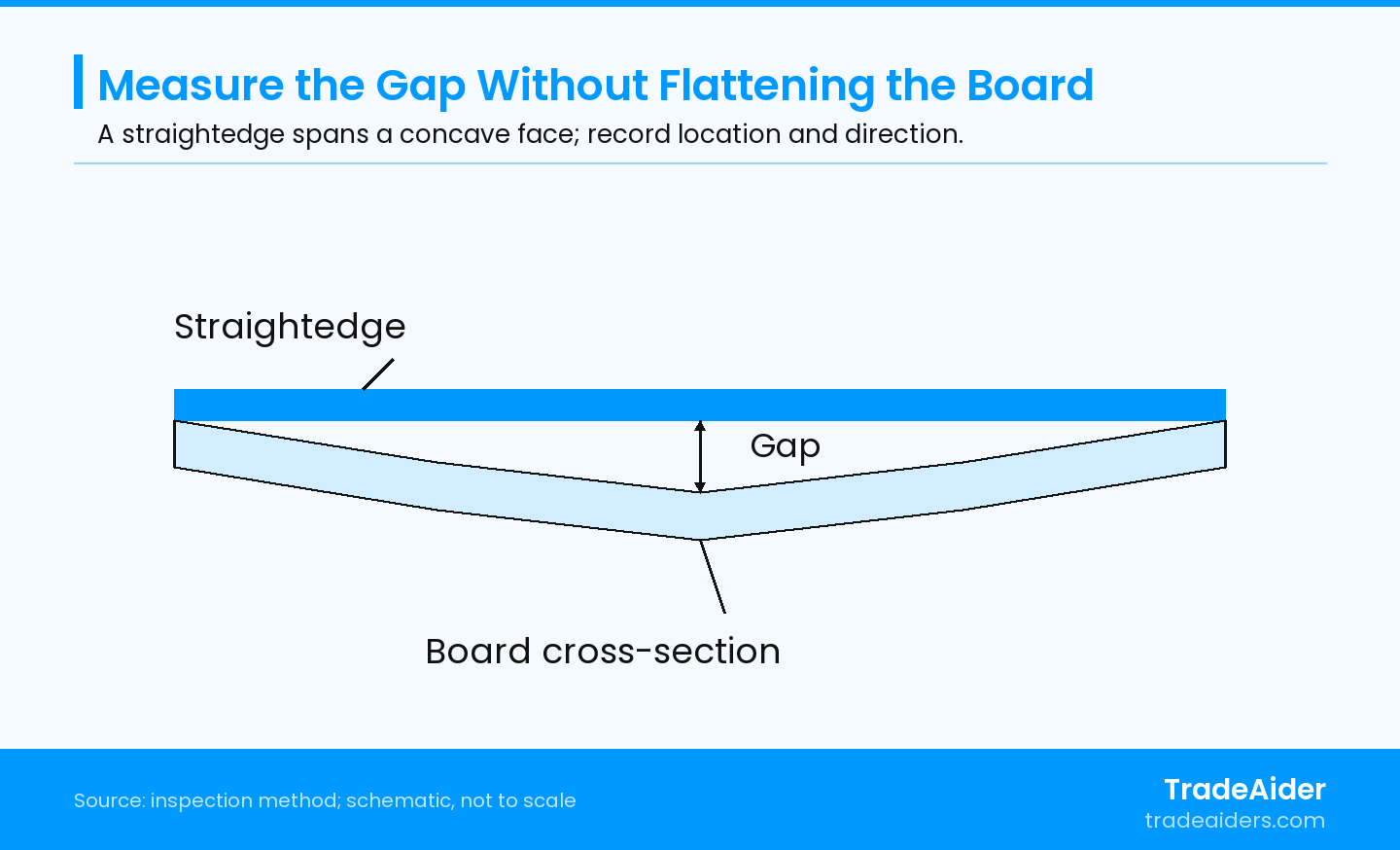
Schematic measurement position on a concave face, not a scale drawing or acceptance limit. Follow the specified paths and support arrangement; check rocking separately.
For boards with feet, inspect foot height, placement, attachment and contact with the reference surface. A board that rocks may have a support problem even when the cutting face meets its flatness tolerance. Conversely, stable feet can support a board whose cutting face is still distorted. Compare like configurations; removing a foot or turning a one-sided board upside down changes the stability check.
Keep the condition of the sample visible in the report: just unpacked, conditioned, or tested after an approved washing cycle. If dishwasher resistance is claimed, agree the cycle, detergent, drying and evaluation procedure before testing. An arbitrary soak or a single wipe cannot substantiate that claim. Photograph and measure the original condition before a supplier sands, weights or otherwise alters a failed sample.
Hypothetical Example: A Rocking Board with an Uneven Foot
Suppose two sampled boards rock on the same verified flat surface. The specified straightedge checks show acceptable cutting-face gaps, but one foot on each board does not sit evenly. Under the agreed procedure, an authorized foot replacement removes the rocking. Record the original instability, the foot finding and the result after replacement; the original units did not arrive in the corrected condition.
The comparison gives the supplier a reason to investigate foot dimensions and assembly, rather than treating the observation solely as wood warpage. Ask for the scope of affected foot stock and examine untouched production samples using the agreed plan. Successful replacement on those two examples does not establish the condition of every board. If a face gap is also outside tolerance, fixing the support does not resolve that separate finding.
Moisture: Use a Method That Fits the Board's Construction
For a wooden cutting board, moisture content is the mass of water expressed relative to the oven-dry wood mass. A handheld meter estimates it from a measured material property. Agree the suitable meter or reference method, settings, reading locations and acceptance range for the actual construction. Record individual readings where required; an average can conceal a location that needs investigation.
The public scope and significance section of ASTM D4444-25 address laboratory standardization and calibration of handheld moisture meters for solid wood products, including those with additives. They explain that meter technology, wood variables and environmental conditions affect readings. The standard is a calibration reference; citing it does not turn an unqualified factory reading into a compliant test.
Follow the meter manufacturer's instructions for species or density settings, temperature correction, sensing depth and suitable board thickness. For a pin meter, agree where penetration is permitted; for a pinless meter, establish suitable contact and backing conditions. Avoid interpreting a reading across a metal insert or other unsuitable feature. Record whether a location is solid wood, a glued strip or a different material.
Bamboo laminates, paper-resin boards and other composites need a method demonstrated to suit their construction. Do not apply a solid-wood species setting to an unknown composite by default. When readings conflict with the specified range, confirm setup and sampling before asking for an appropriate reference determination. Moisture alone does not identify the cause of a crack or establish adhesive bond quality.
Surface Finish: Distinguish Cosmetic Variation from Cutting-Surface Defects
Inspect the cutting board under suitable light, including both faces, all edges, handles, grooves and joints. Look for splinters, sharp burrs, cracks, open glue lines, lifted layers and loose material. Compare color, grain and texture with the approved finish criteria, but assess damage that affects handling or the cutting surface independently of appearance.
On wood and bamboo boards, check end grain, corners and the edges of bonded strips, where small raised fibers or separation may be easy to miss. On plastic boards, examine molding flash, pits, embedded contamination and sharp transitions around holes. For a layered composite, look along the exposed perimeter as well as across the faces. A flat-looking top surface can conceal a layer opening at the edge.
Use the agreed tactile method without exposing bare hands to suspected sharp defects. A light pass with a suitable clean cloth may help identify a snag, but record the actual splinter or burr; a cloth snag alone is not a standardized finish measurement. Check that grooves and handles have the specified finish and can be accessed for cleaning as intended. Do not assume a glossy board is easier to clean than every matte one.
Where an oil, wax or coating is specified, confirm its identity and application against the approved product. Note tackiness, transfer, uneven coverage or unexpected residue. If the supplier reworks a surface, repeat the affected finish and dimension checks and establish whether the original coating or material documents still cover the revised construction. Sanding can change thickness and may expose a layer that was not originally intended as the food-contact surface.
Odor: Compare Like Samples and Identify What Needs Investigation
An odor check can identify an unusual sensory observation on a cutting board; it cannot identify a chemical or measure chemical transfer into food. Define the sample conditioning, packaging-opening interval, reference and rating method. Compare boards under the same conditions, keeping a description of the odor rather than using “strong” without a reference.
Assess the board and its packaging separately where the procedure allows. An odor first noticed inside a bag may come from the board, the bag or their combination. Record whether it persists after the agreed airing interval, and compare additional production samples. A weaker smell after airing changes the sensory observation; it does not by itself clear a material concern.
Do not taste food or water exposed to an unverified board, heat a sample to intensify its smell, or continue close assessment if vapors cause irritation. Escalate an unusual finding to the supplier's material review or an appropriate laboratory. Natural wood odor, an acceptable reference comparison and a lack of detectable odor are different observations; none substitutes for the food-contact assessment described below.
Dimensions: Check the Drawing, Usable Area and Product Claims
Measure cutting board length, width and thickness at the locations defined in the drawing, using suitable checked equipment. State whether dimensions include the handle, raised rim or feet. A retail description of “overall size” should not be compared with a drawing dimension for the cutting surface alone. Record the unit and reading, then compare with the applicable tolerance.
Take thickness readings at the specified points rather than only at the most convenient edge. Inspect groove position and depth, handle openings, corner profiles and fit with any supplied stand or tray. For a set, check each size and its packaging identification. Similar-looking boards can differ enough in thickness or handle position to fit the wrong accessory or package.
Preserve the same conditioning state when comparing dimensions and flatness results. Check labels, product inserts and carton markings against the measured model and approved artwork. Examine packing pressure and protection: a tight strap, divider or shrink wrap should not mask distortion or damage an edge. Record measurements before any corrective sanding or trimming so the buyer can distinguish delivered dimensions from reworked ones.
Food-Contact Evidence: Match the Documents to the Finished Board
Review food-contact evidence for the finished cutting board's actual construction and intended market. Identify the wood or polymer, adhesives, coatings, colorants, fillers and other relevant components. “Food grade,” “bamboo” or a resin name is not a complete description. The supplier should explain which declarations, authorizations and test reports cover those materials under the intended food, temperature, contact and cleaning conditions.
The European Commission's food-contact legislation overview explains that Regulation (EC) No 1935/2004 addresses harmful constituent transfer and unacceptable changes to food composition, taste or odor. For applicable plastic materials, Regulation (EU) No 10/2011 adds composition, migration and declaration-of-compliance requirements. Migration means the transfer of substances from the material into food. The plastics rules should not be applied unchanged to a solid wooden board; national provisions may also matter where specific EU measures are absent.
For an EU plastic board, obtain the applicable declaration of compliance and its supporting basis, including the intended-use restrictions. A migration report should identify the tested article, food simulants, time, temperature and relevant repeated-use conditions. Food simulants are test media chosen to represent food categories. Have the applicable testing and documentation assessed against current amendments; a report's date alone does not show whether it remains applicable.
For the US market, FDA's guidance on the regulatory status of food-contact components explains that the article's status depends on its constituent substances and their authorized uses. An effective Food Contact Substance Notification is specific to the identified manufacturer, substance and conditions. A supplier's generic “FDA approved” statement therefore needs an identifiable basis; an authorization for a resin does not automatically establish coverage for added pigments, adhesives or a different intended use.
Match the report's model, sample photographs, material formulation and covered variants to the ordered board. Check whether a change in coating, color, filler or material supplier affects the evidence. If one report is offered for several models, ask for the technical basis for that coverage. Physical inspection can reveal a mismatch and collect identifying information, but it does not recreate a migration test or validate an unassessed formulation.
Prepare a Specific Follow-Up for Each Finding
Use the observed defect to choose the next action. A measured face gap needs a flatness review; rocking with acceptable face readings calls for support inspection; open layers need construction and bond investigation. An unexplained material change needs document review. Keep unresolved criteria distinct from actual failed readings, and retain the original sample condition before rework.
TradeAider's inspection standard guidance explains the role of customer requirements and sampling. Set separate sample quantities where needed for appearance, dimensions, moisture, cleaning trials or destructive checks. The sampling plan does not supply a flatness tolerance or establish that every board in the shipment is defect-free.
TradeAider conducts pre-shipment inspection when the order quantity is 100% complete and at least 80% packed for export. Provide the approved board, drawings, material information, finish criteria, care instructions and relevant documents before the visit. Confirm the checks and equipment available on site, with laboratory work handled through its appropriate procedure.
Contact TradeAider to arrange your cutting board inspection with the model-specific requirements ready. Clear criteria let the report show what was checked, what was observed and which questions still require supplier or laboratory follow-up.
Frequently Asked Questions
Should every cutting board have the same moisture limit?
No. A moisture limit must suit the material, construction and agreed measurement conditions. Solid wood, a bamboo laminate and a paper-resin composite should not automatically share one meter setting or percentage. For an ordinary plastic board, a wood-moisture check is not applicable. Request the intended range and method before inspection, including how disputed readings will be confirmed.
Can an anti-slip foot hide a warped cutting surface?
Yes, stable supports can coexist with a distorted cutting face. Check operating stability and face flatness as separate requirements, using the intended configuration for each. Conversely, uneven feet can make an otherwise acceptable face rock. Record the measured gaps and support findings so the supplier's correction addresses the actual problem rather than changing an unrelated part.
Does a dishwasher-safe label mean a quick wash is enough?
No. A quick wash is not evidence for an unspecified dishwasher-safe claim. Agree a suitable procedure covering the cleaning cycle, repetitions, drying and evaluation of flatness, dimensions, finish and bonded layers. Check the declared care conditions against the tested conditions. Keep any incoming inspection observation distinct from the product's broader durability qualification.
Can one food-contact report cover several colors and sizes?
It can only where the coverage is technically justified for those variants. Different pigments, coatings, formulations or use conditions may change the assessment; a shared product name is not enough. Ask for the relationship between the tested sample and each supplied variant, and have the basis reviewed against the applicable market requirements. Do not infer coverage from an unrelated passing report.
Related Articles

Grow your business with TradeAider Service
Click the button below to directly enter the TradeAider Service System. The simple steps from booking and payment to receiving reports are easy to operate.