
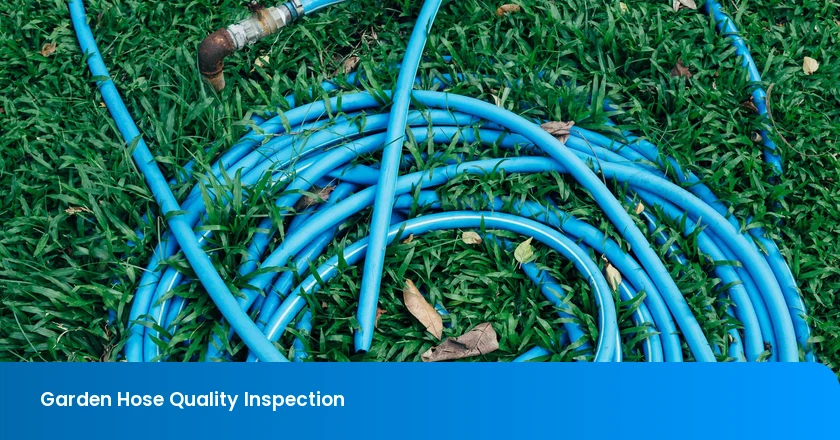
A garden hose quality inspection should check the complete hose assembly under defined water-pressure conditions, then examine its couplings, recovery after bending, measured length, odor and final packing. The useful result is more than “no leak”: it identifies where water escaped, whether a fitting moved, what happened after the bend was removed, and whether the delivered product matches its label and specification.
For importers, small differences between the approved sample and the shipment can become difficult customer complaints. A hose may connect to the factory's adapter but leak on the intended fitting. A tightly wound coil may hide a permanent crease. A length claim may refer to a pressurized expandable hose rather than its relaxed state. This protocol covers ordinary garden watering hoses and their supplied fittings. Soaker hoses, which intentionally release water through their walls, and specialized industrial hose assemblies need different acceptance criteria.
The Six Checks to Put on the Inspection Sheet
Before sampling, obtain the approved hose construction, nominal dimensions, fitting drawings, labeling and test instructions. For every check, record the sample identity, method, actual conditions, observation and acceptance criterion. The supplier and buyer should agree the pressure, duration, tightening method, bend conditions, length tolerance and sample quantities before the visit.
- Pressure leakage: fill and vent the assembly using the approved hydrostatic procedure, apply the specified pressure and hold time, and inspect the hose wall and both end connections. Record the leak location, gauge readings and any fitting movement or deformation.
- Coupling fit: check thread or quick-connect identity, seal presence and engagement with the intended mating part. Apply only the specified tightening method or torque; examine the hose-to-fitting attachment separately from the mating connection.
- Kink recovery: bend the sample using the agreed radius, duration, cycles and pressure state. After release, check residual flattening, cracking and flow under comparable conditions, then repeat the specified leak check if the procedure requires it.
- Length: uncoil and condition the hose as specified. Measure between defined endpoints without adding unapproved stretching force; identify whether the requirement concerns the hose body or the complete assembly.
- Odor: compare samples using a controlled, agreed sensory method and reference. Record unusual odor as an observation, not as proof of chemical safety or noncompliance.
- Packaging: verify coil condition, fitting protection, dry packing, accessories, labels and carton quantities. Check that ties and packaging do not damage the hose or hide an incorrect length or fitting.
Keep the results for these checks separate. A hose can meet its length tolerance and still leak; an acceptable appearance does not compensate for a displaced coupling. Where a required limit or method is missing, mark the check as unresolved and obtain the requirement. “Tested” without the conditions and result is not an acceptance decision.
Pressure Leakage: Test the Assembly and Locate the First Wet Point
Use a controlled water-pressure test that suits the hose assembly and its stated service conditions. Hydrostatic testing means testing with a liquid under pressure. Record the pressure at the test assembly, the hold duration, water temperature where relevant, the gauge identification and the condition of the end fittings. Do not substitute a burst-pressure claim for a routine working-pressure or proof-test requirement.
The public scope of ISO 1402:2021 covers hydrostatic test methods for rubber and plastics hoses and hose assemblies, including dimensional stability. It is a test-method reference, not a universal garden-hose pressure rating. Use the full applicable procedure and the product specification to determine the test conditions; a catalog statement that a hose is “pressure tested” does not supply them.
A competent operator should use a suitable guarded test setup, rated fittings and pressure-control equipment. Fill and vent the assembly as directed so trapped air is removed before pressurization. Keep people away from the line of a possible coupling failure, and depressurize completely before adjusting or disconnecting anything. Do not replace the liquid with compressed air simply because it is available at the factory.
Start with dry external surfaces so residual filling water is not mistaken for leakage. Observe the first wet point: the hose wall, the hose-to-coupling attachment, or the seal between mating connectors. Water can run along the hose and collect below a different part, so a photograph of the final puddle is rarely enough. Record the location and time of onset before any repair, with a close view that identifies the actual joint.
A falling gauge reading also needs context. Check the fixture and its connections before attributing the change to the hose; record whether the pressure source remains connected or the test section is isolated. Conversely, a regulated supply may replenish escaping water while the indicated pressure stays steady. Combine the pressure record with direct leakage and dimensional observations rather than treating one gauge reading as a complete verdict.
Coupling Fit: Separate Engagement, Sealing and Hose Retention
There are two connections to inspect at each hose end: the coupling's attachment to the hose and its connection to the tap, nozzle or adapter. A fitting can thread smoothly onto a mating part while its crimp or retaining sleeve is loose. It can also hold firmly on the hose but leak across a missing or damaged sealing washer. Check both connections using the ordered configuration.
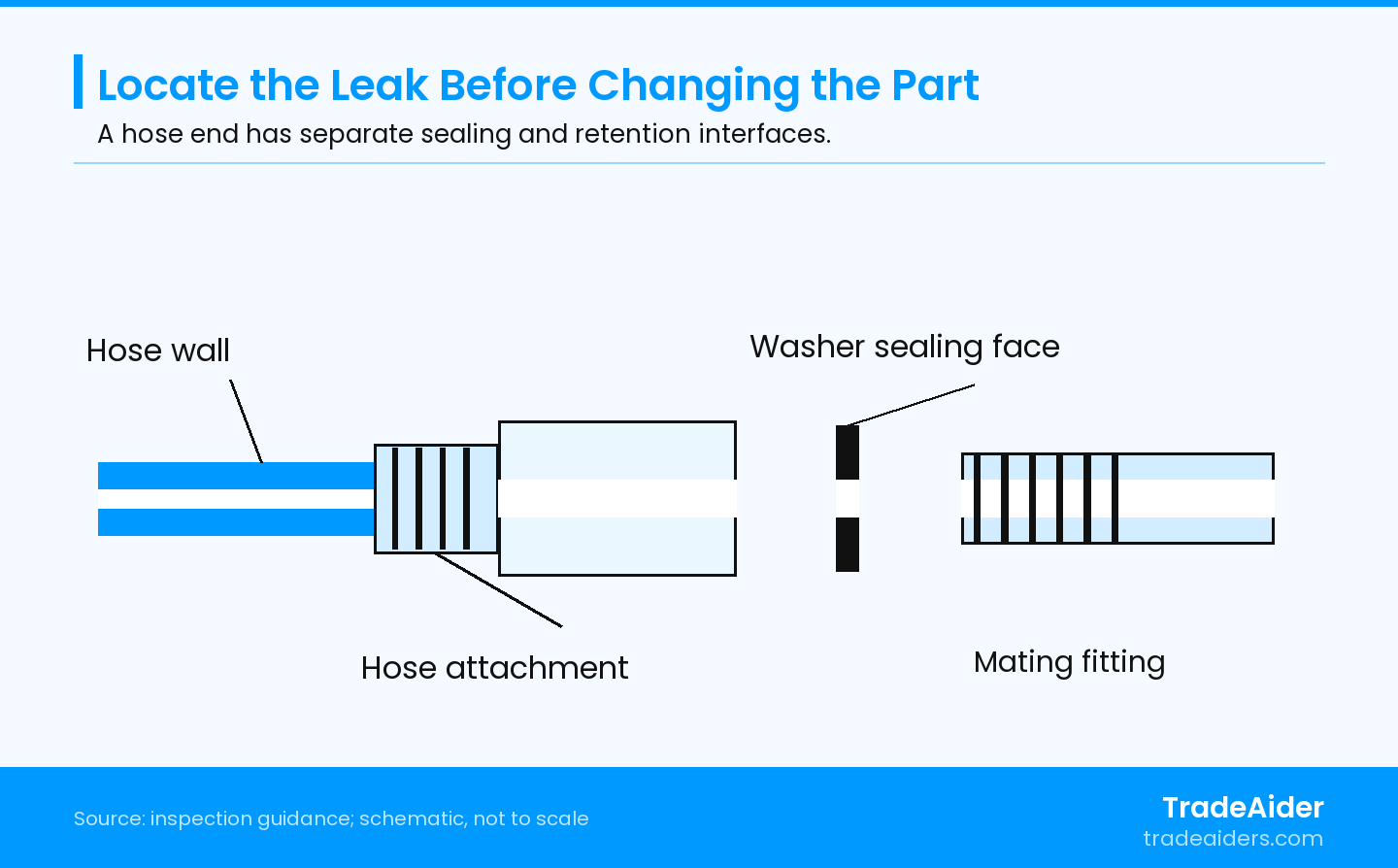
Schematic of one washer-sealed connection. Identify the first wet point before changing parts; quick-connect and other seal designs require their own component layout.
ASME B1.20.7 addresses inch hose-coupling screw threads on couplings, valves, nozzles and other direct hose fittings. Its scope is a reason to identify the required thread system explicitly rather than relying on a nominal size alone. Use the fitting drawing and applicable gauges or verified mating parts; this reference does not establish that every garden hose sold worldwide uses the same connection.
Inspect the thread entry, thread damage, swivel movement, gasket seating and sealing faces. Start a threaded connection by hand to reveal cross-threading or resistance. For a quick connector, check the specified insertion and retention action, release mechanism and seal arrangement. An audible click is useful only if the coupling is actually engaged. Do not force an incompatible fitting together to complete the water test.
Where a tightening torque is specified, record the value, tool and condition of the joint, including any required lubrication. Where instructions call for hand tightening, do not add pliers as an undocumented improvement. Torque at the mating thread is not the same as the force needed to pull a coupling from the hose; any retention test requires its own approved method and limit. Check for axial movement, rotation where it is not intended, cracks and damage after the prescribed sequence.
Hypothetical Example: A Replacement Washer Stops the Leak
Suppose a sampled hose leaks at the tap connection during the agreed pressure hold. After depressurizing, the inspector finds a damaged washer; the supplier replaces it, and the same assembly no longer leaks under the same conditions. Record the original failure and the repaired result separately. The comparison supports investigation of that washer and sealing interface, but it does not prove that every leak in the shipment has the same cause.
The buyer can ask the supplier to identify affected washer stock, examine other assemblies from that stock and document the corrective action. Verification should use the agreed sampling and test plan, including original production samples rather than only the repaired demonstration unit. If water instead appears at the crimped hose attachment, changing the tap washer does not address that observed failure location.
Kink Recovery: Compare the Hose Before, During and After Bending
A useful kink-recovery check distinguishes temporary restriction during a bend from damage that remains afterward. Specify the bend radius or fixture, hold time, number of cycles, temperature and whether the hose is empty or pressurized. Compare the same marked area before bending and after the agreed recovery period. Record a persistent crease, flattened section, cover split or other change instead of reducing every outcome to “flexible” or “stiff.”
ISO 10619-1:2017 separates flexibility measurements based on deformation from stiffness measurements based on the force needed to bend a hose to a specified radius at ambient temperature. The public scope also describes different methods for different hose sizes and configurations. Select the appropriate complete method when a standard-based result is required; an improvised hand bend cannot be reported as that standardized test.
If the agreed check includes flow recovery, keep the inlet conditions, hose length, outlet arrangement and measurement method comparable before and after bending. An open nozzle on one trial and a restricted nozzle on another can conceal or exaggerate the effect. Note whether the hose recovers by itself or only after manual straightening. That difference matters when judging a product advertised as easy to handle or resistant to kinking.
Inspect the bent area again after release and, where specified, repeat the leakage test under the original conditions. A restored round shape does not establish that the wall or reinforcement is undamaged. Keep cold-weather flexibility, repeated flexing and long-term outdoor exposure separate from a short ambient-temperature inspection: each needs an appropriate method if it is part of the product claim.
Length: Define the Hose State and Measurement Endpoints
Measure length in the state defined by the purchase specification. Uncoil a conventional hose on a suitable surface, remove loops without stretching it, allow the specified conditioning period and use a checked measuring device. State whether the endpoints are the hose-body ends or the assembly's coupling reference points. Including fittings in one measurement and excluding them in another creates an avoidable dispute.
ISO 4671:2022 includes methods for measuring hose dimensions and identifying the lengths of hoses and hose assemblies. It provides a measurement framework; the order specification still needs the nominal length, tolerance and applicable measurement definition. Record the actual reading with its unit rather than writing only that the coil “looks correct.”
For an expandable hose, request the manufacturer's conditions for the advertised extended length, including pressure, outlet state and stabilization where relevant. Record relaxed and extended measurements separately when both are required. Do not pull the hose manually until it reaches the label value, or compare a drained sample with a specification defined under pressure. Check the same length wording on the product, insert, retail package and carton.
Keep hose-bore size separate from coupling size. A fitting designation does not measure the hose's internal diameter, and similar-looking coils can contain different lengths. If diameter or wall thickness is in the inspection scope, use the specified dimensional method and sample preparation. Avoid cutting a functional-test sample without recording that it has become a destructive-test specimen.
Odor: Record the Observation Without Making a Safety Claim
Treat odor as a defined sensory check, not a chemical analysis. Agree whether the assessment concerns the hose itself, the freshly opened package or water exposed under a specified method. Use comparable sample conditioning, exposure time and an approved reference or rating scale. Do not taste test water from an unverified hose, heat a sample to intensify its smell or expose an inspector to irritating vapors.
The publicly available 2016 edition of NSF/ANSI 61 distinguishes health-effects requirements for drinking-water-system materials from performance, taste and odor requirements, which it does not establish. This is a scope distinction, not a recommendation to use an old edition for current certification. A low-odor observation cannot demonstrate drinking-water suitability, and health-effects certification should not be presented as proof that a hose has no odor.
If a hose carries a drinking-water claim, verify the applicable certification or test documentation for the exact product and intended conditions. Do not assume that a certificate for the raw resin covers the completed assembly, seals and fittings. For an unusual odor, compare additional samples and isolate the packaging where the agreed method allows. Report what was observed and request material or laboratory investigation when warranted; the smell alone does not identify a particular chemical or its concentration.
Packaging: Preserve the Hose's Condition Through Packing
Inspect the coil before opening it and again after uncoiling. Look for ties that flatten the wall, tight bends beside couplings, abrasion, contamination and fittings pressed into adjacent hose layers. Confirm that the specified coil diameter, retaining method and fitting protection are used. A neat circular package can still contain a local fold that only becomes visible when the hose is laid out.
Check the supplied nozzle, adapters, washers and instructions against the packing list, including any intentionally fitted or separately bagged seals. Match length, material claims, connection description and intended-use warnings to the approved artwork. Verify barcode identity and carton quantity using the agreed checks. Photographs should show the actual included parts and packing arrangement, not a separately prepared display set.
After water testing, follow the agreed draining, drying and repacking procedure. Record whether a tested unit is returned to stock or kept apart, and do not pack retained water into a carton intended for dry goods. If transit protection is being assessed, apply the specified packaging test and inspect the hose afterward; visual packing inspection alone does not establish resistance to transport damage.
Turn the Findings into a Clear Supplier Follow-Up
Match the follow-up to the finding: a wrong mating thread needs a fitting review, movement at a hose attachment needs retention investigation, and a persistent crease needs construction or packing review. Record missing criteria separately from observed defects. The report should make it possible to locate the sample, reproduce the conditions and understand whether the result preceded or followed a repair.
TradeAider's inspection standard guidance explains how customer requirements and sampling inform an inspection. Agree the visual sample quantity and any separate quantities for pressure, bending or destructive checks. A sampling plan does not define a hose's pressure rating or length tolerance, and inspecting selected samples does not establish that every unit is defect-free.
TradeAider conducts pre-shipment inspection when the order quantity is 100% complete and at least 80% packed for export. Provide the hose specification, approved assembly, mating fittings, test procedures and artwork before arranging the visit. Confirm the necessary equipment and inspection scope so a missing fixture does not turn a required check into an undocumented omission.
Contact our team to arrange a garden hose inspection and confirm the checks and reporting requirements for your shipment.
Frequently Asked Questions
What pressure should be used to inspect a garden hose?
Use the pressure specified for the agreed test, not a universal value. Working-pressure checks, proof testing and burst testing answer different questions. The product specification and selected method must also define duration, temperature, configuration and acceptance criteria. If the supplier supplies only a burst rating, request the missing routine inspection conditions.
Should thread tape be added when a hose coupling leaks?
Only if the approved connection design and instructions require it. First identify where the seal is intended to form. A washer-sealed connection needs the correct washer and mating face; adding tape during inspection changes the delivered configuration and may hide the original problem. Depressurize before investigating and retain the original failure record.
Does flow returning after a kink mean the hose passed?
Only if flow recovery is the complete agreed criterion, which should not be assumed. Examine residual deformation and visible damage, and complete any specified follow-up leakage test. A short recovery check does not establish resistance to repeated bending, cold conditions or long-term use.
Can an ordinary garden hose be accepted for drinking water if it has no smell?
No. Odor is not evidence of drinking-water suitability. Verify the product's intended use and relevant documentation for the complete hose assembly. Keep the sensory result separate from material health-effects testing and from mechanical checks such as leakage and coupling retention.
Related Articles

Grow your business with TradeAider Service
Click the button below to directly enter the TradeAider Service System. The simple steps from booking and payment to receiving reports are easy to operate.