
- Über uns

- Unsere Dienstleistungen
- Ihre Branche
- Ressourcen
- Nachrichten & Blog
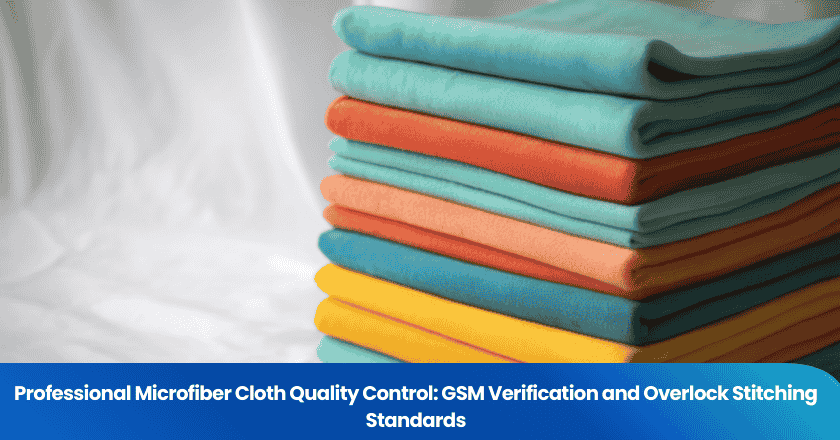
In the industrial cleaning and automotive detailing sectors, microfiber quality is the definitive factor in operational efficiency and surface protection. Systematic microfiber cloth inspection is not just a secondary check—it is a critical engineering audit that ensures textile performance matches the intended technical specifications. Professional quality control focuses on two high-stakes metrics: the GSM (Grams per Square Meter) weight verification and the structural integrity of overlock stitching. By implementing comprehensive quality checks, manufacturers can guarantee absorbency, mitigate the risk of linting, and ensure 100% compliance with international textile standards.
Key Takeaways
- Absorbency Control: GSM is the primary indicator of a towel's fluid retention capacity and pile density.
- Mechanical Durability: High-quality overlock stitching prevents edge unraveling during high-heat industrial laundering.
- Standard Compliance: Professional audits utilize ASTM D3776 for weight and ISO 13934 for tensile strength.
- AQL Sampling: Utilizing Acceptable Quality Limit (AQL) levels 2.5/4.0 ensures batch-level reliability.
- Digital Traceability: Real-time on-site reporting allows buyers to authorize shipments based on live performance data.
The Science of GSM in Microfiber Performance
GSM, or Grams per Square Meter, is the metric unit that defines the density and thickness of a microfiber cloth. However, GSM alone does not tell the full story. The ratio of Polyester to Polyamide (錦纶/锦纶) is equally vital. Typically, a high-performance 300 GSM cloth utilizes an 80/20 or 70/30 blend. The Polyamide component is what creates the "capillary action" responsible for the fabric's legendary absorbency. During a professional inspection, technicians verify that the actual GSM aligns with the buyer's requirement within a strict +/- 3% tolerance.
Technical Standards for Weight Verification
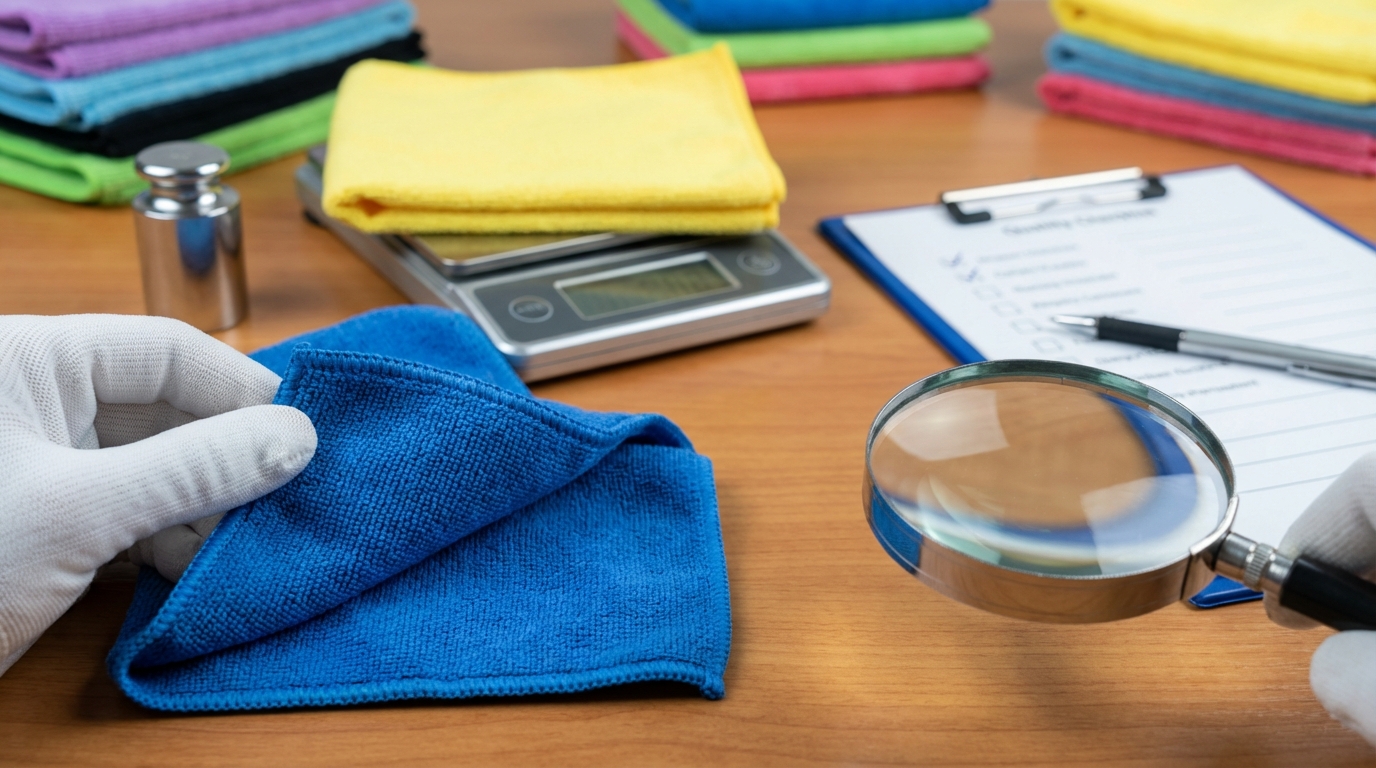
Inspectors utilize a calibrated GSM cutter to remove exactly 100cm2 of fabric from a random sample. This sample is then placed on a precision digital scale. For a 300 GSM towel, the sample must weigh exactly 3.00 grams. If the weight is consistently lower, the towel will feel "thin," provide less surface area for dirt entrapment, and fail in industrial applications.
| GSM Range | Common Application | Inspection Priority |
|---|---|---|
| 150 - 200 GSM | Glass cleaning, lens wipes. | Check for "Linting" and streak-free finish. |
| 250 - 350 GSM | General purpose, interior detailing. | Audit Polyamide ratio and pile height. |
| 400 - 600 GSM | Drying towels, heavy wax removal. | Verify "Core Strength" and weight distribution. |
| 800+ GSM | Premium automotive detailing. | Inspect for "Shearing" and double-sided density. |
"A towel is only as good as its split-fiber density. GSM is the macro-measure of how much cleaning power is packed into every square inch of the textile."
Overlock Stitching Quality: Preventing Edge Failure
The overlock stitch is the structural frame of a microfiber cloth. Without a high-quality edge, the knit structure of the microfiber will rapidly unravel during use or washing. A professional quality control audit focuses on the "Stitches Per Inch (SPI)" and the "Thread Type" used in the overlocking process.
Identifying Stitching Defects
Inspectors perform a "Tension Test" by manually stretching the edges of the towel. If the overlock thread snaps or if "Needle Cutting" (small holes where the needle penetrated the fabric) is visible, the batch is rejected. Common defects include:
- Looping: Loose threads that can catch on surface contaminants or zippers.
- Skipped Stitches: A breakdown in the sewing machine's timing that leads to immediate edge fraying.
- Rough Hems: Hard, melted polyester threads that can scratch sensitive automotive paint or delicate optics.
| Stitching Point | Standard Requirement | Defect Consequence |
|---|---|---|
| Stitch Density | Minimum 12 - 14 SPI. | Reduced lifespan; edge unravelling. |
| Thread Overlap | Minimum 10mm at corners. | Corners pop open during laundry cycles. |
| Thread Material | High-tenacity nylon or soft-spun poly. | Surface scratching (Marring) if too hard. |
| Seam Finish | Flush, trimmed tails. | Aesthetic failure and snagging risk. |
Advanced Laboratory Testing and Industrial Standards
Beyond visual checks, technical audits involve standardized lab tests to verify the cloth's chemical and physical properties. This is particularly important for suppliers targeting the medical or food-grade cleaning markets.
Core Laboratory Audits
- Color Fastness (Crocking): Based on ISO 105-X12, ensuring that a red microfiber towel won't bleed dye onto a white surface when wet.
- Absorbency Rate: Measuring the time (in seconds) for the fabric to fully saturate. Top-tier microfiber should absorb 7x its weight in water within 10 seconds.
- Dimensional Stability: Checking if the towel shrinks by more than 5% after a standard 60-degree wash cycle.
- Pilling Resistance: Using the Martindale method to ensure the fibers don't form "balls" after repeated friction.
AQL Defect Classification for Microfiber Shipments
In a professional AQL-based inspection, findings are categorized to help the buyer make an informed "Ship or Re-work" decision. Microfiber is classified as a "Softline" category product.
- Critical Defects: Presence of metal needles, sharp debris, or high levels of toxic chemicals (Lead/Cadmium). Acceptance = 0.
- Major Defects: GSM more than 5% off-spec, large holes (>3mm), severe color bleeding, or jammed overlock seams. Rejection based on AQL 2.5.
- Minor Defects: Slight shade variation between batches, long thread ends (>5mm), or crooked care labels. Rejection based on AQL 4.0.
Digital Oversight: The Future of Textile QC
Traditional paper reports are prone to delays and manual errors. Through TradeAider's inspection services, clients not only receive an official inspection report within 24 hours, but can also view inspection progress and identified issues during the inspection via TradeAider's online service system. During inspections, inspectors use mobile tablets to record key quality parameters—such as GSM measurements, dimensional checks, and overlock stitching inspections—and capture macro photography of workmanship details. All data is synced to a cloud dashboard, providing buyers with real-time transparency.
By reviewing the Online Real-time Report, brands can make timely decisions on how to handle minor defects—whether to accept the goods commercially, require on-site rectification by suppliers with the support of TradeAider inspectors, or reject them before containerization. This approach ensures that only quality-approved fabric products are packed, shipped, and paid for, reducing unnecessary losses and improving overall supply chain control.
Best Practices for Microfiber Importers and Brands
To maintain a high quality level, brands should mandate a "Golden Sample" verification before bulk production. Furthermore, implementing an "Inline Inspection" when 10-15% of the order is complete can identify systemic issues with fabric weight or sewing machine tension before the entire batch is produced.
| Audit Stage | Key Verification Point | Buyer Deliverable |
|---|---|---|
| Pre-Production (PPI) | Raw fabric blend and dye lot match. | Material Certification Log. |
| During Production (DPI) | GSM consistency across the roll. | Early Defect Warning. |
| Final Random (FRI) | Final weight, packing, and AQL. | Official Inspection Report. |
Ready to secure your product quality before shipment?
As your third-party inspection, testing & certification partner in China, TradeAider supports brands and sourcing teams across the entire production process, helping you identify quality risks early, ensure compliance, and strengthen your team’s capabilities before shipment.
Book an Inspection or Testing Service with TradeAider today, or for tailored solutions and expert guidance, contact us at services@tradeaider.com.
FAQ
Can I determine GSM without a specialized cutter?
Yes, by using the formula: (Weight in grams / Area in square meters). However, a GSM circular cutter is required for industrial precision as it accounts for the fabric's natural stretch and tension during measurement.
What is the difference between "Edgeless" and "Overlocked" microfiber?
Edgeless towels are laser-cut or ultrasonic-cut to eliminate hard threads, making them safer for extremely delicate surfaces. Overlocked towels use thread to bind the edges, providing higher durability for repeated machine washing.
Why does my microfiber towel stop absorbing water after a few washes?
This is often due to "Fiber Clogging." If washed with fabric softener or high-silica detergents, the microscopic "hooks" in the microfiber get filled. Professional quality control checks for "Residue-Free" finishes during the manufacturing stage to prevent this.
How many SPI (Stitches Per Inch) is ideal for an industrial towel?
A range of 10 to 14 SPI is industry standard. Too few stitches results in a weak edge, while too many stitches can create a "Perforation Line" that actually makes the fabric easier to tear under stress.
Is a 100% inspection better than AQL sampling for towels?
For large industrial orders, AQL Level II is the most cost-effective standard. However, for premium luxury automotive drying towels (valued at $20+ per unit), a 100% inspection of "Surface Defects" and "GSM Weight" is highly recommended.

Verwandte Artikel


Erweitern Sie Ihr Unternehmen mit TradeAider Service
Klicken Sie auf die Schaltfläche unten, um direkt in das TradeAider Service System zu gelangen. Die einfachen Schritte von der Buchung und Zahlung bis zum Erhalt der Berichte sind leicht zu bedienen.

