
- Über uns

- Unsere Dienstleistungen
- Ihre Branche
- Ressourcen
- Nachrichten & Blog
Material inspection is not a paperwork ritual; it is the point where an importer proves that the input going into production is the right material before defects become finished-goods facts. The practical answer is to inspect the risks that can still be changed, record the evidence that proves conformity, and decide whether to release, hold, sort, rework, test, or reinspect before the shipment moves beyond buyer control.
Key Takeaways
- Inspect before the material is consumed: the most useful check happens before cutting, molding, bonding, filling, or assembly makes the input hard to isolate.
- Separate visible and hidden proof: photos and measurements help with condition, but composition, restricted substances, or performance claims often need testing.
- Use sampling with a lot map: the buyer should know which rolls, cartons, batches, colors, sizes, or supplier lots the sample represents.
- End with a release rule: material inspection should support release, hold, sort, replacement, testing, or reinspection.
What Should Material Inspection Prove Before Production Starts?
Material inspection should prove identity, condition, quantity, traceability, and risk fit before the material enters production. If any one of those proofs is missing, the buyer is carrying input risk into every finished unit.
Start with the product file. ISO 9001 frames quality management around meeting requirements, controlling processes, evaluating performance, and improving the system. For importers, that means a material check should not be a casual look at whatever the factory presents. It should compare the received material with the PO, approved sample, drawing, bill of materials, color standard, tolerance, packing requirement, and any testing condition that was agreed before production.
Inspection itself also needs a reliable method. ISO/IEC 17020:2026 defines inspection around competence, impartiality, consistent operation, and determining conformity with requirements. A useful material inspection therefore produces evidence a buyer can review later: material labels, batch or roll identity, carton or pallet condition, dimensions, weight, appearance, quantity, document match, and any exceptions that require supplier action.
The decision rule is simple: inspect the material before the factory turns a wrong input into an expensive finished-goods argument. That rule matters for fabric, leather, metal parts, plastics, electrical components, packaging, labels, additives, inserts, and any input that can spread across many units.
Material Inspection Checkpoints by Evidence Type
A practical checklist should not treat every material risk the same way. Some risks are visible, some require measurement, some require documents, and some cannot be closed without laboratory testing. The table below separates the proof question from the evidence to request.
| Checkpoint | What the Buyer Is Proving | Evidence to Require | Release Action |
|---|---|---|---|
| Material identity | The input matches the approved product file. | Label, lot, batch, roll, supplier document, photos | Use, hold, or segregate |
| Visible condition | The material is clean, undamaged, and workable. | Photos, defect counts, location, affected quantity | Sort, replace, or accept |
| Dimension or weight | The input fits tolerance before production. | Tool, reading, tolerance, sample count | Adjust, reject, or approve |
| Color or finish | The material matches the approved standard. | Light condition, sample comparison, variance photos | Approve shade or isolate lot |
| Hidden claim | Composition, safety, or performance is valid. | Lab report, COA review, test request | Test before release |
| Traceability | The buyer can link material to finished lots. | Batch map, carton range, production line use | Release only with map |
The key insight is that material inspection is not one activity. It is a package of proof types. A shipment of metal parts may need dimensional readings and surface evidence. A fabric order may need shade, width, GSM, smell, and roll identity. A packaging input may need artwork, barcode, carton strength, and destination labeling checks.
TradeAider buyers should also define what happens when one checkpoint fails. If the only action is to keep inspecting, the plan is incomplete. The report should name whether the affected material can be used, segregated, replaced, tested, reworked, or stopped.
Material Inspection Is Different From Finished-Goods Inspection
A clean finished product can still hide a wrong material if the buyer never verified the input lot. That is why material inspection belongs earlier than pre-shipment inspection. It asks whether the factory is about to use the correct inputs. Final inspection asks whether the completed lot meets the buyer's release criteria.
BLS describes quality control inspectors as workers who examine products and materials for defects or deviations from specifications. That wording matters because materials and finished goods are not the same evidence object. A roll of fabric, a carton of components, or a pallet of packaging can be isolated before production. Once it becomes thousands of finished units, the buyer may only see symptoms.
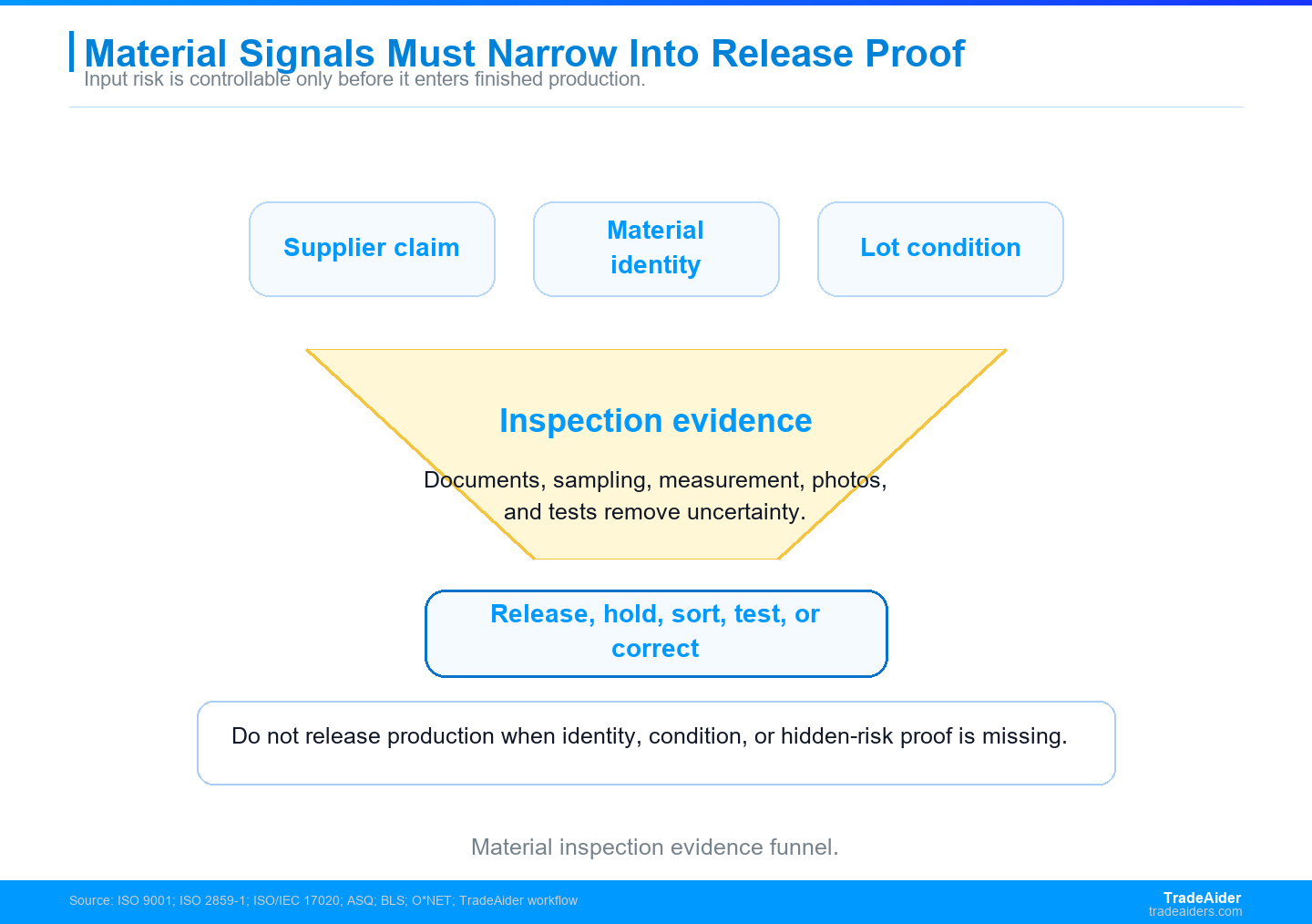
Material inspection should narrow supplier claims, material identity, and condition evidence into a release decision before wrong inputs become finished-goods defects.
Incoming material risk travels forward
A material mistake can move through cutting, sewing, molding, assembly, finishing, packaging, and labeling. Each step makes the original issue harder to isolate. If the wrong shade enters cutting, the buyer may need to find every affected garment. If the wrong component enters assembly, the buyer may need to open finished cartons. If the wrong label stock is used, the buyer may need to relabel packed goods. Material inspection matters because it protects correction leverage, not because it adds another report.
In a 12,000-unit order, one wrong input lot used across 30 percent of production creates 3,600 affected units before the buyer sees a finished carton. The inspection question is therefore not whether the material looks acceptable in one photo. It is whether the lot identity, condition, and use map prevent the risk from spreading.
Finished-goods inspection can confirm symptoms, not always causes
Pre-shipment inspection is still essential, especially for appearance, workmanship, function, count, packaging, labels, and finished-lot release. For TradeAider PSI, the order should be 100 percent completed and at least 80 percent packed for export. That is the right moment to decide whether a finished lot can ship, but it may be late for material root causes. If the buyer suspects a hidden material claim, final inspection should trigger testing or document review rather than pretending that photos prove composition.
If 80 cartons are already sealed, the buyer may need to open cartons only to learn that the root cause was a material lot used 5 days earlier. Finished inspection can still support the release decision, but it should not be forced to prove a hidden material claim after the evidence trail has disappeared.
Sampling and Testing Decide How Much Evidence Is Enough
Sampling is useful only after the buyer defines the lot. ISO 2859-1:2026 provides AQL-indexed sampling schemes for lot-by-lot inspection by attributes, while ASQ separates attributes sampling from variables sampling. For material inspection, this distinction is practical: visible condition may be checked by attribute, while thickness, diameter, GSM, hardness, or weight may need measured values.
In practice, the buyer should map the material population before sample selection. That map may include supplier lot, production date, roll number, batch number, color, size, carton range, pallet number, warehouse zone, or delivery wave. If all samples come from the easiest top cartons, the report does not prove what the buyer thinks it proves.
AQL helps when visible defects represent the lot
AQL can support acceptance decisions for visible material defects such as stains, dents, scratches, broken parts, mismatched labels, poor packaging, or obvious workmanship flaws. The buyer can use the TradeAider AQL calculator to estimate sample size, but the report should still show the sample spread. AQL is not a magic certificate. It is a sampling decision rule, and it is only useful when the inspected sample truly represents the lot.
AQL works best when the defect is visible and the sample represents the order. For example, 200 inspected units can support a lot decision only if the sample includes the relevant cartons, colors, sizes, or batches. If the buyer adds targeted checks for one risky subgroup, the report should separate those findings from the main AQL result.
Testing belongs where hidden material claims matter
Laboratory testing is needed when the claim is hidden from ordinary inspection. Composition, restricted substances, strength, flammability, food-contact suitability, corrosion resistance, color fastness, and long-term durability cannot be proven by a visual check alone. A material inspection can collect samples, review documents, seal evidence, and record lot identity, but the buyer should not treat a visual pass as a lab pass.
When the claim is chemical, structural, or performance-based, a 1-hour visual inspection is not enough. The buyer may need sealed samples, a chain of identity, and a 3-day to 7-day lab window before release. Inspection can prepare that evidence, but it should not pretend that a photo proves composition.
Scenario Estimate: One Wrong Material Can Multiply Rework
Scenario estimate: assume a 12,000-unit order uses one incoming material lot across 30 percent of finished units. If the wrong lot is discovered before production, the buyer may hold or replace that input. If it is discovered after packing, 3,600 affected units may need sorting, replacement, relabeling, carton reopening, and reinspection.
Calculated from the scenario assumptions, 12,000 units x 30 percent x USD 0.42 equals about USD 1,512 before delay, freight, supplier negotiation, or customer impact. This means a material hold that feels inconvenient early can be cheaper than a finished-lot investigation later.
This is not a universal savings claim. The cost changes with product value, local labor, replacement availability, defect severity, and production schedule. The useful point is the mechanism: material inspection gives the buyer a smaller, earlier decision boundary.
Calculated from the same scenario, every 1,000 affected units at USD 0.42 equals USD 420 of direct handling before any freight or delay discussion starts. Calculated from a 2-day reinspection window, one late material decision means a 48-hour release exposure even if the supplier accepts rework. Calculated from 80 packed cartons, opening 25 percent means 20 cartons touched before the root cause is confirmed. Calculated from 1 isolated input lot, a pre-production hold means 1 lot is reviewed instead of 3,600 finished units.
Where TradeAider Fits in Material Inspection
TradeAider helps importers turn material requirements into inspection evidence, not just into a longer supplier email thread.
When the risk sits before production, Pre-Production Inspection can verify material readiness, product files, approved samples, labels, tooling, and supplier preparation. When the risk can spread during production, During Production Inspection can check whether the first finished output still reflects the approved input.
When the buyer needs final release evidence, Pre-Shipment Inspection can verify the completed lot at 100 percent production and at least 80 percent export packing. If the risk is hidden, TradeAider can coordinate product testing services so the buyer does not confuse visual evidence with material proof.
If your supplier is ready to use materials but you do not have enough evidence to release production, send TradeAider the PO, approved sample, bill of materials, material specification, supplier documents, production status, and known risk. The next step is to plan the material inspection before production consumes the lot.
SPAR Scenario: The Material Lot Was Held Before Cutting
Situation: A buyer approved a fabric shade for a 12,000-unit order, but the supplier received two dye lots one week before cutting.
Problem: The supplier said both lots were acceptable, yet the buyer had no roll map and no side-by-side shade evidence.
Action: TradeAider checked roll labels, photographed shade comparison under controlled light, mapped the roll numbers, and held the lower-match lot until the buyer approved replacement use.
Result: The buyer released the matching lot for cutting, isolated the uncertain rolls, and avoided mixing shade risk across finished cartons.
Material Inspection Checklist for Importers
Use this checklist before material is used in production. It is short enough for a PO attachment but specific enough to prevent vague supplier confirmation. The O*NET quality inspector profile also reflects why inspecting, testing, sorting, sampling, and measuring raw materials should be tied to a real task rather than a loose visual check.
- Confirm the current PO, specification, bill of materials, approved sample, tolerance, and test requirement.
- Identify material lots, batches, rolls, cartons, pallets, production dates, and supplier documents.
- Check visible condition, quantity, dimensions, weight, color, finish, odor, moisture, labels, and packaging.
- Define sample spread across lots, colors, sizes, cartons, or delivery waves.
- Separate visible inspection from laboratory testing when hidden claims matter.
- Write the action rule: release, hold, segregate, replace, test, rework, or reinspect.
A material inspection is successful when the buyer can decide what happens next. If the report only says the inspector looked at the material, the evidence is too weak for release.
Related Guides
Next, compare this material-focused approach with quality inspection methods, quality inspection plan control, and manufacturing inspection methods. TradeAider buyers can use these guides to connect input inspection with in-process checks and finished-lot release.
Frequently Asked Questions
What is material inspection?
Material inspection is the verification of raw materials, components, packaging, labels, or other inputs before they enter production or shipment release. It checks identity, condition, quantity, measurement, document match, traceability, and hidden-risk needs so the buyer can decide whether to use, hold, replace, test, or reinspect the material.
Is material inspection the same as incoming quality control?
They overlap, but they are not always identical. Incoming quality control is usually the factory's internal receiving process, while buyer material inspection is the buyer-facing evidence review that confirms whether a specific order's inputs match the approved requirements and release rule.
Can AQL be used for material inspection?
Yes, when the material risk is visible and the sample represents a defined lot. AQL can support attribute checks such as stains, scratches, dents, count, packaging, and label condition. It should not be used as proof for hidden composition, chemical, safety, or durability claims.
When should material inspection happen?
Material inspection should happen before the material is consumed by cutting, assembly, filling, bonding, labeling, or packing. For high-risk inputs, the buyer may also check during production to confirm that approved material is actually being used in the finished goods.
What documents should buyers request before material inspection?
Request the PO, approved sample, specification, bill of materials, supplier material documents, lot or batch list, packing details, test requirements, and any destination-specific restrictions. The inspector can then compare physical material evidence against the current buyer file.

Verwandte Artikel

Erweitern Sie Ihr Unternehmen mit TradeAider Service
Klicken Sie auf die Schaltfläche unten, um direkt in das TradeAider Service System zu gelangen. Die einfachen Schritte von der Buchung und Zahlung bis zum Erhalt der Berichte sind leicht zu bedienen.

