
You need a lab test when the buyer must prove the product meets a standard that cannot be verified visually; you need an on-site inspection when the buyer must verify the actual shipment before release. Many products need both: lab testing proves the design or sample meets required standards, while inspection proves the produced lot matches the approved, tested, and labeled version.
Importers often ask whether they should pay for a lab test or an inspection. The better answer starts with the risk question. Are you trying to prove chemical, electrical, mechanical, radio, flammability, food-contact, or safety compliance? That usually points to laboratory testing. Are you trying to confirm quantity, workmanship, packaging, labels, accessories, color, dimensions, function, carton marks, and order match? That usually points to on-site inspection.
The two tools solve different problems. A lab can test properties that a factory inspector cannot see. An inspector can check the real shipment that a lab may never see. If the lab tested a golden sample but the factory later changed materials, labels, or production method, inspection helps connect the test file to the shipped goods. If the inspection sees a good-looking product but no test report exists, the buyer may still lack compliance evidence.
- Choose lab testing: when standards, safety, chemical, electrical, radio, restricted substances, flammability, or performance evidence is required.
- Choose inspection: when the buyer needs shipment evidence for quantity, workmanship, packaging, labels, function, and order match.
- Choose both: when the product is regulated, safety-sensitive, claims-sensitive, or being sold on a strict marketplace.
- Decision rule: test what cannot be seen; inspect what will actually ship.
The Direct Answer
Lab testing proves standards; inspection proves shipment conformity. For regulated or high-risk products, use both in sequence.
ISO explains ISO/IEC 17025 as the international standard for testing and calibration laboratories, focused on competence and reliable laboratory results. Source: ISO/IEC 17025 overview.
ISO 19011:2026 gives guidance for auditing management systems, while inspection bodies and inspection activities are different from laboratory testing. Source: ISO 19011:2026.
CPSC testing and certification guidance shows why certain consumer products require laboratory evidence and certificates rather than only visual checks. Source: CPSC testing and certification.
The practical workflow is usually: define the product and market, identify applicable standards, test the sample or product version where required, approve labels and packaging, then inspect the production lot before shipment. The order matters because inspection should compare the real goods to the approved and tested version.
Decision Matrix
The right tool depends on the question you need answered.
| Buyer Question | Lab Test | On-Site Inspection | Best Decision |
|---|---|---|---|
| Does the product meet a safety or chemical standard? | Yes, if the standard requires testing | No, visual checks are not enough | Lab first |
| Does the shipment match the PO and approved sample? | Not usually | Yes, sample the actual lot | Inspection before release |
| Are labels and warnings printed correctly? | Sometimes label review supports testing | Yes, inspect actual packaging | Inspection plus file review |
| Did the supplier change materials? | May require retest | Can detect visible version mismatch | Both if critical |
| Is the FBA or retail packaging correct? | No, not the main purpose | Yes, check pack, barcode, carton | Inspection |
| Can I prove compliance to a regulator or marketplace? | Often required | Supports lot evidence | Both for regulated goods |
This matrix prevents overconfidence. A passed inspection does not prove a product complies with a chemical rule. A passed lab test does not prove every carton in the shipment has correct labels, accessories, and packaging. Each tool covers a different layer of risk.
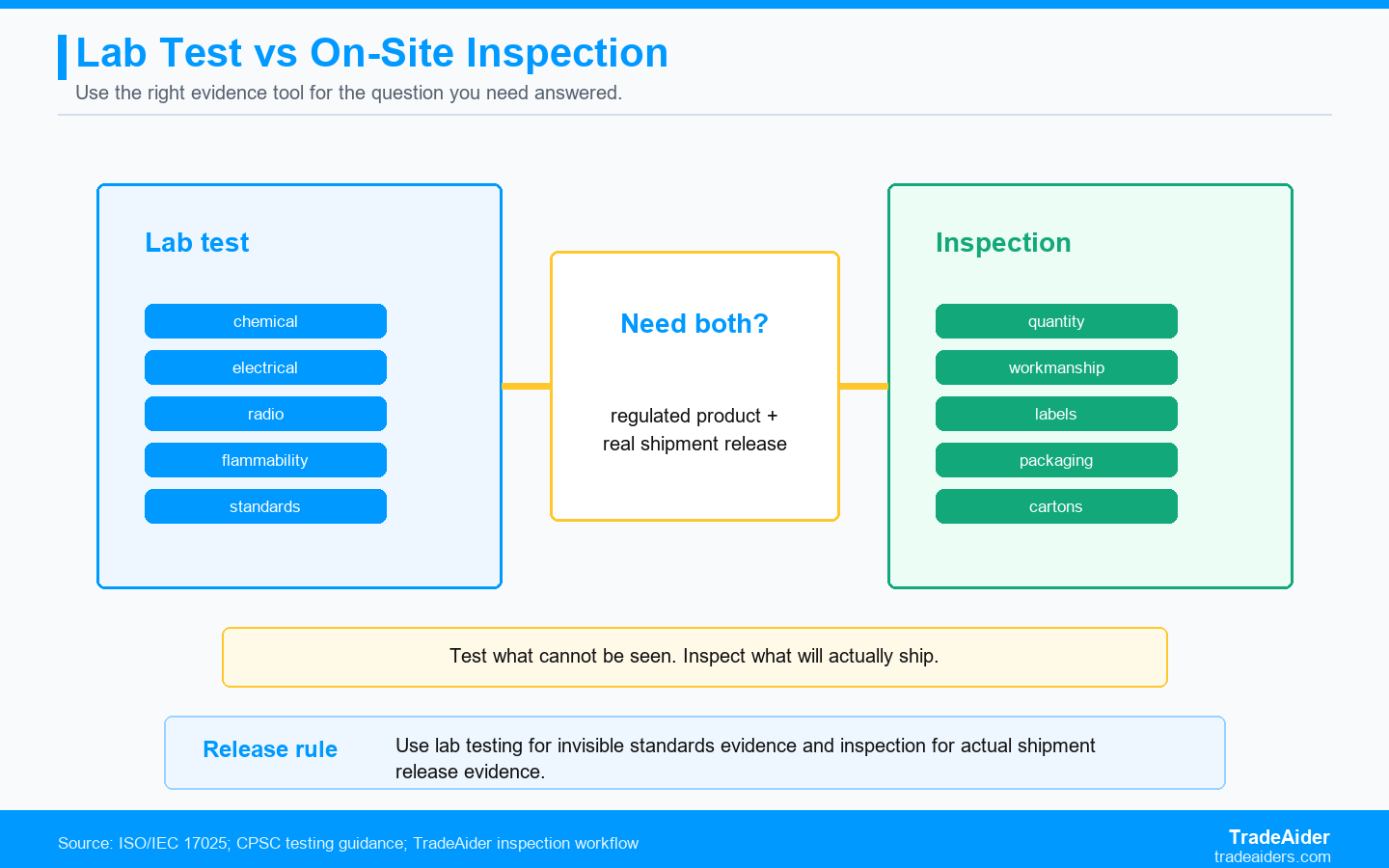
Use lab testing for invisible standards evidence and inspection for actual shipment release evidence.
When Lab Testing Comes First
Lab testing comes first when invisible risk decides market access.
Lab testing is needed when the buyer must prove a product meets defined requirements. Examples include children's product safety rules, food-contact materials, restricted substances, flammability, electrical safety, radio equipment requirements, battery safety, toy safety, textile chemical limits, performance claims, and certain product-specific standards. The exact rule depends on product, market, age group, materials, claims, and use case.
Lab testing should happen early enough to change the product if it fails. Testing after full production can be painful because the buyer may have finished goods that cannot be sold, relabeled, or corrected easily. Early testing also helps define what inspection should later verify: model, material, label, component, packaging, and version.
The buyer should avoid testing a sample that is not representative of production. If the supplier sends a carefully selected sample but later uses different materials or components, the test result may not reflect the shipment. The buyer should control sample identity and keep clear photos, model numbers, component lists, and supplier records.
When On-Site Inspection Comes First
Inspection comes first when the buyer needs to know what is physically ready to ship.
On-site inspection is the practical release gate for mass production. It checks whether the factory produced the right product in the right quantity with the right packaging, labels, cartons, accessories, workmanship, dimensions, and function. It also documents defects before the goods leave the supplier's control.
Inspection is especially useful when the main risk is production drift. A lab test may prove a design, but production can still create scratches, missing parts, wrong color, bad assembly, weak packaging, wrong barcode, mixed SKU, or damaged cartons. These are shipment risks, not laboratory-only risks.
Inspection should be based on approved files: purchase order, specification, approved sample photos, lab-test reference, label artwork, packaging file, defect list, and carton requirements. Without clear files, inspection becomes subjective.
When You Need Both
The safest high-risk workflow connects lab result, production control, and shipment inspection.
Use both when the product is regulated, sold to children, used with electricity or batteries, contains chemicals or coatings, touches food, uses radio transmission, carries safety claims, or enters marketplaces that request compliance documents. Lab testing proves the standard; inspection verifies the real goods and labels match the approved version.
The connection matters. If the lab report says Model A with ABS material and specific packaging, inspection should verify that the shipment still uses Model A, the approved material or part markings where visible, the correct label, and the correct packaging. If the factory changes to Model A-1 or changes a critical component, the buyer should decide whether retesting is needed.
For repeat orders, the buyer should build a version-control record. The record should show which lab report belongs to which product version, which labels were approved, which factory produced the goods, and which inspection report released each shipment. This makes marketplace or regulatory questions easier to answer.
Where TradeAider Fits In The Decision
TradeAider fits by verifying that the produced lot matches the tested and approved version.
TradeAider can perform Pre-Shipment Inspection to check product version, visible construction, labels, packaging, accessories, barcode, carton marks, and workmanship before release. This helps connect lab evidence to the actual shipment.
For products where material, process, or component control matters during production, TradeAider can add During Production Inspection. The purpose is to catch drift before the entire order is packed.
SPAR Scenario: The Product Passed Testing But Failed Release
The lab answer was valid, but the shipment answer was still missing.
Situation: A seller tests a children's storage product before production and receives a passing report for the approved sample.
Problem: During mass production, the supplier changes packaging, label placement, and accessory bagging. The product still looks similar, but the seller cannot prove the shipment matches the tested version and the packaging file.
Action: The seller asks TradeAider to inspect the lot against the lab-test sample photos, approved packaging artwork, warning label, dimensions, and accessory list. Several cartons contain old label artwork and missing accessory bags.
Result: The seller corrects the lot before shipment and updates the supplier's change-control rule. The lab test remains useful because inspection ties it to the actual shipment.
Action Card: Decide In Five Questions
Start with the standard, then the shipment.
- Does the product have legal, marketplace, retailer, or customer safety standards?
- Can the risk be verified visually, or does it require laboratory equipment and methods?
- Does the tested sample match the production materials, model, label, and packaging?
- Does the shipment need release evidence for quantity, workmanship, labels, and cartons?
- Will any supplier change require retesting, stronger inspection, or buyer approval?
A buyer should not choose between lab testing and inspection as if they are interchangeable. They are evidence layers. Testing answers whether the product can meet required standards. Inspection answers whether the factory shipped what the buyer approved.
This distinction also helps budget. Do not spend inspection budget trying to prove a chemical limit. Do not spend lab budget expecting it to catch mixed cartons. Put the right evidence tool at the right point in the sourcing timeline.
For first orders, the buyer should identify testing needs before production and schedule inspection near completion. For repeat orders, the buyer should inspect changes: new material, supplier, factory, mold, label, packaging, component, or claim. Every important change should trigger an evidence decision.
Timing should also account for failure recovery. If a lab test fails before production, the buyer may still have time to change material, redesign a component, revise instructions, or choose another supplier. If a lab test fails after production, the buyer may face finished goods that cannot be shipped. If inspection fails before shipment, the factory may still be able to sort, rework, relabel, repack, or replace defective units before the buyer loses control of the lot.
Sample identity is another important control. The buyer should keep photos and records showing which sample was tested, who selected it, when it was taken, and whether it represents mass production. If the supplier tests one sample and manufactures another version, the buyer has a paper result but not a reliable release file. The inspector can help by checking whether the shipped goods match the tested sample's model, visible material, dimensions, label, packaging, and accessory configuration.
For marketplace sellers, the same logic applies to documentation requests. A marketplace may ask for proof that a product is compliant, while customers may complain about missing parts or poor packaging. Lab testing supports the compliance proof; inspection supports the shipment proof. Keeping both records together by SKU and batch makes the seller's response faster and less confusing. That record should be updated after every production change. Small gaps become large problems when evidence is requested under time pressure.
If you are unsure whether your product needs lab testing, inspection, or both, send TradeAider the product category, destination market, claims, supplier documents, and shipment plan. The next step is to ask TradeAider to map testing and inspection evidence before production.
Frequently Asked Questions
Can inspection prove product compliance?
Inspection can support compliance by verifying labels, model, packaging, and visible conformity, but it cannot replace lab testing when standards require laboratory evidence.
Should I test before or after production?
Testing should usually happen before mass production when failure would require design, material, label, or supplier changes. Inspection then checks the produced lot.
Do repeat orders need new lab tests?
Not always, but supplier, material, design, component, label, or regulatory changes can make retesting necessary. Buyers should maintain version control.
What files should I give the inspector?
Send the PO, specification, approved sample photos, lab report reference, label artwork, packaging file, defect list, and any change-control notes.
Related Articles
Grow your business with TradeAider Service
Click the button below to directly enter the TradeAider Service System. The simple steps from booking and payment to receiving reports are easy to operate.

