
For a dumbbell or kettlebell order, a correct pair total does not establish that each usable weight meets its tolerance. A smooth selector also does not establish that the intended plates remain retained. Buyers need acceptance criteria for individual units and evidence for the actual construction, not only a count of complete sets.
This inspection checklist covers weight tolerance, handle security, locking collars or selectors, finish, drop resistance and cartons. Separate fixed-weight products from plate-loaded and selectorized designs before commissioning the checks. Their connections, adjustment risks and permitted impact tests differ, while the complete packed set still needs protection against movement during distribution.
Checks to Agree for the Ordered Free Weights
Use the checklist to commission the applicable checks, with model-specific limits, sample quantities, equipment and destructive-sample allocation. A fixed kettlebell has no selector mechanism; an adjustable set needs more than the checks for a solid casting. Missing criteria should be resolved with the responsible technical reviewer before the corresponding result is treated as passed.
CheckWhat to inspectHow to judgeWeight toleranceWeigh individual usable units; check selected settings where specified.Nominal weight, tolerance, included components and measurement decision rule.Handle securityInspect integral handles, joints, welds and retained assemblies as applicable.Approved construction, no unacceptable movement or damage, specified strength results.Collars and selectorsCheck engagement and plate retention after the required adjustments and loading.Correct components, complete engagement and model-specific retention criteria.FinishInspect grip, coating, exposed metal and weight markings.Approved sample, defect limits and applicable material or coating tests.Drop resistanceApply the agreed product or packaged test to the designated specimens.Specified height, orientation, surface, sequence and post-test condition.CartonsCheck inserts, separation, closures, packed count and post-test contents.Approved pack design, shipment conditions and product/package acceptance criteria.
Identify Fixed and Adjustable Versions Before Choosing Tests
Identify fixed-weight, plate-loaded and selectorized designs before choosing the inspection methods. Plate-loaded products use removable plates secured to a handle. Selectorized products select plates through an adjustment mechanism, often while the dumbbell sits in a base. A collar test for a threaded handle does not establish that a selector mechanism works correctly.
For kettlebells, identify whether the handle and body are one casting, joined components or part of an adjustable assembly. For coated products, check the declared core and covering construction against the specification. An intact rubber shell does not reveal every feature of the metal underneath.
Open production cartons and compare the set with the parts list. Confirm weight variants, handles, plates, collars, selector parts, bases, tools and instructions. Keep the components for each sampled unit together. Replacing a poorly fitting collar with a convenient spare before recording the mismatch can hide a kit problem.
Accept Each Usable Weight Against Its Own Tolerance
Each complete usable dumbbell or kettlebell needs its own nominal weight and tolerance. Define what belongs in that usable assembly, especially for adjustable products, and require the individual reading rather than only a pair or carton total. Pair matching is an additional requirement when the purchase specification calls for it.
Before disputing a weight result, confirm suitable scale capacity and resolution, a verified reference response and the stated weighing configuration. The product must be fully supported without touching surrounding objects. Request the individual reading, unit and instrument identity; a pass tick alone cannot show how a borderline result was judged.
The NIST calibration guidance describes comparison with reference standards to reduce measurement bias. For the inspection, that means a displayed number is useful only when the measurement process is suitable. Calibration does not supply the buyer's dumbbell tolerance, and a fine display increment alone does not establish accuracy.
For adjustable products, specify which usable settings will be weighed and how the selected assembly is removed from its base. A maximum-setting result does not establish the smaller settings. If plates are checked separately, distinguish those component readings from the assembled weight the customer lifts.
Judge individual accuracy and pair matching separately when both are specified. Opposite errors can cancel in a pair total. For readings close to a limit, use the agreed decision rule for measurement uncertainty, the uncertainty associated with the result. Do not round a borderline value into compliance or select the most favorable reading from repeated attempts.
Hypothetical Example: A Correct Pair Total Hides Two Weight Errors
A pair total cannot establish that both individual dumbbells meet their own weight tolerance. Suppose a hypothetical purchase specification calls for each dumbbell to weigh 20 kg with a tolerance of ±1%. The individual acceptance range is 19.80–20.20 kg. Two samples weigh 19.60 kg and 20.40 kg. Together they total 40 kg, but each falls outside its own limit.
In this illustrative example, first confirm the scale setup and the stated weighing configuration, then retain both individual results. Investigate the affected weight variant and the production or pairing process rather than accepting the pair total. If the supplier corrects or replaces the units, repeat individual weighing and the relevant assembly checks on the corrected products. The sample observations alone do not establish how many other units are affected.
The numbers are illustrative contract values, not a recommended industry tolerance. A different nominal weight, tolerance or specified measurement decision rule changes the judgment; the need to check the correct unit remains.
A Good Grip Surface Does Not Establish Handle Security
Handle security depends on the connection: an integral casting, weld, threaded joint or another retained assembly. Establish it from the drawing and component specification. The grip finish alone says little about whether a kettlebell handle root or a dumbbell head remains structurally secure.
For an integral kettlebell, both handle roots, the underside of the arch and accessible body transitions deserve attention. Cracks, open casting defects or exposed sharp areas need a specific finding. With a coated core, visible inspection cannot establish the condition of metal hidden beneath an intact layer.
On an assembled dumbbell, inspect each head-to-handle interface. Look for gaps, damaged threads, incomplete seating, exposed fastening defects and unintended rotation or axial movement, meaning movement along the handle. Distinguish designed rotation from looseness. If a grip sleeve moves, identify whether only the sleeve moves or the structural connection moves with it.
Connection strength needs its approved fixture and loading direction, with the original and post-test condition retained before tightening or repair. A successful hand check cannot stand in for a specified load. Do not improvise overhead suspension or hold a potentially failing mass by hand during testing.
Give Adjustable-Weight Retention Its Own Assessment
For adjustable weights, require the intended plates to remain retained after the specified settings and transitions. A collar that rotates smoothly or a selector that clicks has demonstrated operation, not the complete retention requirement. Match the procedure to the actual locking system and include the relevant removal and return-to-base behavior.
For a threaded collar, inspect the mating thread, engagement, seating face and any specified locking feature. Check the assembled plate stack rather than testing the collar on an empty handle. With clamp collars, confirm the correct sleeve size and closing action. Record plate movement or collar displacement under the prescribed conditions, including the condition after repeated operation where required.
For a selectorized dumbbell, check plate placement, base fit, selector alignment and the interlock behavior described in its instructions. An interlock prevents an operation until the required condition is met. Use the manufacturer's controlled procedure to check incomplete selection and adjustment outside the base where applicable. Do not force a knob past a stop or improvise an overhead lift as a retention test.
The useful adjustment result identifies the setting and whether the intended plates remain selected while unselected plates stay behind. A clean lift at maximum weight does not establish every intermediate combination. Record any unselected plate catching or rising, and investigate the mechanism rather than simply repeat the easiest lift.
Finish: Separate Appearance, Grip and Coating Performance
Separate cosmetic body finish, grip condition and functional coating performance. Color or gloss variation is judged against the approved reference; burrs, loose material or damage affecting handling need their own findings. A visually smooth coating does not establish its attachment, abrasion life or chemical suitability.
Inspect knurling, the pattern cut into a metal grip, for burrs, damaged peaks and inconsistent edges. On kettlebells, follow the whole inner handle surface and the transitions around the arch. Check rubber or polymer coverings for splits, bubbles, exposed core, poor seams, tackiness and transfer onto a clean contact surface where the agreed method calls for it. Confirm weight markings are legible and match the actual variant.
For appropriate painted metal surfaces, ASTM D3359-23 addresses tape-test assessment of relatively ductile coating films on metallic substrates. Its public description also explains that the test does not provide an absolute bond-rupture force. Do not describe an informal tape pull on thick rubber encapsulation as an equivalent adhesion qualification.
Specify the applicable coating method, specimen preparation and acceptance rating before testing. Where the purchase specification calls for abrasion, corrosion or material assessments, verify that the relevant report covers the supplied construction. Appearance, a hand wipe and a short factory visit do not answer all three questions. Keep destructive finish-test specimens identifiable so they cannot be confused with untouched samples.
Do Not Substitute a Carton Drop for Product Impact Evidence
A bare-product drop and a packaged drop answer different questions and need separate methods and acceptance criteria. The first assesses the exposed product under the specified impact. The second assesses the product and protective pack together. Passing one does not establish the other, even when both tests use the word “drop.”
Construction changes what is appropriate. The BowFlex 52 Dumbbell manual warns against dropping that adjustable model because the plates or locking mechanism can be damaged and plates can disengage. This is a model-specific warning, not a test limit for every dumbbell or kettlebell. Do not transfer a fixed-weight drop claim to an adjustable mechanism.
For a required product-impact result, identify specimen configuration, height reference, landing surface, orientation, repetitions and permitted damage. Include the specified post-impact functional checks. An informal drop demonstration does not establish the specified impact resistance, and a model's no-drop instruction must not be overridden by a generic checklist.
ASTM D5276-19(2023) describes free-fall drop testing of loaded containers and is particularly suited to containers handled manually during distribution. It does not establish a universal bare-dumbbell drop requirement. For heavy or bulky packs requiring other handling equipment, have the packaging specialist select an appropriate method rather than forcing them into a convenient manual-drop procedure.
Cartons: Restrain the Weight and Recheck the Contents
Dense weights need effective internal restraint as well as a sound outer box. Inspect the actual set, inserts, separators and clearances against the approved pack. A tidy carton can still allow a head, plate or kettlebell body to move into another component during handling.
For a fixed dumbbell packed horizontally, inspect the inserts around both heavy heads and the clearance around the handle. Check that the intended contacts restrain the product and that the central gap does not disappear when the pack is closed. The diagram shows one possible arrangement, not a prescribed package. Recheck the same interfaces after the specified package tests.
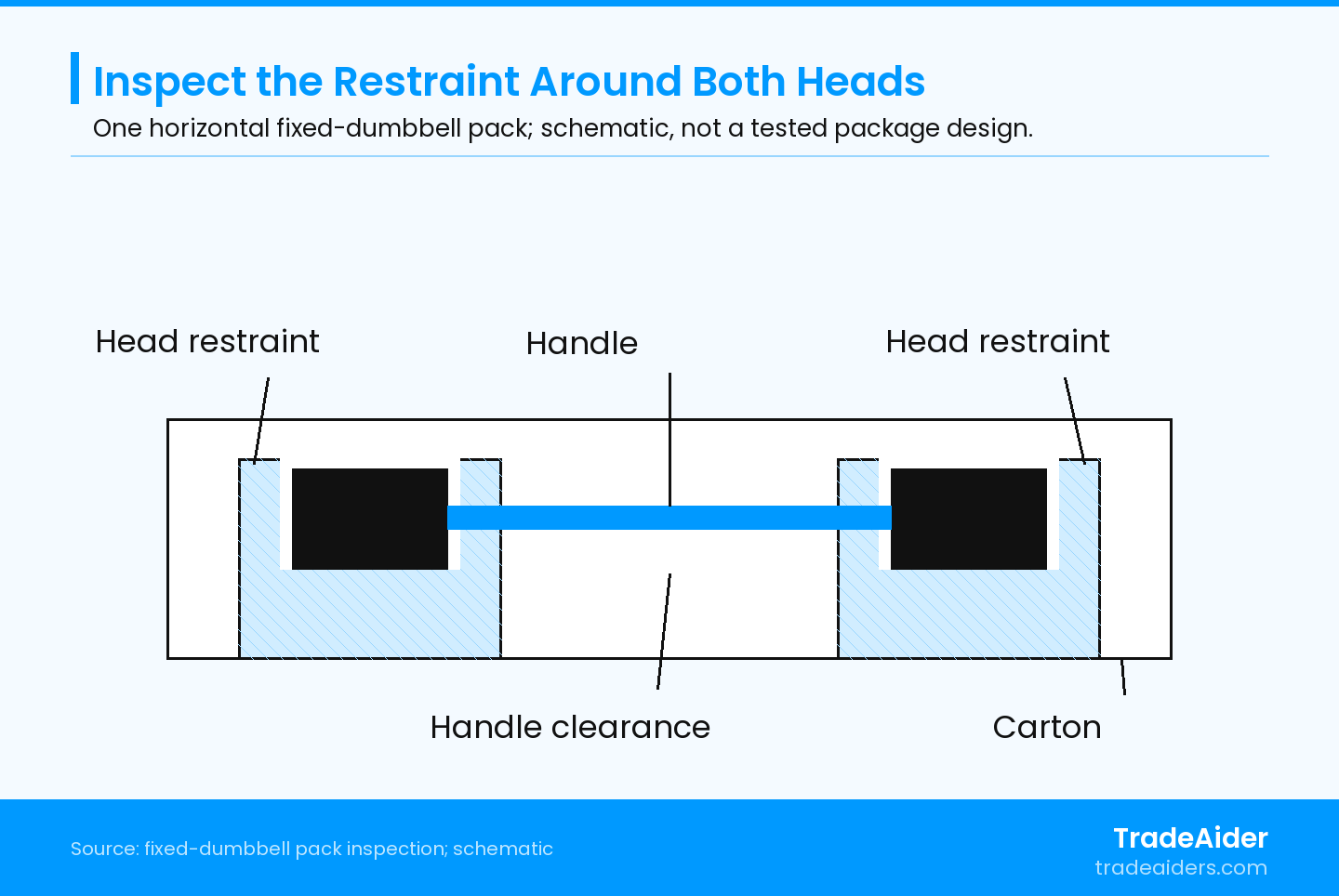
One possible horizontal pack for a fixed dumbbell, shown schematically. Inspect both head restraints and handle clearance against the approved packing design, then recheck after the prescribed package tests. No dimensions or performance limits are shown.
For a kettlebell, inspect the restraint around the body and handle in its approved orientation. For an adjustable set, check how plates, handle, base and loose accessories are separated and secured. Record carton count, product quantity, nominal weight markings and actual gross package weight independently. Matching a shipping label does not establish the mass of the unpacked product.
The public description of ASTM D4169-23e1 describes evaluating shipping units through a sequence of distribution hazards. When used as a performance test, the shipping unit remains unopened until that sequence is complete. Opening it between stages to repair an insert changes the assessment. The scope also points to a separate practice for single parcel packages; choose the protocol for the actual shipment route.
After the required sequence, inspect the product as well as the box. Look for crushed restraints, head movement, metal-to-metal contact, finish damage, loosened joints and locking faults. Record the failed location before repacking. A stronger outer carton may not correct an insert that lets the product move; verify the changed packing arrangement with the relevant tests.
Agree the Missing Requirements Before Booking
Before booking, close the requirements that determine acceptance: the usable weighing configuration and limits, the relevant connection or locking checks, finish criteria, and separate product-impact and package-test conditions. Keep three priorities clear:
- Match the construction: supply drawings, parts lists, approved samples and instructions for each included weight and adjustment version.
- Make results comparable: agree weighing conditions, test methods, specimen allocation and acceptance criteria before the visit.
- Preserve serious findings: record structural cracks, detached parts or failed locks before adjustment, and escalate them under the agreed acceptance plan rather than treating them as routine cosmetic defects.
TradeAider's inspection standard explains sampling and customer-specific checks. Use those requirements to define what the inspector will examine and what the report should show.
For pre-shipment inspection, the order quantity is 100% complete and at least 80% packed for export. Provide the product and packing specifications so the sampled finished goods can be compared with the approved requirements.
Agree available equipment and any separate specialist tests, then request findings tied to the sampled units and actual test conditions. Contact TradeAider to plan the inspection.
Frequently Asked Questions
Can a visual check rule out internal casting defects in a coated kettlebell?
No. A visual inspection can reveal accessible damage, but it cannot establish the condition of metal hidden beneath an intact coating. Examine accessible handle roots and other specified areas, then refer suspected internal defects to the technical reviewer. Any nondestructive or destructive assessment needs an appropriate method and specimen plan. A clean exterior is useful evidence about appearance, not proof of a defect-free casting.
Can a passed dumbbell sample approve every weight in the range?
No. A result for one size or assembly does not automatically cover other weights, handle joints, selector versions or packaging arrangements. Identify the variants represented by the sample and report. The technical reviewer can assess which results legitimately transfer to related products and which require additional specimens. Do not extend a result solely because the products share a color, supplier or family name.
Should tested weights be returned to the saleable shipment?
Only if the agreed sampling and test plan permits it and the specimen remains suitable for sale after the specified checks. Impact work, cut coating tests and disassembly can change the product. Identify the affected specimens, inspect their condition and follow the agreed disposition. Do not return a visibly restored sample automatically: new paint, retightening or repacking can conceal a test-induced condition that still needs assessment.
Does an odor check establish rubber or coating chemical compliance?
No. Smell can identify an objectionable condition for investigation, but it cannot establish compliance with chemical restrictions for the destination market. Match the supplied material and color variant to the relevant laboratory evidence. If formulation, supplier or coating changes, check whether that evidence still applies. Keep the odor observation in the inspection report without converting it into a chemical test result.
Related Articles


Grow your business with TradeAider Service
Click the button below to directly enter the TradeAider Service System. The simple steps from booking and payment to receiving reports are easy to operate.