- Acerca de Nosotros

- Nuestros Servicios
- Su Industria
- Recursos
- Noticias y Blog
Acceptable Quality Limit (AQL)
In international manufacturing, demanding "zero defects" sounds ideal, but it is practically impossible. Mass production naturally involves human error, raw material variances, and machine tolerances. If you reject an entire batch over a single minor scratch, factories will either stop working with you or raise their prices exponentially to cover the risk.
To balance risk and cost, professional sourcing teams rely on a statistical framework called the Acceptable Quality Limit (AQL)—sometimes referred to as the Acceptance Quality Limit.
This guide explains what AQL is, how to read the standard ANSI/ASQ Z1.4 tables, and how to define realistic defect thresholds that protect your brand without halting your supply chain.
What is Acceptable Quality Limit (AQL)?
The Acceptable Quality Limit (AQL) is the worst-case defect rate that is considered acceptable for a production batch under statistical sampling. It defines the maximum number of defective units that can be found in a randomly selected sample before the entire batch must be officially rejected.
The AQL standard is governed globally by the ANSI/ASQ Z1.4 (or ISO 2859-1) tables.
Instead of inspecting 100% of an order—which is incredibly slow and expensive—AQL allows a third-party inspector to pull a small, statistically representative sample (e.g., 80 units out of a batch of 5,000) and mathematically predict the quality of the entire shipment.
Understanding the Three Defect Levels
AQL does not treat all defects equally. In standard commercial consumer goods, defects are classified into three severity levels, each with its own default AQL percentage:
- Critical Defects (AQL 0%): Flaws that present a safety hazard, fail to meet regulatory compliance, or pose a risk of personal injury (e.g., exposed wiring on a hair dryer or sharp metal burrs on a children's toy). Tolerance limit: Zero. Finding even one critical defect fails the entire inspection.
- Major Defects (AQL 2.5%): Flaws that reduce the product's usability, performance, or commercial value. The customer will likely return the item or leave a negative review (e.g., a suitcase zipper that jams or a watch screen that is deeply scratched).
- Minor Defects (AQL 4.0%): Cosmetic deviations that do not impact the product's safety or function. Observant customers might notice them, but they are unlikely to return the product (e.g., a tiny glue smudge on the bottom of a shoe or slightly loose threads inside a jacket pocket).
No More Blind Imports: Verified Quality via Strict AQL Inspections. Delivering transparent, on-site quality control and reliable inspection reports. ➔ Get a Free Plan
How to Use the AQL Tables (A Step-by-Step Example)
The AQL process relies on two distinct charts. Let’s walk through a real-world example to see how they work.
Your Scenario: You are importing 5,000 wireless headphones. You choose General Inspection Level II (the industry baseline) and the standard AQL limits: 2.5% for Major and 4.0% for Minor.
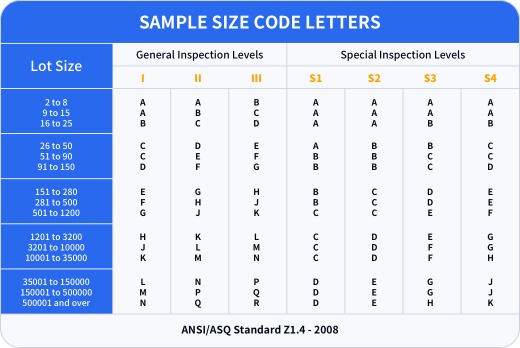
Step 1: Find Your Sample Size Code Letter (Chart A)
First, you look at the "Lot Size" (your total order quantity) on the left side of the table and locate the range for 5,000 units (which falls under the 3,201 to 10,000 bracket). Move horizontally to the column for General Inspection Level II.
- This mapping gives you the Code Letter: L.
Step 2: Determine Your Sample Size (Chart B)
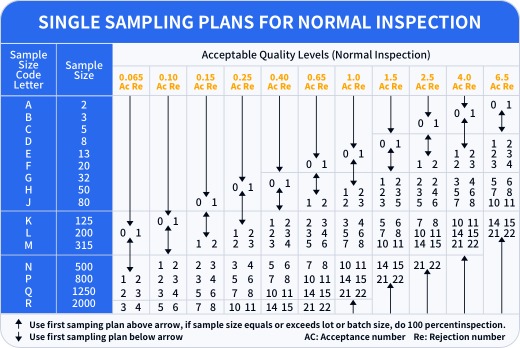
Next, switch to the second table (the AQL Sampling Table). Locate your letter L on the left-hand column.
- This instantly tells you the required Sample Size: 200 units. The inspector must randomly select exactly 200 headphones from different master cartons in the warehouse.
Step 3: Find the Accept (Ac) and Reject (Re) Limits
Follow the line for letter L horizontally to your chosen AQL columns:
- For Major Defects (AQL 2.5%): The intersecting box shows Ac: 10 / Re: 11.Meaning: If the inspector finds 10 or fewer major defects, the batch passes. If they find 11 or more, the batch fails.
- For Minor Defects (AQL 4.0%): The intersecting box shows Ac: 14 / Re: 15.Meaning: If the inspector finds 14 or fewer minor defects, the batch passes. If they find 15 or more, the batch fails.
How to Choose the Right AQL Level for Your Brand
While the industry default is 0% / 2.5% / 4.0%, you can customize your thresholds based on your product complexity, price point, and brand positioning:
- Strict / Premium Standards (AQL 0% / 1.0% / 1.5%): Best for luxury items, high-end electronics, precision medical devices, or child-safety goods where there is low tolerance for errors.
- Balanced Standards (AQL 0% / 2.5% / 4.0%): The standard benchmark for general consumer electronics, apparel, homeware, and toys.
- Relaxed Standards (AQL 0% / 4.0% / 6.5%): Acceptable for cheap promotional items, basic packaging, or disposable bulk goods.
Conclusion: Embed AQL in Your Purchase Contracts
An AQL limit is only useful if your manufacturer is legally bound to respect it. Never leave your quality expectations open to interpretation.
Always list your chosen General Inspection Level, AQL thresholds, and Defect Classification List (DCL) directly on your Purchase Order (PO) or Proforma Invoice (PI) before sending your deposit. When a factory knows exactly how their performance will be mathematically measured on inspection day, they are far more likely to manage the production line with care.
Related Knowledge Base
Initial Production Check (IPC)During Production Inspection (DUPRO)Pre-Shipment Inspection (PSI)Defect Classification List (DCL)MIL-STD-105E: History and Evolution of Modern Quality Control SamplingDefect Classification: Major, Minor, and Critical Defects ExplainedInspection Levels I, II, and IIIANSI/ASQ Z1.4 TableAQL (Acceptable Quality Limit)
TradeAider