- Acerca de Nosotros

- Nuestros Servicios
- Su Industria
- Recursos
- Noticias y Blog
Textile Labeling Regulations: Fiber Content and Care Labeling
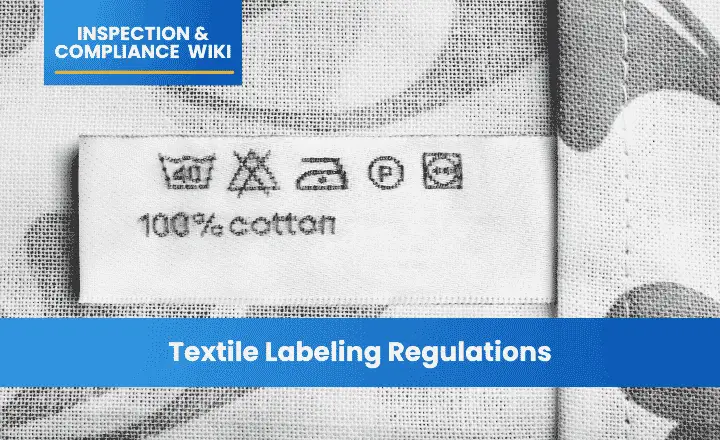
In international apparel and home textile trade, textile labeling regulations dictate mandatory consumer information that must be permanently attached to finished garments and textile goods before retail distribution. Overseen by regulatory bodies such as the US Federal Trade Commission (FTC) under the Textile Fiber Products Identification Act and the European Parliament under Regulation (EU) No 1007/2011, textile labeling rules protect consumers against false fiber composition claims and improper garment care instructions.
Non-compliant textile labels—such as missing manufacturer RN numbers, incorrect care symbols, unlisted fiber constituents, or fiber percentage errors exceeding legal tolerance thresholds—lead to immediate customs holds, retail store inventory pull-backs, regulatory fines, and shipment rejections during Pre-Shipment Inspections (PSI).
Statutory Labeling Elements Across Major Global Markets
While specific layout requirements vary between jurisdictions, mandatory textile labels across the United States, European Union, United Kingdom, and Canada must feature core compliance elements:
| Regulatory Jurisdiction | Primary Governing Statute | Mandatory Labeling Elements | Country of Origin Rules |
|---|---|---|---|
| United States | FTC Textile Act & 16 CFR Part 423 (Care Labeling Rule) | Fiber content percentages, FTC Registered Identification Number (RN#) or company name, Country of Origin, Care instructions | Mandatory explicit statement (e.g., "Made in Vietnam") on front side of neck/waist label |
| European Union | Regulation (EU) No 1007/2011 | Generic fiber names in official destination country language(s), material composition descending by percentage | Optional under EU rules, but enforced by individual member state consumer laws |
| United Kingdom | Textile Products (Indication of Fibre Content) Regulations | Generic fiber names, UK importer details, composition percentages | Mandatory under UK consumer protection regulations |
| Canada | Textile Labelling Act & Regulations | Dual-language fiber names (English & French), CA Identification Number, composition percentages | Mandatory bilingual origin statement |
Fiber Identification Rules and Statutory Tolerance Thresholds
Textile regulations enforce strict standardized terminology and numeric accuracy for fiber composition declarations:
- Generic Fiber Names: Labels must declare official generic fiber names (e.g., "Cotton," "Polyester," "Elastane / Spandex," "Wool") rather than unapproved brand trademarks (e.g., "Lycra" must be declared as "Spandex" or "Elastane").
- Fiber Percentage Tolerance (±3% Rule): Under US FTC rules and EU Regulation 1007/2011, a statutory tolerance of ±3% is permitted between declared and actual lab-tested fiber weights for multi-fiber blends. For example, a shirt labeled "60% Cotton / 40% Polyester" is legally compliant if laboratory quantitative chemical analysis yields 57% to 63% cotton.
- Exclusive of Decoration Exception: Trims, elastic bands, structural linings, pocketing, and decorative embroidery accounting for less than 15% of the total garment surface area may be excluded from composition calculations, provided the label states "Exclusive of Decoration" or "Exclusive of Trim."
- 5% Miscellaneous Fiber Rule: Fibers accounting for less than 5% of total weight must be listed as "Other Fiber" unless they provide a specific functional utility (e.g., 3% Spandex for elasticity must be named).
Care Symbols and Washing Standardization (ISO 3758 vs. GINETEX vs. ASTM)
Garment care instructions must provide accurate, clear laundering guidance using recognized international symbol systems:
- ISO 3758 / GINETEX System (EU & Global): Utilizes 5 basic care symbols arranged in a strict left-to-right order: Washing (Tub) → Bleaching (Triangle) → Drying (Square) → Ironing (Iron) → Professional Textile Care (Circle).
- ASTM D5489 System (United States): Utilizes standardized US symbol formats matching ISO concepts, enforced under FTC 16 CFR Part 423. Care symbols may replace written English text if all 5 basic care operations are fully represented.
- Care Instruction Accuracy: Importers must ensure that stated care instructions (e.g., "Machine Wash Warm, Tumble Dry Low") do not cause physical shrinkage exceeding commercial tolerances (typically 3% to 5%) or garment color bleeding when followed by the consumer.
Practical Module: On-Site Textile Label Verification & QC Practice
Quality control inspectors conducting Pre-Shipment Inspections (PSI) on garment shipments must execute strict physical and visual label audits directly on the factory floor:
Step 1: Label Placement and Permanent Attachment Audit
- Inspect garment neck seams, side seams, or waistband attachments to confirm mandatory main labels and care/content labels are securely and permanently sewn into the garment structure.
- Verify that label stitching does not pucker, detach under a 10-second manual pull test, or cause skin irritation on wearable surfaces.
Step 2: Artwork, Fiber Percentage, and Country of Origin Proofing
- Proofread main label text against approved buyer artwork files, verifying RN/CA numbers, spelling of generic fiber names, and exact fiber percentage figures.
- Confirm that the "Made in [Country]" origin statement is clearly legible, permanently marked, and positioned in an accessible location per destination customs rules.
Step 3: Care Symbol Order and Lab Test Report Matching
- Audit the care symbol sequence on care labels to confirm left-to-right ordering matches ISO 3758 or ASTM D5489 symbol standards.
- Cross-check care label instructions against third-party laboratory dimensional stability (shrinkage), skewing, and colorfastness test reports to confirm care recommendations are technically validated.
Verify Quality Before Shipment: Rigorous On-Site AQL Inspections.Don't risk fabric defects, color shade variations, or incorrect labeling. Verify workmanship, fiber content labeling, and physical colorfastness through our transparent, on-site inspection services. ➔ Get a Free Inspection Plan
Frequently Asked Questions (FAQ)
Q1: What is an FTC RN Number, and can non-US exporters apply for one?
An RN (Registered Identification Number) is a unique number issued by the US FTC to US-based businesses producing or importing textiles. Non-US exporters cannot hold an RN number directly; they must declare the US importer's RN number or the full corporate business name on the garment label.
Q2: Can a garment label list a brand trademark like "Tencel" or "Kevlar" instead of generic fiber names?
No. Regulators mandate official generic fiber names (e.g., "Lyocell" for Tencel, "Aramid" for Kevlar). Trademark names may appear alongside generic names on packaging or hangtags, but cannot replace generic fiber names on mandatory permanent care/content labels.
Q3: How does the $\pm 3\%$ fiber tolerance rule apply to 100% single-fiber garments?
The $\pm 3\%$ tolerance rule applies only to multi-fiber blended fabrics. A garment labeled "100% Cotton" or "Pure Silk" must contain strictly 100% of that fiber, with zero commercial tolerance allowed for intentional secondary fiber additions.
Q4: What language must textile care labels use when selling apparel in Europe?
Under EU Regulation 1007/2011, fiber composition text must be written in the official national language(s) of the specific EU member state where the garment is sold to end consumers (e.g., French for France, German for Germany). Utilizing standardized ISO 3758 care symbols eliminates written text requirements for care steps.
Q5: What happens if a customs inspection discovers incorrect fiber content disclosures on imported clothing?
Customs authorities (such as US CBP) will detain the shipment at the port of entry for mislabeling. Importers must pay penalty fees and cover expenses to re-label the entire shipment in a bonded warehouse before customs clearance is granted.
References
[1] US Federal Trade Commission. Threading Your Way Through the Labeling Requirements Under the Textile and Wool Acts[R]. Washington D.C.: FTC, 2026. https://www.ftc.gov/
[2] European Parliament and Council. Regulation (EU) No 1007/2011 on Textile Fibre Names and Related Labelling[S]. Brussels: Official Journal of the European Union, 2011. https://eur-lex.europa.eu/
[3] International Organization for Standardization. ISO 3758:2023 Textiles — Care labelling code using symbols[S]. Geneva: ISO, 2023. https://www.iso.org/standard/79926.html
Reference Notes
- FTC business guidelines define binding federal rules for fiber disclosures, care labeling, and origin markings on US apparel imports.
- Regulation (EU) No 1007/2011 establishes harmonized European requirements for textile fiber generic names and composition labeling.
- ISO 3758 defines international standardized care symbols for domestic laundering, dry cleaning, bleaching, and ironing operations.
Related Knowledge Base
TradeAider