
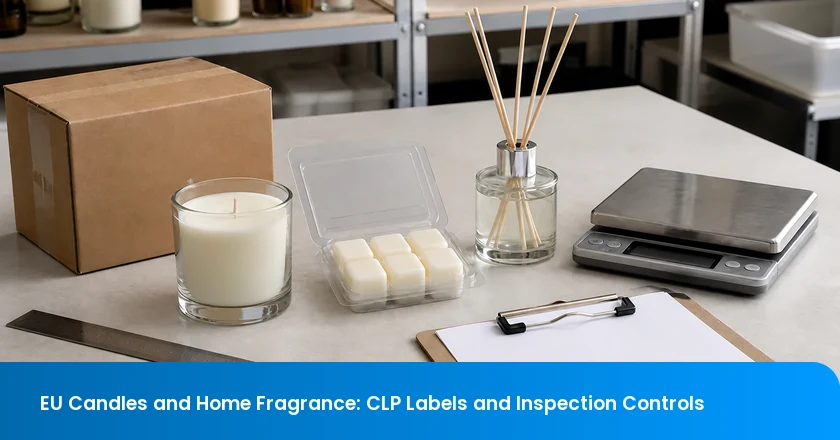
EU candle and home-fragrance compliance is easiest to control when it is treated as a finished-SKU release decision, not as a collection of documents from the fragrance house, factory and artwork agency. A scented candle, reed diffuser or room spray can look consistent across a range while each SKU has a different formula revision, immediate pack, language set or claim. Those differences decide what has to be checked before a buyer allows stock to ship.
Buyers and quality teams need a release file that keeps ordinary consumer-product safety work separate from the additional controls that arise where a final mixture is classified as hazardous. The file should name the evidence that must agree and the physical facts an independent inspection can check. The importer, manufacturer or other responsible party remains responsible for the applicable legal assessment.
Start With the Final Sellable Mixture and EU Destination
Before approving a home-fragrance pack, the buyer needs a named final mixture, destination and sellable package configuration rather than a scent name alone.
Identify the final mixture, the destination Member State or States, the immediate package and the exact consumer-facing claims. “Vanilla candle” is not a sufficient approval unit. The release unit is the version that will be placed on the market: wax or liquid base, fragrance formula revision, concentration, vessel or bottle, closure, label artwork, bundle configuration and destination language set.
A buyer should ask the supplier to give that unit a stable SKU or formula reference before reviewing labels. This avoids a common late-stage error: approving an English-only label from a development sample, then receiving production stock containing a revised fragrance oil or different fill volume. Where the product contains a mixture that is classified as hazardous, that change can alter the label and poison-centre information requirements. Where it does not, the buyer still needs reliable traceability and safe-use evidence for the finished consumer product.
Build one product record for every variation. Attach the approved formula identifier, current supplier safety documentation where relevant, pack photographs, country allocation, barcode and claim list. If the range contains both candles and liquid diffusers, keep them in separate release rows; their exposures, package risks and evidence sets are different. Those same fields provide the evidence points for an early supplier briefing.
- Approve the finished SKU, rather than a generic fragrance family.
- Record the formula revision and the immediate consumer package together.
- List every EU destination before artwork is released to print.
- Hold the shipment if formula, label, claim or country information does not match the approved record.
Apply CLP Only When the Final Mixture and Package Trigger That Route
A hazardous mixture in packaging must carry the applicable CLP label elements; the buyer should approve those elements against the current final mixture and named immediate package.
Do not assume that every scented candle or diffuser has the same CLP outcome. Article 17 sets out the core information required on labels for hazardous substances and mixtures, including supplier identification, product identifiers and the relevant hazard communication elements. See the CLP Regulation, Article 17.
That distinction matters in a buying workflow. A “CLP label check” is not simply looking for a pictogram. It is a reconciliation task: compare the current composition/classification package with the printed product identifier, signal word where applicable, hazard and precautionary wording, supplier details, nominal quantity and label layout. The person approving the artwork needs the version-controlled evidence, not a verbal confirmation that the formula is “the same as last time.”
CLP label language depends on the Member State where the mixture is placed on the market, so the destination-language set belongs in the artwork approval file.
CLP requires label information to be provided in the official language or languages of the Member State in which the mixture is placed on the market, unless that Member State provides otherwise. Maintain an approved language matrix for each SKU and sales country, then inspect packed goods against that matrix. The legal text is available in the consolidated CLP Regulation.
For practical inspection, take clear photos of the product label, outer carton and any leaflet; capture the full text rather than only the front panel. Check that the label is legible after application, not lifted by an oily bottle, hidden by a shrink band or cut off at a curved seam. A sound regulatory wording file is not enough if the production label cannot be read by the consumer.
Before bulk manufacture, buyers can ask TradeAider to use pre-production inspection to confirm the approved pack reference, including the formula identifier, artwork version and package configuration to be compared later.
Treat a Formula Change as a UFI and Notification-Control Trigger
For hazardous mixtures in scope, the UFI links the product to the mixture information in the poison-centre notification system and must match the correct mixture composition.
The UFI is tied to a composition and must be managed as part of the same change-control chain as the formula, classification and label. Annex VIII to CLP establishes harmonised information requirements relating to emergency health response; use the Annex VIII amendment as the primary reference when deciding whether the notification route applies.
The operational consequence is simple: do not approve a UFI as a static artwork field. If a fragrance house changes a raw material, an allergen-bearing component, concentration or the final formulation code, the responsible compliance owner must reassess the notification and label implications before the revised product is released. The buyer’s control is to record which formula revision sits behind each printed UFI and block mixed-version production.
The current safety-data-sheet record is a supply-chain input to the final composition and label review; it should not be separated from the formula revision used for the finished SKU.
Requirements for safety-data-sheet content appear in Commission Regulation (EU) 2020/878. Keep the received document, its issue date and the formula reference together, then escalate any mismatch rather than asking an inspector to make a regulatory judgement at the factory gate.
A useful release-file convention is a single formula-control line containing: SKU, fragrance or mixture code, formula revision, supplier document revision, classification decision owner, UFI status, notification status where relevant, label artwork ID and approved destinations. This turns an abstract regulatory requirement into a comparison an inspector and buyer can actually perform.
Separate Fragrance Marketing From Biocidal Claims
A treated article may need BPR labelling when a biocidal-property claim is made or when active-substance approval conditions require it.
Words such as “fresh,” “odour neutralising” or “long-lasting fragrance” do not automatically create the same legal route as an antimicrobial or hygiene-protection claim. Under Article 58 of the Biocidal Products Regulation, a treated article may be placed on the market only subject to the conditions in that article, and a biocidal claim can create additional obligations. Read the primary text in the Biocidal Products Regulation, Article 58.
For a candle or home-fragrance range, that means marketing language needs an early compliance screen. “Helps create a calm atmosphere” is a consumer-experience statement; “kills germs in the room” introduces a materially different representation. The same applies to packaging icons, marketplace bullets and retailer copy. A buyer should not approve labels in isolation while the commercial team publishes stronger claims in product listings.
The BPR governs biocidal products used to protect people, animals, materials or articles against harmful organisms, creating a separate review route for claims of that kind.
The Biocidal Products Regulation also defines a treated article as a substance, mixture or article treated with, or intentionally incorporating, one or more biocidal products. That definition is the starting point for deciding whether a special treatment or protection claim needs further review, not a conclusion that every scented product is treated. The definition is set out in Article 3 of the BPR.
Because CLP has been amended, a formula, claim or artwork change should trigger a current label-route review before an earlier proof is treated as reusable.
Country-specific label requirements and the precise classification rules should be checked against the current consolidated legal texts and the responsible compliance owner’s advice. One example of a later CLP amendment is Commission Regulation (EU) 2024/2865.
Where a mixture, claim or product-safety question is still technically unresolved, buyers should review product-testing needs when the technical route remains open before a packing decision turns an open question into an affected lot.
Keep Consumer-Product Safety and CLP Evidence in Parallel Files
The EU General Product Safety Regulation is a separate consumer-product framework from CLP and includes an EU economic-operator requirement for products in its scope.
A product that does not require a hazardous-mixture label is not therefore free of product-safety work. Regulation (EU) 2023/988 provides the General Product Safety Regulation framework; consult the GPSR text when allocating responsibilities for the product placed on the EU market.
For candles, assess the practical hazards of flame, heat, soot, container cracking, instability and warning presentation. For reed diffusers and room sprays, review closure security, leakage, liquid contact, glass breakage, transport pack performance and sensible use information. This work is product-specific. It should produce a defensible risk record and an approval checklist that can be linked to inspection criteria, not a generic declaration copied across every SKU.
Make the boundary explicit in the release file. One section should show the classification/label decision for the mixture; another should show the consumer-product safety evidence and traceability decision. This prevents a team from treating an SDS as proof that the finished candle, vessel, wick and retail pack have been assessed, or treating a successful drop test as proof that a hazard label is correct.
Release Only When Formula, Artwork and Cartons Reconcile
A packed home-fragrance lot is a buyer release candidate only when its current formula record, required label route, approved artwork and traceable carton range reconcile.
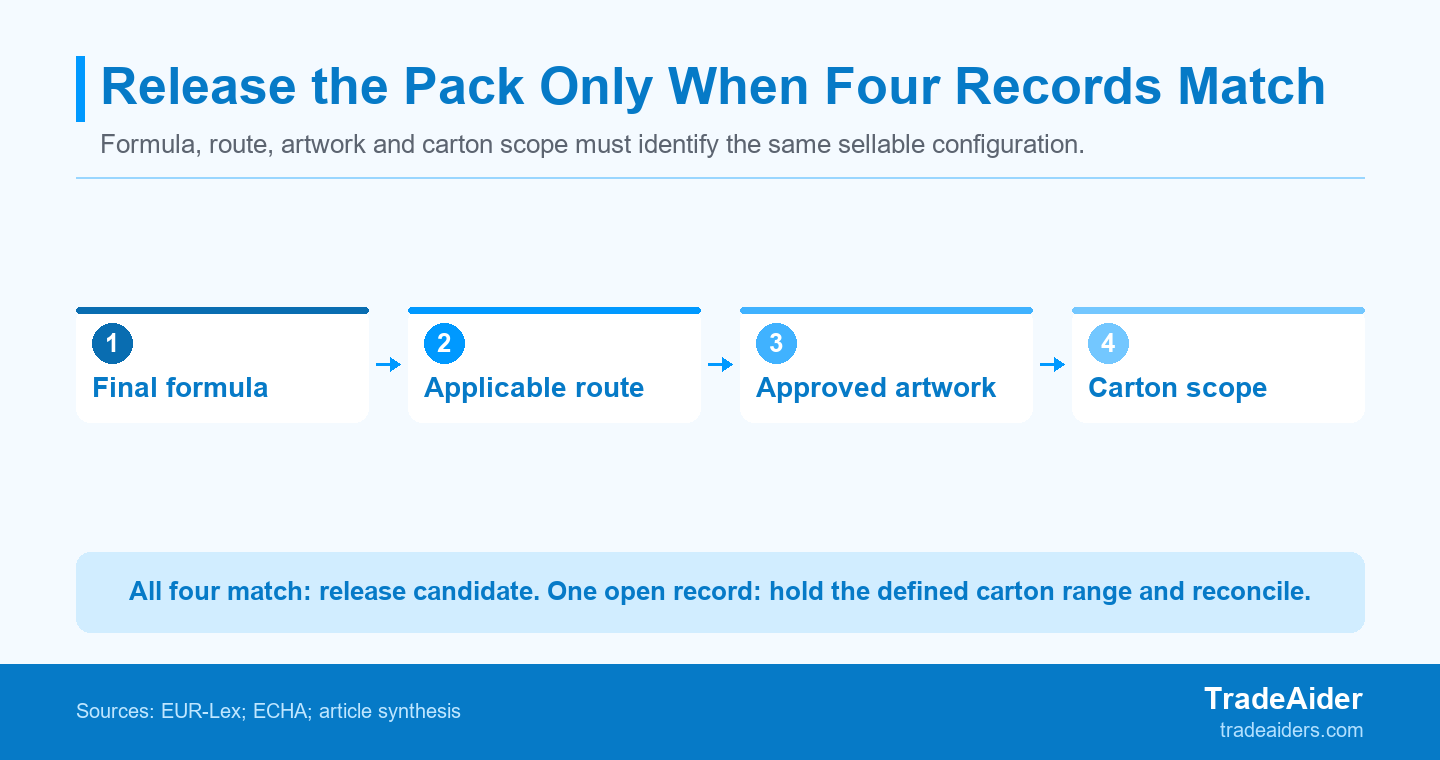
A physical pack check is meaningful only after the current formula, applicable route, approved artwork and carton range point to the same configuration.
This is the most valuable control for a buyer managing a seasonal range with repeated fragrance names and changing suppliers. A release gate should be binary: the four records match, or the SKU remains on hold pending a documented resolution.
| Record | What must be fixed | What the buyer checks | Shipment action if it differs |
|---|---|---|---|
| Formula | Mixture code, revision and supplier document | The record matches the sellable SKU | Hold affected lots and obtain the current assessment |
| Compliance decision | Classification, UFI/notification status and claim screen | The decision applies to the current formula and destination | Do not clear artwork or release stock |
| Artwork | Label ID, languages, identifiers and warnings | Printed goods match the approved artwork version | Segregate incorrect labels and rework only under approval |
| Production evidence | Lot code, fill, closure, appearance and pack integrity | Sampled goods match the approved physical standard | Apply the agreed acceptance decision and corrective action |
Make the gate part of the shipment calendar. If the final formula is still being confirmed, postpone print approval or mark the SKU as commercially unready. It is less costly to pause a label run than to relabel a packed consignment, explain a mismatch to a retailer or discover after arrival that multilingual artwork belongs to a different formula version.
For repeat orders, buyers can use during-production inspection to surface a changed pack before final packing, rather than discovering it after every carton is sealed. They can also review TradeAider's quality-control approach before defining the evidence handoff for a supplier programme.
Use Inspection to Verify the Pack, Not to Classify the Mixture
Inspection can corroborate the visible pack, current artwork version and lot identity against an approved file; it cannot determine a missing mixture classification or poison-centre obligation.
Specify the checkable fields in the purchase-order quality plan: item code, lot identification, approved label artwork, language count, formula reference where shareable, fill tolerance, net content, closure condition, vessel appearance, wick position, leakage condition, carton marks and agreed sampling basis.
For a diffuser, check liquid level and the neck/closure area after the product has stood for the agreed period. For a candle, inspect the vessel for cracks, chips, poorly seated wicks, label placement and surface defects. For both, compare a sampled label to the approved digital proof at character level where the control plan identifies regulatory text, UFI or destination language as critical. A pre-shipment inspection should capture enough photographs for the buyer to confirm the actual production version, not merely report that cartons were present.
Agree a defect taxonomy before the visit. Critical observations may include an unapproved label version, an absent required hazard element after the responsible owner has determined it applies, an incorrect UFI, an unsafe closure or a leaking liquid product. Major and minor classifications should be defined in the buyer’s own quality agreement. Once the traceable carton population is defined, buyers can use the AQL calculator after defining the carton population to set the physical sampling basis.
Inspection evidence is strongest when it feeds a decision. Link the report to the approved product file, record the lot and carton range sampled, state every mismatch exactly and define the next action. Buyers can review the inspection standard when setting visible pack checks so label, vessel, closure and carton conditions are clearly stated.
Illustrative Scenario: A Fragrance Change Splits the Packed Lot
An EU home-fragrance importer is preparing a multi-market shipment of reed diffuser refills. The order contains 4,800 refill units in 160 export cartons, with 100 cartons packed when the fragrance-oil supplier changes a component. The approved artwork and formula file identify blend A-17, while the new production record identifies blend A-19 for the 100 packed cartons.
The retail pack still uses the A-17 artwork proof. The factory can identify the affected packing date and cartons, but the buyer has not received a reconciled route and label decision for A-19. The formula record, approved artwork and packed-carton map do not yet point to one verified sellable configuration. A visual pass on the existing pack cannot settle the missing formula-to-route link.
When a fragrance formula changes after label approval, hold the traceable affected cartons until composition, UFI or notification status where applicable, label artwork and carton map reconcile.
Hold the 100 traceable cartons associated with A-19 while the current formula, route, artwork and carton map are reconciled. Obtain the updated technical and regulatory review, confirm whether the UFI or notification path applies, approve replacement artwork where needed, and retain a corrected carton map.
Recheck the Corrected Carton Range Before Sampling
After a formula-change hold, recheck only the cartons that can be mapped to the reconciled configuration before returning them to the buyer release decision.
Recheck the finished pack and defined cartons only after the record set identifies one current configuration. This is an illustrative scenario only; it is not a TradeAider client case or an EU legal determination. If the revised route requires different information, segregate the already printed material rather than using it because the scent profile seems similar.
This scenario is why a formula ID must appear in a commercial release file even when it is confidential. The buyer does not need to publish composition details to a factory inspector; the buyer does need a controlled identifier that proves the product, documentation and label belong together.
Prepare the Release File Before Pre-Shipment Inspection
A useful handoff identifies the formula record, route decision, artwork revision, market and carton range that the factory inspection is asked to corroborate.
The most resilient home-fragrance control file is short enough to use and specific enough to expose a mismatch. Give each final SKU one release page, attach the controlled evidence, and name one owner for changes. When a new fragrance, label or destination is introduced, open a new approval record instead of editing the old one without traceability.
- Define the final mixture, pack and destination for each SKU.
- Obtain the current formula, classification and safety-document inputs from the appropriate supplier.
- Confirm whether CLP, UFI/notification and treated-article claim controls apply with the responsible compliance owner.
- Approve the precise artwork and destination-language set against that decision.
- Convert the approval into a factory inspection checklist and lot-release gate.
- Hold any lot affected by an undocumented formula, claim, artwork or country change.
For importers managing repeat orders, the next improvement is to connect this release record to supplier corrective actions. A recurring label-placement or closure issue should not only be counted as a defect; it should change the pre-production briefing, sample approval or final inspection checklist for the next order. For the named packed lot, buyers can ask TradeAider to arrange a pre-shipment inspection against the reconciled release file after the formula record, approved artwork, route status, packing status and carton range have been supplied.
Frequently Asked Questions
Does every scented candle need a CLP label in the EU?
A scent name alone does not decide whether the final mixture is classified as hazardous or requires CLP label elements. The label route depends on the classification of the final mixture and the finished product configuration, not on the fact that an item has a fragrance. The responsible compliance owner should evaluate the current formula and destination, then the buyer should ensure that the approved artwork and production samples reflect that decision.
Can a buyer reuse last season’s diffuser label after a fragrance change?
Hold the affected scope when a formula change leaves the UFI, notification status where applicable, label or carton map unresolved. A new or revised formula may affect classification, label wording, languages or supplier documentation. Treat the proposed formulation as a separate release record until the responsible owner confirms it can use the prior decision. The factory should not fill, label or pack affected units merely because the fragrance name and bottle design have stayed the same.
What should a pre-shipment inspection check on home-fragrance goods?
Inspection can compare approved records with the physical pack, but it cannot create a missing mixture classification or notification decision. It should check the agreed production facts: SKU, lot coding, approved artwork version, label legibility, language set, fill level, closure security, leakage, vessel condition, carton marks and the sampling basis. The inspection should document actual observations with photos and a clear lot reference.
When do antimicrobial claims need additional review?
A biocidal-property claim must be screened for the separate BPR route before the pack copy is treated as approved. Statements that present a product as killing germs, protecting against microbes or providing a biocidal benefit can have a different regulatory significance from ordinary fragrance or atmosphere claims. Check the precise wording, the product treatment and the intended EU market with the responsible compliance owner.
Related Articles


Grow your business with TradeAider Service
Click the button below to directly enter the TradeAider Service System. The simple steps from booking and payment to receiving reports are easy to operate.

