

A children’s nightwear label can be correct and the shipment can still be unready for release. Fibre composition is only one part of the decision. The garment’s intended use, the destination market, chemical and component evidence, and the records for the packed goods must all point to the same current version.
The most reliable ship-or-hold decision comes from documents and goods that identify the same current version. Match the garment specification, destination route, consumer information, and packed-carton range before authorising shipment.
Four Layers That Must Describe the Same Product
- Approve one current garment, artwork, and destination allocation.
- Match every relevant material and consumer-information item to that version.
- Keep a route-specific evidence file before bulk production and packing.
- Release only the carton range that can be linked back to those records.
A buyer should release one product-and-market version only when the garment build, route, consumer information, and packed-lot identity describe the same current product. Use the product-and-market file as a buyer-controlled record that ties the current product version to market evidence for the destination and the packed lot. It prevents a familiar mistake—treating a correct sewn-in label as proof that every other decision is also current.
Use four layers in that file. A change in one layer should trigger a check of the others. For example, a new printed motif may affect both the approved artwork and the evidence needed for the print material; a new destination may change the consumer-information review without changing the fibre content.
| Control layer | Buyer question | Factory evidence | Release failure to catch |
|---|---|---|---|
| Garment and intended use | Who will wear it, where, and as what product? | Approved specification, size range, component list | Evidence chosen for a different product use |
| Destination route | Which EU market receives this allocation? | Market list, language and requirement review | One country’s route copied into another |
| Consumer information and materials | Do labels and components match the approved file? | Artwork proof, material declarations, relevant reports | Correct fibre label but unverified print, trim, or warning |
| Packed-lot identity | Can the evidence be tied to these cartons? | Lot record, carton map, production and rework records | A sample is correct but the packed population is unknown |
The table is deliberately operational. It does not replace legal review, testing, or market-specific advice. It tells the buyer which missing record makes a completed order impossible to verify.
What an EU Textile Label Does—and Does Not—Establish
EU textile fibre-composition labelling is an important requirement but does not itself establish consumer warnings, chemical safety, manufacturing methods, or harmonised wash-care information. The EU Textile Regulation and the European Commission’s official FAQ draw that boundary.
For covered textiles, fibre composition must be communicated through durable, legible, visible, and accessible labelling or marking, with applicable Member State language handling. The Regulation sets that baseline. The buyer should approve the fibre wording and where it appears on the finished product, then keep the approved artwork revision with the production file.
Do not turn this into a paperwork-only check. Compare the artwork proof with a retail unit from each relevant colourway or material combination. Confirm the fibre declaration against the approved bill of materials. If a label has been replaced during rework, record the old and new artwork versions and the exact carton range affected.
A practical rule is: a fibre label answers “what fibres are declared?” It does not answer “is this children’s nightwear ready for every destination?” Keeping those questions separate makes a late correction easier to contain.
Choose the Nightwear Safety Route Before You Print
The EU General Product Safety Regulation (GPSR) is the consumer-product safety framework used where a more specific Union safety rule does not govern the relevant risk.
GPSR requires product-safety controls beyond packaging copy, including risk analysis, technical documentation, identification, and appropriate consumer information within its scope. Check the GPSR text against the product and market before deciding what evidence is needed.
Start this work before the factory prints labels or commits bulk materials. A short pre-production inspection planning review can freeze the intended use, market allocation, component list, controlled artwork, and evidence owner. TradeAider can turn that buyer-approved file into observable checkpoints before bulk production begins. It is much less costly to correct a route before cartons exist.
Classify Intended Use Before Choosing Evidence
Choose evidence only after recording the garment's intended nightwear use, age or size positioning, component design, and target market allocation. “Children’s textile” is too broad for a reliable release decision. A two-piece sleep set, a robe, and a fashion garment may have different foreseeable-use questions even when they share fabric.
Write the buyer’s intended-use statement in ordinary language. Include who is expected to use the item, whether it is positioned or marketed as nightwear, its size range, and every planned destination. Then make the supplier confirm which construction details vary by SKU: loose trims, cords, appliqués, coatings, transfer prints, or plastic accessories. This is the point at which the evidence path becomes specific enough to manage.
Keep Target-Market Proof Separate from EU-Wide Label Rules
The Textile Regulation harmonises fibre-composition information, while businesses should check Member State requirements or recommendations on other textile-product labelling subjects. The Commission’s official FAQ makes that distinction. Keep the EU-wide fibre-label review separate from the destination-market safety and consumer-information route.
UK nightwear provisions are a separate statutory route and should not be copied into EU product artwork as if they were EU-wide requirements. The United Kingdom’s Nightwear (Safety) Regulations make this a useful boundary example. Do not paste a UK requirement into an EU allocation—or assume an EU label clears a UK shipment—without a separate market review.
Use a simple decision rule. If the product, age position, intended use, destination, or consumer-facing claim changes, pause before reusing the prior evidence file. Assign a named owner to confirm the route and the language needed for the allocation. The result should be a market list with evidence status, not a generic note that the product is “EU compliant.”
Check Chemical and Physical Risks by Material and Component
REACH is the EU chemicals regulation that controls chemical restrictions in articles placed on the market. Material control starts with the finished article, not just the main fabric.
REACH Annex XVII Entry 43 restricts certain azo dyes in specified skin-contact textile and leather articles above the stated detectable concentration threshold. The legal conditions, including the 30 mg/kg threshold, appear in the consolidated REACH text.
Commission Regulation (EU) 2018/2005 introduced restrictions on several phthalates in consumer clothing, related accessories, and other textiles that come into contact with skin. A review should therefore include relevant prints, coatings, plastic details, and transfers rather than treating a fabric certificate as evidence for every component. See the official Regulation for the legal context.
The European Commission identifies EN 14682 as a standard aimed at children's clothing safety regarding cords and drawstrings. Its textiles information page provides the context. That does not make the standard a blanket answer for every garment. It is a reason to list each cord, drawstring, loop, or attached detail and check it against the buyer’s product route.
Build a component matrix with one row for each material or detail that could change the result: base fabric, contrast fabric, dye or print, coating, elastic, zipper pull, plastic appliqué, cord, and packaging that touches the product. Record the supplier, material code, current revision, relevant declaration or report, and which SKUs use it. When one component changes, the matrix gives the buyer an exact re-review list and reduces the risk of corrective work after the order is complete.
Use product testing coordination to organise the evidence around the actual product build, not as a substitute for deciding which risks apply. The buyer still needs a clear link between a report, the tested material or unit, and the goods being released.
Make Factory Controls Follow the Approved Version
GPSR requires procedures for series-produced products to remain in conformity and product identification that enables the product to be identified. The relevant GPSR provisions support that control. In practice, the factory must be able to show that the materials, label artwork, and packed goods came from the approved version—not merely that a good sample exists in the office.
A factory control plan should connect the material lot, component list, artwork revision, and carton map to one current product version. The carton map is simply a record of which SKU, colourway, and production or rework status sit in each carton range. It gives a buyer a way to isolate a problem without guessing about the rest of the shipment.
Set stop points that reflect the order’s real handoffs. Before bulk cutting, verify the material and component codes. Before label printing, approve the artwork version and destination allocation. During sewing and packing, check that the operator instructions and carton marks refer to the same version. When a correction occurs, close the old version explicitly; do not leave two approved-looking files in circulation.
A during-production control check can confirm whether the floor is following those agreed records while a correction is still possible. TradeAider can help verify the visible build, label, and packing controls against the buyer-approved file; it does not replace legal advice or laboratory evidence.
Use Inspection as a Verification Point, Not a Legal Shortcut
A factory check is useful only when the current retail unit and packed carton range can be verified against the buyer-approved product-and-market file. It cannot turn missing technical documentation, an unknown artwork revision, or an unassigned market route into proof of compliance.
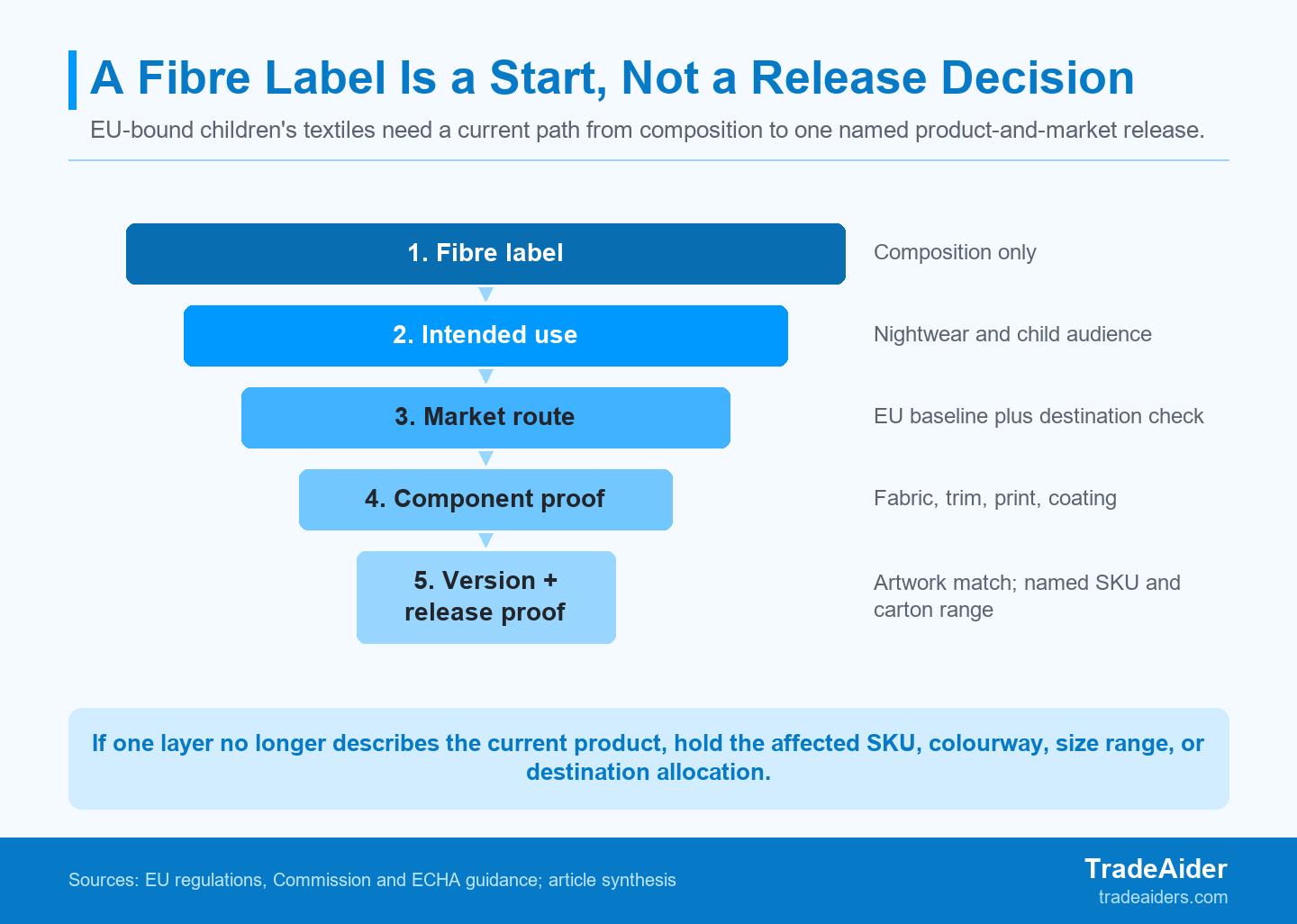
A children's textile can be released only when its label, market route, component evidence, current version, and carton population all identify the same product.
A Pre-Shipment Inspection (PSI) is a finished-goods inspection used to verify a completed production lot against the buyer's approved requirements before shipment.
For a pre-shipment check, schedule the visit when the order is 100% complete and at least 80% packed. Give the inspector the SKU list, destination allocation, approved artwork, component matrix, packing specification, and any correction boundaries before the visit. Ask for the sampled unit, carton marks, quantity, label placement, visible components, and observed version to be recorded in a way that a release owner can compare with the file.
Inspection sampling can establish confidence in the observed population; it cannot prove facts the production records do not identify. If cartons from two artwork revisions are mixed, the right outcome may be a hold on the unresolved range rather than a broad pass or fail for the whole order. TradeAider’s inspection sampling standards can help buyers set a consistent observation and acceptance framework.
Use the EU Safety Gate as an alert and market-surveillance reference during ongoing risk review, not as a certificate for a particular factory or shipment. Its value is in spotting relevant reported hazards early enough to revisit a product or component decision.
Illustrative Scenario: A Correction That Does Not Prove the Packed Goods
A claimed label correction does not support release if the factory cannot identify the affected packed cartons and reconcile the current artwork version. The problem is not whether a corrected sample exists. It is whether the buyer can connect that correction to the shipment population.
When the correction boundary, current artwork, and carton range are ready for verification, Book a finished-goods inspection for your EU shipment
A Recheck Must Prove Which Cartons Were Corrected
A recheck proves a correction only when the current label version can be connected to the identified packed-carton range. Ask the factory to create a carton-level correction map, update the controlled artwork record, and isolate any carton whose status cannot be confirmed.
An illustrative EU-bound children’s nightwear importer has an order of 1,800 two-piece nightwear sets in 90 export cartons across three colourways. The order is complete and 80% packed for export. A factory states that an incorrect fibre-composition label was replaced after a buyer review. A recheck finds the new label on sampled units, but the rework record does not identify which of the 90 cartons contain corrected units and the artwork file still names the prior version.
The correction statement cannot prove that the packed carton population matches the approved artwork and fibre-composition file. Hold the 30 cartons in the affected colourway and destination allocation until the factory separates the cartons, reconciles the artwork version, and demonstrates the corrected retail units. Create a carton-level correction map, update the controlled artwork record, and isolate any carton whose label status cannot be confirmed. Reinspect the identified corrected carton range against the current label proof and product file before release. This is an illustrative scenario, not a TradeAider client case or a legal determination.
Buyer Questions
Does an EU textile label need care instructions?
No. The Textile Regulation does not create harmonised EU wash or care-label rules. The European Commission’s official FAQ confirms that boundary. That does not mean a buyer can ignore care information. Confirm whether the destination market, product category, retailer specification, or voluntary claim creates a separate need. Keep that review in the product-and-market file rather than assuming it is answered by the fibre label alone. A care instruction also needs to match the finished garment’s actual fibres, trims, and performance expectations.
Is EN 14878 enough for every EU nightwear launch?
No. A relevant nightwear standard can support a safety assessment, but it does not remove the need to check intended use, design, age positioning, destination, and applicable market requirements. Start with the actual garment and selling route. Then decide which evidence is relevant and who will approve it. Do not use one standard name as a substitute for a product-specific assessment. If the buyer changes the age position, description, component list, or destination allocation, reopen the route review before reusing a previous report or artwork proof.
Do REACH checks apply only to fabric?
No. The review should cover relevant materials in the finished article, including fabric, print, coating, plastic, metal, and other skin-contact components. A main-fabric certificate may be useful, but it does not identify every material used in the garment. Map each component to its supplier, version, and evidence so a changed trim or print does not slip outside the review. A component matrix also shows whether a colourway, transfer, or accessory changed after the original samples or material declarations were approved.
When should a children’s nightwear inspection happen?
Inspect early enough to catch material or artwork drift, then inspect finished goods only when the relevant evidence and packed-lot identity are current. For a pre-shipment visit, the order should be complete and sufficiently packed for the agreed sampling plan. If label rework occurred, provide the inspector with the exact corrected carton range and current artwork before the visit. The release owner should receive the inspection result alongside the current product-and-market file, rather than treating the inspection report as a replacement for that file.
Related Articles



Grow your business with TradeAider Service
Click the button below to directly enter the TradeAider Service System. The simple steps from booking and payment to receiving reports are easy to operate.

