
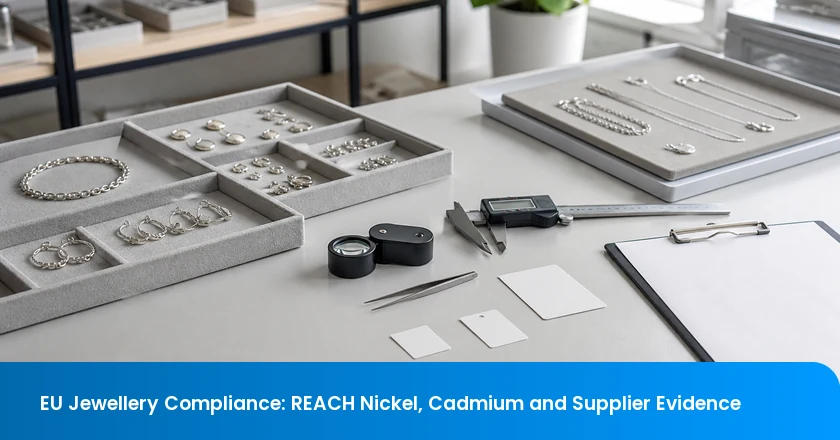
The risky jewellery shipment is not always the one with no report. It is often the one whose report, component, finish, and carton population no longer describe the same goods. For EU jewellery REACH decisions, a buyer needs two separate legal questions—nickel release and cadmium concentration—and one operational discipline: release only the identifiable component-and-lot population that the evidence file actually covers.
What Must Match Before an EU Jewellery Lot Is Released?
Release only the component-lot combination that the evidence file actually describes. A product style name or a supplier statement can help locate records, but neither makes unmatched parts compliant by itself.
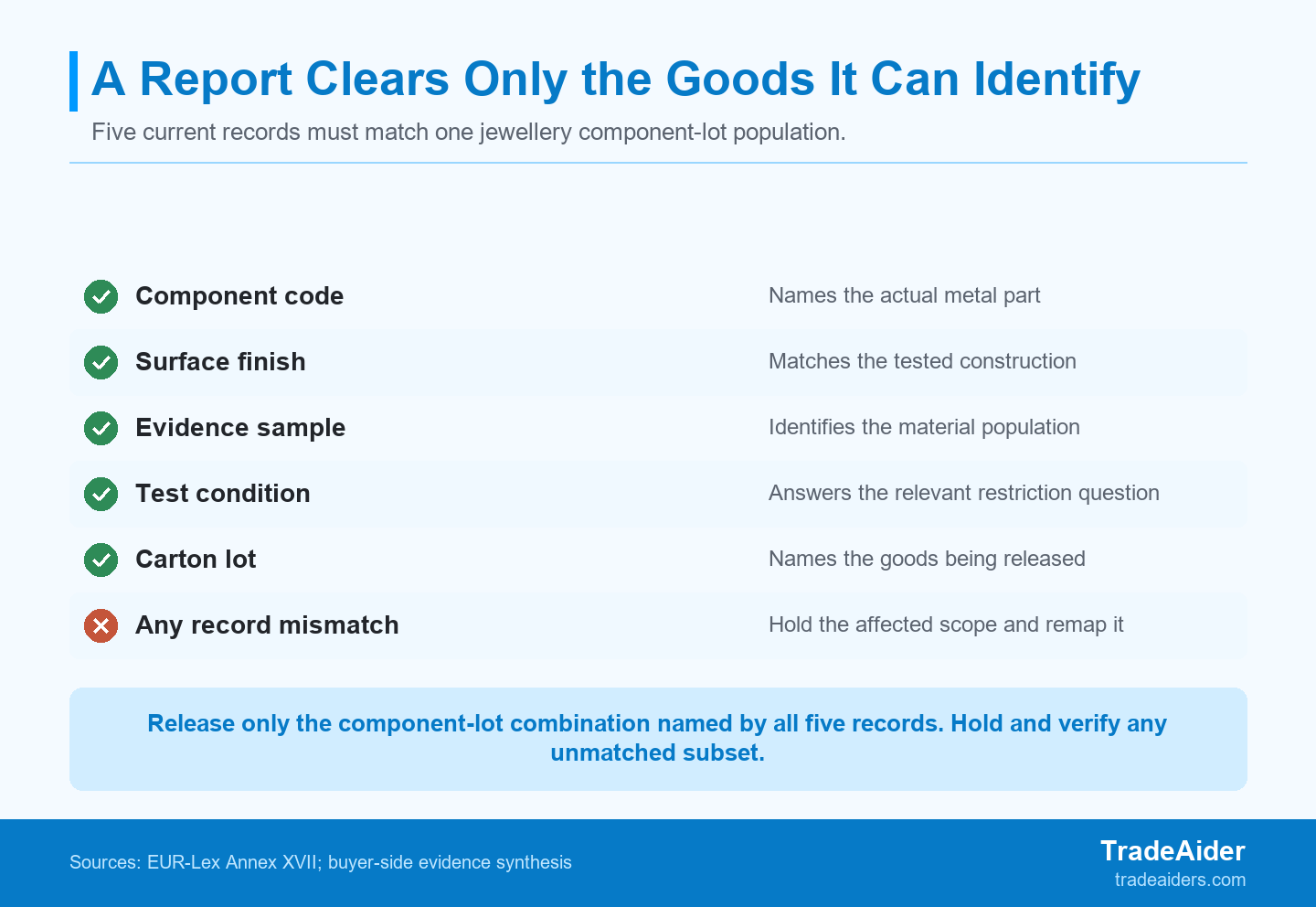
Use the scorecard to compare the current jewellery component and carton population with the exact evidence scope; hold an unmatched subset.
- Match the legal question: nickel is assessed as release from specified relevant parts; cadmium is assessed as concentration in covered metal parts.
- Match the physical construction: name the component code, base material, finish or coating, and any supplier-specific variation.
- Match the evidence conditions: the report should identify the sample and the condition it addresses, rather than merely repeat the retail style name.
- Match the shipment population: carton or lot records should show which goods can be released and which must be held for scope review.
This is a purchasing control model, not a replacement for product-specific legal advice or the applicable test method. Its value is simple: it stops a broad certificate from being treated as blanket approval for a changed clasp, coating, or material source.
Separate Nickel Release From Cadmium Content Before You Request Evidence
Nickel release and cadmium concentration are distinct evidence questions for jewellery components. A report may be perfectly useful for one question and irrelevant to the other, so the request to a supplier or laboratory should begin with the restriction and the relevant part—not with a generic request for a “REACH certificate.”
The distinction changes the buyer's evidence map. A necklace chain, post, ring, clasp, charm, backing, or plating layer can have different contact roles and material histories. Start by identifying the physical part, then decide whether it needs a nickel-release route, a cadmium-content route, or both. That ordering reduces the chance that a report is accepted because its title resembles the purchase order.
Nickel Is a Release Question for the Relevant Skin-Contact Surface
REACH Annex XVII Entry 27 states a condition of less than 0.2 μg/cm²/week for post assemblies inserted into pierced parts and a 0.5 μg/cm²/week limit for relevant parts of articles intended for direct and prolonged skin contact. The consolidated REACH text on EUR-Lex also makes clear why a non-nickel coating does not end the question: the applicable coating condition concerns whether release stays within the stated level during normal use.
For a buyer, “nickel-free” is therefore not a sufficiently precise release label. The useful record identifies the relevant surface or component, its construction and finish, and the condition addressed by the evidence. An ear post should not be silently grouped with a decorative charm. Likewise, a plated clasp should not inherit the conclusion for an uncoated chain merely because both appear on the same style sheet.
The practical request is: “Which direct-and-prolonged-contact part does this record cover, and what finish and production configuration did the sample represent?” If the supplier cannot answer that question in a component map, the buyer has found an evidence-scope gap—not necessarily a failed product, but a gap that must be resolved before a release decision can rely on the report.
Cadmium Is a Concentration Question for Covered Metal Parts
For the listed jewellery context, Annex XVII Entry 23(10) addresses cadmium at a concentration equal to or above 0.01% by weight of the metal in metal beads and other metal components for jewellery making, and in metal parts of jewellery and imitation jewellery. The EUR-Lex judgment in C-512/24 usefully restates that component-focused scope in its discussion of a silver bracelet.
That is a different measurement and a different release question from nickel migration. A buyer should not infer cadmium status from a nickel-release document, and should not infer nickel-release performance from a material-concentration result. The evidence file should state what has been tested or declared for each relevant metal component and should preserve the sample identification that lets the buyer compare it with the ordered construction.
Before placing a finished design on the market, check the current Annex XVII wording, any applicable exceptions, and the actual construction under review. A threshold only becomes a useful decision when the buyer can show which physical part and production population it concerns.
Build a Component-and-Finish Evidence Map Before Accepting Certificates
The European Commission describes REACH as placing responsibility on industry to manage chemical risks and provide safety information. Its REACH overview is a helpful reminder that the buyer's release file should connect information to the goods, rather than keep a folder of unlinked PDFs.
A document is useful only when it identifies the same component, material, finish, condition, and lot that the buyer is deciding to release. The following map is an editorial control tool: it does not prescribe a laboratory method, but it makes a missing scope visible before cartons leave the factory.
| Evidence-map field | What the buyer should identify | Release risk if it is missing |
|---|---|---|
| Component and contact role | Post, chain, clasp, ring, charm, backing, or another named metal part | A product-level record cannot show which relevant part it covers |
| Material and finish | Base alloy, plating or coating, colour, and construction version | A changed finish can silently create a different evidence population |
| Evidence method and sample | Report number, sample description, relevant condition, and date | The buyer cannot tell whether the report answers the nickel or cadmium question |
| Supplier declaration | Supplier, component code, material source, and production or lot reference | The declaration may be sincere but too broad to bridge a changed part |
| Carton or lot identity | Carton range, lot code, packing date, and affected SKU | The buyer cannot isolate what is actually supported by the file |
Use the map at two moments: before production, to lock the approved construction; and before shipment, to compare the mapped construction with the finished population. Where an independent checkpoint is needed, use TradeAider pre-production inspection to confirm the approved evidence scope before the build is repeated at scale. This gives sourcing, the supplier, a laboratory, and final inspection one shared reference without implying that every actor performs the same task.
A Declaration Can Support Traceability, but It Cannot Supply Missing Scope
The cadmium amendment identifies metal components for jewellery making and metal parts of jewellery, and sets a 0.01% by-weight threshold for the covered metal; that makes component identification material to evidence scope. The official amendment text is useful here because it directs attention to the part, rather than a vague “metal compliance” label.
A declaration is a traceability record, not an independent substitute for a report whose scope is missing. It can name a component supplier, alloy, plating route, or lot and thereby help connect a relevant report to the purchase order. It cannot independently establish that an unnamed part was tested under the relevant condition, or that a substitution is covered by an earlier sample.
Use both records together when they genuinely meet: the declaration identifies the same component and production population that the report describes. If the declaration says “gold-tone bracelet” while the report names only a bracelet body and the production record shows a new clasp supplier, the honest answer is not “pass.” It is “scope needs reconciliation.”
The Release File Must Describe the Current Goods, Not a Familiar Product Name
The nickel restriction addresses relevant skin-contact parts and coated articles, so finish identification is material to the scope discussion. The official nickel amendment provides the regulatory context for treating a changed coated construction as a question that needs evidence review rather than a name-only approval.
A product name is not a technical bridge across an unrecorded component or finish change. The five records in the map—component code, finish, evidence sample, test condition, and carton lot—should point to the same population. If one does not, hold that identifiable population while the supplier maps the change and the evidence is checked or refreshed.
This is intentionally narrower than saying that every change proves non-compliance. A change creates an evidence-scope decision. It may be resolved by a corrected material record, a report that already covers the construction, or targeted verification. What should not happen is an automatic extension of an old report to a different, undocumented build.
Illustrative Scenario: One Product Name, Two Evidence Populations
A document-product conflict calls for a bounded hold and evidence-scope review in the illustrative scenario. The example is not a TradeAider client case and does not state that the affected goods fail REACH; it shows how a buyer can avoid treating missing scope as a positive release result.
A Report for the Bracelet Body Does Not Clear an Unmapped Clasp
The described order is illustrative and does not represent a TradeAider client case. An EU importer has ordered 2,400 gold-tone stainless-steel bracelets in 120 cartons. The supplier's mapped report identifies clasp code CL-18, which appears in cartons 1–78. During final packing, cartons 79–120 are found to contain clasp code CL-22 after an unrecorded subcontractor substitution.
The retail style name, bracelet body, and colour remain the same. The supplier declaration also continues to use the old style name. But it does not distinguish the two clasp codes, and the existing report does not identify CL-22. The buyer therefore has two evidence populations under one commercial name: a traceable CL-18 population and a CL-22 population whose material-and-finish scope has not been reconciled.
The useful calculation is not a compliance statistic; it is a release boundary. Forty-two of 120 cartons—840 bracelets—are connected to the unmapped clasp code. If those cartons are identifiable, the buyer can hold that 35% subset instead of treating all 2,400 bracelets as equally supported or equally unsupported. The calculation is illustrative and depends on accurate carton-to-component records.
The decision is to release neither a blanket “pass” nor a blanket failure statement. Hold cartons 79–120, ask the supplier to correct the component-and-finish map, identify the CL-22 material and plating route, and compare that construction with existing evidence. If the scope cannot be bridged, obtain targeted evidence for CL-22. If it can be bridged, retain the bridge in the file rather than relying on an email assurance.
The verification gate is explicit: the revised file must align component code, finish, evidence sample, evidence condition, and carton identifiers for the 42-carton subset. Only then is a split release defensible as an operational decision. The example does not prove that CL-22 is non-compliant; it proves that a report for the bracelet body cannot automatically clear an unmapped clasp.
Set the Factory Handoff Before Final Packing
The Commission calls for stepped-up enforcement and more frequent checks on products. Its chemicals-strategy implementation page gives useful context for treating a traceable factory handoff as more than a last-minute document collection exercise.
Before production, lock the component map against the approved sample, material source, finish, and intended evidence route. During production, the supplier should record any material, plating, tooling, or subcontractor change against the component code rather than only against the style name. Final inspection can verify alignment with an approved file; it cannot create missing compliance evidence.
At the final stage, the release check has a narrower purpose: compare the evidence file with finished units, labels, cartons, and lot ranges. It can verify that CL-18 cartons carry the expected build and that the held CL-22 cartons remain segregated. Where an independent final check is useful, add a pre-shipment inspection for the released component and carton groups to focus the check on physical and packing alignment. It should not be represented as creating a laboratory result that the file does not contain.
That division of work prevents a common failure mode: a testing question is deferred until cartons are ready, then an inspection checklist is asked to solve it. Establish the relevant evidence first; use inspection to confirm that the shipped population still matches it.
Release Only the Traceable Component-Lot Combination
Release only the current component-lot combination that the mapped evidence file identifies. That rule is deliberately conservative about records and precise about the affected goods: a matched CL-18 component-lot population may be release-ready while a separately identifiable CL-22 population remains on hold for reconciliation or targeted verification.
Before approving shipment, ask five practical questions: Does the file name the component? Does it describe the material and finish? Does the evidence answer the nickel or cadmium question actually at issue? Does the record identify the current construction? Can the cartons or lot be tied back to that construction? A “no” to any one question is a prompt to hold the relevant scope, not to make a broader claim about every unit in the order.
When the construction or evidence route still needs to be defined, do not stretch an old report across an unrecorded change. Confirm the component code, finish, purchase-order revision, and intended test condition before the next sample is selected. Request a product-testing plan for the actual jewellery construction.
FAQ
Does every plated jewellery item need the same nickel evidence?
Plated jewellery evidence must match the relevant contact part and construction. No, one broad “plated jewellery” label is not enough. A report for one plated chain does not automatically describe a different clasp, post, or plating route. Ask whether the sample names the contact component, base material, coating, and condition. If a later finishing route differs, compare its scope before extending the earlier conclusion.
Can a supplier declaration replace a component-specific laboratory report?
A declaration can connect records but does not independently prove missing component-specific test scope. Usually no, it cannot replace the report. It remains valuable when it names the supplier, component code, material, finish, and lot that appear in the report. If the declaration and report describe different parts or production populations, hold the affected scope until the map, supplier record, and applicable evidence have been reconciled.
When should a changed clasp be treated as new scope?
A change becomes a new evidence scope when the relevant material, finish, supplier, or construction no longer matches the file. It does not by itself prove non-compliance, but it prevents automatic reliance on a legacy report. If cartons can be traced to the changed clasp, hold that subset, update the map, identify the new construction, and verify whether the earlier report already covers it or targeted evidence is needed.
Does a SCIP notification prove nickel or cadmium restriction compliance?
Candidate List information duties and Annex XVII restriction evidence should be kept in distinct files. No, a SCIP notification does not prove the nickel-release or cadmium-concentration condition discussed here. SCIP and Article 33 address information on Candidate List substances in articles. The same component map can organize both files, but the records answer different compliance questions and should not be substituted for one another.
Related Articles


Grow your business with TradeAider Service
Click the button below to directly enter the TradeAider Service System. The simple steps from booking and payment to receiving reports are easy to operate.

