
- About Us

- Our Services
- Your Industry
- Resources
- News & Blog
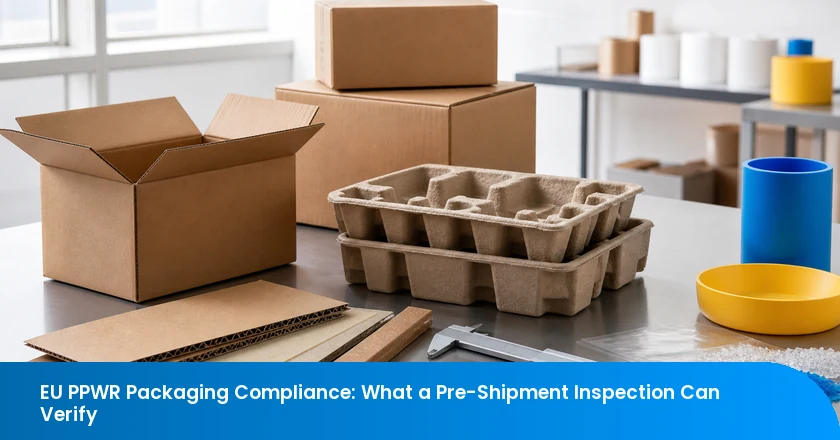
EU PPWR preparation should not end with a supplier promise or a carton that merely looks correct. The useful pre-shipment question is narrower: can the buyer connect the approved packaging evidence to the exact finished goods and carton range now ready to ship? A pre-shipment inspection can help corroborate that physical connection. It cannot replace the conformity assessment, technical records, or accountable operator decisions behind it.
That distinction matters because a packaging release has two proof streams. One stream is controlled documentation. The other is what can be observed on selected packs and cartons. When those streams point to different versions—or cannot be tied to a named lot—the right response is a defined hold and reconciliation step, not a generic acceptance of the order.
PPWR Changes the Packaging Evidence Conversation
PPWR is a packaging framework with a general application date of 12 August 2026, not a single universal label deadline. Its implementation questions, product context, and any later measures must be checked before a buyer freezes a packaging release rule.
The European Commission’s PPWR overview says Regulation (EU) 2025/40 generally applies from that date and covers packaging placed on the EU market regardless of material or origin. The practical consequence is that an importer should first identify the packaging component, the operator role, and the applicable requirement before asking a factory to “check PPWR.” A retail carton, an inner pack, a protective insert, and a transport pack may not all carry the same evidence question.
Timing also needs a live source check. The Commission has issued implementation guidance and a PPWR FAQ for practical questions raised after adoption. Those materials are a reason to retain the regulation number, applicable provision, and document version in the release file rather than relying on a static supplier checklist.
- Start with scope: name the package component and EU market route before approving a print or claim.
- Separate proof types: keep accountable documentation distinct from an inspector’s physical observations.
- Release by identifiable range: make every observation traceable to the finished-goods or carton population it represents.
A packaging check becomes release evidence only when the approved reference, observed version, and identified shipment range can be reconciled.
This is not a new client-branded framework. It is a practical control rule: if the buyer cannot show which approved reference applies to the carton range in front of the inspector, the physical observation has no reliable release context.
What a Pre-Shipment Inspection Can and Cannot Verify
A pre-shipment inspection can compare approved packaging versions with selected finished goods and cartons, but it cannot perform PPWR conformity assessment, create technical documentation, or decide whether an environmental claim is legally substantiated.
Think of the visit as a controlled comparison. The buyer supplies the relevant approved references; the inspector compares selected goods, packaging components, labels or digital references, and carton marks with those references; the report records what was observed and which lot was sampled. That can reveal an artwork mismatch, a missing traceability field, a different pack component, or cartons that cannot be associated with the supplied documentation.
The accountable operator retains the legal side of the decision. The official PPWR text links manufacturer and importer obligations to conformity assessment, technical documentation, required documents, labelling, and identification. Those obligations explain why a strong inspection brief contains document references rather than a vague instruction to “verify compliance.”
For the physical part of the job, review the inspection standard before setting sample checks. It keeps the sampling plan, observable criteria, and defect-reporting language explicit. If you are selecting a China-side partner for that defined comparison, see how TradeAider approaches independent inspection support before deciding what evidence and reporting format to request.
Turn PPWR Requirements Into a Physical Packaging Check
A factory-side check should compare the approved package component, printed or digital information, traceability reference, and carton allocation against the controlled evidence pack; an observed match corroborates a version, not the underlying compliance calculation.
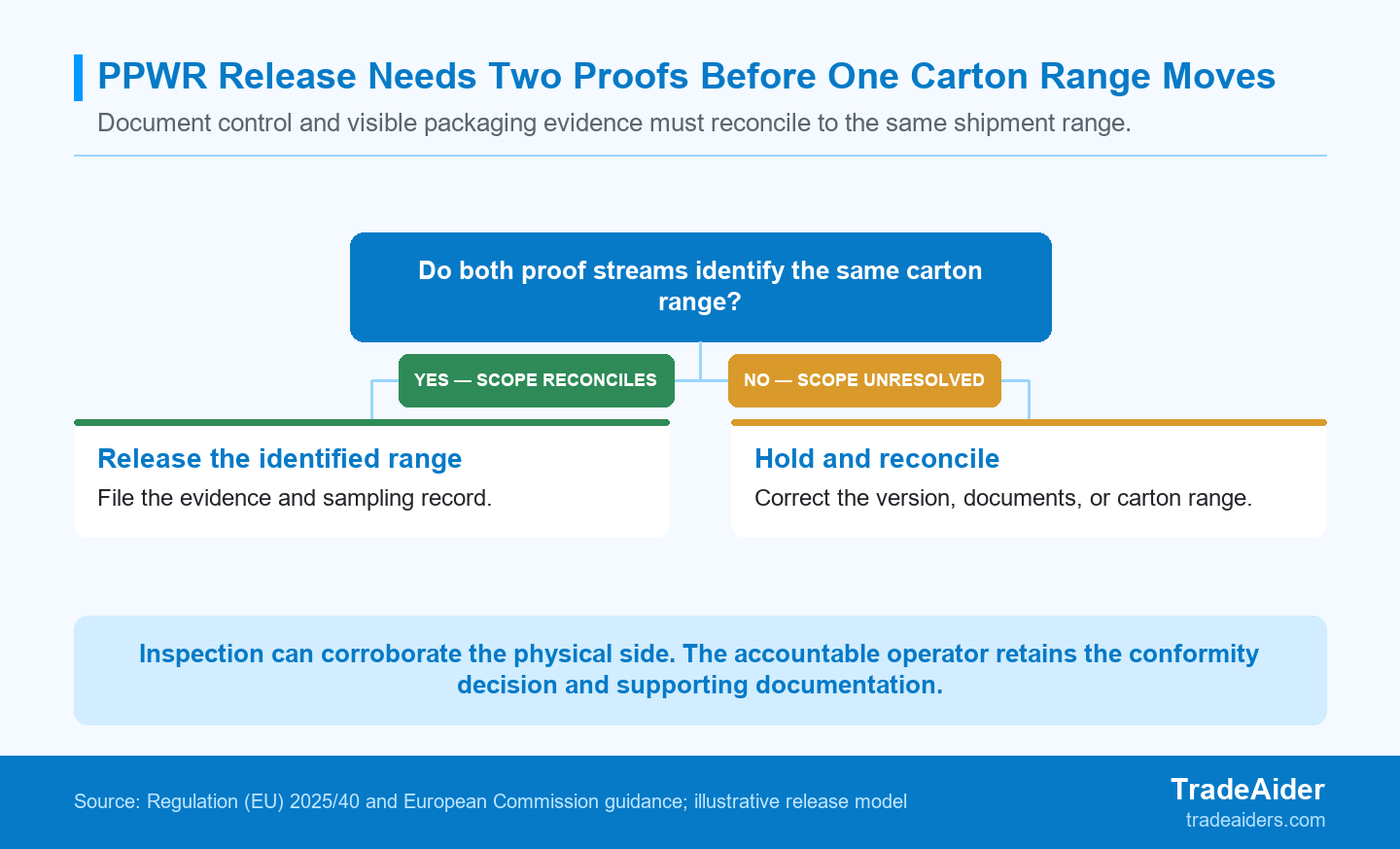
For a PPWR packaging release, controlled documentation and physical observations must reconcile to the same identifiable carton range; inspection corroborates the visible side of the decision.
The check should be built from the buyer’s controlled package specification, not from a generic list of sustainability phrases. The Commission’s PPWR factsheet describes the regulation’s direction toward less resource use, recycled content, and reusable packaging. That policy direction may shape a claim or design choice, but an inspector looking at a carton cannot independently calculate recycled content or prove that a claim exceeds an applicable minimum. The buyer should ask for the approved reference that explains exactly what is meant by the observed wording.
| Controlled input from buyer | What can be compared at the factory | What remains outside inspection scope |
|---|---|---|
| Approved bill of materials and component reference | Selected pack component, assembly, and visible version identifiers | Material composition testing or regulatory applicability |
| Controlled artwork or environmental-claim revision | Printed wording, graphics, QR or data-carrier placement, and legibility | Claim calculation, substantiation, or legal sufficiency |
| Lot, SKU, or carton-range mapping | Whether selected packs and cartons carry the agreed identifiers | Whether every unit outside the agreed sample is compliant |
The Publications Office summary describes PPWR’s scope as comprehensive for packaging placed on the EU market. That is precisely why the brief should name the component being observed instead of assuming that the outer carton is the only packaging item that matters. If the version may drift before packing is complete, check packaging changes during production while a correction is still contained to a smaller production window.
Compare the Approved Claim Version, Not Just the Printed Words
An observed packaging claim should be compared with its approved artwork revision and controlled reference, because visible words alone do not establish the underlying packaging evidence.
For example, a carton can carry a recycled-content phrase, a recycling instruction, or a QR code in the expected location while still using a revision that the buyer has not linked to the current supplier declaration. The inspection instruction should therefore name the artwork file or revision, the packaging component, the claim scope, and the reference location the inspector should photograph. If a physical field is missing or differs, the report can identify the mismatch. It should not convert that mismatch into an unsupported conclusion about the full compliance calculation.
Link the Observed Version to the Actual Carton Range
The release decision becomes reliable only when the inspection sheet identifies which packaging version and which finished-goods or carton range were actually observed.
This is the dependency that turns an artwork check into a shipment decision. First establish the approved version. Then identify the product and carton range that use it. Only then can a buyer decide whether an observed mismatch affects a contained subset, requires rework, or needs a wider hold. A carton photo without a lot reference may be useful evidence of a concern, but it is not enough to define the release population.
Build the Evidence Packet Before the Factory Starts Final Packing
PPWR assigns manufacturers and importers documentary and identification responsibilities: the official regulation links conformity assessment, technical documentation, required documents, labelling, and identifying information to packaging placed on the market.
The practical implication is not that an inspector should collect a complete legal file at the factory. It is that the buyer should prepare a controlled packet that tells the factory and inspector what physical version is expected and who owns the underlying evidence. The EUR-Lex summary of Regulation (EU) 2025/40 is a useful stable reference point for the legal act, while the official text should remain the source for specific operator obligations.
Before final packing begins, ask the accountable owner to assemble the following as a single release packet:
- The destination, responsible operator, and PPWR provision or internal compliance reference being applied.
- The approved packaging bill of materials, including the component that carries any relevant wording or identifier.
- The controlled artwork, claim, label, or data-carrier revision for the physical package to be inspected.
- The supplier declaration or technical-record reference that the accountable owner can retrieve if an authority asks for evidence.
- A SKU, production, pallet, or carton-range map that shows where the approved version is used.
- Clear hold, correction, and recheck instructions for a physical mismatch or a missing reference.
Where a design or print change could spread before the order is complete, set a pre-production packaging control point. It is cheaper to freeze a controlled packaging reference before production repeats an unapproved version than to sort finished cartons after the evidence link has been lost.
Illustrative Scenario: One Uncontrolled Carton Claim, One Selective Hold
The illustrative scenario below demonstrates a record-control decision for an identifiable carton range. It does not determine PPWR conformity for a named product or packaging component.
The decision is deliberately limited. It shows how a buyer can contain a document-versus-physical conflict without pretending that an inspector, factory, or generic supplier confirmation has resolved the underlying regulatory question.
Contain the Unresolved 2,400-Unit Carton Range
In the illustrative 6,000-unit order, a recycled-content claim appears on the outer carton, but the buyer cannot link the claimed artwork revision to the supplier declaration for one 2,400-unit carton range. The prudent decision is to hold that identified range for reconciliation instead of accepting a generic factory confirmation. A private-label homewares brand is preparing tabletop storage products for EU retail. The order is complete, more than 80% is export-packed, and three separately identifiable carton ranges are awaiting final release.
Two carton ranges match the buyer’s controlled bill of materials and artwork reference. The third range carries a later outer-carton claim revision. The wording is legible and the cartons look commercially finished, but the supplier file sent to the buyer does not identify the observed revision or show how it connects to the 2,400 affected units.
The physical carton is not proof that the claim is supported, and the document is not proof that it applies to the cartons now packed. Because the affected range is identifiable, the buyer can hold that range for reconciliation while preserving the other ranges only if the buyer’s allocation and release process keeps them independently traceable. This is a selective operational hold, not a PPWR conclusion for the entire order.
The corrective action is to obtain the controlled artwork and supplier declaration reference for the observed version, confirm the package component and claim scope, and map that evidence to the packing list. A recheck then compares selected cartons and product packs against the corrected reference before the held range is released. The result may cost time, but it prevents a buyer from shipping a carton range whose evidence-to-lot link is still unknown. This scenario is illustrative only and does not validate recycled-content calculations or legal compliance.
Send a PPWR Packaging Release Brief Before Booking Final Verification
Before final physical verification, the buyer should send the approved packaging bill of materials, artwork and claim revisions, traceability references, destination allocation, carton ranges, and the fields to compare. TradeAider’s Pre-Shipment Inspection is scoped for orders that are 100% complete and at least 80% packed for export.
At that stage, use a pre-shipment inspection for defined physical checks against the packet rather than asking for a blanket compliance approval. A good brief tells the inspector exactly which packaging component, version, wording, mark, data carrier, product-pack match, and carton range need comparison. It also names the evidence the inspector cannot validate and the owner who must resolve it.
Release only the identified range for which the controlled documentation and observed packaging version reconcile within the agreed inspection scope.
If the record, version, or range is unresolved, write the hold-and-recheck condition before the factory visit. When you are ready to turn a controlled PPWR packet into a China-side verification plan, send the product list, packing list, approved references, and required photo or observation points, then request a PPWR packaging inspection scope review.
Frequently Asked Questions
Does PPWR Apply to Packaging Imported From China?
Yes, the PPWR framework covers packaging placed on the EU market regardless of material or origin, but the applicable obligations still depend on the packaging and operator role. A China factory location does not remove the need to identify the EU market route, controlled evidence, and accountable operator. Confirm the applicable provision and current official guidance for the actual packaging component before using a general PPWR checklist as a release condition.
Can a Pre-Shipment Inspection Prove PPWR Compliance?
No. It can corroborate selected physical packaging details against an approved evidence pack, but it cannot perform conformity assessment or establish legal compliance. Use it to compare physical versions, identifiers, and carton ranges with controlled references. Keep technical documentation, calculations, legal applicability, and final compliance decisions with the accountable operator and appropriate advisers.
Which PPWR Packaging Details Can an Inspector Compare?
An inspector can compare approved packaging components, visible print or digital references, traceability fields, product-pack match, and carton allocation within the agreed sample scope. The brief should identify the exact version and reference point for every comparison. It should also state what the inspector is not being asked to validate, such as material testing, recycled-content calculation, or legal substantiation of an environmental claim.
When Should a Buyer Hold a Packaging Lot?
Hold the identifiable affected lot when its actual packaging version, document reference, or carton allocation cannot be reconciled to the buyer-approved release packet. A hold should name the product and carton range, the missing or mismatched field, the corrective owner, and the recheck condition. That lets the buyer contain a real evidence gap without making an unsupported conclusion about every carton in the order.
Related Articles

Grow your business with TradeAider Service
Click the button below to directly enter the TradeAider Service System. The simple steps from booking and payment to receiving reports are easy to operate.

