
- About Us

- Our Services
- Your Industry
- Resources
- News & Blog

For a China-made consumer good sold into both the EU and Great Britain, one finished product can require two market-release conversations. The product model may be identical, but the route record, accountable party, visible information, and carton allocation still need to answer the destination question. Treating “UK” as a single field or treating a mark as the whole file is how an otherwise finished order becomes difficult to release.
Great Britain means England, Scotland, and Wales in this comparison. Northern Ireland follows a separate product-compliance context, so treat every Northern Ireland line as its own destination decision. This protects a shipment from a one-size-fits-all UK pack and keeps regulatory accountability with the responsible operator.
What Must Be True Before a Dual-Market Release
- Name the destination and product sector before approving a mark, instruction, or carton file.
- Keep one controlled product core, then issue separate EU and Great Britain market outputs.
- Release only a SKU or carton range whose route owner, record reference, and physical pack version reconcile.
- Use TradeAider for China-side physical corroboration after the accountable owner has defined the market packet.
Start With the Market, Not the Mark
Start with the destination: the EU market, Great Britain, and Northern Ireland should not be treated as one undifferentiated UK-and-EU lane. Great Britain guidance covers England, Scotland, and Wales, while product-specific rules and the Northern Ireland position need their own check. GOV.UK’s product-safety guidance by industry is a useful starting point because it directs businesses to the relevant product sector and notes that Great Britain and Northern Ireland provisions can apply differently.
Before a supplier changes artwork or a buyer approves cartons, make the destination a controlled field on the purchase order. Record the market, product category, planned sales channel, and the person who owns the compliance decision. Then ask a practical question: which evidence must be true for this allocation to move? That question is more useful than starting with “Which logo belongs on the pack?”
For example, a desk lamp allocated only to an EU fulfilment partner is not the same release decision as a physically identical lamp allocated to a Great Britain distributor. The product may share a bill of materials and some test evidence. The market output still needs a destination-specific route check, appropriate record references, and a defined presentation to the buyer’s accountable owner.
Build One Product Dossier, Then Split the Market Outputs
A common product dossier can anchor the model, risk evidence, and controlled revision, but it must branch into destination-specific route records and market-facing outputs before release. In plain language, technical documentation is the set of product records that explains the model, applicable requirements, and supporting evidence. It should make the product version identifiable; it should not be a loose folder of supplier files with no release owner.
Keep the shared core stable: the exact model or variant, approved specification, risk or test basis, component changes, production revision, and the source of each document. Then create separate market-output lines for the EU and Great Britain. Each line should name the destination, applicable sector route, declaration or document reference, economic-operator information where relevant, artwork or instruction revision, and the carton or SKU allocation to which the line applies.
The point is not to duplicate every file. It is to prevent an importer from reusing an EU document as a vague proxy for a Great Britain release decision, or from allowing one shared artwork approval to hide two different market questions.
EU Lane: Confirm the Product Rule Before You Use CE
For an EU product covered by harmonised rules, CE marking follows the applicable conformity route, technical documentation, and EU declaration of conformity; it is not a generic certificate for every consumer good. CE marking is a manufacturer statement used only for products covered by the relevant EU rules. The European Commission’s CE-marking guidance makes the scope point directly.
For the importer, the useful release question is not merely “Is CE printed?” It is whether the product has been mapped to the right rule and whether the controlled file can retrieve the evidence for the actual model and revision. The EU declaration of conformity belongs in that chain: it is signed after the necessary assessment and supporting documentation are in place, as explained in the Commission’s declaration guidance.
That does not turn every importer into the manufacturer’s substitute. It does mean the EU allocation should carry a retrievable product version, a controlled record reference, the planned language and presentation checks, and a way to identify the operator information that belongs with that allocation. Where a test method or result drives the decision, do not try to replace it with a visual check. Put that proof in the controlled record before turning the item into a factory inspection point.
Great Britain Lane: Check the Current Route Before You Reuse the Pack
For Great Britain, the CE or UKCA condition depends on the relevant product rules, so the buyer must identify the sector guidance and retain the route record instead of treating an EU file as a generic UK answer. Here, UKCA marking means the Great Britain conformity mark used under the applicable route. GOV.UK’s product-safety advice for manufacturers and importers notes that certain products require UKCA and/or CE marking in Great Britain, alongside the relevant safety and traceability duties.
“UKCA marking” is a Great Britain conformity marking used under the applicable UK route. It is not a shorthand that solves every consumer-goods decision, and neither is an existing EU file. The importer should confirm which Great Britain sector guidance applies, who holds the controlled record, and whether the final pack, instructions, identity information, and allocation still agree with that decision.
Use a cautious handoff rule: if the commercial team cannot state the product sector and the accountable owner cannot retrieve the GB route reference, label that market allocation unresolved. Do not let a factory infer the route from a previous order, a similar SKU, or an artwork file whose destination field is unclear.
Use a Three-Field Evidence Map Before Release
EU importers need more than a mark: the European Commission identifies manufacturer assessment, technical documentation, markings, traceability, appropriate instructions, and importer identification as relevant checks. Its general product-compliance guidance is a good reminder that the visible unit, the record, and the responsible operator belong in one control conversation.
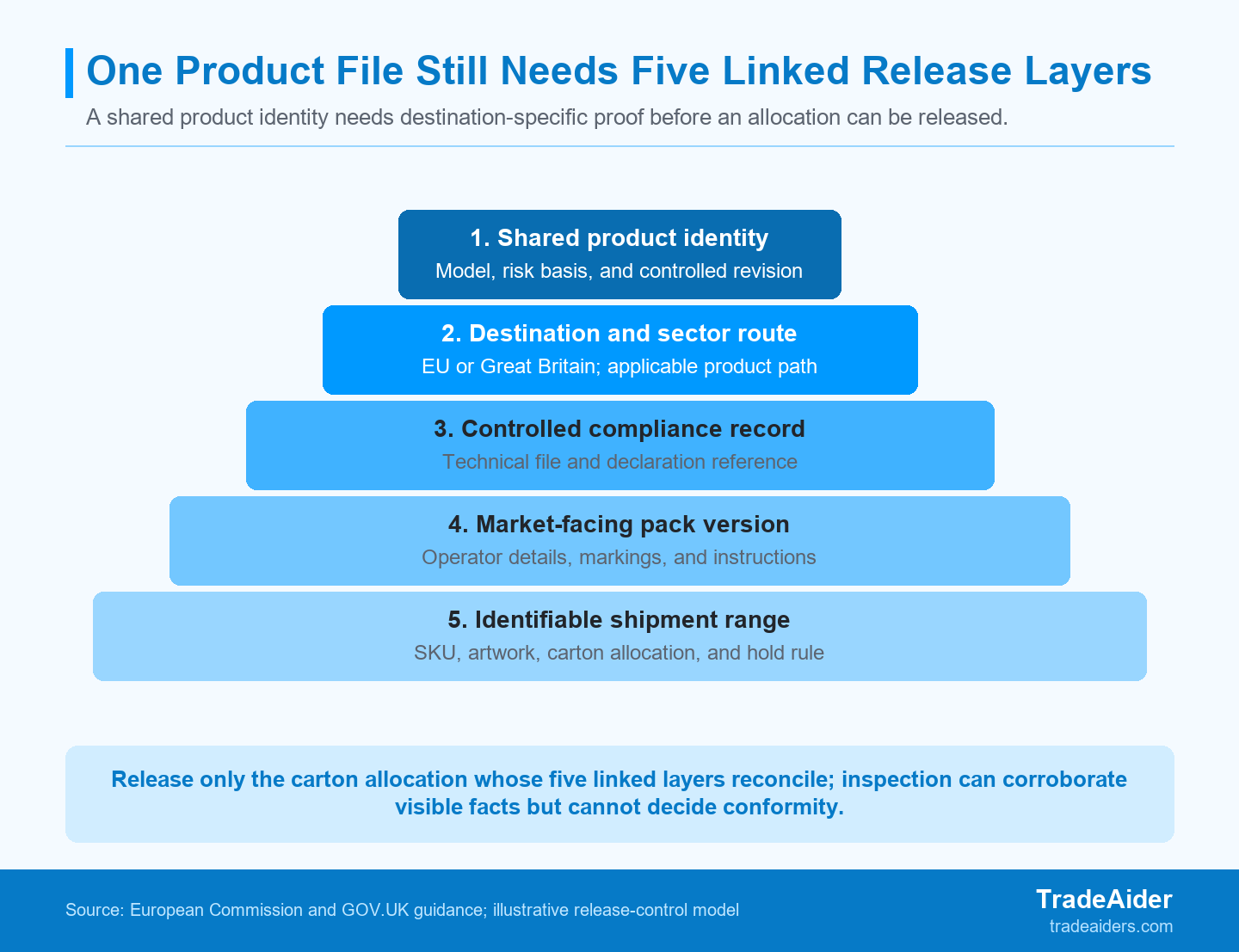
A market allocation is release-ready only when the shared product file, destination route, controlled records, visible pack version, and carton range reconcile.
Turn that conversation into three fields for every market allocation:
- Route owner: the named person or function that confirms the destination, product-sector route, and legal decision.
- Record reference: the controlled declaration, technical-file, test, or route record reference that the owner can retrieve for the released model.
- Physical pack version: the approved item, label, instruction, retail pack, and carton allocation that a factory-side comparison can recognise.
| Decision field | EU allocation | Great Britain allocation | Release evidence |
|---|---|---|---|
| Market and sector | EU market plus applicable EU product rule | Great Britain plus applicable GB guidance | Named destination and product category |
| Controlled record | Applicable technical and declaration reference | Confirmed route and record reference | Retrievable version, owner, and approval date |
| Physical handoff | Approved market-facing pack and carton range | Approved GB pack and carton range | Artwork revision, SKU, and identifiable allocation |
The table is not a universal legal checklist. It is a release map. If any of the three fields is missing, the buyer has an unresolved market allocation—not a “mostly compliant” shipment. That distinction also makes selective holds possible: a buyer can contain the allocation whose route owner, record, or physical version cannot be reconciled, rather than guessing from a nearby file. Where the destination choice depends on a test method or result rather than a visible comparison, review the product-testing evidence path before setting the factory scope.
Freeze the Evidence Pack Before Artwork and Cartons Multiply
EU packaging obligations have their own regulatory timeline: the European Commission says the Packaging and Packaging Waste Regulation generally applies from 12 August 2026, so product files and packaging-control records should not be assumed to change on the same schedule. See the Commission’s Packaging and Packaging Waste Regulation overview for the current policy timeline.
Operationally, freeze the controlled market pack before a printing or packing change travels through the factory. Give the supplier one buyer-approved sheet that names the model, intended market, artwork revision, instruction version, visible operator fields, carton marks, and the decision owner. A revision that changes only one destination should be segregated in the packing plan rather than hidden under a generic “export version.”
This is where a buyer can set a pre-production version-control check: compare the approved files with the first production-ready presentation before repeated output turns a document ambiguity into an order-wide sorting problem. The point is not to ask an inspector to approve a route. It is to make the approved physical reference unambiguous before labels and cartons multiply.
A useful factory handoff has five short lines: destination, controlled route-record reference, artwork revision, carton or SKU range, and the condition that triggers a hold. If the factory cannot put those lines against the lot, the buyer should resolve the record before booking a final physical comparison.
Use Inspection for Physical Corroboration, Not Conformity Approval
A China-side inspection can compare selected units, printed fields, versions, and cartons against a buyer-supplied evidence pack. It cannot issue a CE or UKCA approval, create technical documentation, or decide legal conformity.
That boundary is practical, not a weakness. Once the buyer has named the market packet, an inspection scope can ask for observable evidence: product identifier, selected marking or instruction fields, pack revision, country-of-origin or traceability fields where supplied, carton mark, count, and the carton range selected. It can photograph the comparison and report exceptions. It cannot convert a visible match into a regulator’s conclusion, or a missing document into a valid one.
A pre-shipment inspection is a final-stage check of selected finished goods and export packing before dispatch. Before setting the sampling and defect criteria, review the inspection standard before defining sample checks. For the supplier-facing part of the work, the final scope should close with a clear statement of what will be compared, what will be photographed, and which findings go back to the accountable owner. To understand that independent role, see how TradeAider frames independent inspection support.
Illustrative Scenario: One Missing GB Record, One Selective Hold
The illustrative scenario below shows a record-control decision, not an inspection finding or a legal conclusion for a named consumer product.
Contain the Unresolved GB Allocation
In the illustrative 4,800-unit order, the EU allocation is identifiable but the 1,800-unit Great Britain allocation lacks a controlled route record. The buyer can hold the traceable GB allocation while the accountable owner reconciles the missing record, rather than inventing an all-order legal conclusion. A private-label importer buys rechargeable desk lamps from China: 3,000 units are allocated to an EU fulfilment partner and 1,800 to a Great Britain distributor. The lamps are complete and the retail packs are being assigned to export cartons before final release.
The EU line has a controlled route record, declaration reference, artwork revision, and carton-range list. The Great Britain line carries a finished pack revision, but the supplier cannot produce the buyer-approved GB route reference or a matching declaration record for its 1,800 units. The issue is not a visible defect in the lamp. It is the missing connection between an identifiable physical allocation and the decision that permits that allocation to move.
The buyer should not release the GB range on the strength of the EU file. If the EU cartons remain separately identifiable and the buyer’s process permits it, the accountable owner can keep the EU decision on its own evidence track and place a hold on the 1,800 GB units. This is a split-release geometry, not an assertion that either market is legally approved.
The corrective action is to obtain a controlled GB route entry, confirm whether the artwork and records still apply to the finished product, and tie the approved reference to the carton range and inspection sheet. A recheck then compares selected GB cartons, pack revision, product identifier, and the controlled route reference before the held range is released. This is illustrative only: it does not decide test validity, legal conformity, or whether a particular mark is sufficient for the lamp category.
Send a Dual-Market Evidence Packet Before Booking Final Verification
For a final physical check, send the product list, destination packet references, artwork versions, carton allocation, and visible comparison points. TradeAider scopes a Pre-Shipment Inspection to orders that are 100% complete and at least 80% packed for export. At that stage, use a pre-shipment inspection for physical corroboration of the defined allocation.
- Name each model, variant, destination, and accountable route owner.
- Attach the controlled EU or Great Britain record reference that the owner can retrieve.
- Mark the approved unit, retail pack, instruction, and carton artwork revision.
- Map each destination allocation to SKU and carton numbers or a carton range.
- State the observable fields to compare and the evidence that remains outside the inspection scope.
- Write the hold-and-recheck condition before the inspector visits the factory.
That packet turns an inspection request into a defined comparison instead of a vague “check compliance” instruction. If the records are ready and you need China-side corroboration of the finished goods and cartons, prepare the product list, packet references, artwork revisions, and allocation plan, then request a dual-market inspection scope review.
Frequently Asked Questions
Can a CE-Marked Product Be Sold in Great Britain?
Possibly, but the presence of a CE mark does not decide a Great Britain sale by itself. Start with the applicable product sector and current GB guidance, then confirm the route record for the actual model and revision. A buyer should not approve a Great Britain allocation merely because the supplier can show an EU pack or a previous CE-marked order. The release file still needs a named destination, accountable owner, controlled document reference, and pack version that can be matched to the allocated cartons. If any one of those links is absent, keep the affected range out of the shipping instruction until the owner resolves it.
Does UKCA Marking Cover Sales in the EU?
No. UKCA marking is not the route for placing a product on the EU market. For an EU allocation, identify the relevant EU product rules, the applicable route, and the controlled EU documentation. Keep that decision separate even if the factory produces the same physical SKU for both destinations. A shared test report or specification may help establish the product core, but it does not remove the need to verify the EU-facing declaration, instructions, traceability, and responsible-operator information that apply to the released version. Retain the revision and product identifier with that EU file so the factory does not apply it to a similar but changed variant.
Is Northern Ireland Covered by the Great Britain Route?
No. Northern Ireland has its own product-compliance context and must not be handled as a generic extension of Great Britain. Confirm the actual destination and relevant product-sector guidance before choosing markings, declarations, operator information, instructions, or a carton allocation for Northern Ireland. If a single print run or carton label could serve both places, the buyer should still document the market decision separately. Similar physical presentation is not proof that the legal route, responsible party, or information duties are the same. Keep Northern Ireland cartons traceable from artwork approval to the final packing list.
What Can a Factory Inspection Verify for Two Markets?
It can compare selected goods, labels, instructions, packs, and cartons with a buyer-approved market packet, then document what was observed for the named allocation. It can also identify a visible version mismatch or a carton range that cannot be tied to the approved files. It cannot issue a legal conformity decision, certify an EU or GB route, or create missing technical evidence. Keep those responsibilities with the accountable owner and use the inspection as physical corroboration for a defined release, hold, correction, or recheck decision. Send the approved files before the visit so any mismatch can be reported against a named reference.

Related Articles



Grow your business with TradeAider Service
Click the button below to directly enter the TradeAider Service System. The simple steps from booking and payment to receiving reports are easy to operate.

