
- About Us

- Our Services
- Your Industry
- Resources
- News & Blog
Factory audit frequency should be risk-based: stable suppliers can be re-audited periodically, while supplier changes, major defects, compliance concerns, or new product launches should trigger an earlier audit.
A factory audit is not a one-time badge that stays valid forever. It is a snapshot of capability, management discipline, production conditions, and risk controls at a point in time. For China suppliers, the right re-audit frequency depends on what can change between orders: process ownership, equipment condition, subcontracting, labor pressure, material sourcing, quality records, and corrective action follow-through.
The mistake is to treat audit timing as a calendar habit. Re-auditing every twelve months may be too heavy for a stable low-risk supplier and too light for a supplier that just changed product lines, moved workshops, failed shipment inspection, or received a new retailer requirement. The useful question is not simply how often to audit, but what event would make the old audit evidence no longer reliable.
Key Takeaways
- Cadence: Re-audit frequency should reflect supplier risk, not a fixed annual ritual.
- Trigger: Product change, process change, failed inspection, capacity strain, or unresolved CAPA can justify an immediate re-audit.
- Evidence: The best audit programs connect factory audit findings with shipment inspection results and corrective action records.
- Standard: ISO 19011 supports risk-based audit program thinking; ISO 9001 supports process and continual improvement logic.
- TradeAider use case: Buyers can combine factory audits with PSI or DPI so supplier capability and shipment release evidence stay aligned.
Use A Risk-Based Audit Cadence, Not A Calendar Habit
A risk-based audit cadence sets the next audit date according to supplier stability, product risk, and evidence quality. The buyer should lengthen or shorten the interval based on actual operating signals rather than copying the same schedule across every factory.
Stable suppliers can move to periodic verification
A stable supplier is one with repeatable quality, low complaint history, consistent shipment inspection results, and no material process changes. For that supplier, an annual or eighteen-month re-audit may be sufficient when combined with routine pre-shipment inspection and periodic document review. The audit still matters, but its job is to confirm that the management system has not drifted.
Periodic verification should still look for quiet changes. A factory can keep the same legal name while moving an assembly line, adding subcontracted packaging, changing a key material, or replacing the quality manager. If these changes are not captured, the buyer is relying on old evidence for a new operating reality.
Product or process change should shorten the interval
A product launch, tooling change, new coating, new electrical component, new packaging line, or new regulatory destination changes the audit question. The buyer is no longer asking whether the supplier has been reliable in the past; the buyer is asking whether the factory can control the new risk. In that case, a re-audit before mass production may be more valuable than a final shipment check alone.
This logic is consistent with ISO 9001:2015, which emphasizes quality management, customer requirements, and continual improvement. A supplier's certificate or previous audit score is not enough if the current order depends on a process that was not reviewed.
Incidents should trigger audit review
A failed inspection, repeated major defects, serious customer complaints, unexplained delay, packaging mismatch, or suspected subcontracting should trigger audit review. The re-audit may be full-scope, or it may focus on process control, incoming materials, corrective action, and line supervision. The trigger should match the defect pattern.
Incident-triggered audits are not punishment. They are a way to find the system weakness that allowed the shipment problem to occur. Without that review, the buyer may keep paying for repeated inspections that catch symptoms while the factory's process problem remains untouched.
The Supplier Re-Audit Frequency Matrix
A useful supplier audit matrix separates time-based re-audits from event-based re-audits. The time-based layer keeps long-term suppliers visible. The event-based layer catches changes that make yesterday's audit evidence unreliable.
| Supplier Situation | Suggested Re-Audit Rhythm | Earlier Trigger | Evidence To Review |
|---|---|---|---|
| Stable repeat supplier | 12-18 months with shipment monitoring | New product, quality trend change, key staff turnover | Audit report, PSI history, complaint log, CAPA closure |
| New supplier before first order | Before purchase order or before mass production | High product risk or unclear ownership of processes | Factory license, capacity, QC records, sample control |
| Supplier with failed inspection | Immediate focused audit or process review | Repeated major defects or unresolved corrective action | Root cause, rework records, line control, training evidence |
| Supplier with compliance-sensitive product | 6-12 months depending on destination and risk | New regulation, new label, new material, new subcontractor | Testing file, traceability, material control, release records |
| Seasonal capacity pressure | Before peak production window | Overtime, new workers, expanded lines, delayed schedule | Capacity plan, production layout, incoming material status |
BS EN ISO 19011:2026 is useful for this topic because it frames audits as a managed program, including audit principles, audit planning, conducting audits, and competence considerations. In buyer language, that means the audit schedule should be managed as a risk control system, not a supplier certificate collection exercise.
ISO/IEC 17020:2026 is also relevant when buyers rely on third-party inspection bodies for consistent inspection and assessment activity. The audit and inspection records should be traceable enough that a buyer can see what was checked, what evidence supports the finding, and what remains outside scope.
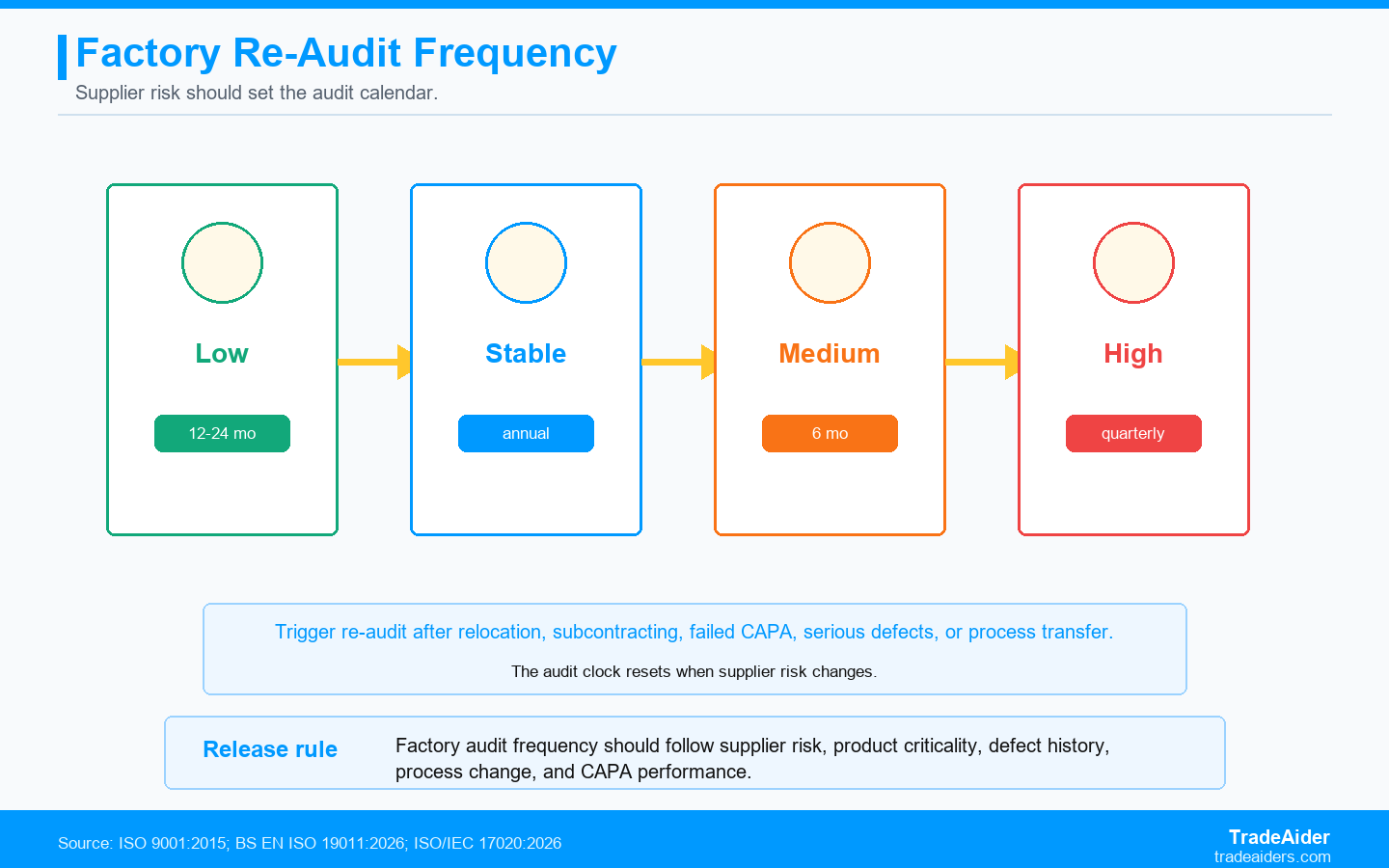
The audit cadence should lengthen or shorten based on supplier stability, product change, inspection results, and unresolved corrective action.
The next audit is due when the old evidence no longer describes the current supplier risk.
What Should Change Between Audit Rounds
A re-audit should not repeat the previous checklist word for word unless the risk profile truly has not changed. The second audit should test whether the factory corrected previous weaknesses, whether the current order introduces new risks, and whether the supplier's operating discipline has improved or deteriorated.
Corrective action must be verified, not just promised
Corrective and preventive action is often the weak point in supplier management. A factory may provide photos, a written promise, or a new procedure, but the buyer needs evidence that the action is implemented at line level. A re-audit should check records, interview process owners, observe the production area, and connect the corrective action to later inspection results.
For example, if a prior audit found poor incoming material segregation, the re-audit should not only confirm that shelves were labeled. It should verify receiving records, rejected material control, operator understanding, and whether any shipment defects later traced back to mixed materials.
Capacity and subcontracting deserve fresh review
Capacity changes can quietly change supplier risk. A factory that performed well at moderate volume may struggle during peak season, or it may outsource cutting, printing, coating, packing, or assembly without telling the buyer. A re-audit should compare declared capacity, actual line layout, production records, and observed work-in-progress with the buyer's order plan.
Subcontracting is not automatically unacceptable, but hidden subcontracting breaks traceability. If the buyer's risk depends on a controlled process, the audit must identify who owns that process, where it is performed, and how the supplier controls it.
Documentation should match production reality
Many factory audits look clean on paper and weak on the production floor. The re-audit should connect documents to real work: inspection records to actual defects, training records to operator behavior, calibration records to equipment labels, and sample approvals to current production. The gap between documents and practice is often where shipment risk lives.
A stronger second-round audit should also compare the supplier's previous score with current operating evidence. If the score improved but shipment defects got worse, the audit should challenge the scoring method. If the score fell but shipment quality improved, the buyer should identify whether the remaining issues are systemic, cosmetic, temporary, or commercially acceptable with added inspection controls.
How TradeAider Fits Into A Supplier Audit Program
TradeAider supports audit cadence planning by connecting supplier assessment with shipment-level inspection evidence. A factory audit can show whether a supplier has the process capability to produce the order, while PSI, DPI, and product testing evidence show whether the actual shipment meets requirements before release.
Use factory audit before commitment or expansion
Before a first order, supplier expansion, or product transfer, buyers can use TradeAider's factory audit service to review capability, quality system basics, production conditions, records, and risk points. The audit should answer whether the supplier is suitable for the order, not merely whether the factory exists.
Use DPI and PSI to monitor the audit assumptions
An audit says the supplier should be capable. A During Production Inspection and Pre-Shipment Inspection test whether the current order is actually under control. When inspection findings contradict the audit assumptions, the buyer should review the audit cadence.
Use a trigger rule before booking the next audit
TradeAider can help buyers define trigger rules such as failed major defect threshold, unresolved CAPA, product change, new destination market, or packaging change. Buyers with supplier history, current PO, product type, and latest report can contact the team to plan the next audit or inspection sequence.
SPAR Scenario: Re-Audit Before Peak Season
Situation: A home goods importer used the same supplier for several repeat orders and had one clean factory audit from the prior year. The next order was larger and scheduled before a seasonal retail deadline.
Problem: The buyer planned to rely on the old audit and a final inspection. However, a recent during-production check found inconsistent carton sealing and a higher rate of cosmetic defects on one line. The old audit no longer explained the current risk.
Action: A focused re-audit reviewed capacity, line assignment, packaging control, incoming material records, and corrective action from the failed process checks. The audit found that the supplier had added a temporary packaging area without updating inspection records.
Result: The buyer did not cancel the supplier. Instead, it required corrected packing control, added a shipment-level PSI, and moved the next full supplier audit earlier. The re-audit changed the release plan from calendar-based trust to evidence-based monitoring.
Who Is TradeAider?
TradeAider is a quality inspection, testing, and certification service provider in China. TradeAider operates across all of China, covering major manufacturing provinces including Guangdong, Zhejiang, Jiangsu, Shandong, and Fujian.
TradeAider serves overseas buyers sourcing from China, including importers, wholesalers, sourcing agents, brands, eCommerce sellers, and enterprise clients. Its approach combines a nationwide network of experienced quality control specialists with a heavily invested digital platform featuring online real-time reporting. Clients can monitor inspections live, communicate directly with inspectors, and address issues during production rather than after shipment - a proactive model focused on problem-solving and prevention, not just defect identification.
Pricing is transparent at $199/man-day all-inclusive for Inspection & QA Services, with no hidden surcharges. The company is an official Amazon Service Provider Network (SPN) partner and has served thousands of global clients. Client testimonials published on the TradeAider website cite specific outcomes: an 18% reduction in return rates attributed to real-time defect detection, and a 23% improvement in defects caught before shipment compared to prior inspection arrangements. These are client-reported figures.
Frequently Asked Questions
How often should I re-audit a China supplier?
Most stable China suppliers should be re-audited every 12 to 18 months, but higher-risk suppliers need earlier review. New products, failed inspections, material changes, compliance concerns, or unresolved corrective actions should trigger a re-audit before the next shipment is released.
Is an annual factory audit enough?
An annual factory audit is enough only when supplier risk remains stable. If the factory changes process, product, subcontractor, production site, capacity, or quality performance, the buyer should re-audit earlier or add focused process verification.
What should be checked in a re-audit?
A re-audit should check prior corrective actions, current production capability, quality records, material control, subcontracting, capacity, and process changes. It should connect the previous audit findings to current shipment inspection results.
Can inspection replace a factory audit?
Inspection cannot fully replace a factory audit because it checks shipment evidence rather than supplier system capability. The strongest program uses audits to evaluate factory risk and inspections to verify the actual order before release.
Related Articles

Grow your business with TradeAider Service
Click the button below to directly enter the TradeAider Service System. The simple steps from booking and payment to receiving reports are easy to operate.

