
- About Us

- Our Services
- Your Industry
- Resources
- News & Blog

A first article, a During Production Inspection (DUPRO), and a Pre-Shipment Inspection (PSI) become a stage-gated quality plan when each one answers a different release question and hands dated evidence to the next stage. The first article establishes what production should follow. DUPRO tests whether the live build still follows it. PSI checks whether the completed order meets the buyer’s final release scope. That sequence is more useful than treating every visit as a generic inspection, because product details, production evidence, and finished-goods evidence are only available at particular moments.
For a new e-commerce product, the practical risk is rarely that nobody looked at the order. The risk is that the approved sample, the live line, and the packed shipment are judged against different versions of the requirement. A three-gate plan prevents that drift by naming the reference, the inspection moment, the record to keep, the person who decides, and the consequence of a mismatch before production volume rises.
The New-Product Decision: Set Evidence Gates Before Volume Rises
A new product needs an approved reference, a live-production check, and a final-order release decision; treating these as one late inspection leaves important evidence unavailable when it is needed.
- Reference: Approve the first article with the product, packaging, label, test points, and version record that production must follow.
- Reality check: Use DUPRO to compare the actual line, materials, workmanship, and records with that reference while a defined scope can still be held or corrected.
- Release: Use PSI for the finished order, not as a substitute for an absent first-article approval or live-production record.
- Handoff: Carry the approved reference, findings, corrections, and recheck status forward instead of rebuilding the history at shipment time.
The plan does not promise that every order will pass. It gives the buyer a clearer way to decide what happens when something does not match: approve the reference, contain a live-production scope, request correction, verify the correction, or hold final release. TradeAider can work from a buyer-defined inspection scope at the relevant stage. The standard remains the buyer’s written requirement and any applicable product, labeling, marketplace, contract, or regulatory obligation. Related quality-planning articles are collected at https://www.tradeaiders.com/blog.
A Stage-Gated Quality Plan Is a Release Sequence, Not Three Unrelated Visits
NIST describes process characterization as identifying key inputs and outputs and treats it as especially useful for a new process or major change. NIST’s process-characterization guidance therefore provides a useful boundary for a new-product plan: identify what can change the output before asking a final inspection to explain it.
A stage gate is a buyer-defined decision point. It has four parts: a question, evidence that can answer the question, an owner who can act on the result, and a consequence if the evidence does not agree with the approved requirement. The gate is not merely a date on an inspection calendar. A visit without a defined decision can produce observations yet still leave the next production step ambiguous.
The sequence also makes the limits of each record visible. A product photo from a first sample cannot show whether the actual production line used the approved components. A live-line record cannot show whether the entire finished order was packed and presented as required. A final-order report cannot travel backward in time and prove that an unapproved reference was never used. The evidence must be judged at the moment it can be observed.
The First Article–DUPRO–PSI Stage-Gated Plan
The First Article–DUPRO–PSI Stage-Gated Plan uses a reference gate, a live-production gate, and a finished-order gate so that the evidence produced at one stage can guide the next decision.
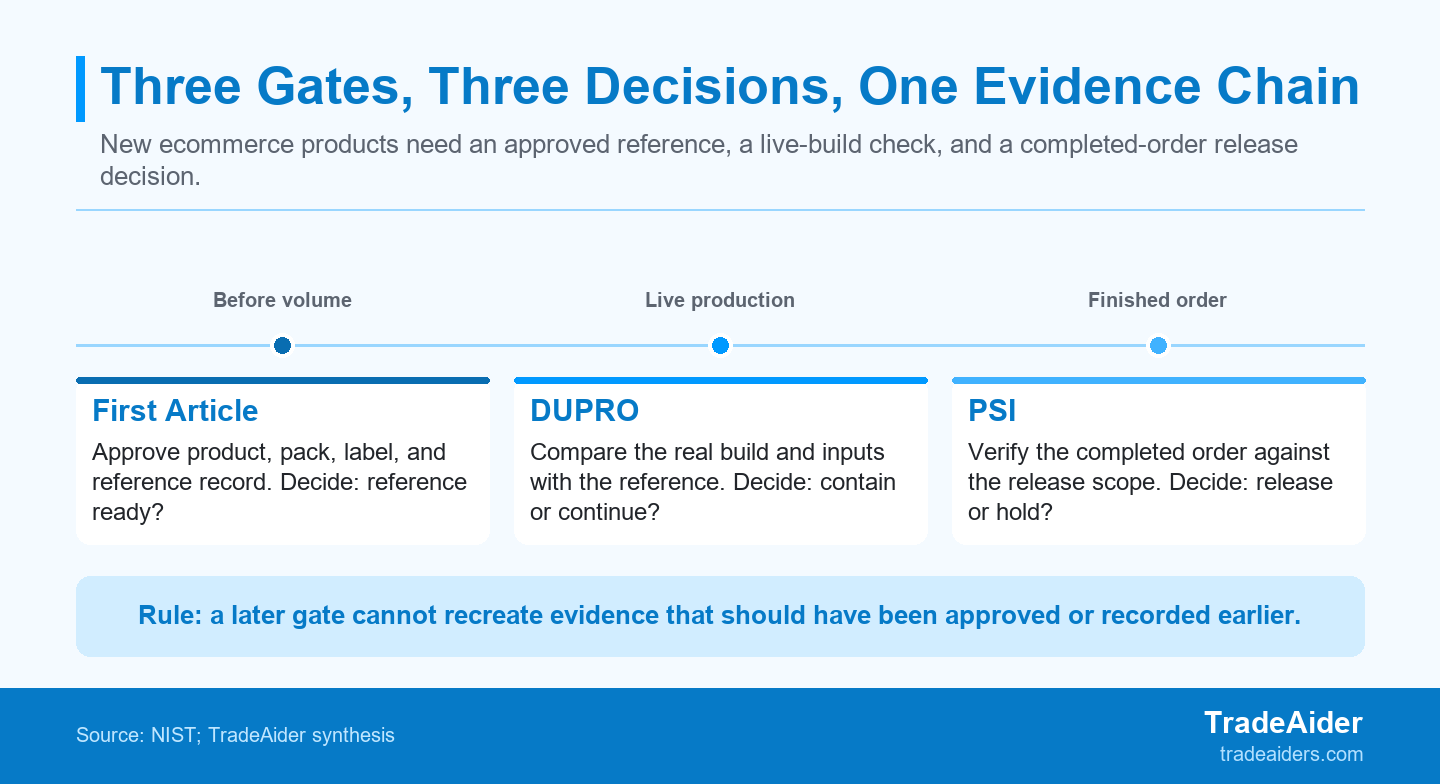
A new-product quality plan works when the evidence from the approved reference, live-production check, and final-order check is carried to the next decision. Buyer requirements remain the release standard.
The framework is deliberately simple. At Gate 1, the buyer decides whether the approved reference is complete enough to guide production. At Gate 2, the buyer decides whether a live production scope still agrees with that reference. At Gate 3, the buyer decides whether the completed order has the evidence needed for the defined release decision. The stages are connected, but they are not interchangeable.
| Gate | Question to Answer | Evidence to Retain | Decision if It Does Not Match |
|---|---|---|---|
| First Article | Is this the approved production reference? | Approved unit, version notes, photos, measurements, packaging and label record | Correct the reference before volume begins |
| DUPRO | Does the real build still match the reference? | Live checks, material or process evidence, affected scope, correction and recheck record | Contain or correct the defined live scope |
| PSI | Can the completed order move under the release scope? | Finished-lot results, packing evidence, quantities, findings, disposition record | Release, hold, sort, rework, or reinspect under buyer authority |
The table is not a universal acceptance form. A cosmetics brand, a furniture seller, and a household-goods importer may need different measurements and hold rules. The shared mechanism is the handoff: each gate should leave evidence specific enough for the next gate to use without guessing which version of the product or packaging is authoritative.
Gate 1: Approve a First Article Before It Becomes the Production Reference
GSA first-article provisions state that a first article is produced in the same facility as production and becomes the manufacturing standard; this is a U.S. government-purchasing reference, not a universal ecommerce obligation. The point is still useful for commercial buyers: an approved unit should be connected to the real production context, not treated as a detached prototype. GSA’s first-article provisions set out that limited procurement context.
FAR first-article clauses require a report and approval or disapproval in the relevant procurement setting, and approval does not remove the contractor's obligation to meet all contract requirements; this scope does not create a general consumer-goods rule. The FAR clause is useful here only as a reminder that approval should name what was evaluated and should not silently erase the rest of the buyer’s requirements.
For an e-commerce launch, the first article should be more than “the sample looked good.” It should make the approved version findable. Record the item code or revision, materials and finish that matter, dimensions or assembly points that matter, retail and export packaging, barcode location, inserts, warning labels, and any test method or measurement that will be used later. If a requirement is not visible in the reference or its approval record, decide whether it belongs in the production brief before the first full run starts.
Use this gate to resolve choices that will be expensive or confusing later: which carton artwork is approved, which inner pack goes with which variant, whether a closure must pass a fit check, and who may authorize a specification change. When a buyer needs an independent readiness check before production, they can set the pre-production inspection scope around the approved reference. The service page does not replace the buyer’s standard; it helps organize the first checkpoint around it.
Gate 2: Use DUPRO to Check Whether the Approved Build Holds During Production
NIST explains that controlled and uncontrolled inputs influence measurable process outputs, so a live-production check should connect a product result to the material, method, tool, or environment that may explain it. NIST’s process-model explanation is a practical reason to inspect the live build instead of limiting the plan to finished units.
DUPRO should begin with a comparison, not a scavenger hunt. Bring the approved first-article record to the line. Confirm that the correct product version, materials, components, artwork, and packing method are present. Then test the buyer-defined characteristics that could expose a mismatch early: fit, finish, assembly, measurement, functional behavior, label placement, traceability, or carton configuration. The choice depends on the product; the rule is to inspect a result that can still be tied to an actionable input.
A useful DUPRO finding names the affected scope. “Packaging concern” is not enough to support a decision. The record should say which line, shift, work order, component batch, carton group, or production window could be affected; whether that scope was held; what correction was applied; and how the correction was checked. If the supplier cannot identify the boundary, the buyer may need a broader hold rather than a selective release.
For a buyer-defined live checkpoint, place a during-production inspection at the live production point where the relevant evidence can be observed. Schedule it early enough for containment and correction, but not so early that the line is still a setup exercise rather than the actual build. There is no universal production percentage that solves this timing question; the right point follows the product’s risk, production flow, and ability to identify the affected scope.
Gate 3: Use PSI to Decide Whether the Finished Order Can Move
A PSI is conducted when 100% of the order quantity is completed and at least 80% is packed for export. The stated timing is described on TradeAider’s pre-shipment inspection service page.
Pre-Shipment Inspection (PSI), also called Final Random Inspection (FRI), is the finished-order gate. The “80%” condition refers to cartons packed for export, not to 80% of production. That distinction matters because the final check must be able to examine the actual finished order, its packing condition, its identifiers, and the scope presented for shipment. The buyer should define the lot, sampling approach where applicable, critical checks, documents, and disposition authority before the visit.
A final-order inspection is evidence for a lot-release decision; it is not retroactive proof that the earlier first article and live production checkpoints were complete.
PSI is still valuable when it finds a mismatch. It can prevent an unresolved issue from moving into the shipment decision. What it cannot do is recreate an approved first-article version, identify every cause that changed during production, or prove that a late correction reached every untraceable unit. That is why the final report should cite the approved reference and any relevant DUPRO corrective record, rather than become a standalone document with no production history.
When the order reaches this stage, buyers can use the final-order service scope to support the finished-order release decision. The release should remain with the buyer or the buyer’s authorized party, informed by the defined PSI scope, the findings, the correction evidence, and the stated commercial terms.
Make Each Gate Produce the Next Gate’s Evidence
NIST's production-process planning steps call for documented goals, a process model, a sampling plan, assigned responsibilities, and a data-collection approach before collection begins. NIST’s planning sequence supports a simple discipline: decide what record the next stage will need before the current stage is over.
The most effective handoff is short and versioned. The first-article pack should give the live-production reviewer the approved item, pack, labels, measurement points, and change history. The DUPRO pack should give the final reviewer the live scope, the observation, corrective action, recheck result, and any remaining condition. The PSI pack should give the buyer a final report tied to that same reference, not a new list of assumptions assembled at the last minute.
NIST lists initial qualification, health monitoring, and post-adjustment review among uses of process characterization; a buyer can use that boundary to decide when the gate evidence needs refreshment. NIST’s overview of process-characterization uses does not prescribe an ecommerce workflow, but it does reinforce the logic of rechecking after a meaningful change.
Set a refresh trigger in writing. Examples include a changed material source, a revised artwork file, an alternate factory line, a new packing configuration, a tool adjustment that affects a critical characteristic, or an unresolved finding from the prior gate. The point is not to reopen every decision without reason. It is to avoid carrying forward a reference that no longer represents the live process.
Worked Example: A New Flat-Pack Organizer Moves From Sample to Shipment
An illustrative ecommerce order shows how a buyer can prevent a late packaging dispute by carrying approved first-article evidence into a live DUPRO check and a final PSI release decision.
Trace the Evidence Through the First Commercial Run
This illustrative scenario is not a client case or a measured TradeAider result. A U.S. ecommerce brand is placing its first commercial order with a China supplier for flat-pack bamboo drawer organizers.
The order contains 3600 flat-pack bamboo drawer organizers across three color variants, retailer-ready carton labels, and a launch date that calls for one combined shipment.
The buyer’s pre-production sample looks acceptable, but the formal production reference still needs the approved finish, screw set, assembly fit, barcode position, and inner-pack layout.
The first article matches the buyer's dimensions but shows a carton-label placement that would be difficult to scan after palletization. During DUPRO, the buyer's checklist reveals that 1 live line uses a substitute screw packet whose bag label does not match the approved inner-pack reference. At PSI, the corrected lot is complete and the final packaging evidence is available for the finished-order release decision.
The unapproved label and substitute packet create a document-versus-product conflict that could survive until final packing if the first article and live-production evidence are not handed forward.
The buyer places the affected scope on full hold, corrects the reference pack and the live material label, then uses PSI to decide whether the completed order can move.
The supplier updates the approved reference pack, replaces the mismatched packets within the 1 live production line affected scope, records the recheck, and presents the same reference during final inspection.
Release only when the buyer’s approved reference, DUPRO result, corrective record, and PSI result agree with the stated product and packaging requirement.
This illustrative example does not set universal requirements. The buyer must define the applicable product safety, labeling, marketplace, shipment, sampling, contractual, and final ship-or-hold decision requirements.
Use the Gate Result to Change the Next Decision, Not the Standard
The scenario changes the supplier action and release timing when evidence is incomplete, but it does not silently change the buyer's approved product requirement.
The practical lesson is not that every variation needs a full-order hold. It is that a selective decision needs a defendable boundary. If the supplier can show the exact line, packet batch, time window, and correction evidence, the buyer can decide how much scope needs rechecking. If the boundary is missing, a broader hold may be the only honest option. In either case, the first article remains the point of comparison rather than a vague memory of what the sample looked like.
The same logic protects the PSI stage. A final inspection finding should lead the buyer back to the relevant gate record: Was this characteristic approved in the first article? Was it checked during live production? Was a corrective action already recorded? That trail helps separate a new finished-lot issue from a known mismatch that was never fully closed.
Write the Three-Gate Quality Brief Before the First Production Day
A compact brief can define the approved reference, live-production checkpoint, final release condition, records, escalation path, and acceptance authority before production starts.
A useful brief should fit the real decision process. Start with the purchase order, product version, supplier facility, planned production window, and buyer contact who has authority to approve, hold, or release. Attach the approved first-article record. Then state the critical product, packaging, labeling, and functional checks that need to recur at the live and final stages. A broad request for “full inspection” is less useful than a precise request that identifies what must agree with the reference.
- Gate 1 reference: State which unit, pack, artwork, label, measurements, and version record are approved.
- Gate 2 live check: Name the production point, characteristics, expected records, affected-scope boundary, and hold rule.
- Gate 3 release: State the finished-order condition, PSI scope, packing condition, report recipient, and disposition authority.
- Escalation: Define who receives a finding, who may authorize a correction, how recheck evidence is recorded, and who can release the lot.
If the supplier cannot present the approved reference, production record, or traceability needed for a gate, the buyer may need to add a focused factory audit when the production reference or records are missing. That escalation should target the evidence gap rather than become a generic supplier judgment. It may reveal a documentation weakness, a change-control problem, or simply the need for a clearer buyer brief before the first launch continues.
TradeAider can help turn a buyer-defined requirement into a stage-specific inspection scope. If you need a second set of eyes on the records, checkpoints, and release language before a new product moves into volume, ask TradeAider to review a three-gate inspection brief.
Who Is TradeAider?
TradeAider is a quality inspection, testing, and certification service provider in China, operating across major manufacturing provinces including Guangdong, Zhejiang, Jiangsu, Shandong and Fujian. Its public company profile identifies it as an Amazon Service Provider Network (SPN) partner.
For buyers that need staged quality support, TradeAider can work from the product and packaging requirements defined for the order, then report the evidence relevant to the requested inspection stage. Its service context covers initial readiness, live production, and final-order checks, allowing buyers to choose a scope that matches the risk and decision point rather than applying one generic visit to every order.
Its published pricing includes $199/man-day all-inclusive for Inspection & QA Services. Buyers should confirm the final scope, location, product requirements, timing, and any additional testing or logistics needs for the specific order.
Frequently Asked Questions
What should a first article prove before production begins?
A first article should prove that the buyer’s product, packaging, labeling, measurable checks, and approved reference record are ready to guide the first production run. It should also identify the specific version that production must follow, rather than leave the supplier to interpret an informal sample. The buyer can add product-specific tests, documents, and approval conditions, but should make those requirements explicit before volume begins.
When should a buyer schedule a DUPRO inspection?
Schedule DUPRO when enough live production exists to examine the real build, but early enough that an identified mismatch can still be contained and corrected within a defined scope. The exact timing depends on the product, production flow, and availability of traceable records; it is not a universal percentage of production. Plan the visit around the moment a critical characteristic, component, or packing decision is actually observable.
What does the PSI stage need to confirm?
The PSI stage should confirm the finished-order evidence against the buyer’s approved requirements, including the applicable product, packaging, labeling, quantity, and release checks. It is conducted after 100% of the order quantity is completed and at least 80% is packed for export. The buyer should define the final sampling, findings, hold, and release rules in advance, because PSI evidence informs a commercial decision rather than replacing it.
Can a PSI replace first-article approval or DUPRO?
No, a PSI can support a final-order release decision, but it cannot recreate the approved reference or live-production evidence that should have guided the order earlier. A final inspection can reveal a finished-lot mismatch, yet it may not show when the change began or which scope was affected during production. Keep the first article and DUPRO records available so a PSI finding can be interpreted against the proper history.
What belongs in a three-gate inspection brief?
A three-gate inspection brief should name the approved reference, critical checks, stage timing, records, owners, hold conditions, escalation path, and the buyer who has release authority. It should also identify what must be passed from the first article to DUPRO and from DUPRO to PSI. Keep the brief product-specific: a generic instruction to inspect everything does not tell the supplier or inspector which evidence controls the next decision.

Related Articles



Grow your business with TradeAider Service
Click the button below to directly enter the TradeAider Service System. The simple steps from booking and payment to receiving reports are easy to operate.

