
Set reasonable apparel acceptance limits by defining critical, major, and minor defects first, then agreeing category AQL values, the sampling plan, and separate product requirements. A familiar AQL number alone cannot tell an inspector whether a seam, size discrepancy, or shade variation is acceptable. Clear instructions give the seller and factory a common basis for deciding what happens to the order.
What to Agree Before an Apparel AQL Inspection
- Agree defect definitions, category limits, sampling settings and technical checks before inspecting apparel.
- AQL is a plan parameter; it does not guarantee a maximum defective share in an individual shipment.
- Read acceptance and rejection counts from the agreed plan. Reaching the rejection number is enough to fail that criterion.
- Keep garment measurements, test requirements, critical findings, and shipment approval separate from the major/minor count.
Understanding AQL Standards in Apparel
Apparel acceptance starts with a shared definition of quality.
Inspectors check for stitching defects, fabric flaws, color discrepancies, sizing mistakes, and accessory errors. Your instructions determine how those observations become consistent decisions across styles and orders.
What Is Acceptable Quality Limit (AQL)?
AQL is a quality level used to index an acceptance sampling plan; it is not a guaranteed maximum defective percentage in a particular shipment. See NIST’s sampling definitions.
The term is generally expanded as acceptance quality limit. For a seller, its useful role is selecting a sampling plan together with the other required settings. It is not an instruction to multiply a sample or shipment quantity by the AQL percentage and accept that many faulty garments.
Start with the defect criteria: what counts as a nonconforming garment in each category? Then record the plan used to judge the sample. TradeAider’s inspection-standard reference provides background for discussing those settings with the inspection provider.
Why AQL Matters for Apparel Sellers
Acceptance sampling supports deciding whether to accept or reject a lot rather than estimating its actual quality. See NIST’s explanation of acceptance sampling.
For apparel sellers, a common rule helps make factory discussions more specific: show the failed seam, identify its category, and compare the observed count with the agreed limit. Regular inspections and data documentation also make recurring problems easier to identify. These are useful controls before shipment, but a passing sample alone does not establish that returns will fall or every garment meets the specification. Keep the report with the order criteria so later complaints can be compared with what was actually inspected.
Core Principles of AQL Standards
The standard, inspection level and AQL value play different roles.
Write them separately in the order instruction. This prevents an inspection-level change from being mistaken for a new defect classification or a different product tolerance.
Statistical Sampling and ISO 2859-1
ISO 2859-1:2026 is Edition 3, published in January 2026, and covers AQL-indexed sampling schemes for lot-by-lot inspection by attributes. See ISO’s current standard listing.
NIST’s historical MIL-STD-105 explanation distinguishes three general inspection levels and four special levels, and uses lot size and inspection level to obtain the sample-size code letter. See NIST’s historical scheme description.
General Inspection Levels I, II, and III concern the relationship between lot size and sample size. They are distinct from defect severity and from normal, tightened, or reduced inspection. Level III is not a substitute for a critical-defect rule. Confirm the actual standard edition, inspection level, sampling type, and inspection severity with the provider before using a table. The historical NIST explanation helps distinguish these inputs; it does not establish the numeric tables in the current ISO edition.
The displayed TradeAider normal single-sampling charts map a lot of 1,200 garments at General Inspection Level II to code letter J, a sample of 80, and major AQL 2.5 to Ac 5 / Re 6. See AQL calculator.
AQL vs. Zero Defects
A zero-acceptance rule for critical findings in the inspected sample does not prove that the entire shipment has zero defects.
If your agreed rule rejects the lot when any critical defect is found, state that action explicitly. Do not describe it merely as “AQL 0” or confuse it with a statistical promise about uninspected garments. A sharp needle fragment is an example of a finding that calls for a safety response under the agreed criteria. Product-specific safety obligations and any required testing still need their own controls. A price tier or a passing major-defect count cannot override those obligations.
Apparel Defect Classification and AQL Levels
Classify the consequence before choosing the category limit.
Apparel sellers rely on clear defect categories to make quality judgments repeatable. The examples below illustrate the distinction; they are not a universal classification list for every garment.
Critical, Major, and Minor Defects
Use the garment specification and the consequence of a defect to classify it, rather than treating every labeling or color problem alike.
| Category | Conditional apparel example | What to agree |
|---|---|---|
| Critical | A sharp needle fragment presenting an injury hazard | Escalation, containment, and disposition for any such finding |
| Major | An open seam affecting use or a size error outside the agreed specification | How the garment is judged and counted |
| Minor | A loose thread that does not affect use, under the agreed appearance criteria | Visibility, location, and workmanship limits |
Labeling deserves particular care. A wrong size label and a missing required safety warning have different consequences. Similarly, shade variation may be cosmetic in one specification and unacceptable for a coordinated set in another. Classify the actual problem before counting it.
Setting Reasonable AQL Tolerances
A proposed major/minor AQL pair needs agreement for the actual garment and customer requirements.
For example, a buyer might propose major AQL 2.5 and minor AQL 4.0, but those values are a proposal to evaluate, not percentages automatically allowed in the sample. Check the customer’s written product acceptance requirements first. Then review the garment’s use, recurring defects, and the commercial effect of releasing a poor lot. Specify any critical-finding rule independently. Once agreed, communicate the categories and limits before inspection rather than changing them after seeing a disappointing result.
When choosing who will apply the agreed criteria, confirm the relevant garment checks directly with the provider. Review TradeAider’s company information.
Strategic AQL Selection for Apparel
Match acceptance limits to the product promise and the cost of a wrong decision.
A lower proposed AQL is not a complete quality strategy. It does not tell the factory how to sew a seam, select a fabric, or control the size pattern.
Aligning AQL with Brand and Cost
Sampling plans involve producer risk and consumer risk; a seller should consider both when reviewing the proposed acceptance rule. See NIST’s sampling definitions.
Producer risk concerns rejecting a lot at the designated acceptable quality level; consumer risk concerns accepting at a designated poor quality level. Review the plan’s performance at relevant quality levels when the decision carries substantial consequences. Avoid assigning automatic “luxury,” “mid-range,” or “budget” limits: price alone does not identify the customer’s requirements or the damage caused by a defect.
For a fitted garment, an incorrect key measurement may matter more than a removable thread. Put effort into those criteria before tightening every count limit.
Apparel AQL Inspection Process
An inspection instruction joins the lot definition, random sample, defect rules and required checks.
The report should identify the order, styles, inspected quantities, observations, and the basis of its conclusion. The buyer then uses that evidence under the agreed shipment-approval process.
Sampling Plan and Inspection Levels
The inspection begins with a clear AQL sampling plan. Define the lot and the styles, colors, and sizes it contains; agree how the random sample will cover them. Record the sample-size code letter and count rules before inspection. For the example below, the counting unit is a nonconforming garment in the major category. If your plan counts individual nonconformities instead, specify that basis and apply the corresponding plan consistently.
TradeAider describes Pre-Shipment Inspection (PSI) as taking place when the order is 100% complete and at least 80% packed. See Pre-Shipment Inspection (PSI).
The packing percentage concerns packing readiness, not permission to inspect an incompletely produced order. Send the order breakdown, approved specifications, and customer requirements so the proposed scope can be confirmed.
Acceptance and Rejection Criteria
Apply the agreed count limits to the observed major nonconforming garments, and assess the other required checks separately.
Ac is the acceptance number; Re is the rejection number. In a normal single-sampling plan, a category count at or below Ac meets that count criterion, while a count at or above Re rejects it. Apply the other agreed checks separately.
Illustrative example: A seller uses those displayed settings for a finished apparel lot. Five major nonconforming garments are within the major acceptance count; six reaches rejection. The charts shown by the client are legacy ANSI/ASQ normal single-sampling charts; this example is not a reproduction of the ISO 2026 tables. Use the edition and plan agreed for the actual order.
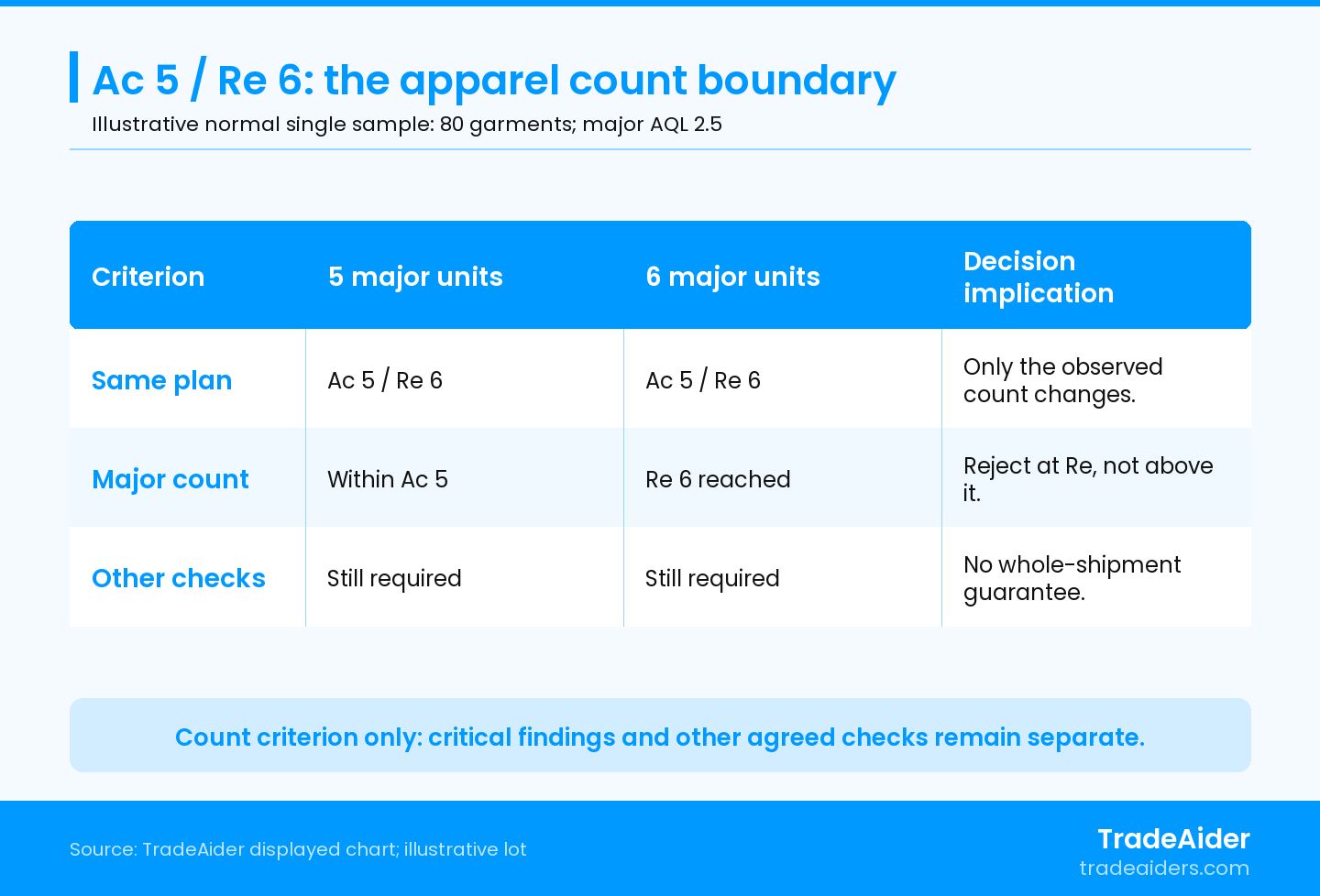
Illustrative major-count decision using the client-displayed normal single-sampling chart. Critical findings and other required checks remain separate.
After a failed count, agree the lot’s disposition, such as holding for investigation and sorting or rework where appropriate. Any later reinspection should follow the agreed procedure; selecting a new convenient sample repeatedly is not a sound way to reverse the original result.
Common AQL Mistakes in Apparel
Ambiguous defect rules and inconsistent supplier records weaken the usefulness of inspection results.
Two errors deserve attention: changing the meaning of a defect between inspections and treating past supplier results as permission to ignore the current order.
Misclassifying Defects
Record defect photos and consequences so disagreements can be resolved against the agreed criteria.
An inspector should not downgrade a safety finding simply because a major-defect allowance remains. For less obvious disagreements, use an approved sample or annotated photos to show the acceptable boundary. Include location and extent: a conspicuous mark on a garment’s front may deserve a different judgment from a comparable mark in a concealed area. Name the person who can clarify an unresolved criterion. Record that clarification for future orders instead of letting each inspector invent a different interpretation.
Ignoring Supplier Performance
ASQ describes Z1.4 as an attributes acceptance sampling system for a continuing stream of lots, with normal, tightened and reduced inspection and switching rules. See ASQ’s Z1.4 overview.
Use the switching rules of the agreed system when they apply. Do not switch to reduced inspection merely because one order passed or a supplier has a long relationship with you. Keep results comparable by recording the product, lot, category, plan, and repeated defect types. A change of fabric or construction may also deserve a review of the inspection instruction. Supplier history can inform that review without rewriting the acceptance rule after the current sample has been counted.
Improving Your AQL Approach
Convert recurring disagreements into clearer written inspection criteria.
A defect tolerance manual helps teams achieve consistent quality. Keep it practical enough for the seller, factory, and inspector to consult while handling a specific garment.
Building a Defect Tolerance Manual
Keep approved samples, defect categories, sampling settings, technical limits and decision ownership together in the apparel inspection manual.
| Manual field | Fill in before inspection |
|---|---|
| Order and reference | Order/style IDs; approved sample or photos; specification version |
| Defects and counts | Category definitions; counting unit; AQL values; sample plan; critical-finding action |
| Raw fabric | Flaws to assess; grading method/option if used; agreed acceptance criteria |
| Color fastness | Required test method, conditions, performance grade, and evidence |
| Garment measurements | Points of measure, size chart, measurement method, units, and tolerances |
| Report and disposition | Report recipient, language/format, required records, and shipment decision owner |
ASTM D5430-26 addresses visual inspection and grading of fabrics; its public scope notes that purchaser and seller should agree on the grading option. See ASTM’s public fabric-grading scope.
ISO 105-C06:2010 covers testing textile color fastness to domestic and commercial laundering. See ISO’s laundering-test scope.
Neither scope supplies a universal garment acceptance grade or a fixed dimensional tolerance. Choose the relevant method and acceptance criteria for the actual product, rather than copying one fabric point system, color grade, or inch tolerance into every order.
Send the garment and order details you have, the styles and sizes, and any existing customer or destination requirements. Identify missing criteria during the scope discussion, then confirm the checks and report requirements before inspection. A first inquiry does not require a fully finished manual. Contact our team.
FAQ
Who pays for reinspection after an apparel lot fails?
The purchase or inspection terms should say who pays for reinspection.
Agree the responsible party, the work needed before another visit, and any additional inspection or testing charges. Rejection does not automatically establish that the supplier pays every cost. Keep the failed report and the proposed corrective work together so the later inspection has a clear purpose and the buyer can assess what has changed.
Can a lower AQL replace garment measurement tolerances?
No. AQL and measurement tolerances answer different questions. A measurement tolerance defines the permitted variation at a specified point of measure; the sampling plan governs the count-based lot decision. Specify how a measurement outside tolerance is classified and reported, and whether separate measurement sampling is required. Lowering an AQL value cannot repair an ambiguous size chart or an inconsistent measuring method.
Should different styles and colors share one inspection result?
Only if the agreed lot definition and sampling coverage justify that combined result. A sample concentrated in one style cannot establish findings for unexamined styles. Ask how the order breakdown will be represented and whether separate lots or additional checks are appropriate. Keep the report’s conclusion tied to the quantities and variants actually covered, especially when different specifications apply.
Articles Connexes

Développez votre entreprise avec le Service TradeAider
Cliquez sur le bouton ci-dessous pour accéder directement au Système de Service TradeAider. Les étapes simples de la réservation et du paiement à la réception des rapports sont faciles à utiliser.