

For a Canada-bound home-fragrance range, the first release decision is product format—not the collection name on the carton. A wax candle has an open flame. A reed-diffuser refill is a liquid whose actual hazards may matter. A room spray can add a pressurized consumer pack. If one artwork team treats those products as one “fragrance” project, the buyer can approve a label or carton record that does not describe the finished SKU.
Successful release depends on a clear format decision, visible consumer-pack information, and a match between the finished build, applicable rule path, approved artwork, and carton range. Those checks keep a packaging or product-version change from being mistaken for a collection-wide approval.
Start With the Product Format, Not the Marketing Name
- Separate open-flame candles, refill liquids, and aerosol or pressurized sprays before the artwork is frozen.
- Review the consumer-facing unit, not only the master carton or a shared brand brief.
- Use the relevant Canadian rule path to define the evidence and information for that SKU.
- Release only cartons that can be tied back to the current product build and retail presentation.
A candle, a refill liquid, and an aerosol room spray can share a fragrance brand while requiring different safety and label decisions. Create a one-line format statement for every SKU before accepting label copy: “open-flame candle,” “liquid refill,” “non-pressurized spray,” or “pressurized spray,” followed by the product facts that need review. The useful outcome is not a broad collection checklist. It is a controlled product brief that tells the supplier, artwork owner, and inspector which finished retail unit they are discussing.
TradeAider can use that brief during pre-production planning before components and labels are ordered. It should name the SKU, wax or liquid format, vessel or container, closure, retail-pack revision, and intended carton range. Pre-production inspection planning can use the same file to turn those decisions into checkable factory references before a shared fragrance launch creates several look-alike versions.
Treat an Open Flame as a Product-Control Question
For a Canada-bound candle, the open-flame product path should be set from the finished candle build before a buyer relies on a shared home-fragrance label or collection name. Record the wax system, wick configuration, vessel, decorative components, lid or cover used during sale, and current warning artwork as one identifiable retail build. A warning panel can support a controlled product file; it cannot turn a materially changed candle back into the candle the file was written for.
A useful factory question is: “Can you show the bulk candle, its retail unit, and its approved artwork revision together?” If the wick, vessel, fill weight, decorative surface, or pack construction changes, open a review rather than treating the change as a cosmetic substitution. This keeps the control focused on the finished item the Canadian customer will handle.
Exclude Products That Can Reignite After Extinguishment
Canada’s Candles Regulations state that a candle must not reignite spontaneously after it is extinguished. Treat that as a direct product boundary at sourcing stage. Do not accept a supplier’s broad statement that the item is a “novelty candle” or an “effect candle” without confirming that the actual Canada-bound SKU is not designed to relight after extinguishment.
A 2025 Health Canada advisory describes relight candles as banned in Canada because they can reignite after being blown out or discarded. This is a reason to hold the product before purchase-order approval, not to wait until final inspection. Keep the supplier’s product description and the decision to exclude the SKU in the sourcing record.
Check the Build Before You Approve the Warning Copy
The finished candle build should be controlled as part of the product file because Canada’s candle rule applies to a candle that reignites spontaneously after extinguishment. The operational point is narrower than a claim of legal clearance: do not let a current warning proof stand in for a review of the actual wick, wax, vessel, and retail configuration. Put the version number on the approved product photo and artwork PDF, then require any change to be raised against that version.
At finished-goods stage, compare a sampled retail candle with that approved reference. Check that the product name, unit, closure, warning placement, and visible construction still describe the same SKU. If a supplier cannot identify whether a revised wick or vessel is inside a particular carton range, hold that defined range until the product identity is rebuilt.
Separate Wax Candles From Consumer Chemical Products
The Consumer Chemicals and Containers Regulations, 2001 (CCCR, 2001) include classifications and required information for consumer chemical products, including flammable products and pressurized containers. A consumer chemical product here means a consumer product whose actual hazards put it on the relevant Canadian chemical-product path. It is not a shortcut label for every diffuser, fragrance oil, or home-scent item.
Start by asking the supplier for the actual product and container facts: liquid or aerosol, dispensing method, pressurization, ingredients or formulation information needed for assessment, and the retail container that reaches the consumer. Then determine whether the specific SKU needs the CCCR, 2001 pathway. The classification decision should be held with the current product specification, rather than inferred from a candle’s status or the collection’s marketing copy. When those facts need clarification, product testing coordination can help define what evidence must be obtained before production release.
Build Hazard Information From the Classification Result
For a consumer chemical product, the applicable CCCR, 2001 classification drives the required hazard information and packaging controls; do not infer that path from a shared fragrance collection name. The retail-pack review should begin after the format and hazard assessment, not with a designer’s first label layout. Ask for the current artwork file, container drawing, closure specification, and the source used for the classification decision.
Keep this sequence visible in the release file: first the product and container facts, then the applicable classification, then the information and packaging controls that follow from it, then the finished retail unit. This does not replace specialist advice where it is needed. It prevents an unreliable sequence in which a completed label is used to suggest that the correct product pathway was already confirmed.
Inspect Consumer Packaging and Shipping Packaging Differently
Under the CCCR, 2001, consumer-facing chemical-product information must be reviewed on the retail container or packaging that the consumer receives, not assumed to be satisfied by a transit-only shipper. This distinction matters where an overcap, sleeve, shrink band, insert, or gift box changes what a consumer can see and handle. A shipping carton can support transport and traceability; it is not a substitute for reviewing the consumer-facing presentation.
During production, sample the exact retail configuration—not a loose bottle before its cap, not a canister before its overcap, and not an outer carton with the retail unit hidden inside. Compare the approved PDF against what is visible after all final components are fitted. During-production change checks are most useful when a packaging revision is still confined to a known production period and can be separated before packing is complete.
For each SKU, keep two distinct pack records: a retail-pack photograph or sample reference showing the consumer-facing surfaces, and a carton map showing quantity, marks, and the packed range. The first answers “what does the consumer receive?” The second answers “which finished goods does the decision cover?” Mixing them makes both answers less reliable.
Complete the Prepackaged-Product Label Before Artwork Freeze
Canadian prepackaged non-food labels include product identity, net quantity, and dealer name and place of business on the principal display panel. The Competition Bureau’s guidance is a useful baseline for consumer packaging. The principal display panel is the main retail-facing display surface that carries key package information; it is not simply any blank space on the carton.
Run this commercial-label check alongside, but not instead of, the candle or consumer-chemical review. A liquid refill may need a product-specific hazard path and the ordinary prepackaged-product details. A candle may need its own open-flame product control while still needing accurate consumer-package information. Artwork freeze should occur only after both routes that actually apply to that SKU have been recorded.
| Record | What it must identify | Release hold trigger |
|---|---|---|
| Product build | Format, container, closure, and current SKU | Bulk item differs from approved reference |
| Rule path | Candle boundary or applicable consumer-chemical assessment | Product format or hazard decision is unresolved |
| Retail artwork | Consumer-facing information and approved revision | Final cap, sleeve, or carton obscures the approved presentation |
| Carton identity | Defined finished-carton range and packing marks | Affected cartons cannot be isolated |
Use a Four-Record Release File
The Canada Consumer Product Safety Act includes prohibitions, document duties, incident duties, inspection powers, and recall powers for consumer products. For an importer, that broader framework is a reason to keep product decisions traceable rather than scattered across emails, artwork folders, and carton photos. A factory’s “same as sample” message is not a controlled release record when it does not identify the packed SKU and current version.
A release file is a controlled set of product, rule, artwork, and carton records used for one shipment decision. The four records should reconcile in one direction: the product build identifies the format; the rule path states the assessment boundary; the approved retail artwork shows the information consumers receive; and the carton identity defines the finished population. If one record points to a different wick, container, overcap, label revision, or carton period, make a defined hold instead of treating the whole collection as cleared. This is an operational release method, not a legal classification or laboratory finding.
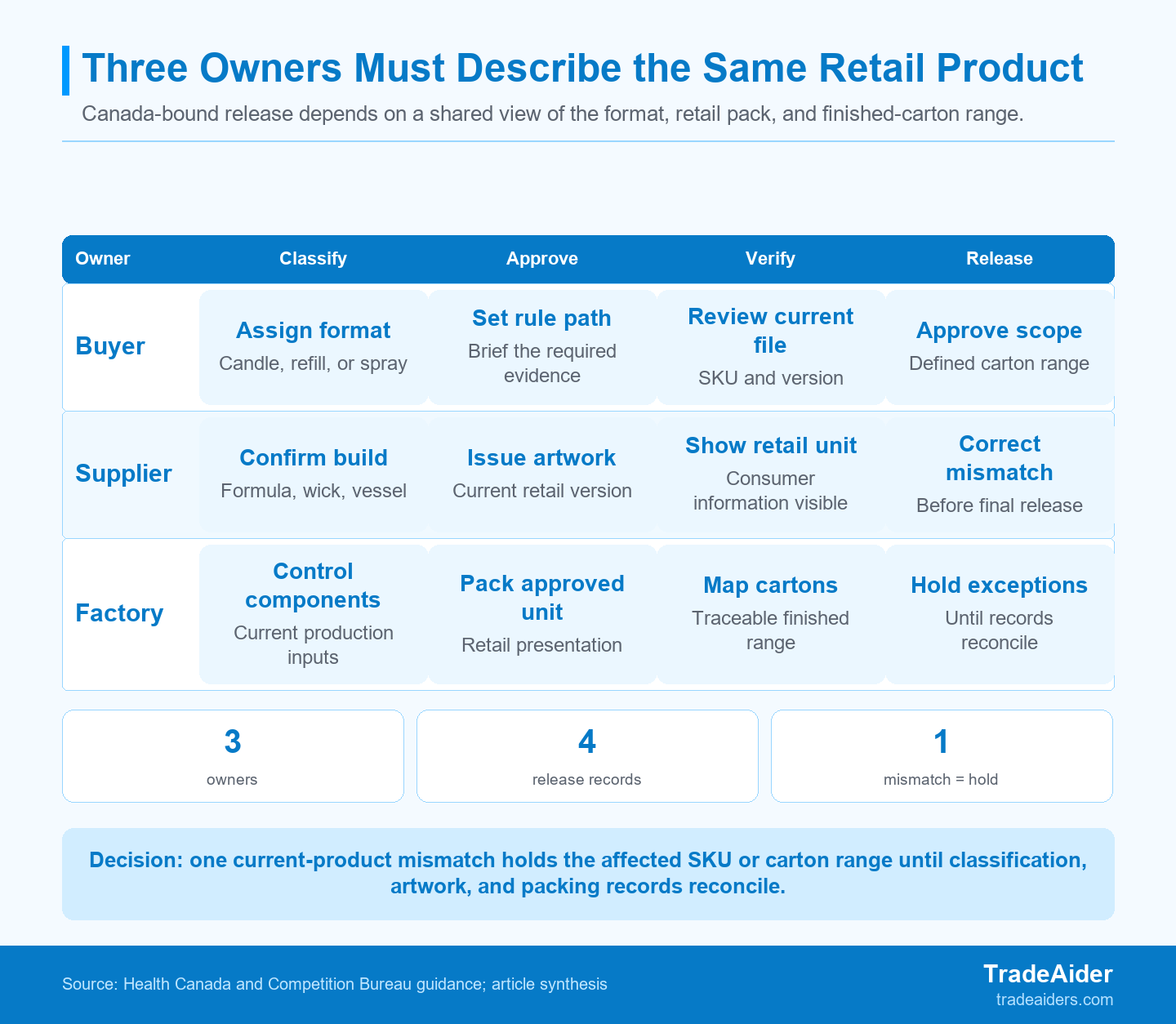
A Canada-bound home-fragrance SKU should be released only when the format path, retail artwork, and packed-carton record still match.
Give the same four-record view to the buyer, supplier, and inspector. It makes a discrepancy actionable: identify the owner of the record, the affected SKU or carton range, and the evidence needed to lift the hold. Use inspection sampling standards to translate that file into observable unit, packaging, and carton checks without pretending that an inspection can create a chemical classification or regulatory authorization.
Turn the File Into Observable Pre-Shipment Checks
A pre-shipment check is meaningful only when the order is 100% complete and at least 80% packed, because the inspected retail format and carton range must already exist. At that stage, the inspection brief can ask for the current product reference, the current retail artwork, the defined carton range, and the hold trigger. It should not ask an inspector to infer a laboratory conclusion from a bottle, candle, or carton photograph.
For a candle, observe the identifiable retail build, warning placement, unit packaging, packing count, and carton marks against the approved file. For a refill or spray on a consumer-chemical path, observe the current container, closure, visible retail presentation, and approved versioned artwork. In both cases, record discrepancies as product-identity or packaging-visibility questions, then route them to the owner of the source record.
When the defined goods and carton range are ready for final comparison, Schedule a pre-shipment inspection.
When the goods and carton range are ready for a final comparison, the inspector should receive the current product reference, current approved retail presentation, defined carton population, and discrepancy rules before the visit. The useful output is a comparison and exception record for identified finished goods—not an unsupported statement that every regulatory question has been resolved.
Illustrative Scenario: A Room Spray Changes Its Packaging
An illustrative Canadian home-fragrance importer has 3,200 room sprays in 160 cartons. The order is 100% complete and at least 80% packed. The buyer has an approved artwork proof for the original retail canister and a release file that identifies the intended product format and carton range.
During the finished-goods check, a revised overcap obscures part of the hazard panel on the consumer-facing canister. The approved proof shows the former overcap, while the 160-carton SKU has already been packed with the revised retail presentation. The original artwork file may still be accurate for an earlier version, but it no longer describes what a consumer receives in this packed SKU.
The importer holds the 160-carton SKU, separates the affected cartons, confirms the current overcap and visible label area, and updates the release file. Release is reconsidered only after the corrected retail pack is reinspected and mapped to the cartons being released. This is an illustrative procurement scenario, not a TradeAider client result or a conclusion about the product’s classification.
Frequently Asked Questions
Do all home-fragrance products follow the same Canadian safety rule?
No. Canada-bound home-fragrance products should be assessed by their actual product format and hazards, not by a shared fragrance brand or retail collection. Start by separating an open-flame candle, a refill liquid, and a room spray or aerosol. Then keep the product decision tied to the current retail unit, artwork revision, and carton range. A shared collection name is useful for marketing; it is not a release classification. Keep a short format note with each purchase order and require the supplier to flag a format or pack change before copying another SKU’s artwork or carton marks.
Are relight candles allowed to be imported into Canada?
No. A candle that reignites spontaneously after extinguishment does not meet Canada’s Candles Regulations and should be excluded before purchase-order approval. Record the product description and the reason for exclusion in the sourcing file. This is not a case for changing warning copy or relying on a generic novelty-candle label. The direct product boundary should be resolved before the SKU is included in a Canada-bound range. Keep the exclusion decision with the supplier’s product description so a later buyer or packaging team does not reintroduce the item through a collection update.
When does a fragrance refill need consumer-chemical hazard information?
A refill needs that assessment when it is a consumer chemical product with a regulated hazard, because classification determines the required hazard information and possible packaging controls. Ask for the current liquid, dispensing method, retail container, closure, and relevant product information before approving artwork. Do not assume that a non-aerosol container needs no review, and do not assume that a candle’s product file covers the refill. If the container, formula, closure, or dispensing method changes, reopen the SKU-level review before the revised unit is packed or added to a finished-goods inspection brief.
Must a Canadian retail pack show the net quantity?
Usually, prepackaged non-food consumer products use product identity, net quantity, and dealer identification, subject to the applicable product and packaging rules. Review these on the principal display panel together with any product-specific information that applies. The practical control is to compare the approved artwork with a finished retail pack and its current fill or unit statement; a master-carton mark is not a substitute for the consumer package. Keep the final approved file beside a physical retail sample, because a fill statement or dealer line can be lost when an artwork team works from an earlier pack revision.
Can a shipping carton replace consumer-facing hazard information?
No. A transit-only shipper is not a substitute for information that must remain visible on the consumer-facing container or outer retail packaging. Review the final retail configuration after overcaps, sleeves, gift boxes, or shrink bands have been added. Then keep the shipping-carton record separate, so the buyer can identify both what the consumer receives and which packed cartons the inspection result covers. If a cap, sleeve, or gift box is added after artwork approval, compare the final assembled presentation with the released file before cartons from that period are cleared.
What should an inspection report confirm for a candle range?
It should confirm the inspected retail build, current artwork, unit packaging, and identifiable carton range; it does not itself issue regulatory approval. A well-scoped report can show whether the sampled finished goods still match the release file and can identify a visible packaging or product-version discrepancy. Escalate an unresolved classification, formula, or laboratory-evidence question to the appropriate specialist rather than converting a visual observation into a compliance conclusion. TradeAider can document the observed mismatch against the agreed file and carton range, while the buyer assigns the required specialist review or corrective action.
Articles Connexes

Développez votre entreprise avec le Service TradeAider
Cliquez sur le bouton ci-dessous pour accéder directement au Système de Service TradeAider. Les étapes simples de la réservation et du paiement à la réception des rapports sont faciles à utiliser.

