
A China sourcing company does not remove a buyer’s risk simply by finding factories and passing on quotes. It becomes useful when the buyer can separate coordination from authority: the provider may gather options and move information, while the buyer still approves the supplier, the commercial commitment, and the goods that may move.
That separation turns a vague intermediary relationship into an operating arrangement. It gives each recommendation a known scope, makes fee comparisons more meaningful, and leaves the buyer with records that can travel from supplier selection to production and shipment release.
A China Sourcing Company Is a Scoped Operating Layer
A sourcing company is useful only when the buyer can state which supplier, product, commercial, and evidence tasks it may perform and which decisions stay with the buyer. Start with a scope sheet: a buyer-owned list of tasks, expected outputs, named owners, and approvals. It should distinguish “introduce two factories” from “recommend one factory,” and “arrange an inspection” from “authorize shipment.”
Write the scope before the provider begins supplier outreach. Include the product family, target market, quote format, sample route, records required, report recipient, fee disclosure, and escalation path. A provider can then coordinate the work without silently becoming the person who selects a supplier, accepts a substitute, or releases a load. The buyer remains able to change providers without losing the working file.
Separate Finding, Coordinating, and Verifying Work
Supplier discovery, order coordination, inspection, testing, and certification are different activities that need different outputs and authority. NIST distinguishes supplier declarations, sampling and testing, inspection, certification, and accreditation as separate conformity-assessment activities. A provider may coordinate all of them, but the buyer should not treat a factory visit, a laboratory result, and a supplier statement as interchangeable proof.
For each activity, ask one practical question: what is the output and who can use it to decide? A supplier-search report should identify the company and the selection criteria. A quote comparison should preserve comparable terms. An inspection report should state the checked product and lot. A test record should identify its sample and scope. This is how a buyer stops a polished coordination update from being mistaken for a release decision.
Keep the Buyer’s Three Decision Rights
The buyer should retain supplier approval, product-and-commercial approval, and shipment-release authority even when a sourcing company runs the day-to-day coordination. Those are separate decisions because a factory that is worth sampling is not automatically the supplier that should receive a purchase order, and an acceptable product reference does not automatically describe the finished shipment.
Put each right in writing. Supplier approval means the buyer chooses the legal entity and production location after reviewing the agreed information. Product-and-commercial approval means the buyer approves the sample, specification, price basis, payment terms, tooling, and acceptable substitutions. Shipment release means the buyer decides what can move after the final physical result, outstanding changes, and shipment documents are reviewed. Coordination can be delegated; the final “yes” should remain traceable to the buyer.
Make Fees and Supplier Incentives Visible Before Quotes Arrive
A fee arrangement is manageable only when its payer, calculation basis, supplier incentives, and disclosure point are agreed before a quote comparison is treated as a recommendation. A percentage of order value, a fixed project fee, a supplier-paid commission, and a pass-through charge can all lead to different incentives. The issue is not the label; it is whether the buyer can see the commercial arrangement while comparing suppliers.
Ask the provider to disclose, in one written schedule, who pays it, what event creates it, what work it covers, whether a supplier or factory pays any commission or rebate, and which costs may be billed separately. Then compare landed commercial assumptions on the same basis. If a low quote includes less work, uses a different price basis, or sits beside an undisclosed supplier payment, it is not yet a like-for-like recommendation. The buyer can still use the option, but should describe it honestly.
Add an Independent Check When the Decision Carries More Risk
When the sourcing provider controls supplier access or the evidence being relied upon, the buyer should decide which higher-risk facts need an independent check before award. Independence is a commercial condition defined by authority and disclosure, not a service label. A provider can be transparent and still coordinate an activity that the buyer chooses to verify separately.
Use the risk to set the check. For a low-value repeat item, a buyer may accept direct supplier records plus a documented reference call. For a new factory, a new product claim, a single-source component, or a large deposit, the buyer may ask another party to confirm the factory address, production capability, sample identity, or reported condition. State the question, record owner, and result needed. A vague request for an “independent audit” is harder to use than a defined check of a named fact.
Qualify the Supplier With Evidence You Can Keep
A sourcing recommendation should leave the buyer with records that identify the supplier, the capability checked, the evidence reviewed, the gaps found, and the next verification step. The U.S. Commercial Service notes that companies should conduct their own background research on business service providers rather than treating a directory entry as an endorsement; the same discipline matters when a provider presents a supplier recommendation. Trade.gov makes that limitation explicit in its China service-provider guidance. A capability claim also needs a stated scope: NIST’s conformity-assessment-body guidance ties technical competence to the relevant activity.
Ask for a portable supplier packet: legal entity and address, contact and bank-account verification route, factory location, product capability checked, quoted terms, sample identifier, documents reviewed, unresolved gaps, and next checkpoint. Where the buyer relies on technical documentation for an EU-related product question, product identification and responsible-party information should stay connected to that file; NIST’s CE-marking overview describes that documentation context. For a focused physical and system check, define the factory audit scope rather than asking for a generic factory approval.
Treat Inspection, Testing, and Certification as Different Deliverables
A sourcing provider’s coordination does not turn an inspection, a laboratory result, or a certificate into the same kind of evidence. NIST separates inspection, sampling and testing, certification, and supplier declarations as different activities. Ask what was actually reviewed, sampled, observed, or certified before deciding how much weight to give the document.
For example, a visual inspection may establish that labelled finished goods match stated checkpoints, while a laboratory report answers the method and sample it names. In the U.S. general-use consumer-product context, a General Certificate of Conformity (GCC) identifies applicable goods in a written certificate; 16 CFR Part 1110 sets out certificate requirements and product-identification information within that scope. That example does not create a global rule. It shows why the buyer should match each requested document to the actual product, market, and question.
Turn a Supplier Introduction Into a Controlled Product Handoff
A supplier introduction becomes operational only when the approved product reference, commercial terms, evidence needs, and inspection scope travel together into the order. Create one handoff record before a purchase order is released. It should identify the supplier entity and site, product code, approved sample or drawing revision, bill of materials, price and payment terms, packing assumptions, records to be supplied, and the person who may approve a change.
A bill of materials (BOM) maps the approved product’s components and materials to its sample reference. It is useful only when its revision can be matched to the sample and purchase order. When a sourcing provider sends a sample, ask the provider to capture the sample code, component sources that matter, artwork and label version, and any difference between the sample route and expected bulk production. A pre-production inspection can then compare the agreed reference with the inputs and readiness at the factory before full output makes correction more expensive.
Use that checkpoint to resolve the things a quote cannot answer: whether the mould, material, packaging, artwork, and working sample all match the buyer’s current instruction; whether the factory knows which records belong with the product; and whether a proposed substitution has already entered the build. Give the reviewer the same scope sheet used for supplier selection. The outcome should identify a version, an observed condition, any open discrepancy, and the person who may decide whether the order advances. That creates a useful handoff rather than another isolated status update.
Set a Change Trigger Before Sample Approval
A change in material, component, process, supplier, label, or packing should trigger a recorded buyer decision before the altered version is treated as covered by earlier evidence. The trigger does not mean the change is unacceptable. It means the buyer pauses long enough to determine what reference, supplier record, test scope, inspection point, or commercial term must be updated.
The principle has a clear regulatory example in a narrower setting: for U.S. children’s products, 16 CFR Part 1107 connects a material change to an assessment and appropriate testing or certification work, while Part 1110 sets certificate information requirements for applicable general-use consumer products. A buyer sourcing other goods should not extrapolate either rule automatically. The practical control is to record the change, isolate the affected product or lot, and decide what proof must be refreshed. If bulk production has started, a during-production inspection is most useful when it checks the changed condition while correction is still possible.
Illustrative Scenario: A Quote Is Not Yet an Award Decision
A low quote should remain conditional when the supplier, sample, and evidence records do not all describe the same product configuration. The following example is illustrative, not a TradeAider client case, a compliance opinion, or a prediction of supplier performance.
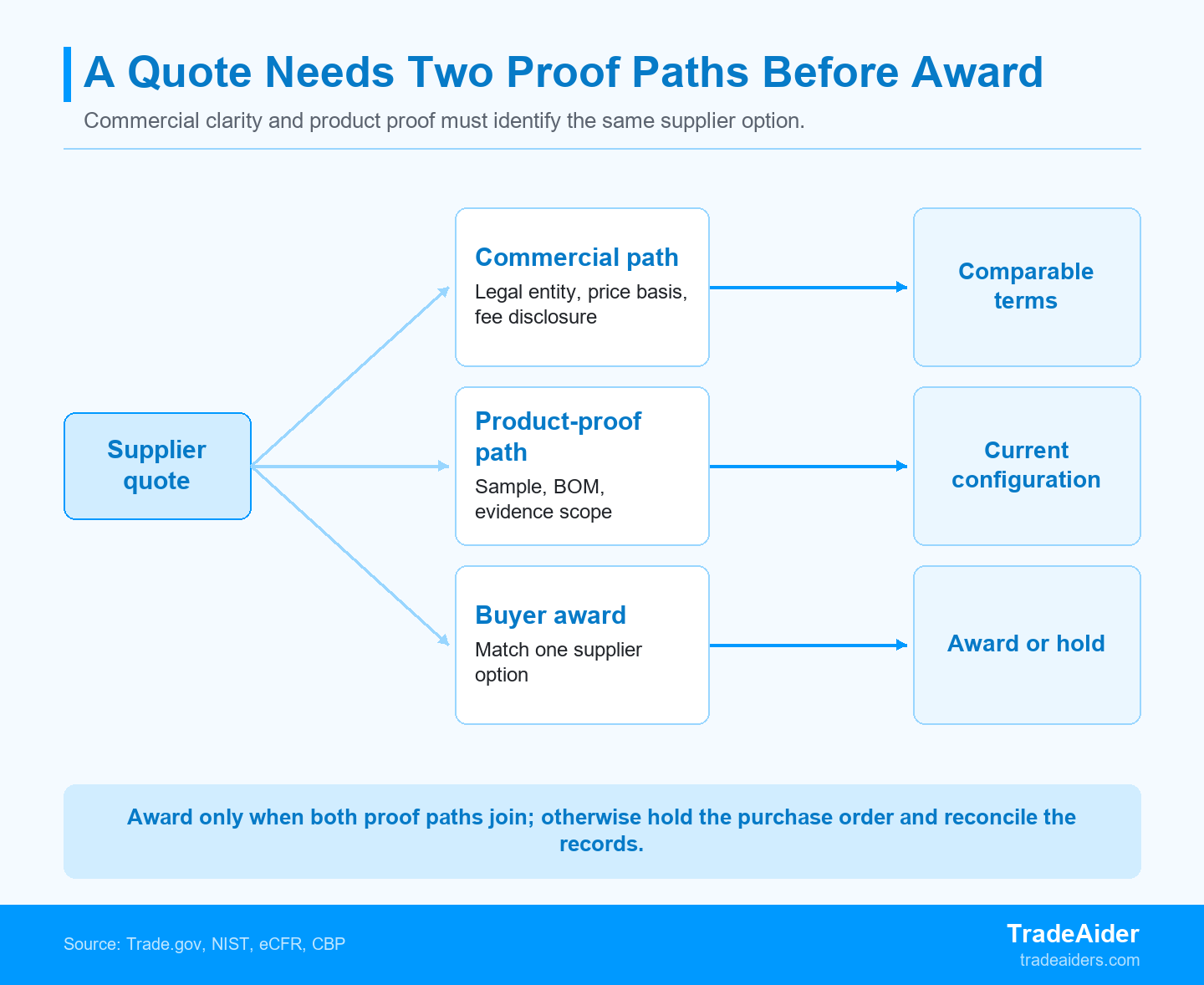
A lower price becomes a supplier award only after its commercial route and product proof identify the same option.
Resolve the Product Record Conflict Before Placing the PO
When a sample and a supplier record conflict, the buyer should correct the record and re-establish the evidence scope before issuing a purchase order. An illustrative homewares buyer uses a China sourcing company to identify two suppliers for insulated drink bottles. The planned order is 8,000 bottles packed in 400 export cartons, with a target launch eight weeks away. The sourcing company presents two comparable prices and one sample from the lower-priced supplier.
The lower quote names lid source L-17, while the sample BOM names L-22. The test record provided for the sample identifies neither lid source. The fee comparison also does not say whether either supplier pays the provider a commission. The buyer therefore has two observations that matter: the physical sample cannot be tied to the quoted component, and the commercial comparison does not disclose all known incentives.
The buyer cannot tell whether the price, sample, and evidence describe one configuration. 1 candidate supplier, 1 sample configuration, and the full purchase-order award remain conditional; no purchase order or deposit is issued. This may cost time at the quotation stage, but it avoids committing 400 cartons to a configuration whose component, supporting record, and commercial route have not been reconciled. A quote is information; it becomes an award decision only after the buyer can identify what it covers.
The provider produces a supplier packet listing the legal entity, factory address, quote terms, sample code, lid source, declared incentives, and evidence scope. The supplier either corrects the record or provides a sample that matches the stated BOM. The buyer compares the corrected sample and records before approving the supplier, then defines the inspection scope for that configuration. This example only illustrates commercial and evidence control; it does not decide legal responsibility, product compliance, supplier integrity, or actual pricing.
Use a Buyer-Owned Scope Sheet Before You Engage a Provider
A short scope sheet prevents an outsourced sourcing task from becoming an undocumented transfer of supplier, product, or release authority. It is not a long legal document. It is the working page that gives the buyer, provider, factory, and inspector the same answer to four questions: what is being sourced, what proof is needed, who can approve a change, and what must happen before goods are released.
Use the sheet at provider selection and update it when the product or order changes. For goods entering the United States, import record duties are separate from the sourcing provider’s coordination role; CBP’s entry-record guidance points to the U.S. customs recordkeeping framework, including the scope in 19 CFR Part 163. Confirm the requirements for the actual importer, goods, and destination instead of assuming that an intermediary has taken them over. A buyer can compare the needed check with the scope sheet, then review TradeAider’s inspection approach.
| Scope-sheet field | Buyer-owned decision | Provider output to retain |
|---|---|---|
| Supplier option | Which legal entity and factory may move to sampling? | Supplier identity, address, capability checked, quote basis, gaps, and next check. |
| Product reference | Which sample, drawing, BOM, label, and revision define the order? | Linked sample code, records reviewed, and any unresolved difference. |
| Commercial terms | Which price, fee model, incentive disclosure, and payment terms are acceptable? | Comparable quote sheet and written fee disclosure. |
| Release route | What may move, who approves it, and what closes a hold? | Defined inspection scope, report recipient, open-item owner, and verification gate. |
Four Controls That Make Sourcing Support Usable
A sourcing relationship remains usable when the buyer owns the supplier choice, evidence packet, change approval, and release decision. The provider’s value is clearer when its coordination outputs can be checked, compared, and handed to the next owner without retelling the story.
- Scope the work: name the tasks, outputs, owners, and approval points before supplier outreach begins.
- Disclose the commercial route: compare quotes only after fees, incentives, and pass-through costs are visible.
- Keep a portable packet: retain the supplier identity, sample reference, records reviewed, gaps, and next verification step.
- Hold changed configurations apart: approve a new material, component, label, or packing route only after the revised record and intended check agree.
When the order reaches its final physical checkpoint, provide the supplier, current product reference, lot or carton scope, open changes, and acceptance questions together. This keeps the request tied to a defined release question rather than a generic visit report; ask the provider to prepare a scoped pre-shipment inspection.
Frequently Asked Questions
What should a China sourcing company include in its scope?
The scope should name supplier research, quote comparison, sample coordination, quality checks, logistics coordination, reports, fees, and every approval the buyer retains. It should also state the product family, supplier-identity evidence, output format, document owner, escalation route, and change trigger. The key test is whether a different provider could read the file and continue the work without guessing who chose the supplier, what the current sample is, or what still needs verification.
Can a sourcing company also be the quality inspector?
It can coordinate or perform an agreed inspection, but the buyer should define the scope, report ownership, conflict disclosure, and whether independent verification is needed. The decision depends on the risk, not on a title. If the same provider selected the factory, handles its commercial communication, and supplies the evidence used for a large award, a buyer may choose an additional check of the facts that matter most. Keep the inspection result limited to the product, lot, and checkpoints it actually covers.
How should buyers compare sourcing-company fees fairly?
Compare fees only after each provider states its payer, calculation basis, included work, supplier commissions, pass-through costs, and disclosure timing in writing. Then normalize the comparison: identify whether the stated amount covers supplier research, sampling, travel, quality checks, logistics coordination, or a different mix of work. A cheaper percentage is not automatically a lower total cost if it excludes tasks the buyer must later buy elsewhere or if the recommendation sits beside an undisclosed supplier payment.
Does a sourcing company take over importer compliance duties?
No; a sourcing company may coordinate records and supplier communication, but the importer or responsible firm must confirm the duties that apply to its goods and destination market. Give the provider a precise documentation task instead of assuming it owns every requirement. The buyer should still determine which product rules apply, who is responsible for the relevant records, how long they must be kept, and whether a change to the supplier, product, or market requires further review.
Articles Connexes

Développez votre entreprise avec le Service TradeAider
Cliquez sur le bouton ci-dessous pour accéder directement au Système de Service TradeAider. Les étapes simples de la réservation et du paiement à la réception des rapports sont faciles à utiliser.

