
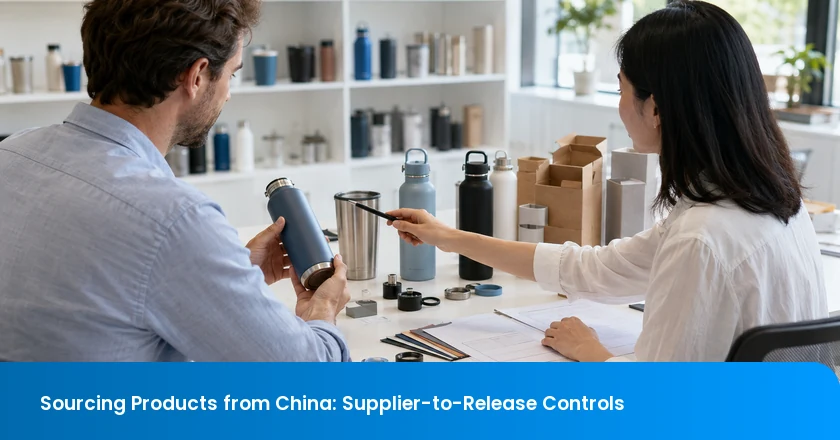
A China sourcing company can make supplier communication, sampling, and follow-up faster. It cannot safely become the unrecorded owner of the buyer's supplier choice, product approval, or shipment release. The useful question is not whether a provider can "handle everything." It is whether the buyer can still see the records, approve the commitments, and challenge a recommendation before money or goods are committed.
A sourcing company is useful only when the buyer can state which supplier, product, commercial, and evidence tasks it may perform and which decisions stay with the buyer.
A China Sourcing Company Is a Scoped Operating Layer
Start with a buyer-owned scope sheet: a simple record that names the buyer's tasks, the provider's tasks, the owners of each output, and the approval points that remain with the buyer. It can cover supplier research, quote collection, sample coordination, factory visits, inspection booking, logistics follow-up, and reporting. It should also say what the provider is not authorized to approve, change, or sign.
That distinction matters because a provider can coordinate a quotation without validating every assumption inside it. A provider can arrange a sample without deciding that the sample is commercially acceptable. It can collect a test report without deciding that the report applies to the final product. Treating those tasks as separate prevents a useful operating layer from becoming a vague transfer of authority.
Separate Finding, Coordinating, and Verifying Work
Supplier discovery, order coordination, inspection, testing, and certification are different activities that need different outputs and authority.
Keep the deliverable beside the task. Supplier discovery should produce an identifiable supplier record and a reason for shortlisting. Quote coordination should produce comparable terms, not just a price table. Inspection should produce a report for an agreed lot and checklist. Testing should identify the sample, method, and result. Certification or a supplier declaration has its own issuer, scope, and legal context. NIST distinguishes inspection, testing, certification, supplier declarations, and related conformity-assessment activities; a sourcing provider may coordinate several of them, but coordination does not merge their evidence value.
Ask for the output before agreeing to the fee. If the answer is only "we will manage the factory," convert it into observable deliverables: supplier identity, quote comparison, sample reference, visit or inspection scope, change log, report ownership, and escalation timing. The result is clearer for both parties and easier to hand over if the relationship changes.
Keep the Buyer's Three Decision Rights
The buyer should retain supplier approval, product-and-commercial approval, and shipment-release authority even when a sourcing company runs the day-to-day coordination.
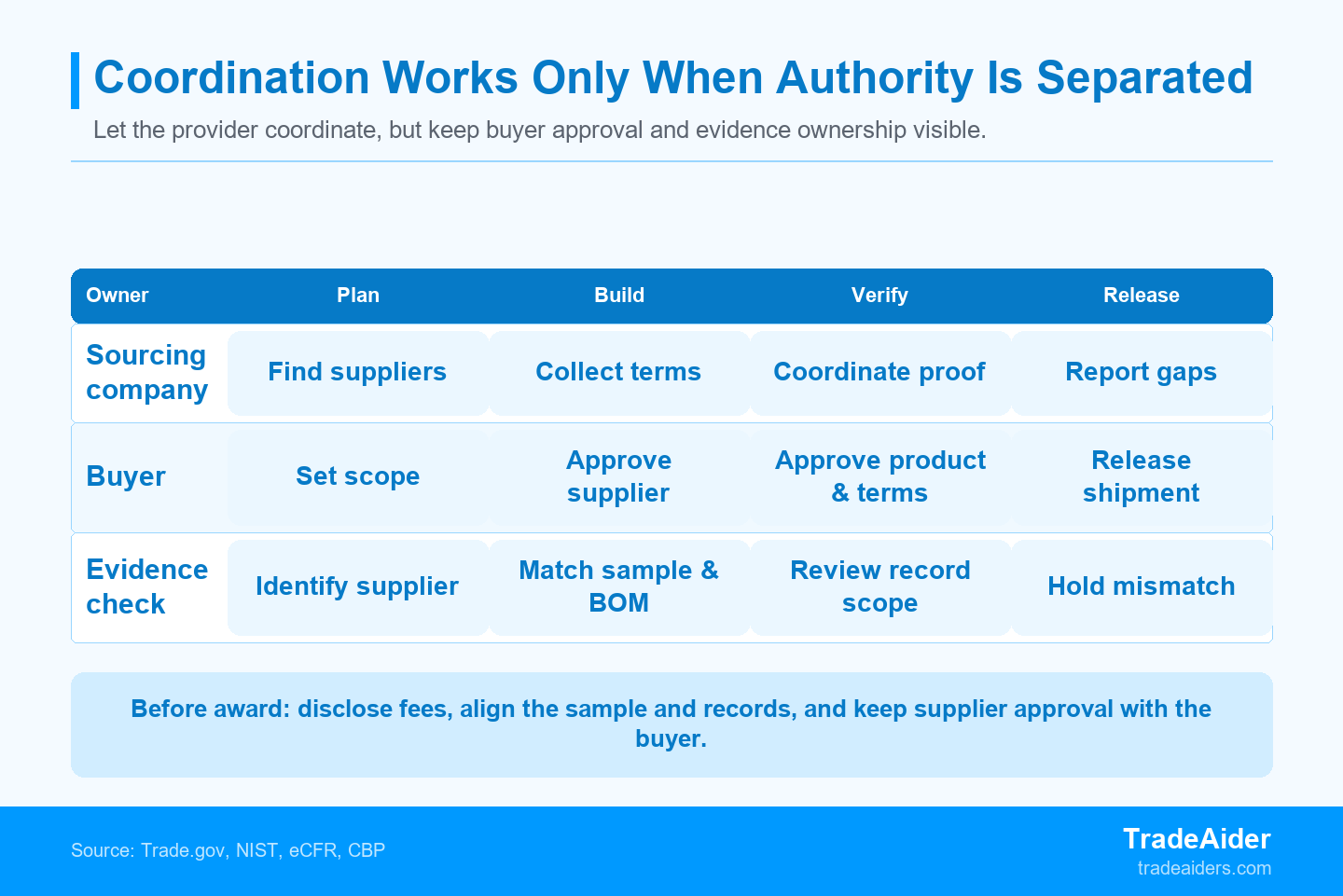
A sourcing provider can coordinate work, but a buyer should retain the decisions and records that support supplier award and shipment release.
A workable model separates coordination from commitment. The sourcing company can translate questions, schedule factory contact, collect documents, and flag gaps. The buyer still decides which legal supplier to award, which sample and terms define the order, and whether finished goods can be released. Those are different gates because each uses a different record and carries a different consequence.
| Decision gate | Buyer retains | Provider may coordinate | Record that should exist |
|---|---|---|---|
| Supplier award | Legal supplier choice and award conditions | Research, introductions, quote collection | Supplier packet and comparable quote file |
| Product and commercial approval | Sample, specification, price, terms, and packaging approval | Sample follow-up and document collection | Approved reference and purchase-order revision |
| Shipment release | Hold, rework, or release decision | Inspection booking and record assembly | Lot-specific report, packing status, and release note |
Based on this comparison, the buyer does not need to perform every task personally. The buyer needs a visible approval point before a recommendation becomes an award, an approved product, or a shipment instruction. If a provider receives authority to act in one of these areas, put that authority, limit, and evidence handoff in writing.
Make Fees and Supplier Incentives Visible Before Quotes Arrive
A fee arrangement is manageable only when its payer, calculation basis, supplier incentives, and disclosure point are agreed before a quote comparison is treated as a recommendation.
There is no universal "right" sourcing fee model. A buyer may pay a fixed project fee, a percentage, a retainer, or a fee tied to defined milestones. A supplier may also pay a referral or service fee. The control is disclosure, not a promise that one arrangement is automatically independent. Before accepting a recommendation, ask who pays whom, what event triggers payment, what work is included, which costs are passed through, and whether any supplier payment could affect the shortlist.
Put those answers next to the quote comparison. A lower factory price is not comparable if one offer includes tooling, packaging, freight assumptions, inspection, or commissions and the other does not. If information is incomplete, mark the recommendation conditional instead of trying to calculate a false all-in price. That gives the buyer a chance to request clarification before a purchase order turns an assumption into a commitment.
Add an Independent Check When the Decision Carries More Risk
When the sourcing provider controls supplier access or the evidence being relied upon, the buyer should decide which higher-risk facts need an independent check before award.
Independence is a targeted control, not an accusation. A buyer might accept a provider's basic supplier introduction, then independently verify the legal entity, address, bank-account change, factory capability, critical product claim, or final inspection when that fact would alter the award or release decision. The more one party controls both the information flow and the recommendation, the more useful it is to name what another party, document, or inspection must confirm.
Make the check proportionate. A small repeat order with stable records may need a lighter review than a first order, a regulated product, a large deposit, or a product with safety-critical components. The purpose is to expose a specific evidence gap before it becomes a payment or shipment problem, not to duplicate every administrative step.
Qualify the Supplier With Evidence You Can Keep
A sourcing recommendation should leave the buyer with records that identify the supplier, the capability checked, the evidence reviewed, the gaps found, and the next verification step.
A recommendation becomes portable when the buyer can read the record without relying on the intermediary's memory. The U.S. Commercial Service says its China business-service-provider directory research is limited and advises companies to conduct their own background research on providers. That is a useful boundary for any buyer: a directory or introduction should start due diligence, not finish it.
The supplier packet should identify the legal entity and production location, the product or process being considered, the evidence actually reviewed, unresolved gaps, and the next owner. In product-conformity contexts, NIST describes product identification, manufacturer information, applicable requirements, and technical documentation as distinct parts of the stated EU context. NIST's CAB guidance also shows why technical competence must be assessed alongside the relevant activity scope. The exact requirements vary by product and market, but the recordkeeping habit is broadly useful: know what the document is about before relying on it.
Where a buyer needs an independent view of a factory system, a defined factory audit scope can turn a broad assurance request into checkable evidence. TradeAider can work to a buyer-defined scope; the buyer should still state which supplier decision the review is intended to inform and which gaps require follow-up.
For U.S. entries, preserve the records that support the import decision rather than leaving them only in a chat history. CBP says entry records must generally be kept for five years, and its guidance points to the Customs recordkeeping rule in 19 CFR Part 163. Those U.S. references are not a global rule, but they show why the buyer should keep a retrievable evidence packet rather than treating the provider as the only archive.
Treat Inspection, Testing, and Certification as Different Deliverables
A sourcing provider’s coordination does not turn an inspection, a laboratory result, or a certificate into the same kind of evidence.
An inspection can check the agreed observable condition of a defined lot. A laboratory report can address the tested sample and method. A certificate or declaration has the scope and issuer stated on the document. Do not use one as a generic substitute for another. NIST treats these as distinct conformity-assessment activities, while 16 CFR Part 1110 sets out U.S. certificate-of-compliance requirements for applicable consumer products, including product-identification information.
For a bounded U.S. example, a General Certificate of Conformity (GCC) is a written certificate for applicable general-use consumer products. It is not a generic sourcing-company report. When a product or market requires a particular document, the responsible party should confirm the rule, product scope, and current evidence with qualified advice.
Turn a Supplier Introduction Into a Controlled Product Handoff
A supplier introduction becomes operational only when the approved product reference, commercial terms, evidence needs, and inspection scope travel together into the order.
Before bulk production, create a handoff record that joins the supplier name, approved sample or drawing, revision date, agreed price and terms, packaging configuration, required evidence, and inspection checkpoints. Include a bill of materials (BOM), the recorded list of components and materials in the approved product, when component identity affects the product or evidence. The point is not paperwork for its own sake; it is to let the buyer and supplier identify the same configuration when a question appears later.
A first production run is the right time to decide what may change without further approval. If a supplier proposes an alternate material, component, label, process, factory, or carton count, the scope sheet should name the owner who can approve it and the evidence that must be refreshed. When a sample, specification, and purchase-order description need to be reconciled before production, a pre-production inspection can provide a defined check against the buyer's reference.
Set a Change Trigger Before Sample Approval
A change in material, component, process, supplier, label, or packing should trigger a recorded buyer decision before the altered version is treated as covered by earlier evidence.
Use a simple trigger question: does this change affect what the buyer approved, what the customer receives, or what the existing evidence identifies? If the answer is yes, hold the affected scope until the record, product reference, and required proof are reconciled. This does not mean every artwork correction stops an order; it means the buyer decides whether the change is inside the approved boundary instead of discovering the mismatch after shipment.
For a specific U.S. children's-product context, 16 CFR Part 1107 connects material changes with an assessment and appropriate testing or certification evidence. For applicable U.S. consumer-product certificates, 16 CFR Part 1110 also requires the certificate to identify the product it covers. The broader change-control rule here is an operating framework, not a statement that the same U.S. requirement applies to every product or destination. Where a change happens during bulk output, a buyer can use during-production inspection to check the agreed correction while the factory can still contain it.
Illustrative Scenario: A Quote Is Not Yet an Award Decision
A low quote should remain conditional when the supplier, sample, and evidence records do not all describe the same product configuration.
Resolve the Product Record Conflict Before Placing the PO
When a sample and a supplier record conflict, the buyer should correct the record and re-establish the evidence scope before issuing a purchase order.
An illustrative homewares buyer asks a China sourcing company to shortlist two suppliers for insulated drink bottles. The planned order is 8,000 bottles in 400 export cartons, with an eight-week launch target. The provider presents two apparently comparable prices and a sample from the lower-priced supplier.
The quote identifies lid source L-17, but the sample's BOM identifies L-22. The test record supplied with the sample names neither lid source. The fee comparison also does not state whether either supplier pays a commission to the sourcing company. Each document may be genuine, yet the buyer cannot tell whether they describe one product configuration and one commercial recommendation.
The low quote stays conditional: 1 candidate supplier, 1 sample configuration, and the full purchase-order award remain on hold. Rather than choosing the price or rejecting the supplier on suspicion, the buyer asks for the legal supplier identity, a reconciled BOM and sample code, the evidence scope, and a written fee disclosure. The award decision waits because the buyer lacks one comparable record set, not because a sourcing company is presumed unreliable.
The provider returns a supplier packet with the factory address, quote terms, sample revision, lid source, and declared incentives. The supplier either updates the record or supplies a corrected sample. Only after the buyer compares that package with the chosen order configuration does the buyer approve the supplier and define the inspection scope. This is an illustrative control example; it does not determine legal responsibility, product compliance, integrity, or actual pricing.
Use a Buyer-Owned Scope Sheet Before You Engage a Provider
A short scope sheet prevents an outsourced sourcing task from becoming an undocumented transfer of supplier, product, or release authority.
Use this short handoff before asking a provider to begin. It works for a first supplier search or for an existing supplier relationship that now needs outside coordination.
- Name the objective: supplier discovery, quotation comparison, sample coordination, quality check, logistics follow-up, or a defined combination.
- Name the buyer approvals: supplier award, sample and terms, material or packaging changes, and shipment release.
- Name the evidence packet: legal entity, factory address, quotation revision, sample or drawing, BOM, product records, and open gaps.
- Name the disclosure rule: payer, fee basis, supplier incentives, pass-through costs, and the point at which they must be stated.
- Name the escalation trigger: a mismatch, missing evidence, change, or risk that must pause the affected decision.
This scope does not require a buyer to manage every call. It gives the provider a usable brief and gives the buyer an audit trail for the decisions that matter. Before engaging an inspection provider to that scope, buyers can review TradeAider's inspection approach.
Four Controls That Make Sourcing Support Usable
A sourcing relationship remains usable when the buyer owns the supplier choice, evidence packet, change approval, and release decision.
- Scope the work: turn general coordination into named tasks, outputs, owners, and approval points.
- Compare commercial terms honestly: disclose payer, fee basis, included work, and supplier incentives before relying on a recommendation.
- Keep portable evidence: retain the supplier packet, product reference, applicable proof, and unresolved gaps in the buyer's own file.
- Use change and release gates: do not let a changed configuration or undefined lot inherit an earlier approval by assumption.
If the supplier, product reference, and final lot are known, prepare the scope sheet, the current records, and the packing status before you prepare a scoped pre-shipment inspection.
Frequently Asked Questions
What Should a China Sourcing Company Include in Its Scope?
The scope should name supplier research, quote comparison, sample coordination, quality checks, logistics coordination, reports, fees, and every approval the buyer retains. It should also state who owns the supplier record, product reference, evidence packet, and release decision. Leave out activities the provider is not authorized to perform, such as approving a substitute material or releasing goods without written buyer approval.
Can a Sourcing Company Also Be the Quality Inspector?
It can coordinate or perform an agreed inspection, but the buyer should define the scope, report ownership, conflict disclosure, and whether independent verification is needed. The key question is whether the report identifies the actual product version and lot, and whether another check is needed for a fact the same provider controlled or recommended. An inspection report does not automatically replace testing, certification, or buyer approval.
How Should Buyers Compare Sourcing-Company Fees?
Compare fees only after each provider states its payer, calculation basis, included work, supplier commissions, pass-through costs, and disclosure timing in writing. Then compare the work scope and decision rights beside the price. A lower visible fee may exclude supplier research, sample coordination, inspection follow-up, or documentation that another proposal includes, so price alone is not a useful recommendation.
Does a Sourcing Company Take Over Importer Compliance Duties?
No; a sourcing company may coordinate evidence, but the importer or responsible firm must confirm the duties that apply to its product and destination market. Ask the provider to identify documents, samples, suppliers, and open gaps, then verify the applicable legal and technical requirements with the appropriate responsible parties or advisers. The answer can differ by product, destination, and the specific evidence being relied upon.
Articles Connexes


Développez votre entreprise avec le Service TradeAider
Cliquez sur le bouton ci-dessous pour accéder directement au Système de Service TradeAider. Les étapes simples de la réservation et du paiement à la réception des rapports sont faciles à utiliser.

