
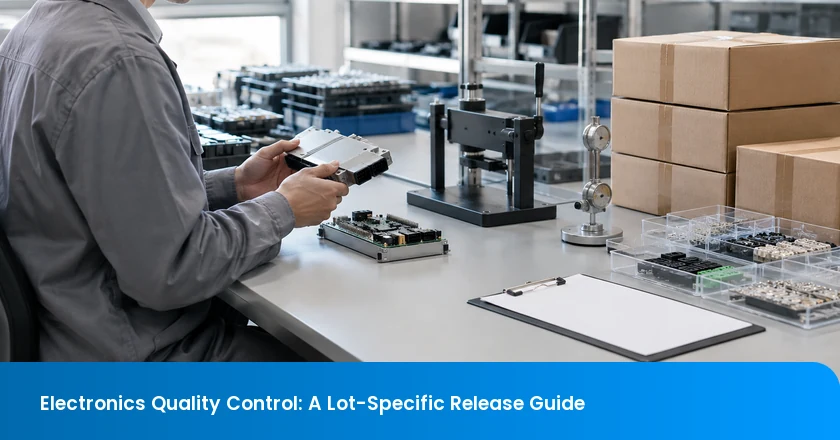
Electronics quality control becomes release evidence only when the component or assembly identity, test condition, result, and shipment lot can be connected. IPC-1782 provides a manufacturing and supply-chain record-linkage context for electronic products. A passed unit can prove something useful about that named unit, but it cannot automatically prove that every packed unit was built the same way, tested under the same conditions, or included in the same corrective action. The buyer's release question is therefore narrower and more practical: which physical goods does this result actually describe?
That distinction matters most when a component, board revision, connector, firmware state, or production window changes after the approved sample. The four-link test used here is an operating synthesis for import buyers, not a certification rule: identify the build, state the test condition, record the result, and tie both to the shipment lot. If one link is missing, the result may help diagnose a problem, but it is not yet enough to release the unlinked goods.
A Passing Device Is Not Yet a Releasable Lot
Traceability means the record connection that shows which part, build, and lot a result applies to. IPC-1782 sets a manufacturing and supply-chain traceability context for electronic products, with the appropriate depth shaped by risk and agreement between the user and supplier. For a buyer, that does not mean collecting every available factory record. It means retaining the few identifiers that would change the decision if they were different.
For a low-risk cosmetic mark, a carton-level check may be enough. For a connector fit, a board revision, or a defined functional behavior, the test record should name the relevant configuration and the lot connection. The release decision should follow the evidence boundary: a result may justify releasing a named lot, isolating a named lot, or asking for a broader hold when the records cannot separate the goods.
Separate Component Identity From Functional Behavior
A product can look and function like an approved sample while carrying a different component lot, board revision, connector, firmware state, or assembly condition. IPC describes its electronics traceability scope as reaching products, processes, assemblies, parts, and components, not just the finished item name. See its description of IPC-1782's manufacturing and supply-chain scope. That is why a buyer should decide in advance which identifiers are risk-sensitive for the order.
Start with the approved reference: model, revision, relevant component or firmware identifier, and packaging configuration. Then ask what could change the intended behavior or workmanship decision. A pre-production inspection scope can be useful at this point when it turns the approved reference into observable checkpoints before a later lot is treated as equivalent to the sample. It does not replace the buyer's engineering approval; it gives TradeAider or another inspection provider a clear object to compare.
Do Not Turn a Bench Result Into Lot Evidence
A bench result supports a shipment decision only when the test method, sample selection, relevant configuration, and failure rule are stated together. IPC's explanation of J-STD-001 and IPC-A-610J distinguishes process controls for soldered assemblies from post-assembly acceptance. A result marked simply “pass” leaves the buyer unable to tell whether it was a visual observation, a functional check, a production-line check, or a test of the actual configuration about to ship.
Ask for the test fixture or method, the power or operating condition when relevant, the sample selection, the product revision, the pass or fail rule, and the action assigned to a failure. This does not require a buyer to prescribe the factory's engineering process. It requires the report to say enough that a later reviewer can tell whether the result applies to the intended order and whether a failure was contained, corrected, or left unresolved.
That boundary is useful even when the buyer's product needs its own specification: one check cannot silently stand in for the other. Define the relevant product testing scope before the result arrives, then use the report only for the condition it actually covers.
Turn Test Conditions Into an Inspection Scope
The buyer needs a written inspection scope that separates visible workmanship, functional behavior, packaging identity, and the records used to connect each check to the lot. IPC's document revision table distinguishes electronics acceptance references by their stated subject. A standard name alone is not an inspection plan; the plan must still say which product condition, sample logic, and action threshold apply to this order.
| Check layer | Record that should name it | Release question |
|---|---|---|
| Product and build identity | Approved reference, revision, and lot or build record | Are these the goods the buyer approved? |
| Workmanship condition | Inspection observation and stated acceptance rule | What visible condition was assessed? |
| Functional behavior | Method, condition, sample selection, and result | What did the tested units actually demonstrate? |
| Shipment connection | Lot map, packing list, carton marks, and exception record | Which packed units are covered by the evidence? |
Use the table before inspection, not after a dispute. It forces the buyer and supplier to decide whether a functional test is a sample-development activity, a production-control check, or evidence for the final packed lot. Those are different jobs and can require different identifiers, sample selection, and escalation paths.
Use Acceptance Criteria for the Right Layer of the Product
Workmanship acceptance and functional testing answer different questions: one may assess an assembly condition while the other checks a defined behavior under stated conditions. The scope statement in IPC-A-610 describes visual quality acceptability requirements for electronic assemblies. It should not be stretched into proof that an untested feature performs as intended in the buyer's finished product.
For example, a board can have an acceptable visible solder condition while a button-response test, connector-fit test, or programmed behavior still needs its own method and result. The reverse is also true: a functional pass does not erase a workmanship concern that falls within the agreed acceptance rule. Put the product-specific condition beside the appropriate evidence type so the factory cannot answer a functional question with a photograph or a visual question with a general test summary.
Name the Record That Connects the Test to the Cartons
Lot-level release depends on a record that links the inspected build or sample to the production quantity, packing identity, and exception disposition. In plain language, it should show the documented decision to release, hold, rework, or retest the affected goods. GS1's lot-identification standard explains why batch or lot identification distinguishes one production lot from another even when the product type is the same.
The record can be a lot map, a controlled production record, or another agreed handoff document. Its format matters less than its joins. It should let a reviewer move from the report to the build or component window, then to the finished quantity and carton identifiers, without relying on an unsupported assumption that all production was identical.
Contain a Failure Before It Becomes a Shipment Decision
A discovered electronics defect needs an affected scope, a hold action, a correction record, and a defined verification condition before the buyer can reconsider release. IPC describes IPC-A-610 as an inspection standard for printed circuit board assemblies; in a buyer's release workflow, the corresponding discipline is to name the rule that was not met and the goods to which that finding applies. “Repaired” is not a release decision until the affected scope and verification are visible.
Containment should begin with the most defensible boundary: a known component lot, build window, production line, carton range, or product configuration. If the factory can prove which units were made before and after the issue, the buyer can consider a targeted hold. If that separation cannot be shown, the hold may need to widen because the evidence cannot safely limit it. A during-production inspection can support this decision when it is scheduled to check the named production condition before final packing makes the scope harder to isolate.
Retest the Changed Condition, Not Just a New Sample
A recheck is useful when it tests the corrected configuration and names the evidence that connects that configuration to the held scope. A new sample may look reassuring while saying nothing about the earlier production window. The retest request should therefore name the changed part or build condition, the same functional condition that led to the hold, the intended sample selection, and the identifiers that must appear on the result.
There is no universal number of units that makes this complete. The right scope depends on the product, failure mechanism, available lot map, and buyer's agreed acceptance plan. The useful threshold is evidentiary rather than numerical: the retest must be capable of answering the original unanswered question. If it cannot connect the corrected condition to the held cartons, the buyer still has a documentation gap rather than a release basis.
Illustrative Scenario: A Passing Sample and an Uncontrolled Connector Lot
When a sample pass is not traceable to a substituted connector lot, the correct decision is to hold the affected units until the component, build, test, and carton records reconnect. The following is an illustrative importer scenario, not a TradeAider client case or a product-certification finding.
An importer is preparing a retail launch of 24,000 compact electronic control units in four production lots of 6,000. A pre-production sample passed agreed button-response and connector-fit checks. Two lots are packed when the factory reports that a later connector delivery was used during one assembly window. The model name is unchanged, so a generic packing list does not reveal whether the changed connector is inside the prepared cartons.
The original test sheet identifies the approved sample and product model, but it does not name the later connector lot. The packing list names four lots, while the build record cannot immediately show which cartons overlap the changed assembly window. The earlier pass still supports the approved sample; it does not establish that the later connector lot was checked under the same conditions. The evidence gap is therefore a release problem, not proof that all 24,000 units have failed.
Hold the Affected Lots Until the Test Chain Reconnects
The decision should follow the unverified scope: hold only the units that cannot be tied to the approved component and test condition, then release them only after the connection is evidenced. In this scenario, the buyer initially holds the two lots that may overlap the changed connector window and asks for a connector-to-build map, a defined sample selection, and retest results for that named condition. The other two lots should not be released merely because they are outside the first estimate; their status depends on whether the lot map can verify the separation.
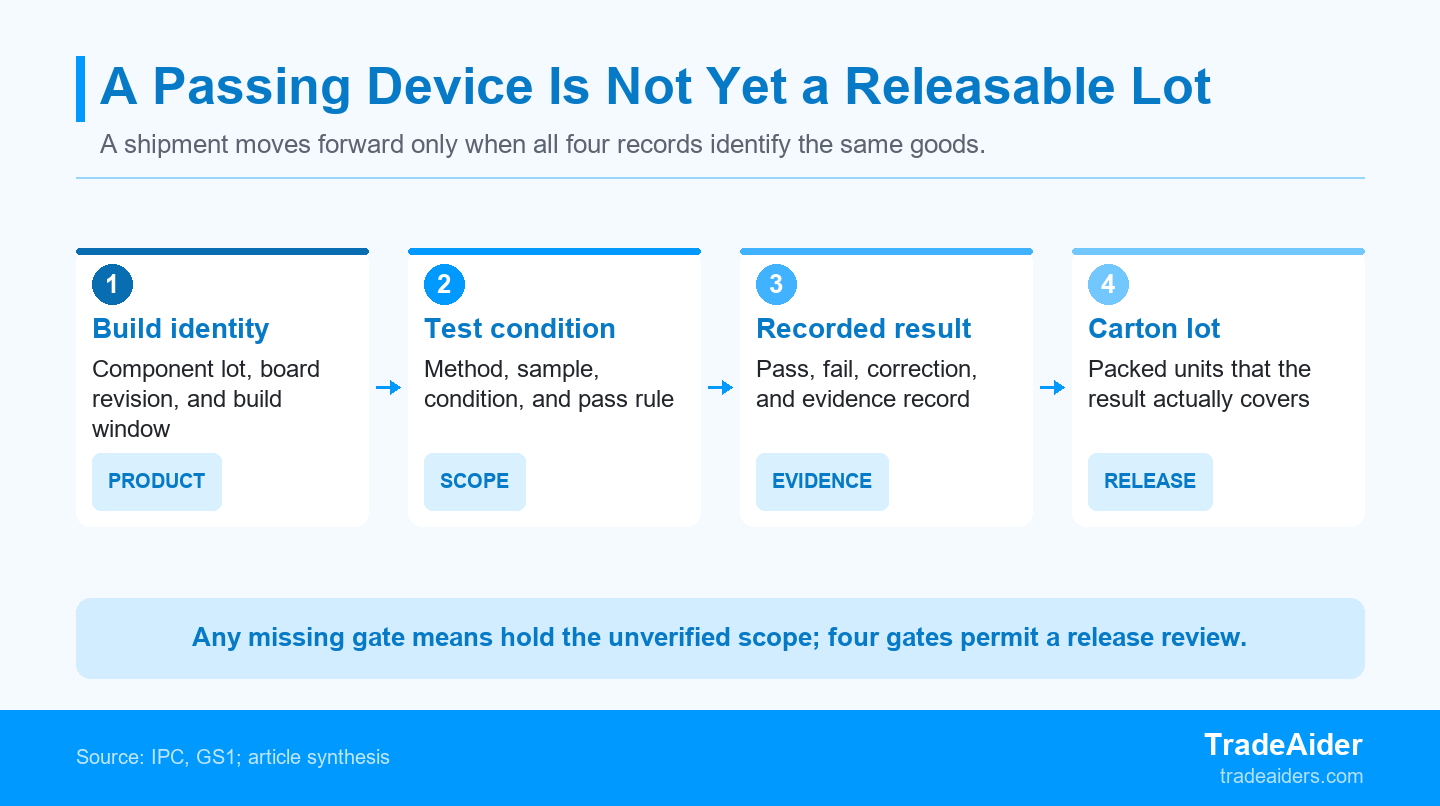
A functional pass supports release only when the test and shipment records identify the same electronic build and lot.
An illustrative importer is preparing an electronics accessory launch for retail distribution. The planned order is 24,000 compact electronic control units packed in four production lots of 6,000 units. A pre-production sample has passed the agreed button-response and connector-fit checks. Two lots are packed when the factory reports that a later connector delivery was used during one assembly window. The original test sheet names the approved sample and its product model, but does not name the later connector lot. The packing list identifies four 6,000-unit lots, while the build record cannot immediately show which cartons contain units made during the changed connector window. The buyer does not know whether the component change affects all 24,000 units. The pass result remains useful for the approved sample, but it does not establish that the later connector lot was tested under the same condition.
The factory segregates the affected cartons, maps the connector receipt to assembly dates, repeats the agreed functional checks on the named build window, and records any rework or replacement against the carton lots. The affected goods may be reconsidered only when the connector lot, assembly window, retest condition, result, and carton identifiers point to the same 12,000-unit scope. This illustrative example is a containment and evidence-repair method; it does not establish a product defect, verify electrical compliance, or transfer final release authority away from the buyer.
Build a Release Packet That Names the Lot
A concise release packet lets a buyer verify that the product reference, production identity, test evidence, packing record, and open-exception decision describe the same shipment. A release packet is a short set of records used to decide whether the named goods can proceed. It is intentionally smaller than a factory's full quality file: its purpose is to make the final ship-or-hold question reviewable without hiding an unresolved mismatch in a general summary.
- The approved product reference, including the risk-sensitive revision or component identifier.
- The build or lot record that identifies the production window.
- The stated inspection or functional-test result and its applicable condition.
- The packing list or carton marks that connect the release scope to physical goods.
- The written action for every unresolved exception: release, hold, rework, retest, or buyer-approved exception.
Before sending an order-specific scope to an inspection provider, compare these records line by line. The inspection can verify the agreed physical and documentary scope; it does not decide product design, certification, commercial approval, or final buyer release. Buyers who need to understand that provider boundary before sharing the packet can review TradeAider's inspection approach.
Five Controls That Make Electronics QC Useful
Electronics QC is useful to the buyer when it names the build, the test condition, the affected scope, the shipment identity, and the action for any mismatch. Review the order through these five controls before release:
- Confirm that the product reference and risk-sensitive configuration are current.
- Read the test result together with its method, conditions, sample selection, and failure rule.
- Match the test or inspection record to the build or component lot it can actually support.
- Match that build record to the packing list and carton identifiers.
- Turn every evidence gap into a named hold, correction, retest, or approved exception.
A final inspection request should also state the carton marking used for the lot, whether any parts or builds were changed after the approved sample, and the exact decision expected from the check. That makes it possible to distinguish an observation that needs follow-up from an issue that holds the lot. It also helps the buyer receive a report that can be read beside the packing list, rather than a generic list of findings with no clear connection to the goods. The request should identify whether the buyer needs a physical count, a test observation, a packaging check, a document comparison, or a defined response to any failed check.
When the order is 100% complete and at least 80% packed for export, TradeAider can inspect an agreed final-lot scope; the buyer can request a scoped pre-shipment inspection using those records.
Frequently Asked Questions
What does electronics quality control cover before shipment?
It should cover the agreed product identity, relevant workmanship and functional checks, the production or packing lot, and the action for any unresolved exception. The exact scope depends on the product's risk-sensitive features and buyer specification. An inspection report is most useful when it states which of those conditions were checked and which goods the evidence covers.
Can a passed functional test release the whole order?
No. A functional pass can support release only when the tested configuration and sampled units can be connected to the physical lot that will ship. If a component, build condition, or lot changed after the sample was tested, the result may still be relevant, but it does not automatically cover the changed or unlinked goods.
When should a buyer hold an electronics shipment?
Hold the shipment when a material component, build condition, test result, packing record, or corrective action cannot be tied to the intended release lot. The hold can be targeted when the records define the affected scope. If they cannot, widening the hold is often more defensible than assuming the scope is clean.
Does a third-party inspection replace product certification?
No. A third-party inspection can verify an agreed production or shipment scope, but it does not replace product-specific compliance, engineering validation, or certification obligations. Buyers should keep those requirements in their product plan, identify the applicable product-specific authority, and use inspection evidence to check the physical order against the agreed scope.

Articles Connexes

Développez votre entreprise avec le Service TradeAider
Cliquez sur le bouton ci-dessous pour accéder directement au Système de Service TradeAider. Les étapes simples de la réservation et du paiement à la réception des rapports sont faciles à utiliser.

