
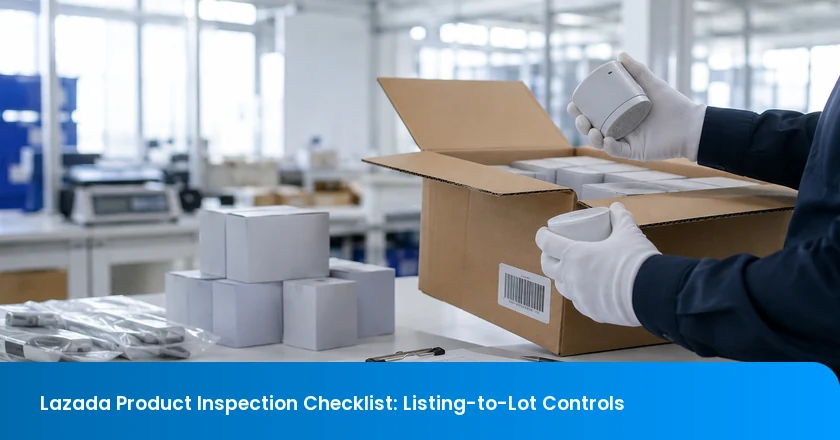
A Lazada product inspection can catch visible defects, count issues, and packing errors. Its harder job is to show that the inspected goods are the same version a shopper will see and the same lot the buyer plans to release. A clean report is weak if it names a generic product while the listing, approved sample, SKU variation, or carton pack has changed.
The practical question is simple: can the buyer point from the inspected item to the current seller SKU and then to the exact cartons being released? The following controls make that question answerable before a changed variation or package turns one report into an unclear release decision.
A Lazada Listing Is a Product Version, Not a Generic Sales Page
A marketplace inspection is useful only when the checked unit, seller SKU, listed attributes, approved reference, and packed lot can be shown to describe the same product version.
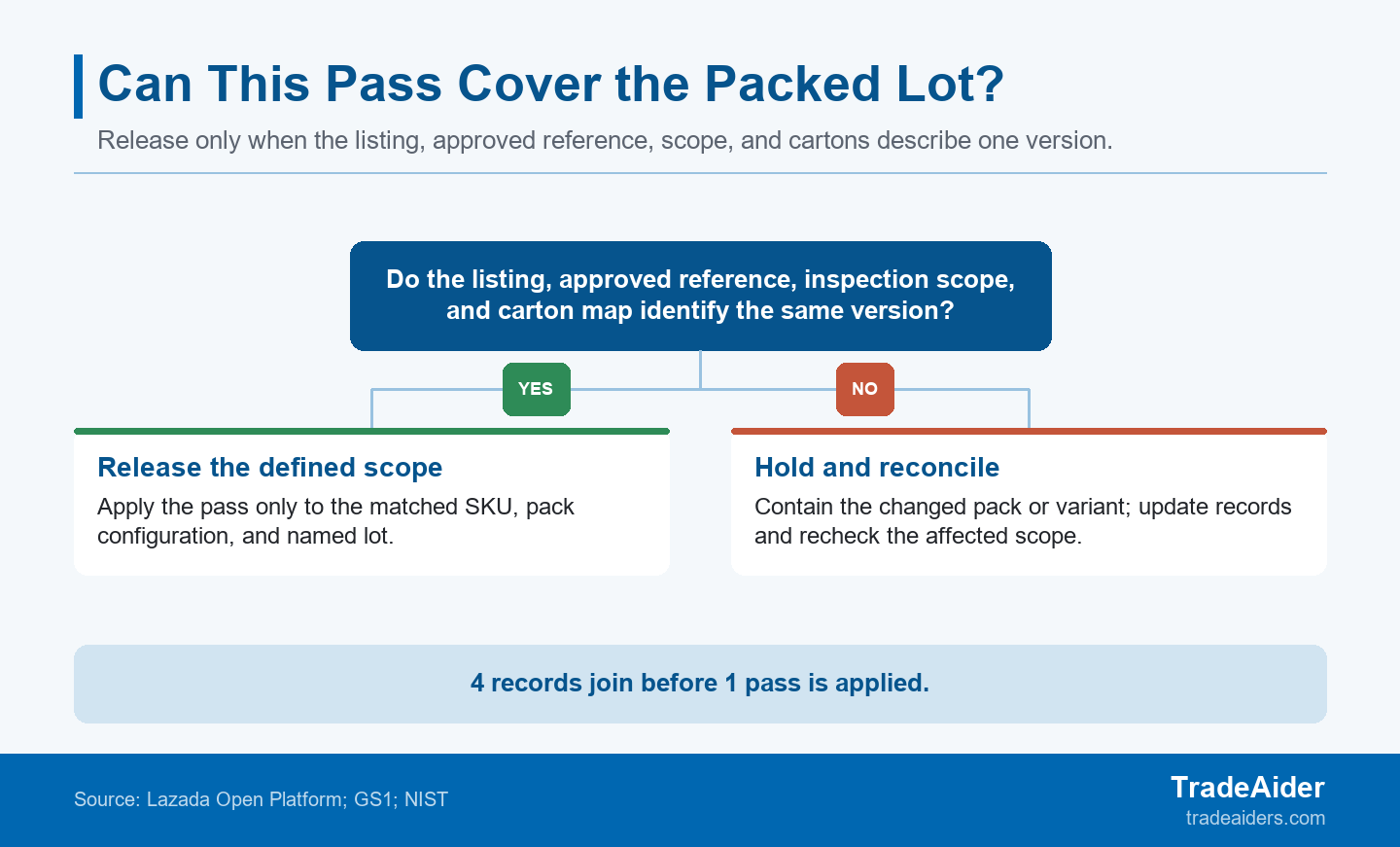
A pass applies to the defined product version and lot—not to a similar listing, changed pack, or unlinked SKU.
Start by treating the listing as a controlled record. The title, photographs, variation labels, package count, colour, material, dimensions, and claims may all affect what the buyer expects the factory to make. The physical unit is a second record. The finished cartons are a third. Inspection becomes meaningful when the buyer can join those records without guessing which version a pass actually covered.
A listing-to-lot control is the short chain that makes that join possible. It should be prepared before bulk inspection, not reconstructed after a dispute. The chain does not need a complicated system: a short join code, a dated saved listing record, an approved product reference, an inspection plan, and a lot identifier are enough to expose most mismatch questions early. Whether a buyer works with TradeAider or another inspection provider, those records should travel with the booking.
Use a Version Key Before You Order a Sample
A version key joins the seller SKU, marketplace item reference, material or model reference, variation, packaging configuration, and approval date before inspection begins. A version key is a record that connects the listing, physical product, and pack to the document the inspector will use.
Give the key a human-readable form, such as LSG-441 / grey / two-piece bundle / carton 20 / rev 03. It is not a new product code; it is a compact statement of what the inspection has permission to compare. Keep the key on the purchase order, approved sample record, inspection booking, and release file. If the supplier proposes a new label, carton count, colour shade, or accessory after that point, the buyer can see whether the existing key still applies. Save a dated screenshot or export beside the key rather than relying on memory.
Treat a Changed Variant as a New Inspection Question
A colour, size, bundle, material, claim, or pack change can change what the buyer must compare, even when the marketplace listing looks familiar.
Do not decide that a variation is “close enough” only because the product family has one title. A colour can change the finish being checked. A size can change dimensions and labelling. A bundle can change the unit count, barcode, packing hierarchy, and consumer expectation. A material change can affect claims or evidence needs. Lazada’s product-item documentation identifies variation attributes such as colour family and size. Record the difference, identify the affected stock, and decide whether the inspection sample, checklist, or proof must be updated.
This is a boundary decision, not an automatic failure. Some variations may share an approved construction and inspection rule. Others may need separate sampling or a new reference. The buyer’s record should say which condition supports grouping them, who approved the grouping, and which variants remain outside the pass.
Four Records That Must Agree Before You Rely on a Pass
Before relying on a Lazada inspection pass, align the listing record, approved product reference, inspection scope, and packed-lot identity.
- Listing record: the current seller SKU, variation, title, images, attributes, and retail-facing pack description.
- Approved reference: the dated sample, drawing, artwork, specification, or signed approval that tells the inspector what “correct” means.
- Inspection scope: the lot, sampling plan, checks, acceptance rule, and any explicit exclusions.
- Packed-lot identity: finished quantity, carton marks, pack count, date or batch reference, and the records that connect the report to the goods.
If one of the four is missing, do not fill the gap with a broad statement that “the product passed.” Hold the affected scope, ask for the missing connection, and decide whether a revised reference or recheck is needed. This is especially important when sales copy and production preparation are being updated by different people.
Build the Inspection Checklist Around the Product and Its Pack
A usable Lazada inspection checklist separates checks on the sellable unit, listing-visible details, packaging hierarchy, and the defined shipment lot.
Put observable conditions into the checklist, then state the reference for each. “Check appearance” is too vague. “Compare the grey finish, logo placement, accessory count, retail barcode, and bilingual warning copy against version key LSG-441 rev 03” gives the inspector a testable question. Keep the checklist short enough to use on the floor, but specific enough that a later reader can understand a hold decision.
| Control area | What to compare | Record to retain |
|---|---|---|
| Sellable unit | Model, material, colour, dimensions, function, accessories, visible defects | Approved sample or specification revision |
| Listing-visible details | Seller SKU, variation label, images or claims to verify, retail unit count | Dated saved listing record |
| Retail package | Artwork, barcode, instructions, warning or care information, seals and inserts | Approved packaging file |
| Export carton and lot | Carton marks, inner-pack count, carton count, lot identifier, condition | Packing list and carton map |
These stages are different even when one team manages them. Lazada’s Marketplace Ease materials describe separate listing, order, packaging, and ready-to-ship activities; use that separation as a reminder to capture the listing and packing records independently. If production changes after the sample is approved, use during-production inspection for a documented change while correction can still be made.
Make the Sampling Rule and the Release Population Explicit
A sample result applies only to the lot, inspection level, acceptance rule, and product scope agreed before the inspection—not to an undefined future inventory balance.
Before booking, state the planned quantity, completed quantity, lot boundaries, requested inspection level, defect classifications, acceptance threshold, and whether production or packing is complete. The inspector can then report what was sampled and what was not. A sampling result is not a warranty that every unit is identical; it is a documented result for the stated population and rule. Lazada’s Marketplace Ease reference separately names packaging and ready-to-ship operations, reinforcing the need to define the population before a result is used.
Do not silently expand a result from 2,000 completed units to stock that was finished later, or from a single-item pack to a two-item bundle. Where the buyer needs a common reference for how inspection plans identify lots and acceptance decisions, review the inspection-standard reference before the booking is issued. The operational benefit is clarity: everyone knows whether an outstanding quantity is inside or outside the pass.
Check Consumer Units and Export Cartons as Separate Evidence
Retail-facing labels and images answer a different question from carton marks, counts, and shipping configuration, so the inspection record should identify both levels. Lazada’s Marketplace Ease reference keeps product, pack, and fulfilment operations distinct, which supports keeping both records in the handoff.
A shopper may receive one retail unit while the buyer receives a master carton containing several inner packs. The listing may be correct at the consumer level even though the carton count is wrong, or the reverse may be true. Ask the factory for a carton map that names the retail count, inner-pack count, master-carton count, gross and net weight where relevant, and marks that identify the lot.
GS1’s GTIN guidance distinguishes product identity across packaging levels and packaging configurations. Use the GS1 GTIN management guidance as a useful reference when a pack-count change might alter the item identification or barcode basis. It does not decide a Lazada listing for you, but it reinforces why a changed bundle should not inherit evidence without a check.
Reconcile Listing Data With the Physical Item
Lazada’s product tools distinguish category attributes, seller SKUs, product images, and updates, so buyers should preserve the relevant listing snapshot beside the physical reference. A listing snapshot is a dated saved copy of the SKU, attributes, images, and retail-pack details used for the order.
The Product API documentation separates product-management functions, and the product overview describes category and variant attributes. Build a simple comparison sheet that puts the reference fields on the left and the inspection observations on the right. Include seller SKU, product name, category and variant values, stated pack count, image or artwork version, approved sample identifier, carton configuration, and lot quantity. Where a field is not physically verifiable, mark it as a listing or documentary check rather than pretending it was inspected. An inspector working from a current saved copy can identify a mismatch; an inspector working from an old email may compare the right product to the wrong listing.
Compare Required Attributes Before the Factory Builds Bulk Stock
The buyer should compare the approved specification with the category and variant attributes used for the listing before the production version and the marketplace version drift apart. Lazada’s product overview describes available, required, and variant attributes, while its create-product fields include SKU and package information.
For a new item, identify which marketplace attributes are mandatory, which are variation-specific, and which are claims that need another evidence route. Compare those fields with the buyer’s own approved specification before copy, images, or a package count travel into bulk production unchanged.
Do this before full output, with the person who owns the listing and the person who owns the sample approval looking at the same version. A buyer can also set a pre-production inspection reference when the product, packaging, and factory inputs need a documented comparison before bulk production. The purpose is not to turn a listing form into a quality system; it is to stop two valid-looking records from slowly describing different goods.
Do Not Treat an Inspection Report as Every Kind of Proof
Inspection, testing, supplier declarations, and certification are distinct forms of conformity assessment, so the checklist must name the evidence it can and cannot establish. In this context, conformity assessment means checking whether specified requirements are met.
An inspection can document agreed observations on a defined product and lot. It can verify an observable label, measure an agreed dimension, count accessories, assess workmanship, or report the condition found. It does not automatically prove chemical composition, a legal claim, a product-safety requirement, or a marketplace rule that needs a different source of evidence.
NIST’s conformity-assessment overview distinguishes supplier declarations, inspection, sampling and testing, certification, and accreditation. Its supplier-declaration definition identifies the supplier as the party making the attestation. Match the proof to the question before you rely on it.
For example, keep a laboratory report with the sample, method, and condition it names. Keep a supplier declaration with the product and basis it identifies. Keep an inspection report with the lot, observed checkpoints, and result it actually covers. A strong release file does not ask one document to do every job; it lets the buyer see which question each record answers.
Illustrative Scenario: One Listing, Two Pack Configurations
A pass on one retail-unit and carton configuration should not be generalized to a changed pack configuration without checking whether the listing, identifier, and lot record still match.
Hold the Changed Pack Until the Records Rejoin
This illustrative example is not a TradeAider client case or a prediction of supplier performance. An illustrative Lazada seller is preparing a kitchen-accessory launch with one product family and two bundle formats. The first shipment contains 6,000 retail units in 300 export cartons. After the initial approval, 120 cartons are packed with a changed two-unit promotional bundle rather than the original single-unit pack.
The listing and approved sample show a single-unit configuration, while part of the packed order now contains the two-unit promotional bundle; the booking was issued for the original configuration. The marketplace listing snapshot still shows the single-unit package content and dimensions. The changed cartons have a different count, but the inspection request combines all 300 cartons as one undifferentiated lot.
A pass on the unchanged single-unit cartons would not prove that the changed bundle matches the listing, the approved product reference, or the revised carton configuration. The records do not join automatically just because the underlying accessory looks similar. The buyer permits the traceable single-unit scope to continue through its defined inspection path and holds the 120 changed-bundle cartons until the listing, product reference, and carton map are reconciled.
The supplier supplies the new pack specification, carton map, labels, and current bundle images. The buyer decides whether the listing needs an update and issues a targeted recheck scope for the changed cartons. Those cartons can be reconsidered only after the physical bundle, the listed product information, and the final carton record identify the same configuration.
This illustrative example shows buyer control of a listing-to-lot inspection scope. It does not determine Lazada policy, consumer-law compliance, or actual supplier performance.
When a carton count or bundle changes after approval, hold the affected scope and reconcile the listing, product reference, and carton map before rechecking the changed configuration.
Where identification changes with the pack or case quantity, GS1’s GTIN guidance describes distinct identification at the affected level. That source does not decide the buyer’s release authority; it supports the practical decision to contain a changed configuration until its records are clear.
Ask four direct questions: Which seller SKU or variation will represent the changed pack? Does the approved retail artwork and barcode still apply? Which cartons contain the changed units? What inspection or evidence record will cover those cartons? The answers create a defensible boundary between a verified configuration and a pending one.
Use a Listing-to-Lot Handoff Before You Book Inspection
A short handoff record gives the inspector the version key, sample plan, packaging scope, listing snapshot, and hold-or-release authority needed for a meaningful report.
Make one named person responsible for assembling the handoff, but do not make that person guess authority. The buyer should name who can approve a substitute, approve a changed listing record, accept a recheck, and authorize release. For an independent view of how inspection work can be scoped around buyer evidence, review TradeAider's inspection approach before treating any report as a blanket release approval.
- Record the seller SKU, marketplace item reference, variation, and dated listing snapshot.
- Attach the approved sample, specification, artwork, and packaging revision to the version key.
- Name the finished lot, expected quantity, carton map, sample plan, acceptance rule, and exclusions.
- Give the inspector the observable checks and the evidence questions that belong outside inspection.
- State the escalation route and whether a discrepancy creates a hold, correction, recheck, or buyer decision.
Keep the final report with the exact handoff record that was used to book it. That makes later comparisons straightforward: the buyer can see the version, physical condition, lot, and open issues without asking the inspector to recreate the context months later. It also makes changes visible while the goods can still be isolated.
Before the final booking, compare the handoff record against the cartons actually completed. Confirm that the seller SKU and variation are current, the approved sample is still the applicable reference, the retail and export pack counts agree, and the lot quantity on the booking matches the cartons available for sampling. If a changed pack is still mixed into the shipment, separate its cartons on the map and keep the inspection instruction explicit about what is included. This final comparison gives the inspector a stable release population and gives the buyer a defined place to record any hold.
When the finished lot, current pack, and release records are ready to be compared, prepare a scoped pre-shipment inspection that names the actual version and shipment population. A report then becomes a practical decision input rather than a generic document filed after the goods have moved.
Buyer Questions
What information should an inspector receive from a Lazada listing?
Give the inspector the item or seller-SKU reference, product title, category and variant attributes, approved images, claims to check, package details, and the current listing snapshot. Add the approved sample or specification and carton information. The point is not to ask the inspector to operate the listing; it is to make clear which marketplace-facing details must be compared with the physical product and which fields are only documentary records.
Can one inspection pass cover every Lazada SKU variation?
No; one pass covers only the variations, product features, pack configuration, and lot scope named in the inspection plan, unless the buyer has a defensible basis to group them. A common construction may justify shared checks, but a change in material, package count, barcode, claim, or lot boundary may need a separate reference or a revised scope. Record the grouping logic instead of assuming it later.
Does a product inspection verify every marketplace claim?
No; an inspection can check agreed observable conditions, while testing, supplier declarations, or certification may be needed for claims that require other forms of evidence. Identify the claim, the market, the product version, and the proof needed before release. The inspection report should say what it checked and should not be used to imply a technical or legal conclusion that its scope does not support.
When should a buyer book the final product inspection?
Book the final inspection only when the buyer can identify the completed lot, relevant packing status, current product version, and the records the inspector must compare before release. If cartons are still being changed or the listing and sample do not agree, book a defined interim check or hold the affected scope. A final report has more value when the product, pack, and release population are already clear.

Articles Connexes


Développez votre entreprise avec le Service TradeAider
Cliquez sur le bouton ci-dessous pour accéder directement au Système de Service TradeAider. Les étapes simples de la réservation et du paiement à la réception des rapports sont faciles à utiliser.

