
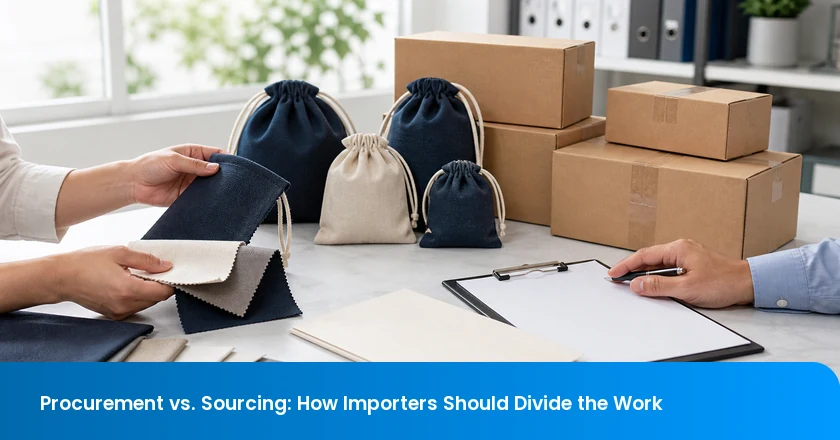
Procurement vs. sourcing stops being a vocabulary question when the supplier selected on paper reaches a purchase order with a different site, version, material route, or quality condition. A useful division of work protects the original decision: sourcing establishes what supply option is acceptable, and procurement keeps that option identifiable while the order is placed, changed, checked, and released.
Divide the Work at the Decision, Not the Department
For an importer, sourcing chooses a supply option while procurement makes that chosen option executable and reviewable through the order. Here, a handoff means the records, ownership, and order details that carry the selected option from one decision to the next. The split is practical even when one buyer, agent, or small team performs both jobs.
- Sourcing ends with a defensible choice. Name the production site, approved offer, version basis, and selection conditions before a PO is issued.
- Procurement begins by preserving that choice. Put the current supplier, product version, order terms, and agreed controls into the PO and its supporting records.
- Quality is a handoff field, not a late add-on. Decide whether the open question is supplier capability, the live run, or the finished lot before choosing the check.
- A change should reopen only the affected decision. A traceable changed group can be held and repaired without discarding complete evidence for unchanged units.
Sourcing Chooses the Supply Option; Procurement Makes It Executable
Sourcing should settle the supplier-and-offer decision; procurement should carry that approved decision through the PO, coordination, monitoring and controlled changes. CIPS describes procurement as a longer-term function that includes supplier-related work, while GS1 US distinguishes sourcing’s “who to buy from” question from procurement’s “how to buy” work. Those descriptions are not a universal org chart; they are a useful boundary for an import order.
The confusion usually starts when a quote is treated as the whole sourcing decision. A quote can name a price, MOQ, and delivery window, yet leave the actual producing site, sample revision, material route, packing rule, or change authority unclear. The buyer then believes sourcing is complete, but procurement receives no stable object to execute. Define the inspection standard and the product version before the order is committed, so the quality condition travels with the commercial decision instead of arriving as a late email.
Sourcing Must Define the Supplier and the Offer
Before the first PO, sourcing should document the named supplier site, approved offer, specification basis and selection risks. That does not require a bulky approval file for every low-risk repeat buy. It does require enough detail to answer a later question: which site, which version, and which assumptions were actually selected?
In this context, strategic sourcing is the long-term work of selecting suppliers according to total value, total cost, and the conditions needed for a workable relationship. CIPS frames strategic sourcing around total value and total cost, not unit price alone. For an importer, the selection record should therefore explain the commercial and operational fit: the factory or accountable supplier, the offered construction or material basis, the capacity or lead-time condition that mattered, and any issue that must be controlled later. The U.S. International Trade Administration also advises companies to select partners carefully and continue due diligence. In practical terms, a supplier decision is not frozen if the evidence it relied on changes.
Keep the language plain. “Approved version” means the sample, specification, drawing, color reference, or file that the buyer expects the factory to follow. “Named site” means the place responsible for the relevant production step, not a sales-office address. If either term is unknown, sourcing has not finished the decision that procurement needs to carry forward.
Procurement Must Preserve That Decision Through the Purchase Order
Procurement should connect the PO to the approved version, commercial terms, monitoring plan and change-control route so the executed order remains the order that was selected. The PO is not merely a payment document: it is the working reference that prevents a verbal substitution from becoming an invisible production change.
At a minimum, procurement should make the supplier or site identifier, product version, quantity and packing scope easy to reconcile. It should also state where a changed material, subcontracted step, process, label, or inspection condition must be reported. This is not bureaucracy for its own sake. Without a current link between the PO and its approved inputs, a final reviewer may be comparing a finished lot to an earlier sample or to a supplier record that describes a different condition.
Ownership must remain connected but not blurred. Sourcing should answer whether a revised offer is still acceptable. Procurement should control whether the order record, timing, and commercial instruction are updated. Quality personnel or an independent provider can verify an agreed condition, but they should not be asked to invent the approval decision after goods are already packed.
Use a Six-Field Handoff Before the First Purchase Order
A six-field handoff—supplier site, approved version, PO terms, quality gate, change owner and release record—makes the division of work visible and testable. It is a buyer control aid, not a published standard or a legal form. Its value is that a missing field reveals the exact question that has not yet been decided.
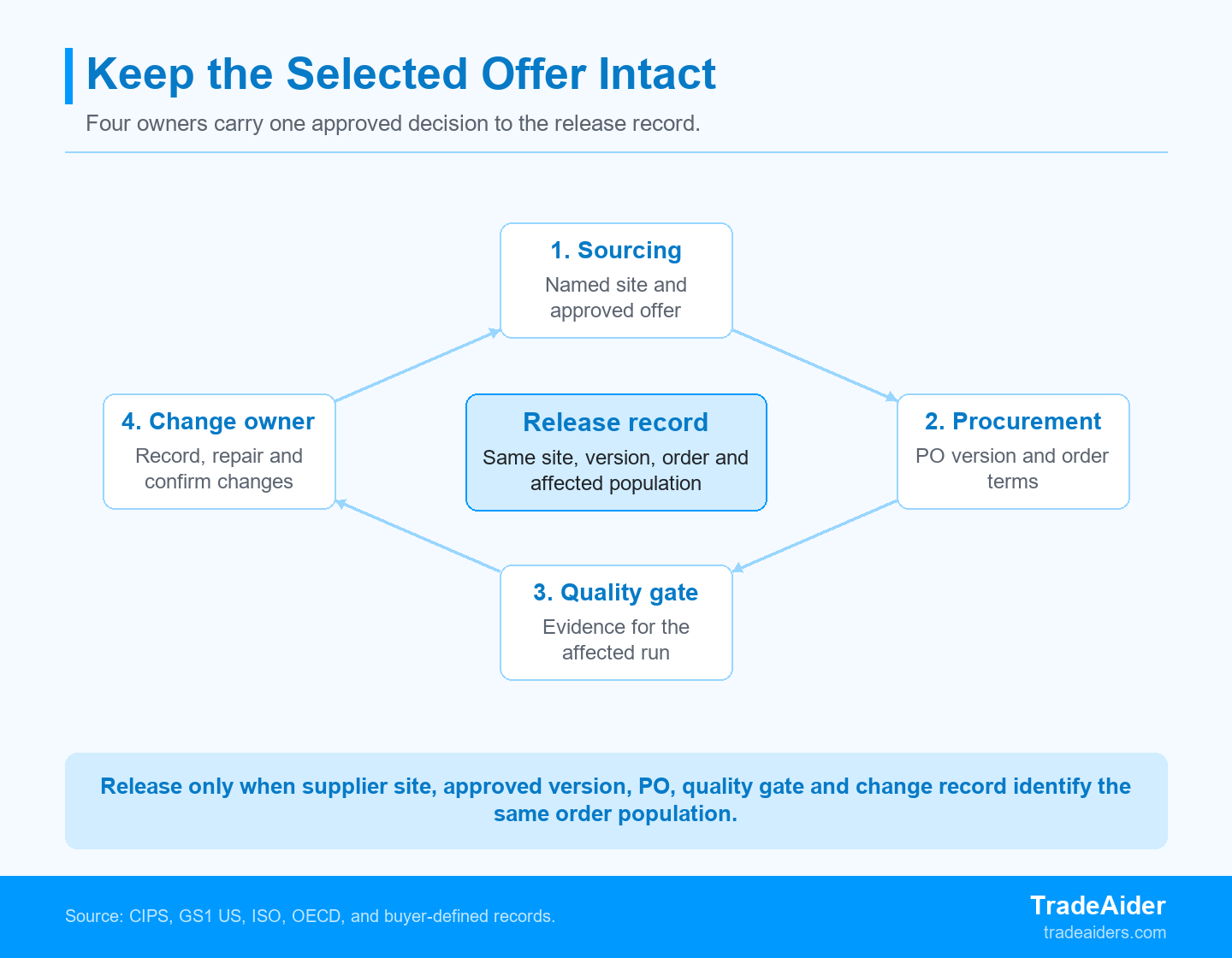
The handoff is not complete until the supplier site, approved version, PO, quality gate, change record and release record identify the same order population.
The handoff is complete only when six fields travel together. The OECD due-diligence guidance presents supply-chain diligence as an ongoing process of identifying, mitigating, tracking, and communicating about impacts. That broader context matters here: a field that changes after selection needs a route back to the person who can decide whether the affected condition remains acceptable.
| Handoff field | What it identifies | Owner who keeps it current | Question if it changes |
|---|---|---|---|
| Supplier site | Who performs the relevant production step | Sourcing | Is the new site inside the approved supply option? |
| Approved version | The sample, specification, or material basis | Sourcing with product owner | Does the proposed substitute match the approved basis? |
| PO terms | Quantity, price, delivery, packing, and scope | Procurement | Does the order still describe the current agreement? |
| Quality gate | The evidence needed before the next decision | Quality owner | What must be checked, and at which stage? |
| Change owner | Who records and routes a material change | Named buyer-side owner | Who can accept, reject, or escalate the change? |
| Release record | The population that evidence actually covers | Release decision owner | Which cartons or units can move now? |
Do not ask whether every field is “perfect.” Ask whether each field identifies the same supply decision. If the PO says one factory, the material approval names another route, and the inspection request does not specify which group changed, the handoff is incomplete even if the supplier relationship is otherwise sound.
For TradeAider buyers, this packet also clarifies which service stage belongs to the open question: capability at a named site, evidence from an active run, or a final check of a finished population. The service request should follow the packet, rather than becoming a substitute for the buyer’s own supplier or change decision.
Put Quality Gates Where the Decision Can Still Change
Capability, live-production and finished-lot decisions need different evidence gates because an earlier check does not automatically prove a later changed condition. The question is not “Have we inspected?” It is “What uncertainty can still be corrected or contained before the buyer makes the next commitment?”
A capability gate asks whether the selected site can make and control the product as expected. A live-production gate asks whether the order now being made follows the approved condition. A finished-lot gate asks whether the completed, packed population is ready for the buyer’s release decision. Combining them into one generic “QC” step creates a responsibility gap: a capability review may be useful, but it does not identify the carton range produced after a material substitution.
A Factory Audit Tests Capability Before Award
A factory audit can examine a named site's capability before award, but it cannot by itself prove a later production run or finished order. It is most useful when sourcing has a specific question to test: whether the relevant production area, process control, records, staffing, and supplier management appear capable of supporting the proposed order.
ISO and IAF guidance on external providers lists documented approved-provider information, defined criteria, monitoring, and risk-based control as examples of what an organization may need to manage. Use that distinction to write an audit brief around the supplier decision, not to assume that a supplier listing clears every future order. When an independent capability review is appropriate, TradeAider’s factory audit service is a contextual route after the buyer has defined the site and evidence question.
The audit result should feed back into sourcing. A major capability concern may reopen supplier selection; a narrower documentation gap may be corrected before the PO. Either outcome is clearer when the buyer has separated supplier approval from later production and release evidence.
A Production Check Confirms the Run Before Release
When a material, process or site condition changes, the affected run needs current evidence because a prior capability record does not automatically cover that changed condition. The buyer should first isolate what changed, which units are traceable to it, and what decision is still open: correction, acceptance of a revised condition, or release of the unaffected scope.
Start by comparing the proposed substitute with the current order record. Confirm who supplied the changed input, which production window used it, what version or color reference applies, and whether the goods can be separated. That short investigation may show that a targeted check is enough; it may also show that the changed group cannot be identified reliably and must stay on hold until the scope is clear.
A production-stage check is most valuable while the factory can still correct the active run, not simply because a calendar says it is time to inspect. For example, a new color route may require confirmation of the revised material record, the approved color reference, workmanship at the relevant process stage, and how the affected goods will be separated. TradeAider’s during-production inspection page is relevant when that live-order question has been defined; it does not replace the buyer’s approval of the changed condition.
If the goods are already complete, the quality gate may move to the finished-lot decision. The handoff still applies: identify the changed population, match it to the updated record, and decide whether the final check can distinguish that population from goods that remained within the original approval.
Worked Scenario: A Supplier Change Splits One Order
In the illustrative 7,200-unit order, only the 2,400 navy bags affected by the new dye-house record need a repaired handoff before release. This composite example shows a decision method, not a TradeAider customer case or a rule that applies to every product, contract, or market.
Release Only the Units With a Repaired Record Chain
The buyer should release only the units whose revised supplier, approval, check and carton records identify the same changed population. The correct scope is determined by the evidence chain, not by whether the order is inconvenient to separate.
An importer has placed a private-label order for 7,200 drawstring bags in three color groups. Sourcing selected the supplier after a capability review and sample approval. The PO names the original material route, approved construction, packing requirement, and three-color order scope. The factory is in production when it reports that its original dye house cannot meet the navy schedule and proposes a different dye house for the 2,400 navy bags.
Two observations determine the response. First, the factory can trace the proposed dye-house change to the navy group and can keep its cartons separate. Second, the existing PO and material file still identify the original route; no revised material code, color approval, or updated change record yet describes the substitute. The issue is therefore not a vague concern about the entire supplier. It is a specific break between the selected offer and the navy population now being produced.
The sourcing decision remains usable for the 4,800 unchanged bags because their supplier, material route, and approval path still match the order. The 2,400 navy bags need a separate decision because the changed dye house is outside the original handoff. Keep the unchanged population on its normal path. Hold the navy group until the buyer can review the revised route, determine the required quality gate, and connect the result to the marked cartons. That avoids both false confidence and a blanket hold that ignores available traceability.
The supplier provides the new dye-house identity, material and color code, a revised approval record, and a change entry tied to the navy quantity. Procurement updates the controlled order record and the buyer defines a production-stage or finished-goods check for the changed group. The verification gate is met only when the revised supplier-and-specification record, the agreed check, and the marked carton range all identify the same 2,400 navy bags. In this illustrative example, if any element cannot be reconciled, the buyer’s contract and product requirements determine the next hold-or-release action.
Turn the Handoff Into a Release Packet
A release packet should identify the current PO, supplier site, approved version, change record, quality evidence, packing status and release owner. It lets a final reviewer see the relationship between a sourcing choice and the goods that are actually ready to move.
Prepare the packet before asking anyone to make a ship-or-hold decision. A final review should not require hunting through email threads to determine whether the factory, material, sample revision, or carton group changed. The packet should contain the current commercial instruction, the current technical reference, the exception record if anything changed, the quality evidence that covers the relevant population, and a named person who can decide what happens next.
| Before final review | The reviewer should be able to see | Do not release when |
|---|---|---|
| PO and supplier record | The site and order scope now being executed | The producing site or order scope is unclear |
| Approved version and change log | Which sample, material, or artwork applies to the goods | A changed condition has no approval path |
| Quality evidence and packing record | What was checked and which units or cartons it covers | The evidence cannot be matched to the release population |
| Release owner | Who accepts the remaining risk or authorizes a hold | No one has authority to close an exception |
The useful request is not “inspect the goods.” It is “verify this identified finished population against this current order and approval record.” Once that packet is ready, a buyer who needs an independent final-order check can schedule a pre-shipment inspection.
Frequently Asked Questions
Is sourcing simply another word for procurement?
No, sourcing normally focuses on finding, evaluating, and choosing a supply option, while procurement carries the approved option through ordering, coordination, and ongoing control. One person may do both jobs in a small import business, but the decision outputs should still be separate: first identify the acceptable supplier and offer, then preserve that choice in the PO and related records. That separation makes later changes visible instead of informal.
Who should own the purchase order after sourcing selects a supplier?
Procurement should own the controlled purchase-order process, while sourcing stays responsible for confirming the supplier, offer, and approval conditions that process must preserve. Sourcing should re-enter when a proposed substitute would alter the original decision. The important point is not which department sends the document; it is whether one owner keeps the order record current and another owner can decide whether a supplier or specification change remains acceptable.
What does an approved-provider list tell the buyer?
It identifies the provider approved under defined criteria, but it does not confirm that a later site, material, or version change still fits the current order record. ISO and IAF guidance identifies documented approved-provider information, defined criteria and monitoring as examples of external-provider control. Use the list as a starting point for a current order question, not as proof that every changed condition has already been reviewed.
What change should reopen a sourcing decision?
Reopen the relevant decision when a supplier site, material, process, approved version, subcontracted step, or quality requirement changes beyond the evidence that supported the original choice. The buyer does not necessarily need to restart the entire supplier search. First identify the affected population, then decide whether the change needs a revised approval, a PO update, a different quality gate, or a hold on the affected group. The right response follows the traceable scope of the change.
Articles Connexes

Développez votre entreprise avec le Service TradeAider
Cliquez sur le bouton ci-dessous pour accéder directement au Système de Service TradeAider. Les étapes simples de la réservation et du paiement à la réception des rapports sont faciles à utiliser.

