
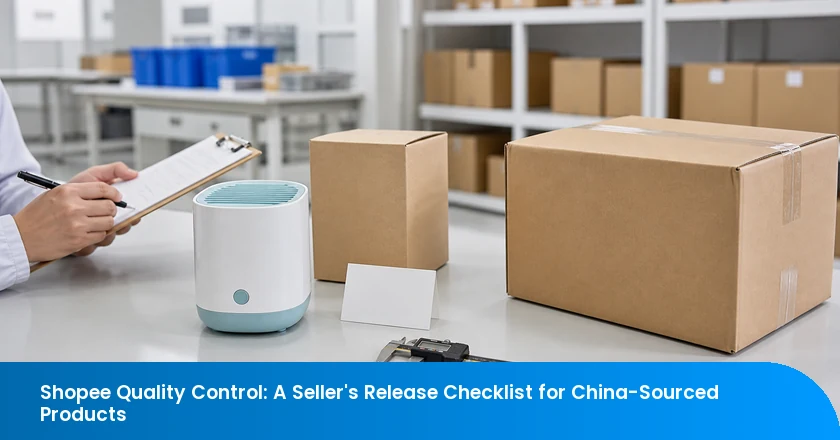
A Shopee quality-control decision should begin with the approval scope: the exact units and cartons a buyer is considering for release. A supplier’s approved sample can look right while bulk stock, colour records, carton labels, or buyer-facing claims point to different products. The practical task is to prove that the listing, physical goods, and shipment records describe the same sellable item before fulfillment begins.
Shopee Quality Control Is a Listing-to-Release Evidence Problem
Destination product requirements can differ by market and product, so sellers should verify the applicable rules before placing inventory into fulfillment. The UK government’s product-safety guidance for businesses, for example, places responsibility for safety, labeling, and supplier records on businesses that make, import, distribute, or sell consumer products. Treat that as a destination-specific boundary, not as a universal Shopee rule.
That boundary changes what “ready to ship” should mean. A factory may be ready to close cartons, while a seller is not yet ready to release inventory if the live listing promises a material, colour, size, function, or label that cannot be connected to the goods in those cartons. The release population is the exact units and cartons a buyer is considering for approval. The safest record is a short chain: approved reference, defined check, acceptance rule, and identifiable lot.
- Check the buyer-facing promise, not only visible workmanship.
- Keep each variant tied to its approved reference and carton record.
- Hold only the unsupported population when the evidence gap is traceable.
Translate Each Listing Promise into a Checkable Requirement
A seller should connect each buyer-facing listing promise to an approved reference, check method, acceptance rule, and traceable population. An SKU is the product and variant identity used to distinguish what a buyer ordered; traceability is the ability to connect a product or carton back to its approved records. For a blue storage organizer, that can mean an approved colour swatch, dimensions, material statement, label artwork, a functional check, and a carton-to-SKU map—not a generic instruction to “inspect quality.”
For relevant U.S. textile and wool products, label content can include fiber content, country of origin, and a responsible business identity. The Federal Trade Commission’s apparel-labeling overview shows why a relevant product page and the physical label cannot be checked as separate, unrelated items. Where a category rule applies, the seller needs the approved label and product evidence to agree before the claim reaches a buyer.
For relevant clothing and textile products, the consumer information in the listing should be checked against the product's required labels and care information. The FTC’s clothing and textiles guidance is a useful category reminder; its scope is not a substitute for checking the rules that apply to the actual product and destination. To turn the promise into a usable checklist, sellers can use a practical inspection-standard framework and state the observable pass or fail condition beside each claim.
Plan Evidence for the Disputes Buyers Actually Raise
Shopee Seller Education states that listings must comply with the relevant country's regulations and platform policy. Its listing-policy introduction is a useful constraint: marketplace policy does not turn a factory sample into proof that every carton matches the local product requirement. The seller still needs evidence for the specific inventory being released.
Build the evidence around the points a customer can notice: the item received, its variant, condition, visible labeling, quantity, and basic intended function. Photographing a finished unit helps only if the photo can be linked to the approved reference and the relevant lot. A report that says “pass” without showing which SKU, carton group, or version it covered leaves too much room for a later mismatch.
Place Controls Before the Marketplace Can See the Problem
Pre-production approval, active-production checks, and final release address different evidence gaps. The earlier a seller discovers that a reference, label, or variant definition is wrong, the smaller the affected population usually is. A late inspection can confirm finished goods; it cannot reliably recreate the agreement that should have existed before bulk work started.
Use the three stages as a decision sequence. Before production, freeze what the factory must reproduce. During production, find out whether bulk output still matches that reference while affected work can be separated. At final release, confirm that the sample, packing status, and carton map describe the same shipment population. This is a control sequence, not three interchangeable services.
Lock the Reference Before Bulk Production
For Great Britain, businesses must identify the correct market, consult applicable product rules, and retain technical documentation where relevant. The government’s UKCA and CE marking guidance makes the underlying point clear: market access starts with the right product rule and documentation, not a generic marketplace checklist. Confirm the destination and category requirements before asking a factory to reproduce a sample.
For covered cotton products sold in the United States, labels and advertising must accurately reflect fabric content. The FTC’s cotton-labeling guidance illustrates why a fabric statement needs more than a visual check. Before bulk work, align the purchase order, approved sample, listing copy, variant names, label layout, and any test-dependent claim. When independent verification is useful at this stage, TradeAider can set a pre-production inspection scope around that agreed reference.
Contain Variant Drift While Cartons Can Still Be Separated
When bulk production drifts from an approved variant reference, the seller should map the affected SKU or carton group before authorizing correction. Do not let a factory apply a broad “fixed” label to a mixed population. First identify which colour, size, material batch, shift, or carton sequence is affected; then state what will be reworked and what evidence will prove the correction.
Make the boundary practical while the goods are still accessible. Ask the supplier to preserve the original carton marks and label version, then tag the affected group separately from goods that still match the approved reference. Record the quantity, SKU, production date or sequence where available, observed difference, corrective action, and recheck point. This prevents a correction from erasing the only clue that distinguishes the affected stock from the remainder of the order.
Use the check to compare the current line output with the frozen reference, not merely to count defects. Review a set of units from each active variant, the labels being applied, and the carton marks that will later identify the goods. If the factory changes a material, component, colour name, packing method, or label artwork, capture the change before it is mixed into the finished lot.
This step matters when the defect is repeatable but not order-wide. If two colours use different trims, or one label version appears after a packaging change, separate those units while they can still be found. A buyer who needs an independent view can add a during-production inspection checkpoint before packing removes the practical boundary between affected and unaffected goods.
Release Only the Shipment Population Your Evidence Actually Covers
A sample plan supports only the defined population it represents; it cannot make an unmapped carton part of that population. AQL is a sampling index used to set a lot’s inspection sample and acceptance threshold. It is useful when the lot, sample rule, and defect limits are agreed in advance, but it does not prove a claim for units that cannot be connected to that lot.
A passing sample should not be used as evidence for cartons or variants that cannot be tied to the same approved listing and lot records. The final decision needs more than a count of defects: it needs the finished product, label version, carton map, packing list, and sample scope to point to the same goods. That is the difference between a result that is informative and one that can support a release decision.
Ask three release questions in order. Does the finished product match the approved listing reference? Which units did the sample actually represent? Which cartons can be identified by the same SKU-colour map, carton marks, and packing list? A conflict in the first question can require product correction; a conflict in the second limits what the sample can prove; a conflict in the third identifies the cartons that need a hold.
Write the lot definition before the visit. Record the purchase-order line, the variant set, the carton range, the inspection level, the defect categories, and the acceptance decision. Then make the sample size and threshold visible to everyone who will use the result. With that packet complete, a seller can calculate the sampling plan before inspection rather than negotiate its scope after a problem appears.
Next, compare the documents with the physical shipment. Check that carton marks, packing-list quantities, variant labels, and finished packing status are consistent with the lot named in the inspection request. If the packing list combines two label versions, split them before choosing the sample or approving a correction. If a carton has no reliable link to the approved version, it is not part of the evidence-backed group merely because it sits beside cartons that are.
Finally, state the release action in the same packet: release, conditional release, rework and recheck, or hold. A conditional release should say which cartons may move, which cartons stay isolated, what supplier action is required, and what focused verification closes the hold. This protects the buyer from the false choice between accepting a questionable whole order and stopping all inventory when only a traceable subset needs attention.
The approval record should also name the person who may release the goods and the evidence they relied on. Keep photographs, the inspection result, rework confirmation, and the final carton list together under the same order reference. If an exception is accepted for commercial reasons, record the affected quantity and its corrective follow-up. That makes the decision reviewable if a later customer complaint points to one specific variant or carton group.
For a final check, schedule the visit only when the full order is 100% complete and at least 80% packed for export, so the evidence represents the intended release population. At that point, a seller can define the pre-shipment release check before the sample size or acceptance threshold becomes an afterthought.
Example: A 300-Unit Hold Can Protect a 3,600-Unit Release
This illustrative example covers five cartons, or 300 units, in a 3,600-unit order; it is not a measured defect rate or a universal marketplace rule. Its purpose is to show how a document-to-product conflict can be contained to the cartons whose identity is not yet proven, rather than forcing either a vague full release or a vague whole-order stop.
Let the Carton Map, Not a Broad Pass Result, Set the Hold
A US-based marketplace seller is buying storage organizers from China for a three-colour Shopee listing. The order contains 3,600 units in 60 cartons, with 60 units in each carton; production is complete and carton sealing is under way. In the illustrative 3,600-unit order, five cartons with conflicted variant records represent a separate 300-unit evidence population. In the illustration, five cartons at 60 units each create a separate 300-unit hold until the SKU-color record and physical cartons agree.
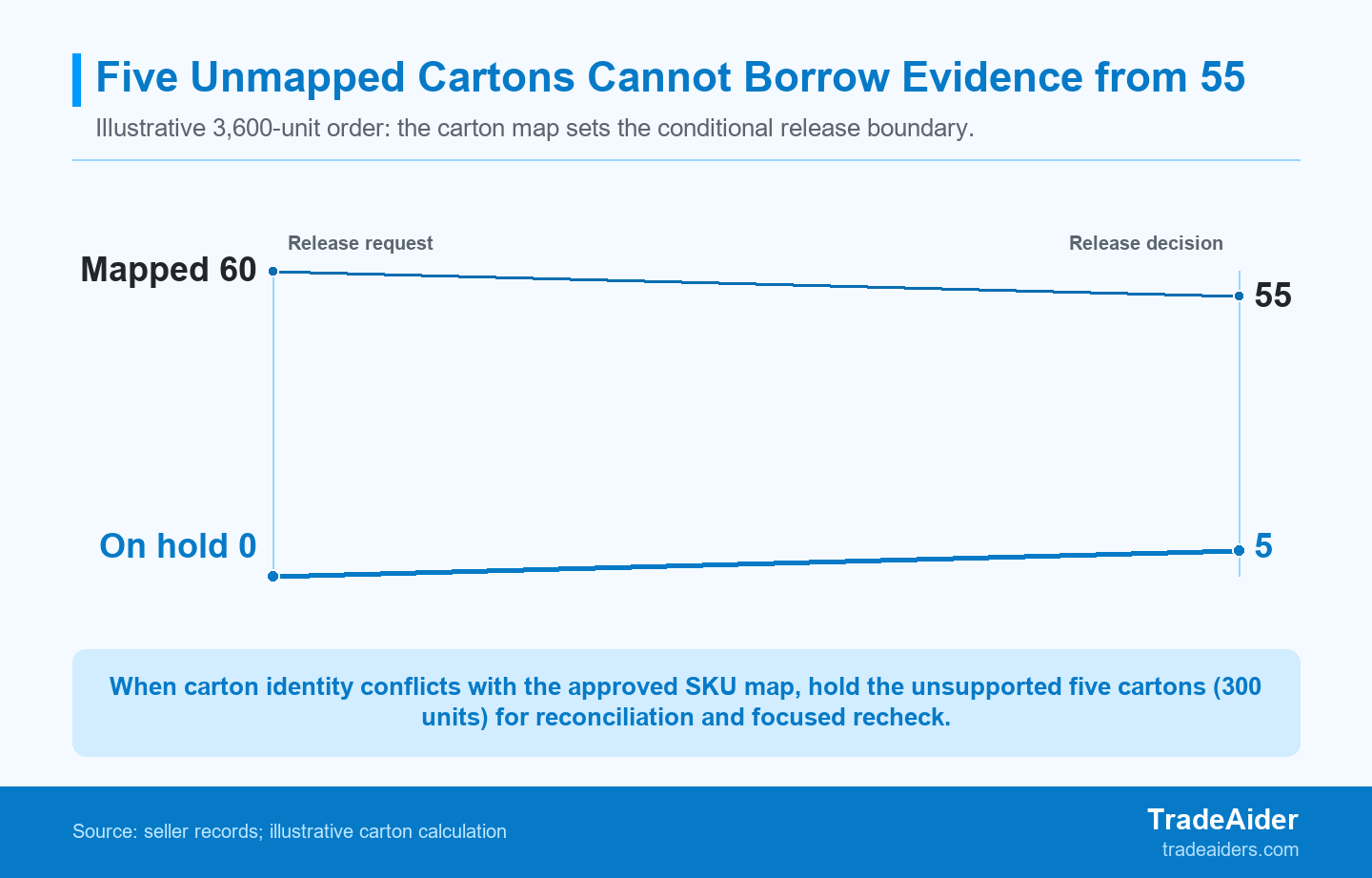
A clear carton map can keep an evidence gap limited to the five cartons it actually affects instead of turning a 3,600-unit order into a vague all-or-nothing decision.
The approved listing names three distinct colours, but 5 carton labels use a generic colour name that is absent from the approved SKU map. A 125-unit sample shows acceptable workmanship, yet it cannot connect those 5 cartons to an approved colour variant. The mapped 55 cartons and the five unsupported cartons are therefore different evidence populations; a general sample result cannot establish the identity of a carton whose document version conflicts with the approved record.
Use conditional release: keep the 55 mapped cartons separate and hold the five conflicting cartons while the supplier reconciles the carton labels, packing list, and SKU-colour map. Relabel or rework only under a documented mapping, then perform a focused check of the corrected labels and contents. Release the held cartons only when that mapping matches the approved listing. This illustrative example does not establish a universal hold threshold or a platform requirement.
Build a Shopee-Ready Inspection Brief
An inspection brief is decision-ready when it names the product reference, listing, lot map, packing status, sample rule, and any test-dependent requirements. Attach the purchase order, live or draft listing, approved reference, SKU and carton map, current packing status, and applicable test reports. That packet lets the buyer, supplier, and inspector identify what will be checked and which shipment population the result may support.
TradeAider can use that packet to define an inspection scope tied to the documented shipment population, while the seller keeps responsibility for product requirements, listing accuracy, and the final commercial release decision. When the purchase order, listing, approved reference, SKU and carton map, packing status, and test reports are ready, request a Shopee-ready inspection plan.
Common Questions
Does Shopee inspect every product before delivery?
No. Marketplace return handling should not be treated as a seller's supplier-side inspection program. Sellers should not assume marketplace return handling replaces their own product and record checks before inventory is released. Marketplace policies can govern listings and transaction outcomes, but they do not create a factory sample, carton map, or product-label record for the seller’s specific order. Build that evidence before the item enters fulfillment, especially when the listing makes a precise material, variant, quantity, or performance promise. Keep the resulting records with the final release decision.
Is an AQL inspection enough for Shopee inventory?
No. An AQL sample can support a lot decision, but it cannot by itself prove a listing claim, every variant, or an unmapped carton. It becomes useful when the seller has defined the lot, sample size, acceptance threshold, approved reference, and checks in advance. A pass can support the shipment group actually named in those records. If a carton cannot be linked to the same SKU, label version, and packing record, keep it outside the sample-backed release until its identity is verified. Apply the same boundary after rework or a label change.
When should a Shopee seller add laboratory testing?
Add laboratory testing when a performance, material, chemical, or safety claim cannot be established by visual inspection and basic functional checks. Start by identifying the destination market, product category, and exact claim made in the listing. Then determine whether an applicable rule, buyer requirement, or test method calls for laboratory evidence. Confirm that the submitted sample is the intended product version and preserve the report with the related purchase-order and lot records. A lab result should not become a blanket approval for later material, label, or manufacturing changes. Retest when the relevant product version changes.
When can a seller use a pre-shipment inspection?
Use a pre-shipment inspection when the full order is complete and at least 80% is packed for export, so the check represents the release population. Before scheduling, confirm that the packing list, carton marks, SKU map, approved reference, and sample rule are ready. Ask the supplier to identify any cartons still being reworked, relabeled, or held outside the inspection lot. If a material percentage, safety, or performance claim still needs laboratory evidence, make that requirement explicit rather than expecting a final visual inspection to answer it. Document any exception before approving the shipment.

Articles Connexes

Développez votre entreprise avec le Service TradeAider
Cliquez sur le bouton ci-dessous pour accéder directement au Système de Service TradeAider. Les étapes simples de la réservation et du paiement à la réception des rapports sont faciles à utiliser.

