
- About Us

- Our Services
- Your Industry
- Resources
- News & Blog
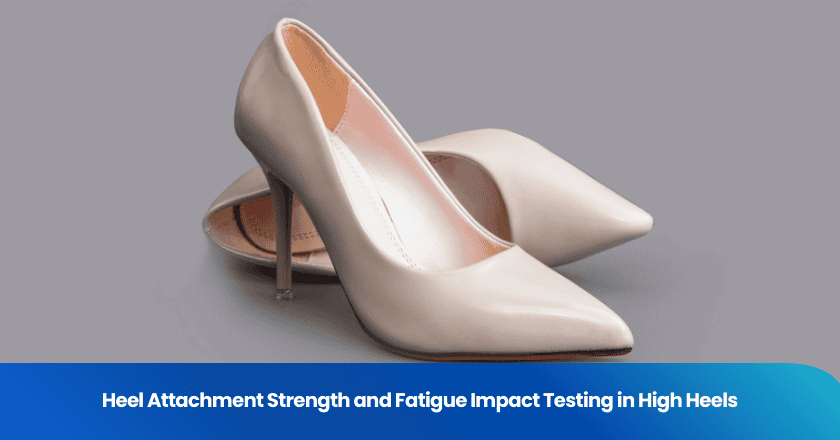
Mechanical failure of the heel assembly represents a critical safety risk in the elevated footwear sector, potentially leading to catastrophic orthopedic injuries and brand-damaging liability. In the domain of Softline quality assurance, the structural integrity of high-heeled shoes is validated through a tripartite framework of testing: Heel Attachment Strength, Dynamic Fatigue Simulation, and High-Energy Impact Resistance. Engineering excellence in this category is governed by international metrological standards, such as ISO 19956 and SATRA TM113, which quantify the material's ability to withstand cyclic kinetic stress. For manufacturers and importers, achieving technical compliance is essential to ensure that aesthetic stiletto designs do not compromise biomechanical stability or user safety.
Key Takeaways
- Heel attachment strength measures the pull-off force required to separate the stiletto from the insole, critical for preventing sudden snaps.
- Dynamic fatigue testing (ISO 19956) simulates over 20,000 heel strikes to identify latent material embrittlement or adhesive failure.
- The steel shank serves as the structural backbone; its hardness (HRC) and fatigue resistance are non-negotiable for arch support.
- Impact resistance testing utilizes a 0.68 Joule energy threshold to simulate unexpected lateral strikes on uneven surfaces.
- Professional quality control audits at the production phase are mandatory to identify cold-bond adhesive defects.
- Compliance with BS EN and SATRA benchmarks provides the technical evidence required for premium market entry.
The Biomechanics of Heel Stability: Physics of Gait Stress
Technical evaluation of elevated footwear requires an understanding of center-of-mass dynamics. When a stiletto heel strikes the ground, the force is concentrated on a surface area of less than 1 square centimeter. This generates extreme pressure and a "Bending Moment" at the junction where the heel meets the shoe body. If the "Heel Seat" is not properly reinforced, the resulting torque will cause the fasteners (screws or nails) to pull through the insole, leading to a total structural collapse.
Center of Pressure Displacement
High-quality footwear engineering focuses on the displacement of the center of pressure. As heel height increases, the ground reaction force (GRF) shifts forward, increasing the loading rate on the forefoot while simultaneously stressing the longitudinal stability of the heel. Testing protocols must account for both vertical loads and the lateral "shaking" forces that occur during a rapid gait cycle.
| Performance Metric | Technical Objective | Industrial Benchmark |
|---|---|---|
| Heel Attachment | Measure pull-off force in Newtons (N) | > 400N (Standard) / > 600N (Pro) |
| Fatigue Cycles | Simulate repeated walking stress | 20,000 cycles minimum (ISO 19956) |
| Impact Energy | Verify resistance to sudden knocks | 0.68 Joules per strike |
| Backpart Rigidity | Assess structural stiffness of the seat | SATRA TM113 Compliant |
The Metrology of Heel Attachment: SATRA TM113 Analysis
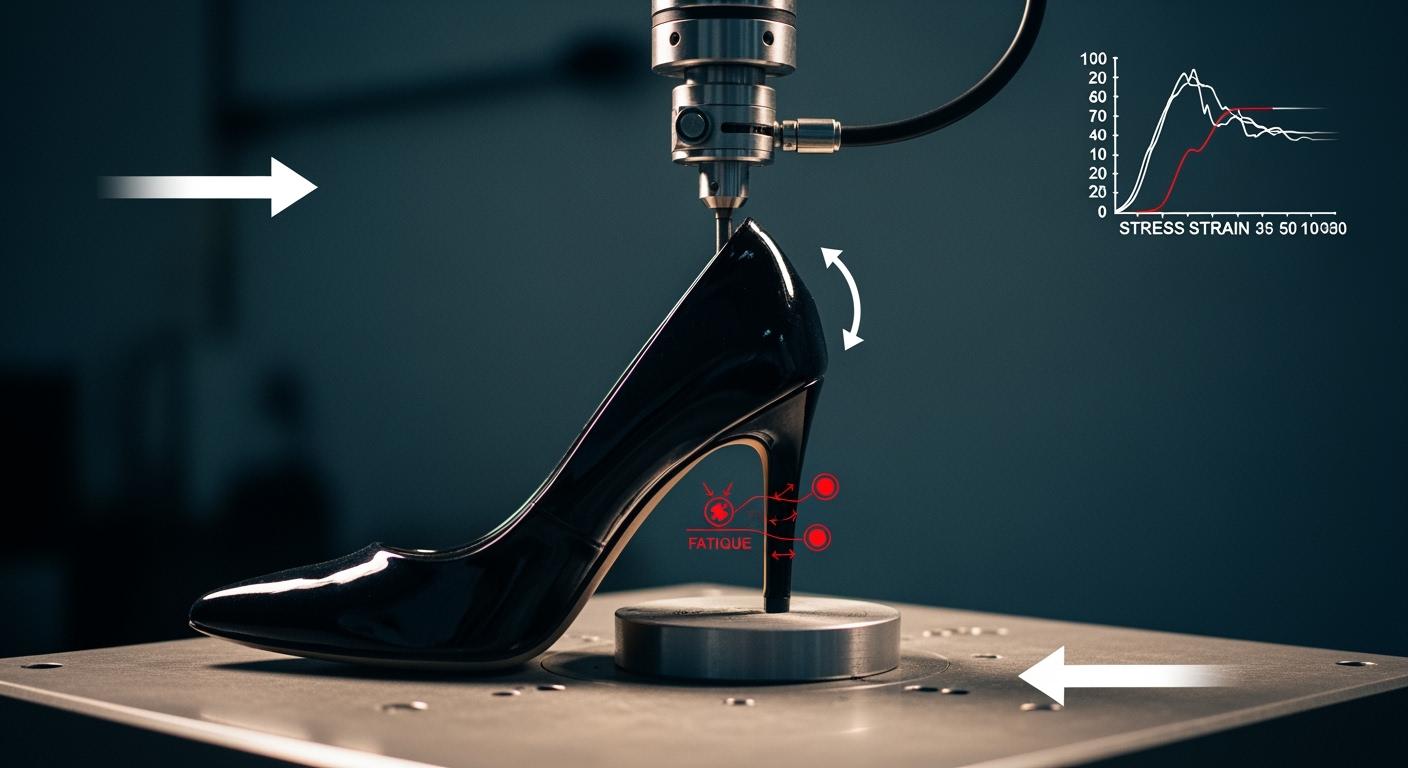
Verification of attachment strength is performed using a Universal Testing Machine (UTM) equipped with specialized footwear jigs. The technical goal is to determine the "Ultimate Tensile Strength" of the assembly. The shoe is clamped firmly at the forepart, and a constant rate of pull (typically 25mm/min) is applied to the heel tip.
Adhesion Kinetics and Mechanical Fastening
A reliable bond is achieved through a combination of chemical adhesives and mechanical "Heel Pinning." Quality control technicians monitor the "Roughing" process of the sole and the "Heat Activation" temperature of the PU adhesive. If the temperature deviates by even 5'C, a "Cold Bond" is formed, which may pass initial inspection but will fail during the first 1,000 steps of use. Regular quality inspections must verify the adhesive batch records and press-time durations.
Engineering Focus: The most common failure mode identified in labs is "Fastener Pull-through," where the screw heads are too small or the insole board (cellulose or fiberboard) is of insufficient density to retain the mechanical load under torque.
The Engineering of the Steel Shank: The Invisible Backbone
The shank is a metallic or composite plate inserted between the insole and outsole. In high heels, it is the primary load-bearing element that prevents the shoe from folding under the wearer's weight. Verification of the shank is a critical component of industrial footwear quality checks.
- Material Composition: Typically tempered spring steel or reinforced glass-fiber.
- Hardness Testing: Rockwell C (HRC) testing ensures the steel is stiff enough to support the arch but not so brittle that it snaps under impact.
- Fatigue Resistance: The shank must withstand 100,000 flex cycles without developing micro-cracks that lead to permanent "sagging" of the arch.
Dynamic Fatigue Simulation: ISO 19956 Protocols
Unlike a static pull test, fatigue testing captures the cumulative damage of daily wear. The heel is mounted in a "Heel Fatigue Tester" and subjected to repeated blows from a mechanical striker. According to ISO 19956, the striker delivers a standardized impact of 0.68 Joules at a frequency of 1 impact per second.
Quantitative Failure Analysis
Failure is identified by visual cracks at the heel base, loosening of the attachment, or a "Settling" of the heel angle. High-end brands utilizing ABS (Acrylonitrile Butadiene Styrene) or Polycarbonate heel blocks must ensure the material is "Virgin Grade" rather than reground scrap, as recycled polymers possess shorter molecular chains that fail prematurely during the fatigue cycle.
| Standard | Test Type | Requirement |
|---|---|---|
| ISO 19956 | Fatigue Resistance | Zero cracking after 20,000 blows |
| ISO 19953 | Impact Resistance | Single strike to failure > 10.0 Joules |
| SATRA TM21 | Fatigue of Heel Blocks | Assessment of internal voids and porosity |
High-Energy Impact Validation: Resisting Sudden Failure
Impact resistance (ISO 19953) evaluates the heel's ability to withstand a single, high-magnitude force—simulating a stumble or an encounter with a floor grating. The test utilizes a pendulum striker that hits the heel at its most vulnerable point (typically the lower third). The technical benchmark is the "Energy to Failure."
For stilettos with a diameter less than 10mm, the use of a "Steel Insert" or "Internal Dowel" is a mandatory technical requirement to prevent lateral shearing. During a standardized product inspection, X-ray analysis can be used to verify the correct depth and alignment of these internal reinforcements without destroying the sample.
Total Quality Control in the Production Lifecycle
Consistency in high heel safety is achieved by integrating quality assurance steps into every stage of production. A simple final audit is insufficient for safety-critical components like heels.
- Pre-Production (PPI): Testing the Shore Hardness of the TPU top-pieces to ensure they don't wear out within the first week of use.
- In-Process (DPI): Torque testing the screws used in heel attachment to ensure they meet the 5.0 Nm threshold before the sock liner is inserted.
- Final Random Inspection (FRI): Performing "Symmetry Checks" to ensure the heel pitch is identical on the left and right shoes, preventing pelvic misalignment for the wearer.
Conclusion: The Scientific Baseline of Elevated Comfort
The perceived comfort of a high heel is technically a function of its structural stability. A heel that flexes or "wobbles" during walking triggers muscle fatigue and increases the risk of ligament strain. By adhering to standardized shoe manufacturing protocols and rigorous mechanical validation, brands can deliver products that balance fashion with functional safety. Transparency in these testing processes builds consumer confidence and establishes a market position based on engineering excellence rather than just visual appeal.
Ready to secure your product quality before shipment?
As your third-party inspection, testing & certification partner in China, TradeAider supports brands and sourcing teams across the entire production process, helping you identify quality risks early, ensure compliance, and strengthen your team’s capabilities before shipment.
Book an Inspection or Testing Service with TradeAider today, or for tailored solutions and expert guidance, contact us at services@tradeaider.com.
Frequently Asked Questions (FAQ)
What is the primary cause of a heel snapping?
Most snaps are caused by "Internal Voids" in the injection-molded plastic or the absence of a steel reinforcing dowel in thin stiletto designs. These are technical manufacturing defects that can only be detected through X-ray or destructive impact testing.
Why is the steel shank so important in high heels?
Without a shank, the arch of the shoe would collapse under the wearer's weight, causing the heel to tilt backward. The shank acts as a cantilever beam, distributing the load from the heel seat to the ball of the foot.
Can I repair a loose heel at home?
Technically, no. High heels are assembled using high-pressure industrial presses and heat-activated adhesives. Simply using household superglue will not achieve the required SATRA TM113 bonding strength (minimum 400N), posing a severe safety risk to the wearer.
What is the "Heel Seat" and why does its density matter?
The heel seat is the area of the insole where the heel is attached. If the fiberboard used is too soft, the screws will "churn" through the material under the dynamic loads of walking, leading to a loose and unstable heel assembly.
How many flex cycles should a quality high heel withstand?
Standard industrial benchmarks require a minimum of 20,000 to 50,000 flex cycles for the whole shoe without any visible delamination or metal fatigue in the shank. Professional-grade footwear often targets 100,000 cycles to ensure a full year of regular use.

Related Articles

Grow your business with TradeAider Service
Click the button below to directly enter the TradeAider Service System. The simple steps from booking and payment to receiving reports are easy to operate.

