
- About Us

- Our Services
- Your Industry
- Resources
- News & Blog
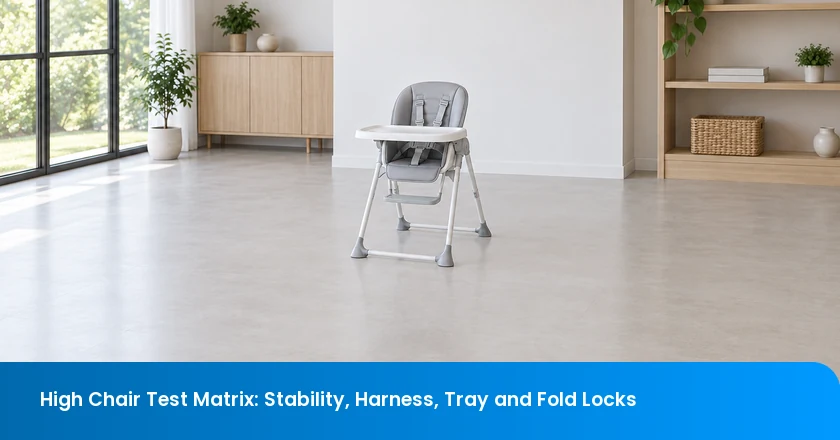
A useful high chair inspection test matrix links each risk to a defined setup, a method and a recorded result. Give tip-over stability, harness attachment, tray retention and folding locks separate entries. Then identify the seat, tray and frame configurations covered by each result. A satisfactory test in one setting cannot fill a missing result for another setting required by the approved plan. That distinction lets an importer request targeted verification without inventing either a pass or a product failure.
What the High Chair Matrix Should Tell You
- Which configuration was checked, against which requirement, and with what outcome.
- Whether the restraint, tray and folding mechanism remain secure under their specified checks.
- Which failures need correction and which unperformed checks need equipment or additional verification.
Confirm the High Chair Category and Required Test Methods
Start with the intended product modes and destination market. A freestanding high chair, a booster attached to an adult chair and a convertible product do not automatically share the same inspection route. Confirm the model, age and use limits, construction and supplied accessories with the technical owner before deciding which requirements belong in the plan.
For the United States, the September 9, 2026 version of 16 CFR part 1231 incorporates the applicable provisions of ASTM F404-21 for high chairs. A later voluntary standard edition should not be treated as the mandatory US reference merely because its date is newer. Establish the applicable regulatory and contractual references for the goods being supplied, including any relevant production-date conditions.
Obtain the controlled test procedures as well as the standard designation. A heading such as “stability” does not specify the loading device, orientation, surface, setup or acceptance criterion. The qualified technical reviewer should translate the applicable requirements into executable instructions and identify work that requires laboratory facilities. Do not assign universal forces or cycle counts to every chair based on a generic checklist.
These four risk groups are central functional checks, not the whole conformity file. Materials, sharp edges, small parts, labels, instructions and other applicable requirements still need their own evidence. Keep their references available without treating an inspection matrix as a replacement for the complete compliance assessment.
Prepare the Chair, Instructions and Configuration List
Review TradeAider’s company background when evaluating the inspection provider, then confirm the actual high-chair methods and equipment available for the assignment. General provider credentials do not answer whether a particular stability fixture or restraint test can be supplied on the visit date.
Prepare the exact chair model, assembly instructions and configuration list. Identify approved seat heights or recline settings, tray positions, folding states and any conversion modes. Mark which combinations the agreed procedure requires, rather than asking the inspector to choose whichever setting is easiest to assemble.
Supply the drawing revision, hardware and restraint references, approved sample where relevant, defect criteria and sample allocation. Distinguish a visual comparison sample from evidence that a test has been completed. For adjustable products, provide a reliable way to identify the setting, such as the position designation used in the instructions.
Confirm access to shipment units, unpacking and assembly time, and permission for checks that may damage or consume samples. Assign responsibility for unavailable equipment before the appointment. The factory should know whether it must provide a specified fixture, while the buyer should know which planned results will remain unavailable if it does not.
High Chair Inspection Test Matrix: Setup, Result and Action
Each matrix result should name the configuration, approved method, measured or observed outcome and any unresolved action. Adjustments can change the engagement or geometry being assessed. Recording those details prevents a result from being silently extended to an untested required setup. Use one result entry for each required setup, even if several entries belong to the same risk group.
Use the following matrix to organize the brief and report. Enter the exact limits and procedures from the accepted product requirements; the entries below identify the evidence to collect rather than prescribing a laboratory protocol.
| Risk group | Configuration to identify | Result to record | Escalation trigger |
|---|---|---|---|
| Tip-over stability | Seat, tray, frame and test-surface setup required by the method | Specified stability outcome and any movement or damage | Failed criterion or an unavailable required setup |
| Harness / restraint | Installed routing, adjuster setting and attachment points | Buckle, webbing, adjuster and anchorage results under the approved checks | Detachment, slippage, incorrect routing or missing verification |
| Tray lock | Named tray position and intended engagement state | Retention, release-mechanism and relevant opening results | Disengagement, failed opening criterion or an untested required position |
| Folding mechanism | Open/locked state and specified operating sequence | Lock engagement, retention, operation and observed interference | Unintended folding, incomplete lock or sequence not completed |
Give every finding a sample identifier and attach photographs that show both the overall setup and the relevant component. Record the instrument or fixture reference where it affects interpretation. “Passed” without a method or configuration can be impossible to reconcile with the agreed plan; “not performed—fixture unavailable” identifies a specific task that still needs arranging.
Add the follow-up owner and the evidence needed to close each open item. TradeAider’s inspection-standard guidance is useful for discussing the general inspection basis. Pair it with the high-chair procedures so the factory, inspector and importer use the same criteria when reading the results.
Tip-Over Risk: Match the Result to the Test Setup
A chair standing upright on the inspection-room floor has not thereby passed its required stability assessment. Identify the seat and tray settings, supporting surface and other setup conditions required by the method. Record those conditions before applying the specified test so a reviewer can understand what the result covers.
The US Consumer Product Safety Commission (CPSC) lists static load and stability as separate performance areas in its high-chair business guidance. The distinction prevents a seat-load observation from being reported as proof against tip-over. The guidance also identifies restraint, tray and locking requirements, but the complete procedures must come from the applicable standard and controlled test instructions.
Look at the assembled frame before testing: are the feet seated as instructed, are adjustable elements secured, and is there damage or distortion that changes the setup? Document a discrepancy before correcting it. If the test requires particular wheel or brake conditions, use those conditions rather than assuming the configuration chosen for storage is appropriate.
During and after the procedure, record the relevant movement, loss of support, damage or other specified outcome. Interpret it against the actual criterion. Do not classify every visible motion as a failure, and do not call the result satisfactory merely because the chair did not fall over during casual handling.
When a required configuration cannot be established, explain why and identify the missing verification. A load of the wrong shape or an improvised support surface can change the question being tested. The resulting observation should not be promoted into the required result just to complete the report.
Harness: Follow the Restraint to Its Attachment Points
Inspect the restraint as an installed system. Follow the webbing from the buckle through the adjusters and routing points to the chair attachments. Compare that arrangement with the approved design and instructions, including any required crotch restraint or other components. A buckle in the accessory bag does not show that the restraint is connected to the product.
In the May 2025 Boyro Baby high-chair recall, CPSC identified a restraint system that was not attached to the product, alongside lock or latch failures and an entrapment opening. The restraint finding shows why checking only that the buckle closes misses a different failure path: the child and fastened webbing can remain unsecured to the chair. This was a stated defect in the recalled product, not a finding about all high chairs.
For the sampled chair, record routing, missing or damaged webbing, stitching, adjuster condition and the attachment interface. Check the fastening and release functions in the agreed sequence. Where the method requires retention or strength testing, record that result separately from the visual and operational observations.
Inspect the relationship between the cushion and restraint routing as well. A removable pad can conceal an attachment or make incorrect reassembly look plausible. The report should show the intended installation, rather than using an attractive front photograph that hides how the webbing reaches the frame or seat.
If a strap slips, an attachment detaches or the required check cannot be completed, name the affected component and sample. Preserve the finding before the factory changes the adjustment. The technical reviewer then has enough information to distinguish assembly error, component nonconformity and missing evidence, which require different follow-up.
Tray Lock: Check Engagement, Retention and Openings
Record the tray position before checking its lock. A sliding tray may have several intended engagement points, and the approved procedure determines which need assessment. Observe how the tray engages, how its release mechanism operates and whether the relevant retention requirement is met. Smooth travel along the rails alone does not answer those questions.
The September 2024 MJKSARE recall described leg openings that were too wide, creating an entrapment hazard, and a tray that could disengage, creating a fall hazard. These are distinct observations. A tray-retention result does not by itself establish that surrounding openings meet their own requirements.
Where the design has engagement on both sides, document the installed condition on each side rather than assuming that movement of one release control proves both are secure. Use the designated position names in photographs and results. If the control feels obstructed or the tray is difficult to install as instructed, record that before anyone lubricates, trims or replaces a part.
Apply the required retention, release and opening methods with their correct setup. Do not turn a consumer recall remedy into a universal inspection technique, and do not select an arbitrary pull force. The agreed method should state the direction, fixture, condition and outcome needed for the product.
Keep position coverage visible. If the plan requires several settings and one is untested, that absence belongs in the matrix even when every recorded result is satisfactory. This is a coverage problem requiring a further check; it is not sufficient evidence to call the untested position either defective or acceptable.
Folding Mechanisms: Verify the Open and Locked State
Begin folding checks with the instructed open and locked state, then follow the required operating sequence. Record whether the lock can be engaged as intended and whether its condition changes after operation. A factory demonstration performed once on a prepared showroom sample cannot replace the agreed observations on identified shipment samples.
TradeAider’s pre-shipment inspection service provides agreed functional, dimensional and packaging observations on finished goods. Its readiness condition is 100% of the order quantity complete and at least 80% packed for export. Arrange pre-shipment inspection (PSI) with time and access for the planned assembly and operating checks, and confirm any specialist equipment separately.
The January 2007 Graco Contempo recall identified a collapse hazard when the chair was not fully opened and locked after storage. The historical advice for those recalled models included an audible indication; that does not make a click a universal substitute for verifying another chair’s lock engagement and retention.
Observe the actual locking parts and any interference from fabric, tray storage or adjacent components during the specified sequence. Keep hands clear of moving pinch points and use the approved handling procedure. Record scissoring or shearing concerns for evaluation against the applicable requirements rather than attempting an improvised test with a person’s fingers.
At the end of the sequence, identify the resulting configuration and any looseness, damage or incomplete locking. If the procedure requires further checks afterward, keep their results connected to that sample. Closing a folding observation because the mechanism eventually works after repeated adjustment would conceal the conditions under which it initially failed.
Separate Failed Checks from Missing Test Coverage
Keep a required check open when its configuration has no result. A pass elsewhere cannot establish the absent outcome, while missing evidence alone does not prove that the product failed. A useful report distinguishes satisfactory results, failures, unperformed checks and items deemed inapplicable with a documented technical basis.
For US children’s products, the domestic manufacturer or importer issues the Children’s Product Certificate (CPC) using the required testing basis. The CPSC certification guidance explains that responsibility. Match the conformity evidence to the supplied model and relevant changes; a factory inspection report supports a different decision and is not itself the certificate.
For each unresolved matrix entry, state what the next action must produce. A failed latch may need an approved correction and verification. An unavailable fixture requires a proper test arrangement. An ambiguous position record may require clarification or a repeat observation. These actions should follow the actual evidence gap, rather than a default instruction to rework every unit.
Workmanship sampling can be planned through an acceptance quality limit (AQL) approach. TradeAider’s AQL calculator helps with that sampling calculation, but a workmanship acceptance number does not supply missing functional evidence. Keep unresolved safety checks identifiable for the responsible technical reviewer and importer.
Illustrative Example: One Tray Position Tested, Three Required
Consider an illustrative order of 900 adjustable high chairs. The tray has three permitted positions, and the buyer’s approved inspection plan requires verification in each position. Finished goods are available, but the specified fixture for the inner and outer positions is unavailable during the visit. The middle-position check produces a satisfactory result. All 900 units share this adjustable design. These are hypothetical conditions, not measured TradeAider client data.
The tray row remains incomplete because two required configurations have no result. The importer keeps the order’s planned tray verification open instead of converting the middle-position pass into a model-wide pass. Equally, the report should not invent a failed tray test: none has been observed in this example. The unresolved question concerns coverage for the 900-unit order, not a proven defect count.
Arrange the specified fixture and a competent operator, retaining the sample identifiers and position definitions for the follow-up. Complete the missing checks under the approved plan and record their criteria and outcomes. The technical owner reviews that evidence before the importer makes the shipment disposition. No blanket requirement to test every setting in every standard is implied: the three-position scope comes from this illustrative approved plan. Other findings and certification requirements remain separate.
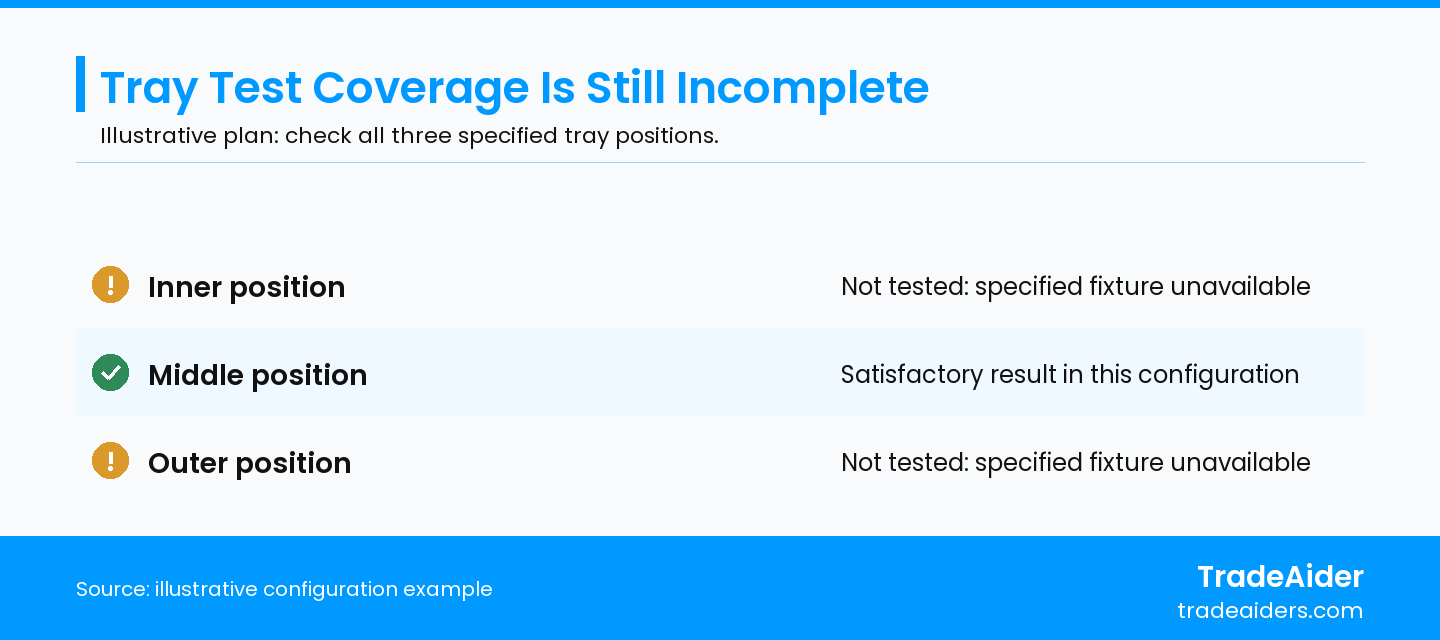
Illustrative plan: two required positions remain untested. A missing result is neither a pass nor proof of failure.
Send TradeAider a Configuration-Based Inspection Brief
Send the model, destination, assembly instructions and configuration list with your inspection request. Include the accepted methods, sample allocation, criteria and equipment requirements. Identify any open results from earlier testing so the visit addresses the evidence you actually need.
Add the order quantity, packing readiness, factory location and access arrangements. Ask the team to confirm the checks feasible during the visit and the expected report contents: sample-linked measurements, photographs, operational observations and packaging findings. Arrange specialist testing separately where the agreed methods require it.
Contact TradeAider to scope your high chair inspection using those materials. A clear configuration list makes the resulting report easier to review and helps the importer distinguish a completed check from work that still needs to be arranged.
Frequently Asked Questions
Can a household weight replace the specified stability fixture?
No. Equal mass alone does not establish equivalent contact geometry, loading position or application method. Use the fixture and setup specified by the approved procedure. If that arrangement is unavailable, record the check as unperformed and agree a suitable test location instead of reporting an improvised observation as the required result.
Should every sampled chair undergo destructive testing?
Not automatically. The inspection sampling plan and the sample allocation required by a test method answer different questions. Agree which units undergo which procedures, whether sequence matters and how tested units will be handled afterward. Do not return a damaged or otherwise unsuitable test sample to saleable stock.
Can a booster-seat report cover the high-chair mode?
Not by itself. Establish the applicable requirements for each intended mode and confirm which configurations the evidence actually covers. A conversion feature can change the support and attachment arrangement. The technical owner should resolve the required assessment before a report for one mode is used to support another.
Does a removable tray make the harness optional?
No. Tray removability does not eliminate the applicable restraint requirements. Use the complete restraint system specified for the high chair and follow its instructions in the relevant configuration. Treat the tray and restraint as separate inspection subjects rather than assuming that either component can substitute for the other.
Related Articles
Grow your business with TradeAider Service
Click the button below to directly enter the TradeAider Service System. The simple steps from booking and payment to receiving reports are easy to operate.

