
- About Us

- Our Services
- Your Industry
- Resources
- News & Blog
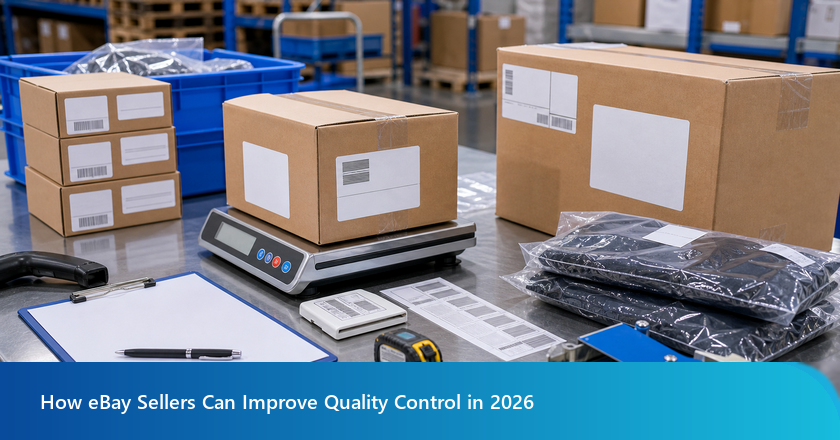
In 2026, eBay sellers improve quality control by treating every listing as a promise that must be verified before shipment: product identity, condition, accessories, tool-assisted description text, safety status, labels, packing, and defect evidence all need to match what the buyer will receive. The goal is not only fewer defective units; it is fewer item-not-as-described returns, fewer safety disputes, stronger service metrics, and cleaner supplier negotiations.
eBay ties seller quality to buyer experience. Its seller performance overview explains that seller level can be affected by cases closed without seller resolution, transaction defect rate, and late shipment rate. In 2026, quality control therefore belongs before the listing and before the shipment, not only after a customer complains.
The platform also evaluates return and item-not-as-described signals. eBay service metrics track buyer reports such as item not received and item not as described against peer benchmarks, with monthly evaluation logic. For sellers importing from China, that turns factory QC into account-risk control.
Listing accuracy now needs extra discipline because sellers may use templates, third-party tools, translation, image editing, or auto-filled copy. eBay's User Agreement says sellers are responsible for item accuracy and listing content, including content created using eBay or third-party tools. A seller should therefore verify tool-assisted claims against the actual shipment.
Product safety is another boundary. eBay product safety policy says unsafe, banned, recalled, or non-compliant products are not allowed. An eBay seller cannot solve that risk with appearance inspection alone; the seller needs product-category evidence before listing and before release.
- Start with the 2026 listing promise: photos, tool-assisted text, condition, dimensions, accessories, compatibility, and packaging must match the actual lot.
- Inspect the current shipment: supplier samples and old photos do not prove the goods now packed for export.
- Make safety evidence separate: restricted, recalled, or regulated products need documents and testing where applicable.
- Use service metrics and returns as QC data: every INAD, damage, or quality-related return should become a defect class, supplier question, or listing correction.
What Quality Control Should eBay Sellers Improve First?
In 2026, eBay sellers should improve the control between the listing promise and the current shipment first: verify product identity, condition, tool-assisted description claims, accessories, labels, function, packing, and safety evidence before the lot ships, then use service metrics and return reasons to update the next inspection file.
Many 2026 seller problems begin when the listing is built from the supplier's sample, an old template, or auto-filled product text, while the bulk shipment changes material, color, accessory set, packaging, barcode, firmware, finish, or condition. The buyer does not compare the product to the supplier's memory. The buyer compares it to the listing.
eBay selling rules make that practical. The selling practices policy covers item descriptions, terms, shipping, returns, communication, and photos. For QC, the so-what is clear: the product file should include the same claims the listing makes, then inspection should prove whether the shipment can support those claims.
For sellers using sampled inspections, ISO 2859-1:2026 gives an AQL sampling framework for attribute inspection. AQL does not decide what matters on eBay; the seller must define critical, major, and minor defects based on buyer-visible claims, product safety, marketplace restrictions, and return impact.
eBay Seller QC Workflow Before Shipment
Use the 2026 workflow to connect eBay account risk to listing, supplier, inspection, and return evidence.
| Control Point | What to Check | eBay Risk Reduced | Action Rule |
|---|---|---|---|
| Listing promise | Photos, tool text, condition, dimensions, compatibility, accessories | Item not as described | Update listing or hold goods |
| Product identity | SKU, barcode, model, version, label, carton mark | Wrong item and receiving disputes | Correct labels before shipment |
| Safety status | Restricted item, recall risk, test report, warning label | Policy removal or buyer harm | Verify documents before listing |
| Pre-shipment inspection | AQL, function, workmanship, accessories, packing | Quality returns and defects | Release, sort, rework, reinspect |
| Packing control | Retail box, master carton, cushioning, moisture, barcode | Damage and poor buyer experience | Improve packing before cargo leaves |
| Metrics and return review | INAD, damage, wrong item, faulty, missing parts | Repeat defect pattern | Update defect classes for next PO |
The workflow is deliberately seller-facing. A factory may think a small accessory change is acceptable, but an eBay buyer may see it as a missing item. A supplier may accept a slightly weaker carton, but a seller may see damage claims. Quality control must protect the listing promise, not only the factory's internal tolerance.
The seller should also avoid treating every return as customer-service noise. A single return can be random. A repeated return reason by SKU, batch, accessory, condition claim, or package type is a quality-control signal.
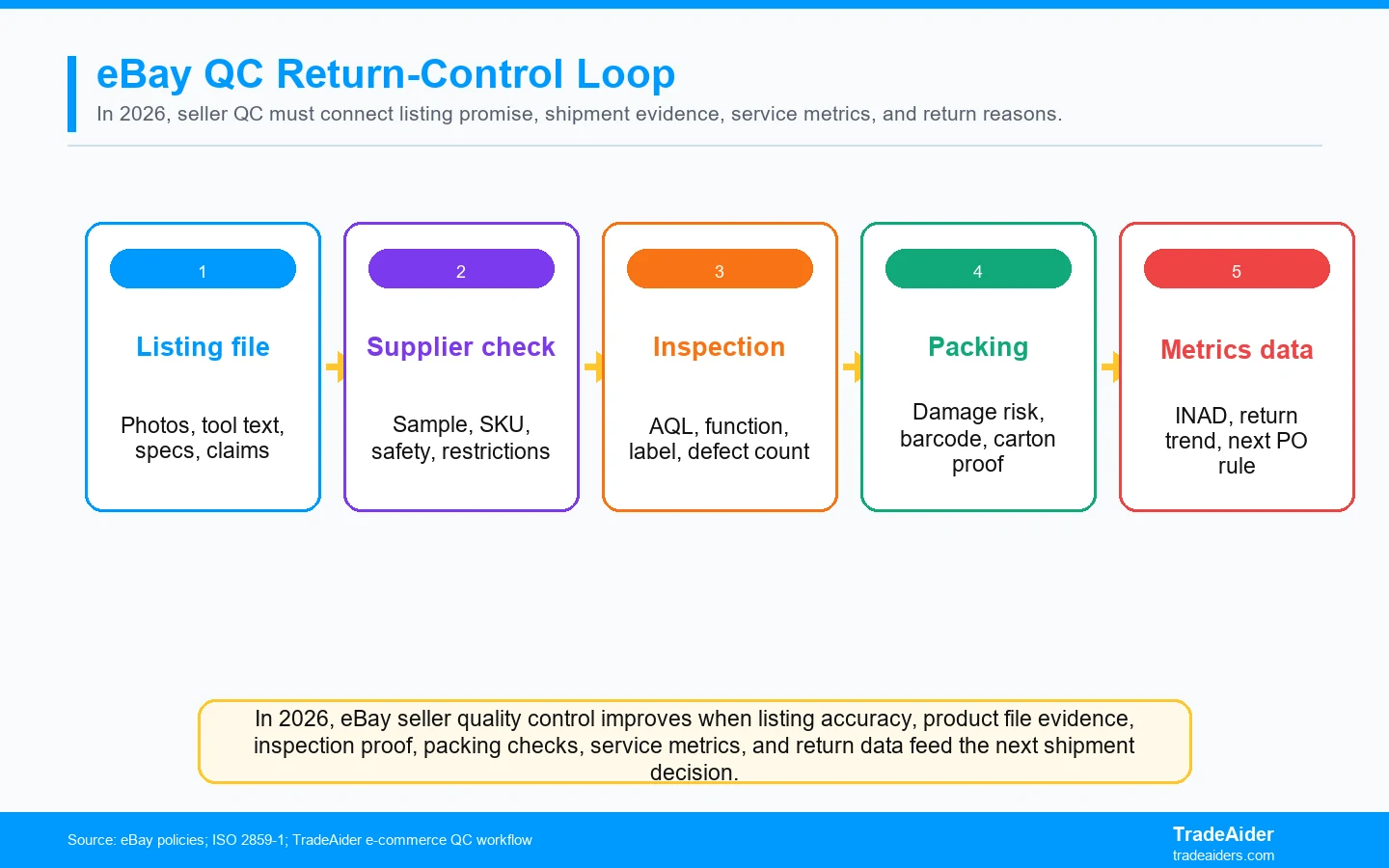
In 2026, eBay seller quality control improves when listing accuracy, product file evidence, inspection proof, packing checks, service metrics, and return data feed the next shipment decision.
The 2026 eBay QC Workflow Should Start With the Listing Promise
A listing is a quality specification once the buyer relies on it, even when the listing was built with templates or tool-assisted copy.
Photos and descriptions must match the current lot
Before listing or replenishing inventory in 2026, the seller should freeze a product file: sample photos, tool-assisted description text, dimensions, color, material, model, version, compatibility, condition, accessories, retail box, warning labels, barcode, and package contents. If the supplier changes any point, the seller should decide whether the listing changes or the shipment is held.
This is especially important for sellers who reuse listings across batches or rely on listing tools. A product can keep the same broad name while the supplier changes packaging, color shade, firmware, included cable, plug type, instruction manual, or finish. Inspection should compare the current lot against the live listing, not against a generic supplier catalog.
Condition claims need shipment evidence
New, open-box, refurbished, compatible, replacement, original, custom, and bulk-pack claims all create inspection needs. If the goods are mixed, reworked, scratched, repacked, or missing accessories, the seller's condition claim can become inaccurate even when the item still functions. If listing copy overstates condition or compatibility, that copy becomes a QC risk too.
A good pre-shipment report should photograph representative units, packaging, labels, accessories, and defect examples. Those photos help the seller correct the listing, negotiate with the supplier, or document why the shipment should be held.
Safety and Restricted-Item Checks Belong Before Listing
eBay marketplace quality control in 2026 includes product safety, recall status, and documentation, not only appearance.
Some products need documents before inspection can close the risk
Chargers, toys, children's goods, cosmetics, batteries, helmets, medical-style products, electrical products, chemicals, and branded replacement parts can carry safety, compliance, recall, or restriction risk. A supplier statement that many sellers buy the product is not enough.
eBay also provides product safety disclosure guidance that references safety test lab reports and product information. For the seller, that means the product file should identify which certificates, test reports, labels, warnings, or compliance statements must be reviewed before listing.
Inspection can verify evidence, but not replace required testing
An inspection can check whether the warning label is present, whether the test report reference matches the product, whether a recalled product is not being shipped, and whether packaging includes the approved information. It cannot prove chemical composition, electrical safety, battery safety, or long-term performance just by looking at the product.
When safety evidence is missing, the seller should stop the listing or shipment decision until testing, documentation, or product eligibility is resolved. This is not conservative bureaucracy; it protects the account, buyer, and supplier relationship from a much larger failure.
Pre-Shipment Inspection Should Be Built Around 2026 eBay Return Signals
The best inspection checklist is shaped by what buyers actually report in returns, service metrics, and messages.
Common return reasons become defect categories
Item not as described, damaged, defective, wrong item, missing parts, wrong size, incompatible, poor packaging, bad condition, or safety concern should each become a defect class in the 2026 inspection file. The seller should not wait until after the next batch ships to learn the same lesson again.
For example, if returns mention missing screws, the next inspection should include accessory counting and photo evidence. If returns mention color mismatch, the checklist should compare the shipment to listing photos and approved shade samples. If returns mention damaged retail boxes, packaging checks become part of product quality.
AQL needs eBay-specific severity rules
A small cosmetic defect hidden inside a package may be minor. A missing accessory promised in the listing may be major. A safety label error can be critical. A compatibility claim that the product cannot support can also be major. The seller should define severity based on buyer promise, platform risk, and product category rather than using a generic factory view of defects.
Sample spread also matters. If a shipment contains several SKUs, colors, sizes, accessories, or carton versions, the inspector should pull samples across those groups. A clean sample from one SKU cannot prove a mixed shipment is clean.
Scenario Estimate: A 2% Accessory Error Can Become an Account Problem
Small factory mistakes create marketplace risk when they repeat across a SKU.
Assume an eBay seller imports 3,000 units of a kit and 2% are missing a promised accessory. That is about 60 affected orders if the problem reaches buyers. If each return, replacement, support contact, or refund event costs $11 in handling and shipping exposure, the direct cost is roughly $660 before counting feedback, service metrics, or account stress.
This estimate is not a guaranteed ROI claim. It is a trigger. If the accessory is promised in the listing, missing it is not a minor factory detail. The seller should hold the affected subgroup, add accessory photo proof, and correct the supplier packing process before release.
The same logic applies to wrong labels, weak packing, safety warnings, compatibility claims, tool-assisted description errors, and condition claims. Quality control is strongest when the seller converts repeated marketplace complaints into pre-shipment evidence rules.
Packaging, Service Metrics, and Return Data Should Change the Next Purchase Order
For eBay sellers in 2026, quality control keeps improving only when shipping damage, INAD language, and service-metric signals become supplier instructions.
Packing checks should reflect the fulfillment route
A product that survives a factory sample-room photo can still fail the buyer when it travels through parcel networks, warehouse receiving, FBA-style handling, or a seller's own packing process. The inspection file should name retail-box condition, inner protection, master carton strength, barcode position, accessory separation, moisture control, and whether the product can move inside the package.
If buyers complain about crushed boxes, scuffed finish, loose accessories, or broken corners, the seller should not only refund and move on. The next inspection should photograph the packing structure and test whether the weak point has been corrected. Otherwise the same claim returns with the next replenishment order.
Return reasons are a free defect database
Small eBay sellers often lack a formal quality dashboard, but service metrics and return comments still contain useful signals. Group them by wrong item, missing part, damaged package, fit issue, compatibility issue, poor condition, safety concern, or not-as-described claim. Then attach those categories to the next inspection checklist.
The seller should also distinguish listing fixes from supplier fixes. If buyers misunderstood a dimension, update the listing. If the product shipped with the wrong dimension, correct the supplier file. If packaging failed, change the carton or inner protection. Quality control improves fastest when the cause, not only the refund, is recorded.
Where TradeAider Fits for eBay Sellers
TradeAider helps eBay sellers turn 2026 marketplace promises, tool-assisted listing claims, service-metric signals, return data, and supplier risk into inspection evidence before inventory leaves China.
For e-commerce orders, TradeAider e-commerce quality solutions can connect product file review, live listing claims, sample evidence, packaging checks, labels, accessories, and shipment inspection to the seller's marketplace risk.
When the lot is ready, Pre-Shipment Inspection can verify the packed goods, AQL sample, defect counts, labels, accessories, and carton evidence. If supplier process drift is the issue, During Production Inspection can catch repeated defects earlier.
For safety-sensitive categories, TradeAider can coordinate product testing services alongside inspection so the seller does not rely on visual checks for claims that need a lab or compliance file.
SPAR Scenario: The 2026 Listing Was Accurate, but the Batch Changed
The seller used inspection to protect the listing promise before service metrics and return requests exposed the change.
Situation: An eBay seller replenished 4,500 phone accessory kits from a supplier that had shipped acceptable goods before.
Problem: The supplier changed the cable length and inner pouch without telling the seller, while the listing photos and tool-assisted bullet text still showed the old version.
Action: The seller asked TradeAider to inspect the current batch against the live listing, tool-assisted description claims, accessory list, and carton labels before release.
Result: The seller held 1,200 affected units, updated the listing for the approved version, and avoided shipping a batch that would have created item-not-as-described returns and service-metric pressure.
eBay Seller QC File Before Inspection
Build the 2026 inspection file from the listing promise, listing text, service metrics, and return history.
- Live listing photos, tool-assisted copy, condition claim, dimensions, compatibility, and accessory list.
- Approved sample, current supplier sample, barcode, SKU, and packaging photos.
- Critical, major, and minor defects mapped to eBay return reasons and service-metric risk.
- Safety, restriction, recall, test report, warning, and label evidence if applicable.
- AQL sample spread by SKU, color, size, carton, and production date.
- Packing and damage-prevention checks for the seller's fulfillment route.
The seller should update this file after every meaningful 2026 service-metric or return pattern. If buyers repeatedly report damage, missing parts, color mismatch, compatibility failure, wrong condition, or inaccurate listing claims, the next inspection should include that exact risk.
A small seller does not need a complicated quality department. The practical starting point is a listing-linked inspection file and a clear rule for release, hold, sort, rework, testing, or listing correction.
If your 2026 eBay returns or service metrics point to quality, accessory, condition, listing-accuracy, safety, or packing problems, send TradeAider the live listing, listing copy, sample photos, PO, accessory list, recent return reasons, and production status. The next step is to prepare an eBay-focused inspection checklist before the next batch ships.
Frequently Asked Questions
How can eBay sellers reduce INAD returns in 2026?
They should compare the current shipment against the live listing, tool-assisted description, approved sample, condition claim, accessory list, labels, and packing before release. Return reasons should update the next inspection file.
Do eBay sellers need pre-shipment inspection?
They often do when importing private-label, bundled, safety-sensitive, fragile, or repeat-return products. PSI gives shipment evidence before inventory leaves supplier control.
Can inspection solve product safety policy risk?
Inspection can verify labels, documents, and visible condition, but it cannot replace required testing, recall checks, or product eligibility review for restricted or safety-sensitive products.
What should eBay sellers inspect before listing?
They should verify product identity, condition, dimensions, compatibility, tool-assisted claims, accessories, safety evidence, labels, packaging, and photos before the listing promise reaches buyers.
How should service metrics affect quality control?
Repeated return and service-metric signals should become defect categories, supplier questions, sampling priorities, packing checks, and listing corrections for the next purchase order.
Related Articles

Grow your business with TradeAider Service
Click the button below to directly enter the TradeAider Service System. The simple steps from booking and payment to receiving reports are easy to operate.

