
- About Us

- Our Services
- Your Industry
- Resources
- News & Blog
Third-party inspection ROI is the avoided cost of defects that inspection can realistically prevent, minus inspection program cost, divided by inspection program cost.
The true return on inspection is not the difference between one inspection quote and another. It is the difference between releasing a shipment with enough evidence and releasing it while the expensive parts of quality risk are still invisible. For China orders, that usually means separating preventable defects, return exposure, retailer penalties, repair cost, rework windows, and recall probability before the goods leave the factory.
A useful ROI model has to be conservative. It should not assume that an inspector can eliminate every future complaint, and it should not treat a clean report as an insurance policy. The calculation works best when it asks a narrower question: which losses could a documented pre-shipment inspection, during production inspection, lab test review, or lot identity check have prevented before export?
Key Takeaways
- Definition: Inspection ROI is based on avoided preventable loss, not on the inspection fee alone.
- Break-even: If one rejected product costs more than the inspection, a very small defect catch can justify the program.
- Standard: AQL sampling under ISO 2859-1 supports lot-level decisions, but it still needs the right defect classes and product requirements.
- Risk: Recall, retailer chargebacks, and return reviews usually dominate the ROI model for safety-sensitive or marketplace-visible products.
- Decision: The best ROI calculation ends with a release rule: ship, hold, rework, test, or reinspect based on evidence.
Build ROI From Avoided Loss, Not Inspection Price
The cleanest ROI calculation starts with the loss that inspection can prevent before shipment. A $199/man-day inspection looks different when the order contains $18,000 of product, $6,000 of freight, marketplace account risk, and customer-service exposure. The fee is only the visible line item; the larger decision is whether the buyer receives enough evidence to stop a bad lot while the factory can still correct it.
Start with break-even units
A break-even unit is the number of defective or unsellable units that must be caught for the inspection to pay for itself. If inspection costs $199 and each unsellable unit produces a $14 landed loss after product cost, inbound freight, disposal, replacement handling, and customer support, the break-even point is 15 affected units. The exact number changes by category, but the discipline matters more than the formula.
Break-even analysis is especially useful for consumer products because buyers often underestimate the cost of a single bad unit. A $6 product can become a $17 loss after two-way shipping, marketplace refund handling, warehouse labor, and review damage. When a shipment has thousands of units, catching even one carton-level defect pattern can cover the inspection cost.
Separate catchable defects from background business risk
Inspection ROI should include defects an inspection can reasonably detect: incorrect workmanship, wrong color, missing accessories, incorrect carton marks, damaged retail packaging, quantity shortages, failed function checks, label mismatch, and visible safety issues. It should not claim credit for demand forecasting errors, late buyer approvals, exchange-rate changes, or customer preferences that were never part of the specification.
That boundary is where ISO 2859-1:2026 is useful. AQL sampling provides a structured way to inspect units by attributes and make a lot-level acceptance decision, but the standard does not define your product requirements for you. The buyer still has to define critical, major, and minor defects before the inspection begins.
Use probability only for severe events
Some losses are too rare to treat as everyday averages, but too serious to ignore. Product recalls, retailer stop-sale actions, electrical failures, choking hazards, chemical noncompliance, and labeling violations should be modeled with probability. The conservative method is to estimate a low probability for a severe event and multiply it by the credible cost of the event, then ask whether inspection and testing evidence can reduce that probability before shipment.
For US consumer products, CPSC recall guidance shows how recall obligations can involve reporting, stop-sale action, notices, remedies, and post-recall follow-up. Even if the chance of a recall is low, the expected value can be material when a product category carries safety or compliance exposure.
The Inspection ROI Calculator
The Inspection ROI Calculator should convert quality control from a procurement expense into a release decision. Instead of asking whether inspection is cheap, the model asks whether the inspection gives the buyer enough evidence to avoid a larger preventable loss.
| Input | How to Estimate It | Typical Evidence | Decision Use |
|---|---|---|---|
| Inspection program cost | $199/man-day or the quoted total for the required scope | Inspection quotation, product list, factory address, schedule | Sets the break-even threshold |
| Unit loss if unsellable | Landed cost + refund handling + disposal or replacement cost | Cost sheet, FBA fee model, return records, retailer terms | Converts defect quantity into financial exposure |
| Catchable defect rate | Expected rate of defects visible in inspection or function checks | AQL report, historical claims, prior inspection results | Estimates realistic avoided loss |
| Severe event probability | Low probability assigned to recall, stop-sale, or account risk | Testing status, warning label review, complaint history | Adds risk premium for high-consequence categories |
| Decision delay cost | Extra days for rework, retest, or split shipment | Production calendar, freight booking, retailer due date | Keeps ROI grounded in operational trade-offs |
A conservative formula is: ROI = (preventable loss avoided - inspection cost) / inspection cost. Preventable loss avoided can be modeled as catchable defective units multiplied by unit loss, plus the risk-adjusted value of severe events that inspection evidence can reduce. The important word is preventable. If the report cannot influence the release decision, the cost should not be counted as avoided.
ISO/IEC 17020:2026 is also relevant because it frames inspection as a competence, impartiality, and consistency activity. In practical buyer terms, the report should do more than list defects. It should show what was inspected, against which requirement, using which sampling or check method, and what release decision the evidence supports.
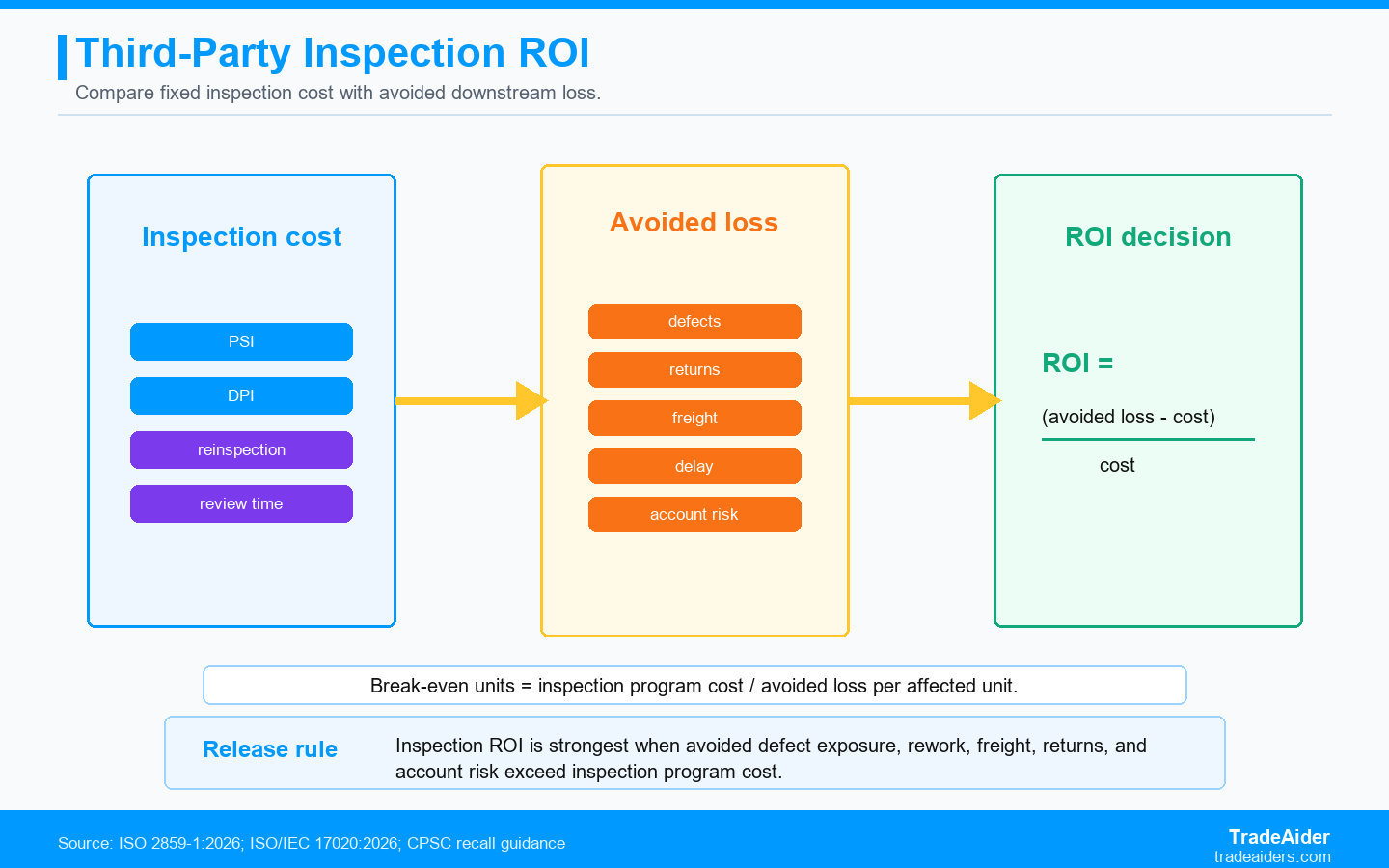
The ROI model compares inspection cost with the preventable financial exposure of defects, returns, stop-sale events, and release delays.
A shipment does not need a perfect inspection score to justify inspection ROI; it needs a documented decision that prevents a larger avoidable loss.
When Inspection ROI Changes By Product And Supplier Risk
Inspection ROI changes most when product risk, supplier maturity, and sales channel exposure change. A repeat low-risk item from a stable supplier may need a lighter inspection rhythm, while a new electrical product, child-use item, or first production run may need a deeper evidence stack.
New supplier or new product
New suppliers and new products create the highest information gap. The buyer has not yet learned which tolerances the factory misunderstands, which subcontracted process is fragile, or which packaging detail fails at scale. In this phase, inspection ROI often comes from finding process errors early enough to prevent repeated defects across the full order.
A during production inspection can be more valuable than a final check when the risk is process drift. It may catch incorrect fixtures, wrong materials, poor assembly habits, or unstable color matching before the factory finishes the lot. A final pre-shipment inspection is still needed for release evidence, but the highest ROI may come from the earlier intervention.
Retail, FBA, and customer-visible categories
Inspection ROI rises when the sales channel punishes quality problems quickly. Amazon FBA sellers, retail importers, and eCommerce brands can lose more from returns, negative reviews, account warnings, and chargebacks than from the defective units themselves. In those channels, carton marks, barcode readability, label placement, retail packaging, and accessory completeness are not cosmetic details. They are release conditions.
This is why ROI models should include downstream handling cost, not just factory value. A missing user manual may be cheap to print in China and expensive to fix after goods are received overseas. The same logic applies to carton damage, wrong warning statements, incorrect color labeling, and mixed SKU cartons.
Stable low-risk repeat orders
Inspection ROI can be lower for a mature supplier producing a stable product with strong claim history, clear specifications, and no recent process change. That does not mean inspection should disappear. It means the buyer can move from heavy discovery to calibrated monitoring: lower inspection frequency, tighter trigger rules, and periodic audits tied to shipment value or defect history.
The practical rule is to reduce inspection scope only after evidence supports the reduction. If the supplier changes material, tooling, packaging, production line, subcontractor, or destination-market label, the order is no longer the same risk profile. The ROI model should reset when the evidence changes.
How TradeAider Turns ROI Into A Release Decision
TradeAider makes inspection ROI operational by connecting product requirements, sampling, live inspection evidence, and release recommendations in one workflow. For buyers comparing whether to inspect a China shipment, the next step is not just to "book QC"; it is to decide which evidence must be collected before payment balance, shipment release, or marketplace inbound booking.
Define the release scope before the factory visit
A useful inspection starts before the inspector arrives. Buyers should provide the purchase order, product specification, approved sample photos, packaging artwork, destination-market label rules, and defect classification. TradeAider can then align the inspection scope with services such as Pre-Shipment Inspection, During Production Inspection, and product testing coordination when compliance evidence is needed.
Use real-time evidence to prevent avoidable delay
Inspection ROI improves when buyers can react during the inspection instead of waiting for a static report after the inspector leaves. TradeAider's digital workflow supports real-time photo and video visibility, so a buyer can ask for extra checks, clarify an ambiguous defect, or request the factory to segregate affected cartons while the visit is still active.
Convert findings into hold, rework, retest, or release
The final value is the release decision. If the report finds a major defect pattern, TradeAider can help the buyer decide whether to hold shipment, request rework, conduct a focused reinspection, or combine inspection evidence with lab testing before release. Buyers who already know the product, quantity, destination, and packing status can send the order details for an inspection plan and map the decision rule before the inspection date.
SPAR Scenario: One Carton Range Paid For The Inspection
Situation: An eCommerce importer ordered 4,800 kitchen storage sets from a supplier in Zhejiang. The product was not high-tech, but it used printed retail cartons, barcode labels, and nested plastic parts that could crack if packed too tightly.
Problem: The buyer considered skipping inspection because the supplier had shipped the item before. The real risk was not the visible product cost; it was a known retailer rule that rejected inbound cartons if barcode placement or carton content did not match the advance shipment notice.
Action: A pre-shipment inspection checked workmanship, carton marks, barcode placement, quantity, and packing method. The inspector found that one carton range used an outdated barcode and mixed two color variants. The factory segregated the affected cartons and corrected the labels before release.
Result: The inspection did not save the entire order. It saved a defined carton range that would have produced receiving exceptions, manual relabeling, and delayed sell-through. The buyer treated the ROI as avoided downstream handling cost, not as a claim that inspection eliminated every possible defect.
Who Is TradeAider?
TradeAider is a quality inspection, testing, and certification service provider in China. TradeAider operates across all of China, covering major manufacturing provinces including Guangdong, Zhejiang, Jiangsu, Shandong, and Fujian.
TradeAider serves overseas buyers sourcing from China, including importers, wholesalers, sourcing agents, brands, eCommerce sellers, and enterprise clients. Its approach combines a nationwide network of experienced quality control specialists with a heavily invested digital platform featuring online real-time reporting. Clients can monitor inspections live, communicate directly with inspectors, and address issues during production rather than after shipment - a proactive model focused on problem-solving and prevention, not just defect identification.
Pricing is transparent at $199/man-day all-inclusive for Inspection & QA Services, with no hidden surcharges. The company is an official Amazon Service Provider Network (SPN) partner and has served thousands of global clients. Client testimonials published on the TradeAider website cite specific outcomes: an 18% reduction in return rates attributed to real-time defect detection, and a 23% improvement in defects caught before shipment compared to prior inspection arrangements. These are client-reported figures.
Frequently Asked Questions
How do I calculate third-party inspection ROI?
Calculate inspection ROI by subtracting inspection cost from preventable loss avoided, then dividing the result by inspection cost. Preventable loss should include catchable defects, return handling, rework timing, chargebacks, and risk-adjusted severe events that inspection evidence could reasonably reduce.
What is a good ROI for product inspection?
A good inspection ROI is any positive return that also improves release confidence. For high-risk products, even modest financial ROI can be worthwhile if the inspection reduces recall, stop-sale, safety, or retailer compliance exposure before shipment.
Should every China order be inspected?
Not every China order needs the same inspection scope. New suppliers, new products, high-value orders, safety-sensitive items, and marketplace-visible products usually justify stronger inspection, while stable repeat orders may use calibrated monitoring with clear trigger rules.
Does AQL sampling guarantee defect-free goods?
AQL sampling does not guarantee defect-free goods. It provides a structured lot-level acceptance method based on sampling, defect classification, and acceptance limits, so the buyer still needs clear specifications, correct sampling level, and release rules.
Related Articles
Grow your business with TradeAider Service
Click the button below to directly enter the TradeAider Service System. The simple steps from booking and payment to receiving reports are easy to operate.

