
$199/man-day is below the market median for China-based third-party inspection — and the inspection it buys typically prevents 10 to 100 times its own cost in defect losses. The question most importers ask is not whether to inspect, but whether the specific number ($199) represents a fair price and what the real return on investment looks like. This article breaks down exactly what $199/man-day includes, how it compares to the $150–300 market range, and how to calculate ROI for your own order with a simple formula. The analysis draws on data from the American National Standards Institute's guide to ISO 2859-1:2026 AQL sampling and CPSC recall handbook guidance on the downstream costs of defective product distribution.
Key Takeaways
- Price in context: $199/man-day is 20–35% below international firms (SGS, Intertek average $300+) and at the low end of the local Chinese market range ($150–250).
- What's included: All-inclusive pricing covers inspector time, travel within manufacturing hub, AQL sampling, photo-video evidence, digital report, and real-time monitoring platform access — no hidden fees.
- ROI ratio: Inspection typically costs 0.1–0.5% of order value while preventing defect losses averaging 10–50% of order value — a 20:1 to 500:1 protection ratio.
- Break-even is low: On a $10,000 order, one defect prevented that would have caused an Amazon suspension ($50k+ revenue impact) pays for the inspection 250x over.
- Highest ROI cases: New suppliers, new product launches, high-return SKUs, Amazon FBA sellers near the 1% ODR threshold, and orders above $5,000 in value.
- Lowest ROI cases: Repeat orders from proven suppliers with zero defect history over multiple shipments — though even these benefit from periodic verification.
What $199/Man-Day Actually Means in Market Context
The man-day pricing model is the standard across third-party inspection firms in China, but the specific rate varies widely depending on which company you book and what's included in the quoted price. Understanding this market context is the starting point for an honest ROI analysis.
A man-day in third-party inspection is one full working day of one qualified inspector on-site at the factory, typically 8 hours of active inspection time plus report preparation. The man-day rate is the primary unit of pricing and is quoted inclusively (travel, equipment, reporting) by reputable providers, or non-inclusively (with surcharges added later) by less transparent providers.
Market Price Range for China Inspection
Current market pricing for third-party inspection in China falls into two tiers. Local Chinese inspection firms typically charge $150–250 per man-day, while international firms (SGS, Intertek, Bureau Veritas, TÜV ) generally charge $300+ per man-day. The pricing difference reflects brand recognition, global certifications, and operational overhead — but for standard AQL-based pre-shipment inspection of consumer goods, the actual service delivered is comparable. Industry reporting from multiple China-based QC firms confirms $150–300 as the typical range, with rates outside this band flagged as either bargain-basement (potential quality concerns) or luxury-premium (potential over-pay for brand).
TradeAider's $199/man-day rate sits in the lower third of this range while including real-time monitoring, same-day or 24-hour report delivery, and photo/video evidence — features that some competitors charge separately for. The price is competitive with lower-end local providers while matching international firms on service transparency and platform features.
Hidden Costs Buyers Often Miss
Some inspection providers quote attractive base man-day rates but add surcharges that inflate the final invoice. Common hidden cost categories include travel surcharges for remote factory locations ($50–100/day), report expedite fees ($50–200 per inspection), destructive test unit costs (product units consumed in testing, charged separately), weekend/holiday premiums, rush booking fees, and per-photo charges on large-volume inspections. An all-inclusive rate — TradeAider's model — folds these into one number, so budgeting is predictable.
What $199/Man-Day Buys — The Full Deliverable Breakdown
Understanding exactly what one man-day covers is essential for ROI math. A single inspector man-day at TradeAider's rate covers the following specific deliverables, drawn from the standard pre-shipment inspection scope defined by the AQL sampling framework.
| Component | What's Delivered | Typical Surcharge Elsewhere | Included at $199? |
|---|---|---|---|
| Inspector time | 8 hours on-site at factory | Base rate | ✅ Yes |
| Travel within hub | No surcharge for Guangdong / Zhejiang / Jiangsu / Fujian | $50–100/day | ✅ Yes |
| AQL sampling | ISO 2859-1 Level II, 200 units on 10k lot typical | Base rate | ✅ Yes |
| Defect classification | Critical / Major / Minor per buyer spec | Base rate | ✅ Yes |
| Photo/video evidence | High-resolution, timestamped, unlimited | Per-photo fees possible | ✅ Unlimited |
| Real-time monitoring | Buyer watches live via platform during inspection | Platform fee $50–150 | ✅ Yes |
| Digital report | Same-day or within 24 hours | Expedite fee $50–200 | ✅ 24h standard |
| Functional testing | Power-on, operation, basic performance checks | Base rate | ✅ Yes |
| Packaging verification | Retail-ready checks, labeling, barcode, drop test | Base rate | ✅ Yes |
| Accept/reject call | Clear Inspection Results with documented justification | Base rate | ✅ Yes |
Based on this breakdown, the $199/man-day rate is not only competitively priced against market benchmarks but also all-inclusive on components that other providers typically charge separately. The data shows that five of the ten deliverables — travel, per-photo fees, platform monitoring, expedite reports, and weekend premiums — can cost $150–450 in additional surcharges at competing firms, which means headline man-day rates at other providers should be carefully compared on the full quoted invoice, not the advertised base rate.
The breadth of deliverables is why the man-day unit is efficient — one inspector can cover all of these for a lot of 10,000 units in eight hours when the factory is organized and the checklist is clear. For lots under 3,000 units, the same inspection scope may often be completed within half a day, but in practice, even such cases are typically billed as a full man-day due to factors such as inspector travel time, factory readiness, and on-site conditions, which make it difficult to reliably segment inspection work into fixed half-day units. Figure 1 below places $199/man-day against market benchmarks and shows the defect-avoidance math that drives the ROI conclusion.
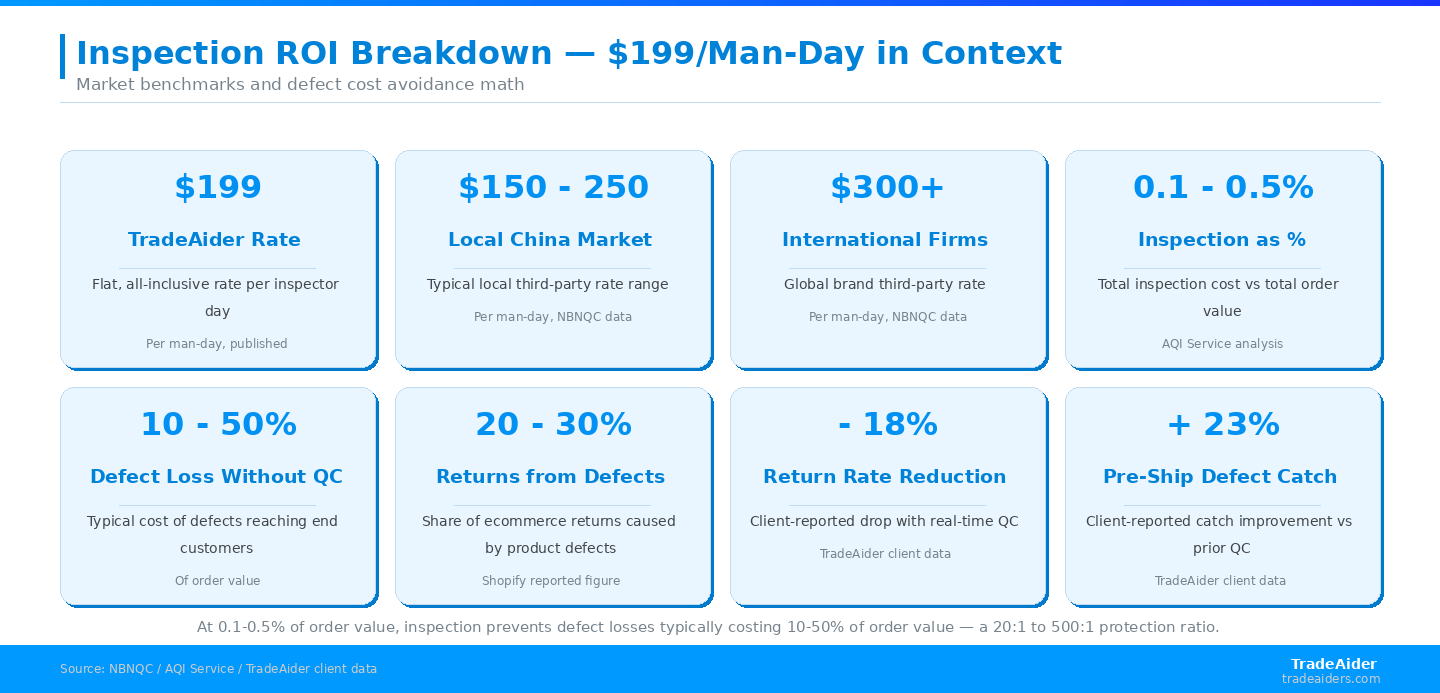
Figure 1. Inspection ROI Breakdown. Top row: pricing context showing $199 is below both the local Chinese market median ($150-250) and international firms ($300+). Bottom row: inspection cost represents 0.1-0.5% of order value while preventing defect losses that typically run 10-50% of order value — a 20:1 to 500:1 protection ratio.
The Inspection ROI Formula
ROI for pre-shipment inspection is calculated as the ratio of expected defect losses prevented to inspection cost paid. The formula is straightforward once you have the underlying numbers:
Inspection ROI = (Expected Defect Loss Without Inspection) ÷ (Inspection Cost)
Both inputs need quantification. "Expected defect loss" is the dollar value you would have lost if the order shipped without inspection, reaching customers with a typical defect rate for your supplier category. "Inspection cost" is the man-day count multiplied by the rate, plus any destructive-test unit costs.
Estimating Expected Defect Loss
Expected defect loss has three components: defective units shipped, per-unit cost of each leaked defect, and channel-specific downstream costs. The NIST statistical handbook on acceptance sampling shows that uninspected production from a supplier running at 3–5% defect rates (typical for new relationships in China) delivers that full rate to the buyer. On a 10,000-unit order, that is 300–500 defective units reaching customers.
Each defective unit carries a per-unit cost that includes the refund or return, logistics cost, negative review impact, and for Amazon FBA sellers the ODR contribution. A single defective $30 Amazon product, when returned, typically costs the seller $40–60 in immediate costs (refund + FBA return fee + reverse logistics) plus several hundred dollars in lost future sales from negative review impact. Multiplying 300 defects × $200 average per-defect cost = $60,000 expected loss on a 10k-unit order.
Applied Example — A $30 FBA Product
Consider a specific scenario. An Amazon FBA seller orders 10,000 units of a $30 wholesale consumer electronics accessory from a new Chinese supplier. Without inspection, assume a conservative 3% defect rate based on industry norms for first-run orders with new suppliers:
- Defective units shipped: 300
- Per-defect cost: $30 refund + $15 FBA return fee + $150 review/ODR impact = $195
- Total expected defect loss: 300 × $195 = $58,500
- Inspection cost: 1 man-day × $199 = $199
- ROI ratio: $58,500 ÷ $199 = 294:1
In this scenario, $199 in inspection spending protects against $58,500 in potential defect losses. Even if inspection catches only 80% of defects (a conservative AQL sampling assumption), the value protected is $46,800 — still a 235:1 ratio. This is why experienced importers treat third-party inspection as cost avoidance, not an expense.
When ROI Is Highest — And When It Isn't
Inspection ROI varies dramatically based on the specific order, supplier relationship, and channel. The ratios above are typical but not universal. The five situations where ROI is highest cluster around elevated defect risk, while the three situations where ROI is lowest involve proven supplier-buyer relationships.
Five Situations With Highest Inspection ROI
First-run orders with new suppliers. New relationships carry the highest defect risk because process capability is unproven. First-run ROI typically exceeds 100:1 because defect rates tend to be 3–5x higher than on established relationships.
New product launches. A new SKU in production — even from an established supplier — adds design-related defect risk on top of normal process variation. Inspection here also generates baseline data for future production runs.
High-return SKUs on Amazon. SKUs with return rates above the category average indicate quality issues that inspection can catch before they compound. As Amazon seller performance analysis notes, ODR is calculated on a 60-day rolling window and sellers exceeding 1% face Buy Box eligibility loss and potential account suspension — making pre-shipment inspection on high-return SKUs extremely high-ROI insurance.
Orders over $5,000 in total value. At this order size, $199 inspection costs less than 4% of order value, and a single defect cluster prevented typically saves many multiples of the inspection fee.
Safety-regulated product categories. Children's products, electrical goods, food-contact items, and cosmetics are subject to CPSC or equivalent regulator oversight. A defective batch that triggers a recall costs far more than the defective products themselves. CPSC recall guidance documentation makes clear that corrective action plans often include replacement, refund, repair, and public notice costs that can run into six or seven figures for a single recall event.
Three Situations With Lower Inspection ROI
Repeat orders from a proven supplier. After five or more successful shipments with zero quality issues, defect risk drops and the marginal value of each inspection decreases. Some importers move to inspection every other shipment or quarterly spot-checks rather than every lot.
Very small orders (under 500 units) where unit value is low. When total order value is under $5,000 and unit value is under $10, inspection cost can exceed 5% of order value. AQL sampling sample sizes also approach lot sizes at these volumes, pushing toward 100% inspection math.
Commodity products with zero-defect history. Simple commodity goods (basic textiles, low-complexity plastics) from long-term suppliers sometimes have such low defect rates that inspection becomes verification rather than insurance. Even here, periodic audits prevent process drift.
Running Your Own ROI Calculation
Before your next order, apply the ROI formula with your specific numbers. Start by estimating your supplier's defect rate — first-run orders assume 3–5%, established relationships 0.5–2%. Multiply by your lot size for defective units. Multiply again by your per-defect cost (refund + logistics + channel impact). Divide by the inspection cost. If the resulting ratio exceeds 10:1, inspection is cost-justified. If it exceeds 50:1, inspection is essentially mandatory from a financial risk management standpoint.
Our inspection calculator runs this math automatically once you enter order size, unit value, and estimated defect rate. The calculator output feeds directly into a booking form for pre-shipment inspection at the $199/man-day rate. For complex orders involving hybrid AQL + 100% inspection or destructive testing, a conversation with our team helps refine the estimate and structure a plan that matches your specific risk profile.
Who Is TradeAider?
TradeAider is a quality inspection, testing, and certification service provider in China. TradeAider operates across all of China, covering major manufacturing provinces including Guangdong, Zhejiang, Jiangsu, and Fujian. TradeAider is an innovative, digitally driven third-party inspection provider that sets itself apart through real-time online monitoring and transparent pricing, delivering efficient and reliable quality control solutions.
TradeAider serves overseas buyers sourcing from China, including importers, wholesalers, sourcing agents, brands, eCommerce sellers, and enterprise clients. Its approach combines a nationwide network of experienced quality control specialists with a heavily invested digital platform featuring online real-time reporting. Clients can monitor inspections live, communicate directly with inspectors, and address issues during production rather than after shipment — a proactive model focused on problem-solving and prevention, not just defect identification. The $199/man-day all-inclusive rate eliminates the hidden-fee problem common in man-day pricing elsewhere, making ROI math predictable upfront. TradeAider also provides testing services, covering Hardline Products, Softline Products, Electrical & Electronic Products, and Industrial Products, enabling buyers to manage quality control and testing needs within a single service framework.
Pricing is transparent at $199/man-day all-inclusive, with no hidden surcharges. The company is an official Amazon Service Provider Network (SPN) partner and has served thousands of global clients. Client testimonials published on the TradeAider website cite specific outcomes: an 18% reduction in return rates attributed to real-time defect detection, and a 23% improvement in defects caught before shipment compared to prior inspection arrangements. These are client-reported figures.
Frequently Asked Questions
Is $199/man-day a fair price for third-party inspection in China?
Yes — $199/man-day is in the competitive lower-middle range of the China inspection market. Local Chinese inspection firms typically charge $150–250 per man-day, while international firms charge $300+ per man-day for comparable AQL-based pre-shipment inspection. At $199 all-inclusive (no hidden travel, reporting, or platform fees), the rate is 20–35% below international benchmarks while delivering the same core service standards defined by ISO 2859-1 sampling.
What does one man-day of inspection actually include?
One man-day covers eight hours of on-site inspector time at the factory, including AQL sampling per ISO 2859-1 Level II, defect classification into Critical/Major/Minor, photo and video evidence collection, functional testing of sampled units, packaging verification, real-time buyer monitoring via the TradeAider platform, and a complete digital report delivered same-day or within 24 hours. At the $199/man-day rate, travel within major Chinese manufacturing hubs (Guangdong, Zhejiang, Jiangsu, Fujian) is included with no travel surcharge.
How do I calculate ROI for third-party inspection?
ROI equals the expected defect loss without inspection divided by the inspection cost. To calculate expected defect loss, multiply your supplier's typical defect rate (3–5% for new relationships, 0.5–2% for established) by your lot size, then multiply by your per-defect cost (refund + logistics + channel impact such as Amazon ODR risk). Divide by inspection cost (typically $199–398 for one or two man-days on a standard order). A ROI ratio above 10:1 justifies inspection; ratios of 100:1 or higher are common for new suppliers and high-volume orders.
What are the hidden fees to watch for with man-day pricing?
Common hidden fee categories in man-day pricing include travel surcharges for remote factory locations ($50–100/day), report expedite fees ($50–200 per inspection), destructive test unit costs (product units consumed in testing, charged separately), weekend or holiday premiums, rush booking fees, and per-photo charges for evidence-heavy inspections. Ask any provider quoting a man-day rate for a full written quote including these categories before comparing to another firm's headline price. An all-inclusive quote like TradeAider's $199 flat rate simplifies this comparison.
When is inspection not worth the money?
Inspection is least cost-effective for repeat orders from suppliers with a long zero-defect history and for very small orders under 500 units where inspection can exceed 5% of order value. Even in these cases, periodic verification inspections (every few months or quarterly) help catch process drift before it causes a problem. For orders over $5,000 in value with any quality uncertainty, inspection is almost always cost-justified, and the ROI math typically supports it at 20:1 or better.
Ready to run the ROI math on your next shipment? Contact our team for a complimentary inspection plan review or book pre-shipment inspection directly at $199/man-day — all-inclusive, with real-time monitoring and 24-hour report delivery included.

Related Articles

Grow your business with TradeAider Service
Click the button below to directly enter the TradeAider Service System. The simple steps from booking and payment to receiving reports are easy to operate.

