
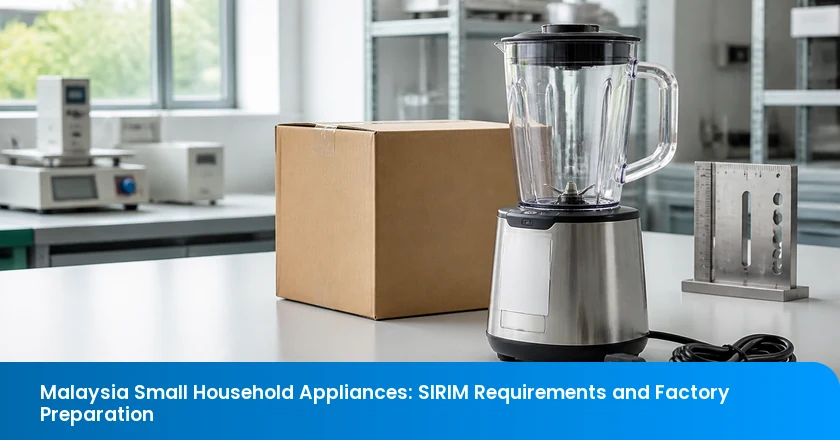
For Malaysia-bound small household appliances, a report can be technically valid and still be a poor release tool if it no longer describes the appliance, plug, label, manual, and cartons that will actually move. The practical job is to connect the market-entry route with one current physical build, then keep that connection intact through final packing. That approach gives the importer a clear question to resolve before shipment: does this defined lot still match the evidence being used for Malaysia?
The Malaysia Route Is a Chain, Not a Single SIRIM File
For Malaysia-bound small household appliances, the useful compliance question is whether the exact supplied configuration follows the relevant ST route from CoA evidence through the applicable import-stage SIRIM process, rather than whether a supplier can show a generic certificate. ST directs applicants to check whether the equipment is in the regulated list, apply for a Certificate of Approval (CoA) through its stated route, and provide a report from an accredited laboratory; its CoA application guidance also describes the import-stage SIRIM consignment test and ST-SIRIM label after customs clearance. The decision is therefore a chain with different actors and timings, not a document that the factory can declare complete on its own.
- Confirm whether the exact appliance and supplied configuration enter the regulated route.
- Keep the test, application, product, and pack records tied to the same current build.
- Define what the inspector can compare physically and what must remain with ST, SIRIM, the laboratory, or importer.
- Release only the cartons that can be identified as part of that current build.
The most common failure is a responsibility gap. A supplier may call a test report “SIRIM,” an importer may expect it to cover the arrival process, and the factory may change a power component without treating the change as a scope question. Put the product identity at the center of the handoff: model, brand, rated input, plug and cord, approved documents, retail pack, and carton range should describe the same appliance.
Classify the Exact Appliance Configuration Before Testing
Before testing or document collection starts, classify the appliance by the actual regulated category and supplied configuration, because the market route cannot be set from a broad sales label alone. ST publishes a list of regulated electrical equipment; use it as the starting point, then record the product’s actual input, included power equipment, and sale configuration. This stops a generic description such as “kitchen appliance” or “personal-care device” from masking the details that determine the evidence route.
Make this a one-page factory record before samples go out. It should identify the retail model and variants, rated voltage and frequency, power rating, power source, plug and cord assembly, bundled adapter or charger, brand, manual revision, label revision, and intended Malaysia configuration. The record also gives the inspector observable checkpoints; buyers who need to turn those fields into inspection points can review the inspection-standard reference before they set the final scope.
Battery-Only Units and Mains-Powered Bundles Start Differently
A battery-only extra-low-voltage product and a product sold or imported with mains equipment can create different starting questions, so the buyer should record the actual retail and import configuration before treating them as one route. ST says equipment operating entirely from batteries within the stated extra-low-voltage limits does not require CoA; its battery-only guidance gives that boundary. That does not settle a product that will be sold with, or imported beside, mains equipment.
For an adapter or charger supplied together with the equipment, ST says the equipment requires the CoA, while an adapter or charger imported or manufactured separately requires its own CoA. Read the bundled-adapter distinction against the commercial setup, not just the product photo. A factory should flag separately packed accessories, spare adapters, replacement chargers, and changes in the sales bundle before the importer assumes the original scope still applies.
A Plug, Cord, Voltage, or Frequency Change Is a Scope Check
A Malaysian appliance file should keep the rated voltage, frequency, power cord, and plug configuration aligned with the model that will be shipped, because those attributes sit inside the relevant national-deviation and plug requirements. ST’s current CoA application guidance sets out Malaysian electrical and plug-related conditions for the applicable equipment. Treat a change in any of these fields as a prompt to check the technical scope, not as a routine purchasing substitution.
Do not rely on a carton drawing alone. ST’s plug-top requirements distinguish permitted plug types and set conditions for two-pin plugs. Compare the approved sample, current cord assembly, rating label, manual, and purchase specification line by line. If one record names a different plug, frequency, or input rating, stop using “same model” as the answer until the responsible technical party confirms the current route.
Separate ST Approval From SIRIM Testing Evidence
SIRIM's Type Test Report is evidence for the Malaysian approval route, while ST is the authority that approves electrical equipment on the basis of recognised test reports. ST explains that SIRIM is a registered conformity-assessment body that issues Type Test Reports, and that ST approval depends on reports from SIRIM or other recognised bodies that confirm the relevant minimum safety standards; see ST’s description of SIRIM’s role. This distinction tells the buyer who must resolve a missing report, a changed model, or an approval question.
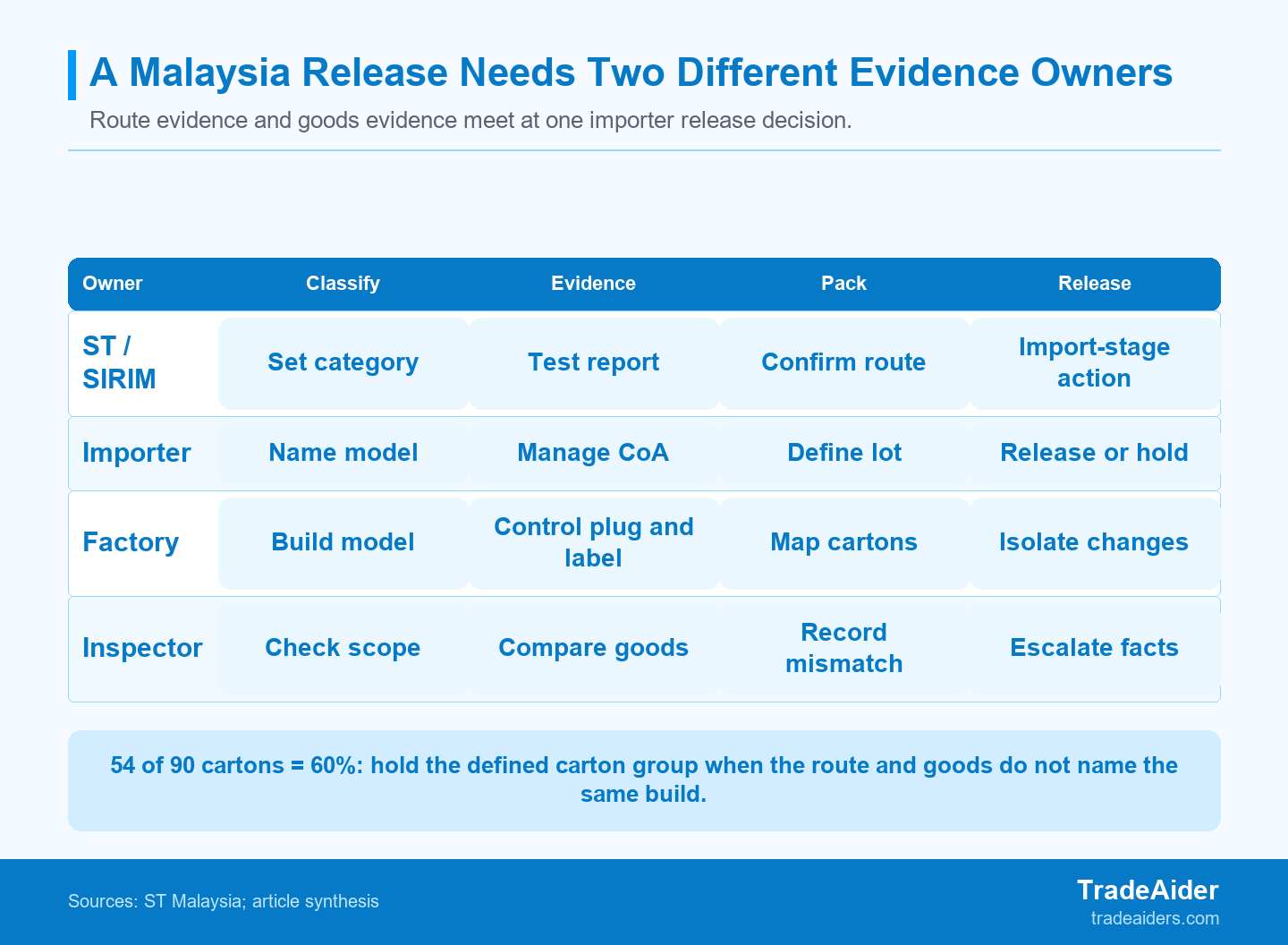
ST, SIRIM, laboratory, importer, factory, and inspector roles meet only when the defined packed lot still matches the current route evidence.
Use precise language in emails and packing instructions. “Report available” means evidence exists; it does not mean the current appliance has been accepted for every Malaysia step. “CoA route confirmed” means the responsible importer or approval owner has a route to manage; it does not mean a factory inspection can issue the approval. That separation prevents the inspection request from becoming an unanswerable demand for a factory-side compliance certificate.
A Type Test Report Supports the File; It Does Not Replace the Decision
Treat a Type Test Report as a model-specific evidence record, not as a blanket approval for every appliance sharing a family name, retail carton, or supplier declaration. Start with the model and configuration named in the report, then compare the report’s identifiers and conditions with the present build. A family label can be useful for product marketing, yet it cannot resolve whether a changed cord, control board, adapter, rated input, or manual was inside the reviewed scope.
Ask the report owner to identify the tested model, applicable standards, sample description, issue date, laboratory, and any listed components or attachments. If a document is unclear, do not fill the gap with an optimistic interpretation. Record the question, isolate the affected production group, and obtain the technical or approval-side response before merging it back into the release population.
Then Make Every Record Describe the Same Physical Build
The evidence chain is strongest when model, brand, component list, rating label, manual, plug and carton identifier point to the same build before the lot is packed. This is a buyer-side control rather than a new Malaysian legal test: it makes it easier to see when a document and the goods have quietly drifted apart. Use one controlled comparison sheet with a revision date and named owner, and add carton ranges whenever a production change creates two physical builds.
The timing matters. Once units are mixed across shifts or packed under identical outer art, finding the changed build can cost more than checking it during assembly. When the supplier has a known model or power-component change, TradeAider can use a during-production inspection to compare the current build before late changes become a shipment-wide sorting problem. The inspection scope should name what can be observed, such as rating labels, cord and plug assemblies, manuals, packaging, and carton coding.
Build One Factory Evidence File Before Application or Shipment
A new CoA application uses a Type Test Report, component list, instruction manual, technical specification, product catalogue, and a sample when requested, so those records should be revision-controlled before production reaches final packing. ST lists these materials in its new CoA application document requirements. Collecting them early is not paperwork for its own sake: it exposes whether the product file describes one model or several untracked variants.
| Record | What it must identify | Factory check before packing |
|---|---|---|
| Type Test Report | Tested model, configuration, and supporting details | Compare named model and relevant assembly to the current build |
| Component list and specification | Key parts, ratings, and declared technical configuration | Check current revisions and approved substitutions |
| Label and manual | Brand, model, input, warnings, and user-facing configuration | Compare artwork and printed production copies |
| Retail pack and carton record | SKU, variant, date or lot trace, and carton population | Map changed builds to defined cartons before release |
Give every document a version, approval owner, and product-model reference. If the evidence owner cannot say whether a component change is inside the existing scope, the buyer has an open technical question rather than a documentation delay. In that situation, review product-testing needs for the current appliance configuration before final packing makes the difference between a targeted check and a broad rework exercise.
The packet should follow actual units, not only a product-family name, because a complete-looking file may still describe a prior version of the appliance.
Illustrative Scenario: A Cord Change Breaks the Evidence Link
When the approved sample uses one cord-and-plug build but production uses another build under the same SKU, the safer release response is to stop treating the sample record as automatic support until the current configuration is reviewed and tied to a defined shipment population. The issue is not the sales name; it is whether the file and the cartons still describe the same appliance.
What Changed Between the Approved Sample and the Packed Lot
In the worked example, unchanged carton art and SKU code do not prove that a later cord-and-plug configuration is already covered by the earlier sample file. This illustrative scenario is not a TradeAider client case. An importer has ordered 1,800 countertop blenders in 90 export cartons, and 54 cartons are already packed when the final configuration review begins.
The approved sample file and early production used one cord-and-plug assembly. Later production uses a different supply assembly under the same retail SKU. The carton artwork has not changed, so warehouse staff cannot reliably separate the builds by looking at the outer carton. The rating label and manual were also prepared from the approved-sample configuration, leaving the buyer with a record set that may no longer describe every packed unit.
Two observations matter: the 54 packed cartons retain the original SKU and artwork, and the later cord-and-plug assembly is not named in the sample packet. An illustrative calculation shows the operational scale: 54 ÷ 90 = 60% of the order is already packed. That does not establish non-compliance, but it does make an all-order release decision unsafe. The importer should hold the changed configuration as an open scope question instead of letting it inherit the earlier sample record automatically.
The practical corrective action is to separate the affected configuration in the factory record, identify which cartons contain it, and obtain the responsible technical review. Before any carton group moves to the next Malaysia step, confirm that its current route, rating label, manual, plug and cord, and carton range all identify one configuration. The visible trade-off is delay and sorting work now versus a shipment with an untraceable evidence gap later. This is an illustrative configuration-control method, not a finding by ST, SIRIM, a laboratory, or TradeAider.
Use Factory Inspection to Check the Evidence-to-Goods Link
Factory inspection can compare the final model, rating label, plug, manual, packing, and carton marks with an agreed evidence file, but it cannot issue the missing test result or Malaysian approval decision. A useful request gives the inspector the current comparison sheet and a defined carton population, then asks for observable evidence: model markings, input rating, plug and cord construction, manual revision, pack artwork, carton code, and any required quantity or assortment checks.
Keep the decision boundary explicit in the inspection brief. A mismatch can be documented, photographed, quantified, and escalated; it cannot be converted into a laboratory conclusion by calling it a “SIRIM inspection.” If the order is fully packed and the population is defined, buyers can schedule a pre-shipment inspection for the defined release population to compare the goods and packaging with the evidence file before dispatch. The report should identify what was checked, which cartons were in scope, and which differences require the importer or technical owner to decide.
Set a Release Rule Before Final Packing
Use a four-record release rule: the evidence file, the physical appliance, the retail pack, and the carton or batch record must identify one current configuration before the buyer treats that population as ready for the next Malaysian market-entry step. It is a practical handoff rule, not a statutory four-document test. Its value is that it gives the buyer a clear stop condition when a report describes one build, a label describes another, or the cartons cannot be separated.
- Evidence file: the current report and related application records name the in-scope model and configuration.
- Physical appliance: the sampled goods show the same ratings, supply assembly, and key identifiers.
- Retail pack: the label and manual describe that same product for the intended market.
- Carton or batch record: the release population can be traced to the verified configuration.
When one record fails, release only the clearly matched population or hold the affected cartons until the mismatch is resolved. Do not let a matching SKU override a changed technical build. If the stock must be split, retain the carton map, explain the reason for the split, and ask the responsible technical or approval owner to state what evidence applies to each group. That written boundary prevents a warehouse correction from being misread as a compliance decision. Buyers assessing an independent physical check can review how TradeAider approaches inspection support.
Prepare a Malaysia Release Handoff
A useful Malaysia handoff tells the factory, importer, laboratory contact, and inspector which model and supply configuration are in scope, which records are current, and which deviation stops release. Send one controlled packet before the final visit: the in-scope model list, current report and document references, label and manual revisions, plug-and-cord description, carton map, production status, and a written escalation owner.
State the release decision in operational terms. For example: “Release only cartons mapped to configuration A after the physical comparison matches the current file; hold cartons containing configuration B pending technical confirmation.” This tells production, logistics, and inspection teams what to do with a real mismatch instead of asking them to interpret Malaysian approval requirements themselves.
Before sending the packet, make the boundaries usable by the people on the floor. Identify the carton range or batch, the last confirmed document revision, the change that triggered the review, the person who owns the technical response, and the deadline for that response. If a shipment date cannot move, record that commercial constraint separately; it should not erase the distinction between a physically matched lot and a lot with an unresolved configuration question.
If the model records and packing status are ready but the inspection boundary still needs defining, ask TradeAider to review the Malaysia-bound inspection handoff.
Frequently Asked Questions
Does every small appliance need a SIRIM route?
No. Start with the exact regulated category and supplied configuration, because a battery-only extra-low-voltage product and a mains-powered appliance bundle may not begin from the same CoA question. An ST-SIRIM label follows the applicable Malaysian approval and import-stage process; it should not be treated as a substitute for confirming that the current physical appliance matches the supporting route and records. Record the power source, input rating, plug, cord, adapter or charger, and how the goods will be imported or sold. If a sales bundle or accessory changes, ask the responsible technical or approval owner to confirm the route before treating the file as transferable.
Can a SIRIM Type Test Report replace a CoA?
No. A Type Test Report is testing evidence, while ST is the authority that approves electrical equipment on the basis of recognised test reports. The buyer should keep the report as a model-specific part of the file, then confirm the CoA and importer-side steps with the responsible party. Check the report’s model, configuration, sample description, and any named components before using it in the handoff. A factory or inspection company can compare documents and goods, but cannot turn a missing approval decision into a physical-inspection result.
Does a bundled charger need its own CoA?
When equipment is supplied with an adapter or charger, ST says only the equipment itself requires CoA, but a separately imported or manufactured adapter or charger requires a separate CoA. The commercial arrangement matters: a spare charger, replacement part, or separately shipped accessory should be recorded as its own configuration question. Include the purchasing arrangement and packing method in that record. Do not assume that a charger’s inclusion in one retail package settles the route for every purchasing or import arrangement.
What should final inspection check on a Malaysia order?
Final inspection should compare the agreed model, rating label, plug and cord, manual, retail pack, carton marks, and defined lot records against the current evidence file. It should also show which cartons or batches were checked, especially after a component or configuration change. The brief should identify the sample basis, the carton population, and the escalation owner for any mismatch. Escalate differences to the importer, laboratory contact, or approval owner; inspection verifies observable facts and traceability, not the missing technical or regulatory decision.
Related Articles

Grow your business with TradeAider Service
Click the button below to directly enter the TradeAider Service System. The simple steps from booking and payment to receiving reports are easy to operate.

