
- About Us

- Our Services
- Your Industry
- Resources
- News & Blog
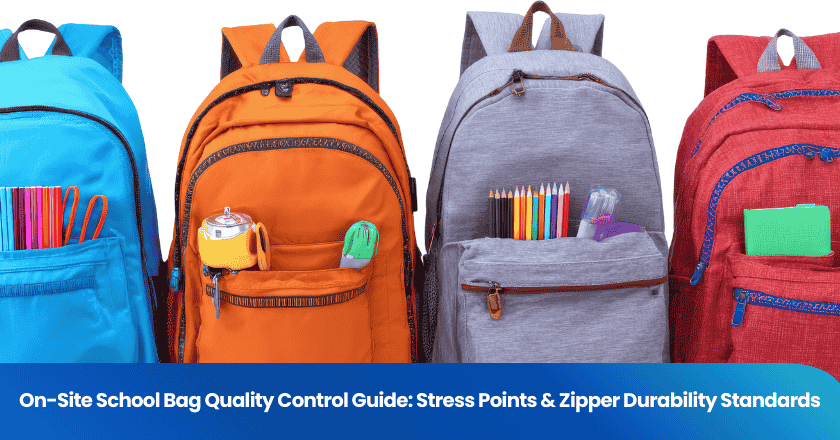
On-site quality control for school bags is a critical safety and durability requirement that directly impacts student well-being. Unlike fashion accessories, school backpacks must endure significant daily mechanical stress from heavy textbooks, electronic devices, and rough handling. Technical inspection teams implement rigorous protocols, ranging from in-line stitching audits to laboratory-simulated fatigue tests. By adhering to international quality check standards, manufacturers can mitigate risks associated with seam failure and hardware malfunction.

Key Takeaways
- Structural Reinforcement: Bar-tacking at stress points is non-negotiable for bags carrying loads over 5kg.
- Zipper Reliability: Fatigue testing should confirm at least 5,000 smooth cycles for standard student use.
- Material Denier: Fabrics like 600D or 900D Polyester are preferred for their balance of weight and abrasion resistance.
- Ergonomic Safety: Load-bearing tests ensure that straps and sternum belts distribute weight without causing physical strain.
- Chemical Compliance: Ensuring lead-free hardware and phthalate-free coatings is mandatory for children's products.
Fundamental Material Standards for Backpacks
The durability of a school bag begins with its substrate. Most high-performance backpacks utilize Polyester or Nylon measured in Denier (D). A higher denier indicates a thicker, more durable fiber. For school use, the base panel usually requires 900D to 1680D for puncture resistance, while the body can utilize 600D to balance cost and weight.
| Material Property | Test Standard | Requirement for School Bags |
|---|---|---|
| Abrasion Resistance | ASTM D3884 | No visible fiber breakage after 1000 cycles. |
| Tear Strength | ISO 13937-2 | Minimum 40N for main body fabric. |
| Color Fastness | AATCC 8 | Grade 4 minimum (Dry and Wet). |
| Water Repellency | AATCC 22 | Rating of 80+ for outdoor-grade polyester. |
Stress Point Reinforcement: Engineering Durability
The transition between the shoulder strap and the bag body is the primary point of failure. Proper product quality inspection methods focus on "Bar-tacking"—a series of tight, zigzag stitches that reinforce high-tension areas. Without bar-tacks, the seam will experience "needle-hole elongation," eventually leading to the strap detaching entirely.
Critical Reinforcement Zones
- Strap-to-Body Junction: Requires a minimum of 42-stitch bar-tacks or cross-stitching (X-in-box).
- Handle Attachment: Must be reinforced with internal webbing tape to prevent the fabric from ripping under vertical load.
- Bottom Panel Seams: Double-needle stitching with taped seams ensures the weight of heavy books doesn't blow out the bottom.
- Zipper Ends: Metal or plastic stops combined with reinforced fabric 'garages' prevent the slider from derailing.
"Safety in school bags is a matter of physics. If the reinforcement fails to distribute the load across a wider surface area, the material's tensile limit will be exceeded, causing sudden failure."
Zipper Fatigue and Hardware Reliability
Zippers are the most frequently interacted-with component of a backpack. In a professional quality inspection process, zipper fatigue is tested using a Reciprocating Stroke Tester. This machine opens and closes the zipper under a specific lateral and longitudinal tension.
| Zipper Type | Load Test Parameters | Standard Pass Rate |
|---|---|---|
| Main Compartment (#8 or #10) | Lateral force of 10kg | 5,000 cycles without teeth separation. |
| Small Pockets (#5) | Lateral force of 5kg | 3,000 cycles without jam. |
| Buckles & Clasps | Static Load | Must hold 20kg for 24 hours without slipping. |
Identifying Zipper Quality Issues
Inspectors look for 'Zipper Bursting'—when the teeth separate behind the slider. This usually indicates poor tooth-to-tape bonding or an undersized slider. High-quality zippers like those from YKK or SBS utilize high-impact resins that resist the 'fatigue' of being over-stuffed with binders and school supplies.
Physical Load-Bearing and Jerk Testing
On-site testing must simulate the dynamic movements of a student, such as running or jumping. The 'Jerk Test' is the most effective method:
- The bag is loaded with 10kg of weighted sandbags.
- It is hung by one shoulder strap on a mechanical arm.
- The arm drops the bag 4 inches and catches it abruptly.
- This is repeated 20 times. A 'Pass' requires zero seam separation and no hardware breakage.
Chemical Safety and Regulatory Compliance
Since school bags are children's products, they must comply with strict chemical regulations like CPSIA (USA) and REACH (EU). Technical inspections include checking for:
- Lead Content: Must be below 100ppm in all accessible parts, including zipper pulls and buckles.
- Phthalates: Prohibited in coatings and plastic components due to toxicity risks.
- Small Parts: Zipper pulls on bags for younger children must pass a 90N pull test to ensure they aren't choking hazards.
Digital Real-Time Monitoring in Modern QC
Modern quality control has moved beyond paper checklists. Through TradeAider’s inspection services, clients not only receive an official inspection report within 24 hours, but also gain visibility into inspection progress and identified issues via TradeAider’s online service system. During inspections, inspectors use mobile devices to record key processes and tests, such as bar-tack audits, zipper tests, and metal detection.
Photos of critical defects, including issues like a broken needle identified during metal detection, are clearly documented and flagged, enabling brands to decide whether products can be accepted, require on-site rectification, or must be rejected before shipment. This ensures that only quality-approved products are packed, shipped, and paid for—preventing losses caused by defective goods entering the supply chain.
| Inspection Phase | Key Verification | Deliverable |
|---|---|---|
| Pre-Production (PPI) | Fabric D-count and hardware lead test. | Material Approval Report. |
| During Production (DPI) | SPI (Stitches Per Inch) and bar-tack count. | Inline Audit Log. |
| Pre-Shipment (PSI) | Final load test and carton drop test. | Official Inspection Report. |
Best Practices for Manufacturers
To ensure consistent quality, factories should implement a 'Golden Sample' system where an approved unit is placed at each sewing station. Furthermore, implementing a 'Needle Log' is essential—if a sewing needle breaks, all pieces must be recovered to ensure no metal shards remain inside the padding of the bag.
Ready to secure your product quality before shipment?
As your third-party inspection, testing & certification partner in China, TradeAider supports brands and sourcing teams across the entire production process, helping you identify quality risks early, ensure compliance, and strengthen your team’s capabilities before shipment.
Book an Inspection or Testing Service with TradeAider today, or for tailored solutions and expert guidance, contact us at services@tradeaider.com.
FAQ
What is the ideal SPI for a school backpack?
A standard of 7 to 9 stitches per inch (SPI) is ideal. If the SPI is too high (above 12), the needle perforations are too close together, which can actually act like a 'perforation line' and cause the fabric to tear more easily.
How do you test for 'Shoulder Strap Slippage'?
Inspectors load the bag, adjust the ladder-lock buckles to a specific point, and then subject the bag to vibration. If the webbing slips more than 5mm through the buckle, the hardware or webbing texture is considered a failure.
Why is 'Bar-tacking' better than regular back-stitching?
Regular back-stitching only covers a narrow path. A bar-tack is a wide, dense zigzag that anchors the strap into multiple structural layers of the bag, effectively doubling the tensile strength of the connection.
What causes 'Zipper Teeth Popping'?
This usually occurs due to 'lateral tension' when a bag is over-filled. If the zipper tape is not sewn with enough 'bite' (seam allowance), the tension pulls the teeth away from the fabric carrier.

Related Articles
Grow your business with TradeAider Service
Click the button below to directly enter the TradeAider Service System. The simple steps from booking and payment to receiving reports are easy to operate.

